
Introduction
Compliance Training Platforms are specialized digital systems designed to help organizations educate employees on laws, regulations, ethical standards, and internal policies relevant to their roles. These platforms go beyond basic learning management systems by focusing on risk reduction, regulatory adherence, and audit readiness across industries such as healthcare, finance, manufacturing, technology, and government.
In today’s regulatory-heavy environment, compliance failures can lead to severe consequences—financial penalties, legal action, reputational damage, and even business shutdowns. Compliance training platforms help organizations standardize learning, track completion, prove compliance during audits, and update training quickly when regulations change.
Real-world use cases include onboarding employees with mandatory ethics training, annual refreshers on data protection laws, role-based safety training, anti-harassment programs, and industry-specific certifications. Modern platforms also support microlearning, multilingual content, automation, and analytics to ensure training is both effective and measurable.
When choosing a compliance training platform, buyers should evaluate content quality, regulatory coverage, ease of use, automation, reporting depth, integration with HR systems, and security standards. Scalability, support quality, and long-term value are equally important for sustainable compliance programs.
Best for:
Compliance Training Platforms are ideal for HR leaders, compliance officers, legal teams, risk managers, and L&D professionals in SMBs to large enterprises. Highly regulated industries—healthcare, finance, insurance, manufacturing, energy, IT, and education—benefit the most.
Not ideal for:
Organizations with no regulatory obligations, very small teams needing informal training, or companies seeking pure skills-based learning (coding, design, marketing) may find general LMS or learning libraries more suitable.
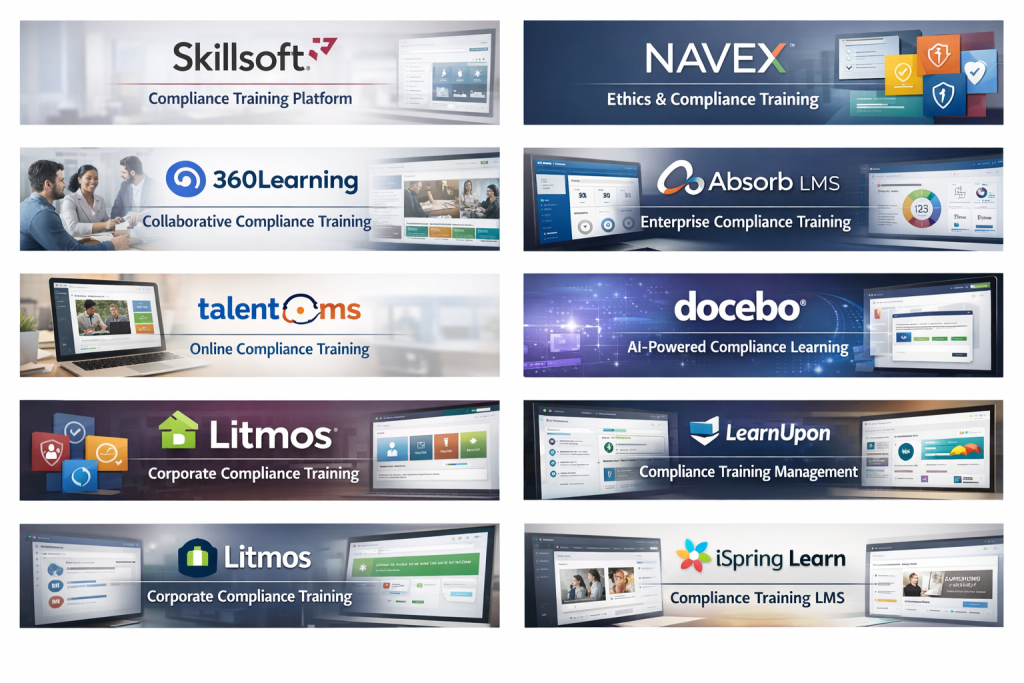
Top 10 Compliance Training Platforms Tools
1 — NAVEX One
Short description:
NAVEX One is an enterprise-grade compliance and risk management platform offering robust compliance training alongside policy management and incident reporting.
Key features:
- Extensive regulatory training library
- Role-based and risk-based learning paths
- Automated training assignments and reminders
- Policy acknowledgment tracking
- Advanced compliance reporting and dashboards
- Global content with localization support
Pros:
- Strong enterprise and regulatory coverage
- Excellent audit-readiness capabilities
Cons:
- Higher cost for small organizations
- Interface may feel complex initially
Security & compliance: SOC 2, GDPR, ISO-aligned controls, SSO, encryption
Support & community: Dedicated account managers, enterprise onboarding, strong documentation
2 — Skillsoft
Short description:
Skillsoft provides comprehensive compliance and workforce training with a massive content library designed for global enterprises.
Key features:
- Broad compliance and ethics course catalog
- AI-driven content recommendations
- Multi-language and global compliance coverage
- Custom learning paths
- Analytics and progress tracking
- Integration with HR and LMS systems
Pros:
- Depth and breadth of content
- Scales well for global teams
Cons:
- Can feel content-heavy
- Customization may require admin expertise
Security & compliance: GDPR, ISO standards, SSO, secure data hosting
Support & community: Enterprise support, onboarding assistance, training consultants
3 — SABA Cloud
Short description:
SABA Cloud combines compliance training with talent development, ideal for organizations aligning compliance with performance.
Key features:
- Compliance-focused LMS capabilities
- Personalized learning experiences
- Automated certifications and renewals
- Reporting and audit dashboards
- Mobile-friendly learning
- Talent and performance integration
Pros:
- Strong learner engagement tools
- Unified learning and compliance
Cons:
- Premium pricing
- Setup may take time
Security & compliance: GDPR, ISO, enterprise-grade encryption
Support & community: Global support teams, structured onboarding
4 — Litmos
Short description:
Litmos is a cloud-based LMS offering fast deployment and prebuilt compliance training for SMBs and mid-market companies.
Key features:
- Ready-made compliance course library
- Automated assignments and reminders
- SCORM and content authoring support
- Mobile learning access
- Reporting and tracking tools
Pros:
- Quick setup and easy UI
- Good value for growing teams
Cons:
- Limited advanced analytics
- Less suited for very large enterprises
Security & compliance: GDPR, SSO, encryption at rest and transit
Support & community: Knowledge base, customer success managers
5 — 360Learning
Short description:
360Learning emphasizes collaborative learning with compliance modules for organizations valuing peer-driven education.
Key features:
- Compliance training creation tools
- Collaborative learning workflows
- Automated certification tracking
- Analytics and learner insights
- Integration with HR systems
Pros:
- High learner engagement
- Flexible content creation
Cons:
- Smaller compliance library
- Requires internal content effort
Security & compliance: GDPR, SOC 2, SSO
Support & community: Active community, onboarding specialists
6 — Cornerstone OnDemand
Short description:
Cornerstone OnDemand is a robust enterprise platform combining compliance, learning, and workforce management.
Key features:
- Enterprise compliance learning modules
- Role-based assignments
- Certification and renewal automation
- Deep analytics and reporting
- Integration with enterprise HR suites
Pros:
- Enterprise scalability
- Strong reporting and compliance depth
Cons:
- Steeper learning curve
- Higher implementation cost
Security & compliance: ISO 27001, GDPR, SOC, encryption
Support & community: Enterprise-grade support, global presence
7 — Docebo
Short description:
Docebo offers AI-powered learning experiences with compliance training suitable for modern, digital-first organizations.
Key features:
- AI-based learning recommendations
- Compliance course management
- Automated tracking and reporting
- API and HRIS integrations
- Mobile and social learning
Pros:
- Modern UX and automation
- Flexible integrations
Cons:
- Compliance content may need partners
- Pricing tiers can escalate
Security & compliance: GDPR, ISO, SSO
Support & community: Strong documentation, customer success teams
8 — TalentLMS
Short description:
TalentLMS is a lightweight, easy-to-use platform ideal for SMBs implementing basic compliance training.
Key features:
- Simple compliance course delivery
- Automated user management
- Reporting and certification tracking
- Custom branding options
- Mobile access
Pros:
- Very easy to use
- Cost-effective
Cons:
- Limited enterprise controls
- Basic analytics
Security & compliance: GDPR, encryption, SSO
Support & community: Email support, knowledge base
9 — Absorb LMS
Short description:
Absorb LMS delivers scalable compliance and training solutions with strong automation and reporting.
Key features:
- Compliance-focused reporting
- Automated enrollments
- Content authoring tools
- E-commerce and partner training
- HRIS integrations
Pros:
- Balanced feature set
- Scales across industries
Cons:
- UI customization limits
- Pricing varies by usage
Security & compliance: GDPR, SOC 2, SSO
Support & community: Responsive support, onboarding services
10 — Ethena
Short description:
Ethena modernizes compliance training with engaging, scenario-based content focused on ethics and culture.
Key features:
- Interactive compliance courses
- Culture and ethics-focused modules
- Automated reminders and tracking
- Lightweight admin controls
- Analytics dashboards
Pros:
- High engagement and relevance
- Modern content style
Cons:
- Limited industry breadth
- Less customization
Security & compliance: GDPR, SSO, standard encryption
Support & community: Concierge onboarding, responsive support
Comparison Table
| Tool Name | Best For | Platform(s) Supported | Standout Feature | Rating |
|---|---|---|---|---|
| NAVEX One | Large regulated enterprises | Web, Cloud | End-to-end compliance suite | N/A |
| Skillsoft | Global enterprises | Web, Mobile | Massive content library | N/A |
| SABA Cloud | Talent + compliance alignment | Web, Mobile | Personalized learning | N/A |
| Litmos | SMBs and mid-market | Web, Mobile | Fast deployment | N/A |
| 360Learning | Collaborative teams | Web, Mobile | Peer-driven learning | N/A |
| Cornerstone | Large enterprises | Web, Mobile | Enterprise analytics | N/A |
| Docebo | Digital-first companies | Web, Mobile | AI-powered learning | N/A |
| TalentLMS | Small businesses | Web, Mobile | Ease of use | N/A |
| Absorb LMS | Growing organizations | Web, Mobile | Automation flexibility | N/A |
| Ethena | Culture-focused teams | Web | Engaging content | N/A |
Evaluation & Scoring of Compliance Training Platforms
| Criteria | Weight | Description |
|---|---|---|
| Core features | 25% | Depth of compliance tools, automation, reporting |
| Ease of use | 15% | User experience for admins and learners |
| Integrations & ecosystem | 15% | HRIS, SSO, API support |
| Security & compliance | 10% | Certifications, encryption, audit controls |
| Performance & reliability | 10% | Stability, scalability |
| Support & community | 10% | Onboarding, documentation |
| Price / value | 15% | Cost vs delivered value |
Which Compliance Training Platforms Tool Is Right for You?
- Solo users: Lightweight tools with basic tracking and affordability
- SMBs: Easy setup, prebuilt compliance content, minimal admin effort
- Mid-market: Automation, integrations, and scalable reporting
- Enterprise: Advanced analytics, global compliance coverage, audit readiness
Budget-conscious buyers should prioritize usability and content relevance, while premium buyers benefit from deeper analytics and governance. Organizations with complex IT stacks should focus on integration and scalability, while regulated industries must prioritize security certifications and audit logs.
Frequently Asked Questions (FAQs)
- What is a compliance training platform?
A system designed to deliver, track, and document regulatory and policy training. - Is compliance training mandatory?
In many industries, yes—laws require documented employee training. - Can small businesses use these platforms?
Yes, many tools are built specifically for SMB needs. - How long does implementation take?
From a few days for simple tools to several weeks for enterprise systems. - Are these platforms secure?
Most reputable platforms follow strong security and data protection standards. - Do they support remote teams?
Yes, cloud-based access supports global and remote workforces. - Can content be customized?
Most platforms allow customization or internal content creation. - How is training tracked?
Through dashboards, completion reports, and certification logs. - Are integrations important?
Yes, especially with HR and identity systems for automation. - What mistakes should buyers avoid?
Ignoring scalability, underestimating admin effort, and overlooking reporting needs.
Conclusion
Compliance Training Platforms play a critical role in protecting organizations from regulatory risk while building a culture of accountability and awareness. The right platform simplifies training delivery, ensures audit readiness, and adapts as regulations evolve.
There is no universal “best” tool. The ideal choice depends on organization size, regulatory complexity, budget, and integration needs. By focusing on features that align with real-world compliance challenges, organizations can select a platform that delivers long-term value, not just checkbox compliance.

Find Trusted Cardiac Hospitals
Compare heart hospitals by city and services — all in one place.
Explore Hospitals
Platforms like Docebo and 360Learning rely on partner or in-house content, which quietly gives the compliance team a new job, because nobody pushes updates when a regulation changes. I’d give every custom course a named owner and a review date, and ask the vendor whether outdated content can be flagged or retired automatically. Otherwise an audit can turn up a perfectly tracked course that teaches last year’s rules.
Spot on. The most critical operational failure point in corporate compliance training software is audit trail corruption and version tracking decay during regulatory inspections. When organizations update mandatory safety, financial, or anti harassment modules, unoptimized learning platforms often overwrite past completion records or fail to log the precise historical course version and assessment criteria completed by an employee. If a compliance platform cannot provide immutable, time stamped records proving that a specific worker completed the exact policy version in effect on the date of an incident, enterprise legal teams face catastrophic evidentiary failure, heavy statutory fines, and total exposure to corporate liability.
Compliance training platforms should be evaluated on whether they can demonstrate that employees have understood the material, rather than simply confirming that a course was opened or completed. Someone may finish a training module quickly without being able to apply the policy correctly in a real workplace situation. I would look for scenario-based assessments, question randomization, and the ability to identify topics where employees repeatedly struggle. Another useful capability is assigning targeted refresher training based on assessment results instead of making everyone repeat the same course. This gives compliance teams better evidence of learning effectiveness and helps them identify knowledge gaps before those gaps lead to workplace violations.
Compliance training platforms help organizations educate employees on regulatory requirements, workplace policies, data protection, and ethical business practices. Features such as automated course assignments, progress tracking, assessment tools, certification management, and audit-ready reporting can simplify training administration while improving accountability. I believe customization, integration with existing learning management systems, engaging course content, and reliable reporting are essential factors when comparing these solutions. The right platform should make compliance training accessible and measurable while helping organizations maintain accurate records, identify knowledge gaps, and build a culture of responsibility and continuous learning.
Compliance training platforms help organizations deliver required training, track course progress, and keep records ready for audits. I would check how easily a platform updates training when rules change and reminds employees about overdue courses. Short lessons, clear progress reports, and simple access on mobile devices can make training easier to complete. It is also useful to track whether employees understand the material, rather than only checking course completion. How can companies make compliance training more engaging while ensuring employees understand the rules they need to follow?
and workplace ethics. Features like automated training reminders, progress tracking, and detailed reports can simplify compliance management. I believe businesses should compare platforms based on course quality, ease of use, reporting capabilities, and integration with HR systems. Regularly updated training content is also important for keeping employees informed about changing requirements. The right platform can improve employee awareness and help organizations maintain better compliance standards.
Compliance training works better when employees understand how to apply the rules in their daily work, not just remember what they read. Short lessons, real-life examples, and simple quizzes can make the learning process more useful. I would also look for tools that track course completion and send reminders when training needs to be renewed. This helps companies keep records organized and makes it easier to spot areas where employees need more support.
One important factor in evaluating compliance training platforms is whether employees can apply what they learn, rather than simply completing mandatory courses. While automated certification tracking and audit-ready reports are valuable, scenario-based assessments and role-specific refresher training can reveal knowledge gaps more effectively.
Compliance training platforms are most effective when they turn regulatory requirements into practical learning experiences rather than treating training as a box-ticking exercise. Automated reminders, assessment tracking, and completion reports help organizations maintain accountability while identifying knowledge gaps across teams. Regular content updates and role-specific learning paths are equally important for keeping employees prepared as policies, industry standards, and legal obligations evolve.
Compliance training platforms help organizations assign courses, track completion, and keep training records. A good system should make required learning easy to access and simple to monitor. Reminders can help staff finish courses on time. Managers also need clear reports and proof of completion for audits. When comparing platforms, review course options, language support, assessment tools, and integration with HR systems. Training should help people understand how rules apply to daily work, not just complete a checklist. The right platform can support stronger awareness and more consistent compliance practices.
Compliance training platforms are most effective when they help employees understand rules and apply them to real workplace situations. Short learning modules, role-based training, and automated reminders can improve completion rates without disrupting daily work. Accurate completion records and regular content updates also help organizations prepare for audits and keep pace with changing regulations.
A compliance platform should make it easy to prove that training records are accurate and still relevant. I’d check how it handles employees who change roles, move to another region, or leave the organization before finishing required courses. Reports should clearly show outstanding obligations without mixing them with completed training from an earlier position. It is also useful to retain a clear history of assignments, exceptions, and approvals. These details help auditors understand what each employee was required to complete at a specific point in time.
Compliance training platforms help organizations deliver required training, track employee progress, and maintain completion records. When comparing tools, I would focus on course customization, automated reminders, assessment tracking, and reporting capabilities. Clear records can help managers identify training gaps and prepare for audits more easily. The right platform should make compliance learning accessible while helping organizations maintain consistent training standards.
Deploying enterprise compliance training demands seamless HRIS directory synchronization and SCORM-compliant LMS tracking, ensuring automated recurring course assignments, localized policy acknowledgments, and tamper-proof audit trails that satisfy strict regulatory mandates across distributed workforces.
Compliance training platforms are most effective when they turn complex rules into practical lessons employees can understand and apply. When comparing solutions, I would look for customizable learning paths, automated reminders, assessment tracking, and clear reports showing completion and knowledge gaps. Short, role-specific modules can make training more relevant and easier to fit into busy schedules. Regular content updates are also essential as regulations and internal policies change. How can organizations measure whether compliance training actually changes employee behavior rather than simply tracking course completion?
Completion records alone do not always show whether employees can apply compliance rules in real situations. A stronger approach is to measure knowledge retention through scenario-based assessments and follow-up checks after training. For example, teams could compare assessment results with recurring policy violations or incident patterns while protecting employee privacy. It is also worth checking whether the platform can identify knowledge gaps across specific roles, locations, or departments. This helps compliance teams target refresher sessions where they are most needed instead of assigning the same training to everyone. Over time, these measures can show whether the training program improves employee decisions, rather than simply increasing completion rates.
Choosing the right platform goes far beyond just checking regulatory boxes; the real challenge lies in keeping the content engaging enough to prevent passive clicking. For distributed teams, automated reminders and seamless HRIS integrations are game-changers for maintaining high completion rates. It would be insightful to know how some of these tools handle localized compliance updates across multiple international jurisdictions.
Compliance training becomes harder to manage when regulations change and employees have already completed older courses. It helps when platforms track which training needs updating and identify staff who must complete the revised material. Keeping completion records ready for audits can also save HR teams from chasing certificates and checking spreadsheets manually.
Compliance training platforms help organizations deliver required training, track employee progress, and maintain records for audits and regulatory reviews. Comparing course customization, automated reminders, assessment tools, completion reporting, and learning management integrations helps businesses choose solutions that simplify compliance administration and encourage a stronger culture of accountability.