
Introduction
Molecular Modeling Software plays a critical role in modern chemistry, biology, materials science, and drug discovery. These tools allow scientists and researchers to visualize, simulate, analyze, and predict molecular structures and behaviors using computational methods rather than relying solely on physical experiments. By modeling molecules digitally, organizations can dramatically reduce research time, lower costs, and improve decision-making accuracy.
The importance of molecular modeling has grown rapidly with advances in computing power, artificial intelligence, and simulation algorithms. Today, these platforms are used for drug design, protein–ligand interactions, material property prediction, enzyme engineering, and chemical reaction analysis. From academic labs to large pharmaceutical enterprises, molecular modeling software has become a core part of R&D workflows.
When evaluating molecular modeling tools, users should focus on accuracy of simulations, ease of use, performance, scalability, integration with other scientific tools, security, and long-term support. The right choice depends not only on technical depth but also on who will use the software and for what purpose.
Best for:
Molecular modeling software is ideal for computational chemists, structural biologists, medicinal chemists, materials scientists, academic researchers, pharmaceutical R&D teams, and biotech companies of all sizes.
Not ideal for:
These tools may not be suitable for non-technical users, small teams without computational expertise, or organizations needing only basic visualization rather than full simulation and analysis capabilities.
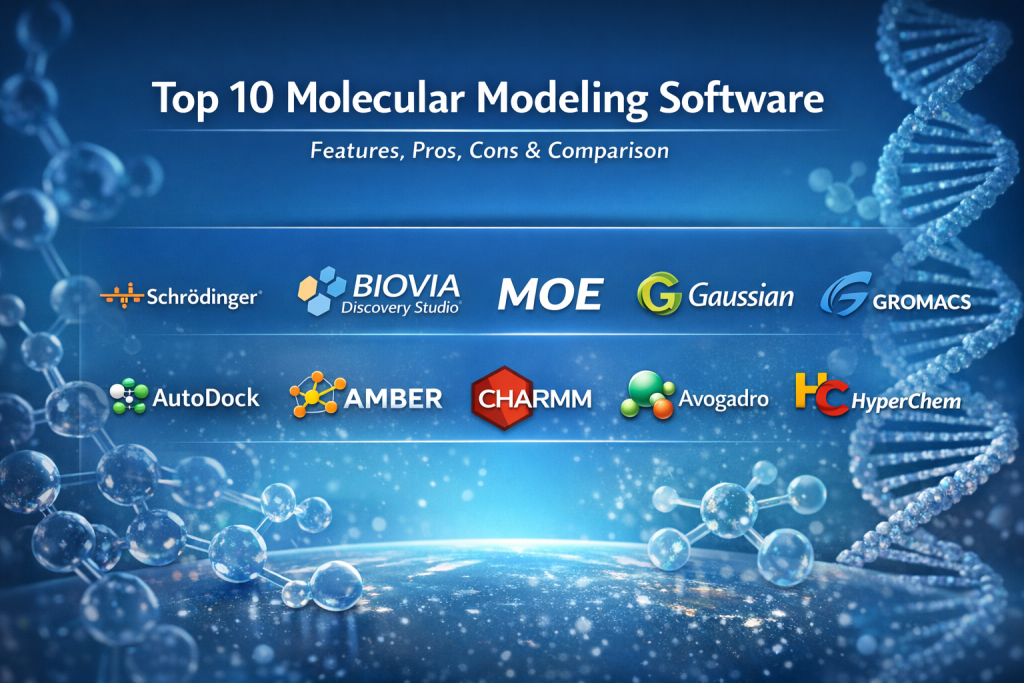
Top 10 Molecular Modeling Software Tools
1 — Schrödinger Suite
Short description:
A premium, enterprise-grade molecular modeling and simulation platform widely used in pharmaceutical and biotech research.
Key features:
- Advanced molecular dynamics and quantum chemistry tools
- Drug discovery and lead optimization workflows
- Protein–ligand docking and scoring
- AI-assisted compound design
- High-performance computing support
- Integrated visualization environment
Pros:
- Industry-leading accuracy and reliability
- Strong adoption in pharma R&D
Cons:
- High licensing cost
- Requires trained specialists
Security & compliance:
Enterprise-grade security, access controls, encryption, compliance varies by deployment.
Support & community:
Excellent documentation, professional onboarding, enterprise support, strong scientific user base.
2 — BIOVIA Discovery Studio
Short description:
A comprehensive modeling and simulation suite focused on life sciences and drug discovery.
Key features:
- Structure-based drug design
- Molecular docking and pharmacophore modeling
- Protein modeling and simulation
- Visualization and analysis tools
- Integration with enterprise R&D systems
Pros:
- User-friendly interface
- Strong visualization capabilities
Cons:
- Commercial licensing required
- Performance depends on system resources
Security & compliance:
Supports enterprise security standards, audit controls, and regulated environments.
Support & community:
Strong vendor support, structured training, moderate community engagement.
3 — MOE (Molecular Operating Environment)
Short description:
An integrated platform for molecular modeling, simulations, and cheminformatics.
Key features:
- Molecular dynamics and docking
- QSAR and cheminformatics tools
- Protein structure analysis
- Scriptable workflows
- Visualization and reporting
Pros:
- Balanced feature depth
- Widely used in academia and industry
Cons:
- Steep learning curve for advanced features
- Licensing cost
Security & compliance:
Standard enterprise security features, deployment-dependent compliance.
Support & community:
Good documentation, responsive support, active academic user community.
4 — Gaussian
Short description:
A specialized tool focused on quantum chemical calculations and electronic structure analysis.
Key features:
- Ab initio and DFT calculations
- Reaction mechanism analysis
- Spectroscopy predictions
- Geometry optimization
- High-accuracy energy calculations
Pros:
- Extremely accurate quantum calculations
- Trusted in academic research
Cons:
- Limited visualization tools
- Requires strong theoretical background
Security & compliance:
Varies / N/A (primarily research-focused).
Support & community:
Extensive documentation, academic community support, limited enterprise services.
5 — GROMACS
Short description:
A high-performance molecular dynamics engine widely used in computational chemistry and biophysics.
Key features:
- Fast molecular dynamics simulations
- GPU acceleration
- Large system support
- Open-source flexibility
- Strong performance optimization
Pros:
- Excellent speed and scalability
- Free and open-source
Cons:
- Command-line driven
- Limited built-in GUI
Security & compliance:
Varies / N/A (open-source).
Support & community:
Very strong global community, extensive tutorials, academic support.
6 — AutoDock
Short description:
A popular open-source tool focused on protein–ligand docking and binding analysis.
Key features:
- Flexible docking algorithms
- Binding energy estimation
- Ligand conformation sampling
- Integration with visualization tools
- Widely cited in research
Pros:
- Free and accessible
- Proven docking accuracy
Cons:
- Narrow focus on docking
- Manual workflow setup
Security & compliance:
Varies / N/A.
Support & community:
Large academic community, good documentation, limited enterprise support.
7 — Amber
Short description:
A powerful suite for molecular dynamics simulations of biomolecules.
Key features:
- Advanced force fields
- Protein and nucleic acid simulations
- GPU acceleration
- Free and commercial components
- Reproducible research workflows
Pros:
- Highly accurate biomolecular simulations
- Trusted by experts
Cons:
- Complex setup
- Requires domain expertise
Security & compliance:
Varies / N/A.
Support & community:
Strong academic community, detailed manuals, training workshops.
8 — CHARMM
Short description:
A long-standing molecular simulation platform used for macromolecular modeling.
Key features:
- Force-field-based simulations
- Protein, lipid, and nucleic acid modeling
- Flexible scripting
- Advanced analysis tools
- Research-grade accuracy
Pros:
- Proven scientific reliability
- Flexible modeling capabilities
Cons:
- Outdated UI
- Steep learning curve
Security & compliance:
Varies / N/A.
Support & community:
Strong academic base, extensive literature, limited commercial support.
9 — Avogadro
Short description:
An open-source molecular editor and visualization tool for basic modeling tasks.
Key features:
- Molecular structure building
- 3D visualization
- File format support
- Plugin-based extensions
- Educational use cases
Pros:
- Free and easy to use
- Excellent for beginners
Cons:
- Limited advanced simulations
- Not enterprise-grade
Security & compliance:
Varies / N/A.
Support & community:
Active open-source contributors, good documentation.
10 — HyperChem
Short description:
A desktop molecular modeling tool designed for teaching and small-scale research.
Key features:
- Molecular mechanics and dynamics
- Quantum chemistry basics
- Visualization tools
- Educational-friendly interface
- Small system simulations
Pros:
- Easy learning curve
- Suitable for teaching
Cons:
- Limited scalability
- Less active development
Security & compliance:
Varies / N/A.
Support & community:
Basic documentation, limited community activity.
Comparison Table
| Tool Name | Best For | Platform(s) Supported | Standout Feature | Rating |
|---|---|---|---|---|
| Schrödinger Suite | Enterprise drug discovery | Windows, Linux | End-to-end drug design | N/A |
| BIOVIA Discovery Studio | Life sciences R&D | Windows, Linux | Visualization & modeling | N/A |
| MOE | Academic & industry research | Windows, Linux | Integrated modeling | N/A |
| Gaussian | Quantum chemistry | Windows, Linux | High-accuracy calculations | N/A |
| GROMACS | Large-scale MD simulations | Linux, Windows | Performance & speed | N/A |
| AutoDock | Docking studies | Cross-platform | Binding prediction | N/A |
| Amber | Biomolecular simulations | Linux, Windows | Advanced force fields | N/A |
| CHARMM | Macromolecular modeling | Linux | Research reliability | N/A |
| Avogadro | Education & visualization | Cross-platform | Ease of use | N/A |
| HyperChem | Teaching & small research | Windows | Simplicity | N/A |
Evaluation & Scoring of Molecular Modeling Software
| Criteria | Weight | Description |
|---|---|---|
| Core features | 25% | Simulation depth, modeling accuracy |
| Ease of use | 15% | UI, learning curve |
| Integrations & ecosystem | 15% | Compatibility with tools and workflows |
| Security & compliance | 10% | Enterprise readiness |
| Performance & reliability | 10% | Speed, scalability |
| Support & community | 10% | Documentation, user base |
| Price / value | 15% | ROI vs cost |
Which Molecular Modeling Software Tool Is Right for You?
- Solo users & students: Open-source tools like Avogadro, AutoDock, or GROMACS
- SMBs & academic labs: MOE, Amber, or Gaussian depending on focus
- Mid-market & enterprise: Schrödinger Suite or BIOVIA Discovery Studio
- Budget-conscious users: Open-source platforms with community support
- Premium solutions: Enterprise platforms with integrated workflows
- Ease of use vs depth: Visualization tools vs advanced simulation engines
- Security needs: Enterprise-grade platforms for regulated industries
Frequently Asked Questions (FAQs)
- What is molecular modeling software used for?
It is used to simulate, visualize, and analyze molecular structures and interactions digitally. - Is molecular modeling only for drug discovery?
No, it is also used in materials science, chemistry, and academic research. - Do I need coding skills to use these tools?
Some tools require scripting, while others offer graphical interfaces. - Are open-source tools reliable?
Yes, many open-source platforms are scientifically validated and widely used. - Which tool is best for beginners?
Avogadro and HyperChem are beginner-friendly options. - Are these tools expensive?
Costs vary widely; enterprise tools are premium, open-source tools are free. - Can these tools handle large molecular systems?
Yes, platforms like GROMACS and Amber are designed for large systems. - Do these tools support cloud or HPC environments?
Many enterprise and open-source tools support HPC deployments. - How long does implementation take?
From hours for simple tools to weeks for enterprise platforms. - What is the most common mistake buyers make?
Choosing overly complex tools without matching expertise or needs.
Conclusion
Molecular modeling software has become a foundational technology in modern scientific research and industrial innovation. From simple molecular visualization to complex, large-scale simulations, these tools enable faster discovery and deeper understanding of molecular behavior.
When choosing a molecular modeling platform, focus on accuracy, usability, performance, support, and long-term scalability. There is no single “best” tool for everyone—the right solution depends on your goals, expertise, budget, and industry requirements. By aligning these factors carefully, organizations and researchers can unlock the full potential of molecular modeling technology.

Find Trusted Cardiac Hospitals
Compare heart hospitals by city and services — all in one place.
Explore Hospitals