
Introduction
Data Enrichment APIs are tools that enhance raw data by appending additional, meaningful information from external and verified sources. Instead of working with incomplete or outdated records, businesses can enrich customer, company, IP, location, or behavioral data in real time. This results in cleaner datasets, better insights, and more accurate decision-making.
In today’s data-driven world, enrichment APIs play a critical role in sales intelligence, marketing personalization, fraud detection, customer analytics, compliance, and automation. Whether you are a startup validating leads or an enterprise optimizing account-based marketing, enriched data improves relevance, efficiency, and ROI.
Common real-world use cases include:
- Enhancing CRM records with firmographic and demographic data
- Improving lead scoring and qualification
- Powering personalization engines
- Detecting fraud and reducing risk
- Supporting compliance and identity verification
What to look for when choosing a Data Enrichment API:
- Data accuracy and freshness
- Coverage (global vs regional)
- Ease of integration (APIs, SDKs, webhooks)
- Scalability and performance
- Security, privacy, and compliance
- Pricing transparency and value
Best for:
Sales teams, marketing teams, growth managers, product teams, data engineers, RevOps, compliance teams, startups, SaaS companies, fintech, e-commerce, and enterprises working with large datasets.
Not ideal for:
Very small teams with minimal data needs, offline-only workflows, or use cases where static/manual data collection is sufficient.
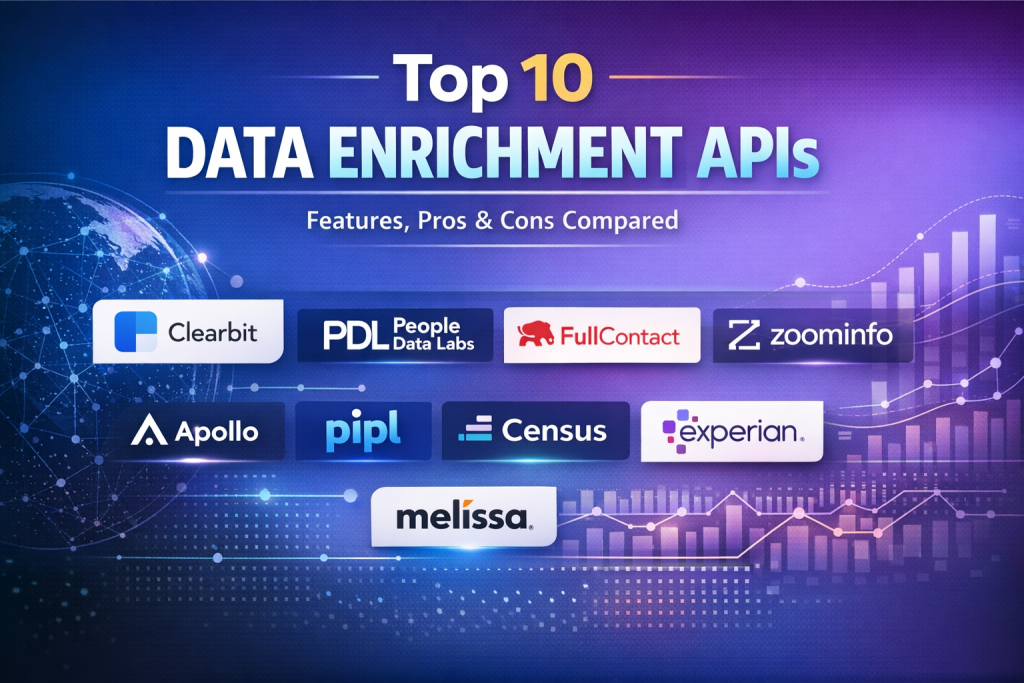
Top 10 Data Enrichment APIs Tools
1 — Clearbit
Short description:
Clearbit provides real-time B2B data enrichment for companies and contacts, widely used in sales, marketing, and revenue operations.
Key features:
- Company and contact enrichment
- Firmographic and technographic data
- Real-time and batch enrichment APIs
- CRM and marketing automation integrations
- IP-based company identification
- Lead scoring signals
Pros:
- Highly accurate B2B data
- Excellent ecosystem integrations
Cons:
- Premium pricing
- Limited for B2C use cases
Security & compliance: SOC 2, GDPR, encrypted APIs
Support & community: Strong documentation, enterprise onboarding, dedicated support
2 — People Data Labs
Short description:
People Data Labs offers large-scale people and company datasets for enrichment, analytics, and AI use cases.
Key features:
- People and company enrichment
- Massive global datasets
- Batch and real-time APIs
- Resume and profile parsing
- Data matching and identity resolution
Pros:
- Broad data coverage
- Flexible API design
Cons:
- Requires data engineering effort
- Less plug-and-play for non-technical teams
Security & compliance: GDPR, CCPA, SOC 2 (varies by plan)
Support & community: Good docs, developer-focused support
3 — FullContact
Short description:
FullContact focuses on identity resolution and customer profile enrichment for personalization and privacy-safe data unification.
Key features:
- Identity graph and resolution
- Customer profile enrichment
- Data hygiene and deduplication
- Consent-based data handling
- Cross-channel identity matching
Pros:
- Strong privacy-first approach
- Excellent identity resolution
Cons:
- Less sales-focused
- Enterprise-oriented pricing
Security & compliance: GDPR, SOC 2, consent management
Support & community: Enterprise support, onboarding specialists
4 — Hunter
Short description:
Hunter enriches domains and email addresses, mainly used for sales prospecting and outreach verification.
Key features:
- Email finding and verification
- Domain-level enrichment
- Company metadata
- Bulk enrichment
- Simple REST API
Pros:
- Easy to use
- Affordable for SMBs
Cons:
- Limited enrichment depth
- Primarily email-focused
Security & compliance: GDPR compliant
Support & community: Good documentation, responsive support
5 — ZoomInfo
Short description:
ZoomInfo provides enterprise-grade B2B intelligence, enrichment, and intent data for sales and marketing teams.
Key features:
- Contact and company enrichment
- Intent and buying signals
- Technographic insights
- CRM synchronization
- Advanced filtering and segmentation
Pros:
- Very rich dataset
- Strong enterprise adoption
Cons:
- Expensive
- Complex setup
Security & compliance: GDPR, SOC 2, enterprise-grade controls
Support & community: Dedicated account managers, training resources
6 — Apollo
Short description:
Apollo combines enrichment, prospecting, and engagement data into a single sales-focused API.
Key features:
- Contact and company enrichment
- Email verification
- Sales intelligence signals
- Bulk enrichment
- CRM integrations
Pros:
- Good value for money
- All-in-one sales workflow
Cons:
- Data depth varies by region
- Limited customization
Security & compliance: GDPR, standard API security
Support & community: Solid docs, active user base
7 — Pipl
Short description:
Pipl specializes in identity verification and deep people search for risk, compliance, and fraud detection.
Key features:
- Identity enrichment
- Email and phone resolution
- Risk and trust indicators
- Global coverage
- Fraud prevention use cases
Pros:
- Deep identity insights
- Strong compliance focus
Cons:
- Not sales-oriented
- Pricing not transparent
Security & compliance: GDPR, CCPA, enterprise compliance
Support & community: Enterprise-grade support
8 — Census
Short description:
Census enriches operational tools by syncing data from warehouses into business systems.
Key features:
- Warehouse-driven enrichment
- Reverse ETL workflows
- Data validation rules
- SaaS tool synchronization
- Scalable pipelines
Pros:
- Modern data stack friendly
- Strong data governance
Cons:
- Requires data warehouse
- Not a raw data provider
Security & compliance: SOC 2, GDPR
Support & community: Strong documentation, data engineer community
9 — Experian
Short description:
Experian offers enrichment APIs focused on consumer, credit, and risk data.
Key features:
- Consumer demographic enrichment
- Credit and risk indicators
- Identity verification
- Fraud prevention data
- Global datasets
Pros:
- Highly trusted data
- Strong compliance credentials
Cons:
- Heavy onboarding
- Enterprise-centric
Security & compliance: ISO, SOC, GDPR, regional regulations
Support & community: Enterprise support and SLAs
10 — Melissa
Short description:
Melissa focuses on address, phone, email, and identity enrichment with high accuracy.
Key features:
- Address and location enrichment
- Email and phone validation
- Identity verification
- Batch and real-time APIs
- Global coverage
Pros:
- Very accurate data
- Competitive pricing
Cons:
- UI less modern
- Limited intent data
Security & compliance: GDPR, SOC 2 (varies by product)
Support & community: Good technical documentation
Comparison Table
| Tool Name | Best For | Platform(s) Supported | Standout Feature | Rating |
|---|---|---|---|---|
| Clearbit | B2B sales & marketing | API, CRM | Real-time firmographics | N/A |
| People Data Labs | Data engineering & AI | API | Massive datasets | N/A |
| FullContact | Identity resolution | API | Privacy-first identity graph | N/A |
| Hunter | Email enrichment | API, Web | Email accuracy | N/A |
| ZoomInfo | Enterprise sales | API, CRM | Intent data | N/A |
| Apollo | SMB sales teams | API, Web | All-in-one sales data | N/A |
| Pipl | Risk & compliance | API | Deep identity search | N/A |
| Census | Data ops teams | Cloud, API | Reverse ETL enrichment | N/A |
| Experian | Financial services | API | Credit-grade data | N/A |
| Melissa | Data quality | API | Address accuracy | N/A |
Evaluation & Scoring of Data Enrichment APIs
| Criteria | Weight | Evaluation Notes |
|---|---|---|
| Core features | 25% | Breadth and depth of enrichment |
| Ease of use | 15% | API design, docs, onboarding |
| Integrations & ecosystem | 15% | CRM, data stack compatibility |
| Security & compliance | 10% | GDPR, SOC, enterprise readiness |
| Performance & reliability | 10% | Latency and uptime |
| Support & community | 10% | Docs, SLAs, onboarding |
| Price / value | 15% | ROI vs cost |
Which Data Enrichment APIs Tool Is Right for You?
- Solo users & startups: Hunter, Apollo, Melissa
- SMBs: Clearbit, Apollo, People Data Labs
- Mid-market: Clearbit, FullContact, Census
- Enterprise: ZoomInfo, Experian, Pipl
Budget-conscious: Hunter, Apollo
Premium solutions: ZoomInfo, Experian
Feature depth: ZoomInfo, People Data Labs
Ease of use: Clearbit, Hunter
Scalability needs: Census, People Data Labs
Strict compliance: Experian, FullContact
Frequently Asked Questions (FAQs)
1. What is a Data Enrichment API?
It enhances raw data by appending verified information from external sources.
2. Are enrichment APIs real-time?
Most support real-time and batch processing.
3. Is enriched data always accurate?
Accuracy depends on provider coverage and update frequency.
4. Are these APIs GDPR compliant?
Leading providers follow GDPR and privacy regulations.
5. Can enrichment APIs integrate with CRMs?
Yes, most support major CRM systems.
6. Do I need technical skills to use them?
Basic API knowledge helps, but many offer low-code options.
7. Are enrichment APIs expensive?
Pricing varies widely based on volume and depth.
8. Can they enrich existing databases?
Yes, via batch or scheduled jobs.
9. Are there B2C-focused tools?
Yes, Experian and Melissa focus more on B2C data.
10. What mistakes should I avoid?
Ignoring data privacy, over-enrichment, and poor validation.
Conclusion
Data Enrichment APIs are foundational tools for modern, data-driven organizations. They improve accuracy, efficiency, and personalization across sales, marketing, analytics, and compliance workflows.
The most important factors when choosing a solution are data quality, compliance, integration ease, scalability, and value for money. There is no single “best” platform—the right choice depends on your specific use case, budget, and technical maturity.
By aligning your needs with the strengths of each tool, you can unlock the full potential of enriched data and make smarter, faster decisions.

Find Trusted Cardiac Hospitals
Compare heart hospitals by city and services — all in one place.
Explore Hospitals
Enrichment APIs only help as much as the data stays fresh—stale job titles, bounced emails, or mismatched company records can quickly pollute CRM routing and lead scoring. Balancing developer-first datasets like People Data Labs or reverse ETL syncs like Census with sales intelligence, email, or identity tools like Clearbit, ZoomInfo, Apollo, Hunter, or FullContact keeps workflows moving without overspending on every lookup. Where do you see the biggest bottleneck in enrichment pipelines: real-time API latency on live forms or keeping batch warehouse records clean?
Data enrichment APIs can make existing records more useful by adding missing details and keeping information consistent across business systems. I would compare providers based on data coverage, field accuracy, geographic reach, update frequency, and the types of records they support. API response time, rate limits, batch processing, and clear error handling are important for applications that enrich data at scale. Teams should also review source transparency, duplicate matching, privacy controls, and pricing limits to understand whether the returned information is reliable enough for their workflows.
Data enrichment APIs help businesses improve existing records by adding useful information from external data sources. When comparing these APIs, I would focus on data accuracy, coverage, real-time enrichment, integration options, response speed, and pricing. These capabilities can improve customer profiles, support better segmentation, and help teams make informed business decisions. The right API should provide reliable data, strong security, easy integration, and flexible options that fit different business requirements.
Real-time enrichment calls placed directly on checkout or lead capture forms can severely degrade frontend conversion speeds. Running enrichment asynchronously via background worker webhooks preserves snappy UI responsiveness while updating CRM records with firmographic data.
Data enrichment APIs help businesses improve the quality of their existing data by adding useful details from different sources. Accurate information, easy integration, and regular updates are important when choosing the right solution. I think data privacy and validation should also be considered to avoid outdated or incorrect records. A reliable API can help teams make better decisions and understand their customers more clearly.
Data enrichment APIs help businesses add useful details to existing records, improve data quality, and build more complete customer or company profiles. When comparing options, consider data accuracy, API response speed, coverage, update frequency, privacy compliance, and integration flexibility to support reliable data workflows.
Data enrichment APIs append useful attributes to records, and this article explains the value proposition well. What resonates with me is the emphasis on data freshness and sourcing transparency, since stale enrichment hurts deliverability and decisions. One tip is to enrich at the point of use rather than bulk hoarding, which keeps records current and reduces storage. Quality enrichment sharpens targeting. Practical read for growth teams.
Data enrichment APIs can improve incomplete records, but inaccurate additions may create more problems than missing information. When comparing providers, check how they verify updated details, indicate data freshness, and handle records that return conflicting results. Clear confidence indicators and source-level attribution can help teams decide which enriched fields are reliable enough to use in customer profiles or business decisions.
Data enrichment APIs help businesses transform incomplete records into more useful information by connecting multiple data sources and adding relevant attributes. Reliable API responses, accurate matching, real-time updates, and seamless integration are essential for maintaining data quality across applications. Strong privacy safeguards and validation processes also help organizations use enriched information responsibly while improving analytics, customer understanding, and operational decisions.
Different enrichment providers may supply conflicting details for the same customer or company. Teams need clear rules to decide which source should take priority. They should also retain previous values and record when each detail was last checked. This makes incorrect updates easier to trace and fix. Such controls help prevent unreliable information from spreading through connected business systems.
Data enrichment APIs help businesses enhance existing records by adding valuable information from external data sources. Key features such as real-time data enrichment, company and contact profiling, demographic insights, email verification, firmographic data, and seamless API integration can improve data quality and usability. When comparing solutions, organizations should evaluate data accuracy, source coverage, API response times, scalability, privacy compliance, and pricing. The right platform can reduce incomplete records, improve customer segmentation, strengthen lead qualification, and support more informed sales and marketing decisions.
Data enrichment APIs add useful details to existing records by connecting them with other data sources. They can help teams improve customer profiles, business records, and lead lists. However, more data does not always mean better data. Businesses should check accuracy, update frequency, source quality, and missing fields. API limits, response speed, and pricing can also affect daily use. Privacy rules must guide how teams collect and use enriched information. The best API adds relevant details while keeping data reliable, secure, and easy to manage.
When integrating enrichment APIs into production systems, teams need a clear strategy for resolving conflicting data from different providers. One service may return an outdated job title, while another supplies a newer company affiliation or contact detail. Automatically overwriting existing records without checking data freshness and source reliability can damage CRM quality over time. I would recommend storing source information, timestamps, and confidence indicators alongside enriched fields, with defined rules for resolving disagreements. Teams should also track how often updates prove incorrect and provide a way to restore previous values. This approach keeps customer records trustworthy and makes multi-provider enrichment easier to maintain as business needs evolve.
This comparison proved that enrichment speed is useless without deterministic schema validation. Ingesting third-party firmographics directly into production databases creates massive drift unless reverse-ETL pipelines sanitize payloads, reconcile conflicting identity attributes, and enforce strict caching tiers before sync jobs touch downstream CRMs.
Data enrichment APIs help businesses improve existing records by adding useful details such as company information, contact attributes, or location data. When comparing providers, check data accuracy, update frequency, field coverage, API response times, pricing, and privacy compliance. Validating enriched records before adding them to business systems can reduce duplicate entries, prevent outdated information, and improve the quality of reporting and customer outreach.
A great breakdown of how different tools fit specific architectural and team needs. One thing worth keeping in mind when designing pipelines around these APIs is managing rate limits and handling graceful degradation when a vendor’s endpoint times out. Implementing a robust fallback or caching strategy at the warehouse level can save a lot of headaches downstream.
Data enrichment APIs help businesses enhance existing records with additional details, making customer profiles, lead databases, and analytics more useful. Services like People Data Labs provide APIs for enriching person and company data, helping teams improve lead research, streamline workflows, and make better-informed sales and marketing decisions.
Data enrichment delivers the most value when teams validate added information before using it for segmentation or decision-making. Combining match-rate monitoring with clear privacy rules and regular data refreshes helps maintain reliable records as customer details change.