
Introduction
Competitive Intelligence Platforms are specialized tools designed to collect, analyze, and interpret data about competitors, market trends, and industry movements. Instead of relying on guesswork or scattered research, these platforms give businesses a structured, data-driven view of what competitors are doing—across pricing, messaging, product updates, marketing campaigns, partnerships, and overall strategy.
In today’s fast-moving digital economy, competitive intelligence is no longer optional. Markets evolve quickly, customer expectations shift overnight, and competitors launch new features or campaigns constantly. Without reliable competitive insights, teams risk making decisions based on outdated or incomplete information.
Common real-world use cases include tracking competitor product launches, monitoring pricing changes, analyzing marketing performance, identifying market gaps, supporting sales conversations, and guiding long-term strategic planning.
When choosing a Competitive Intelligence Platform, buyers should evaluate data coverage, update frequency, automation, ease of use, integrations, reporting depth, and security standards. The right tool should not just collect data—it should translate insights into clear, actionable intelligence for teams across the organization.
Best for:
Competitive Intelligence Platforms are ideal for product managers, marketing leaders, sales teams, strategy professionals, founders, and executives in SaaS, e-commerce, finance, technology, healthcare, and enterprise services. Mid-market and enterprise organizations benefit most, though many tools also serve startups and SMBs.
Not ideal for:
These tools may be unnecessary for very small businesses, solo founders, or local offline businesses with limited competition. Teams that only need occasional manual research or basic SEO data may find lighter-weight alternatives sufficient.
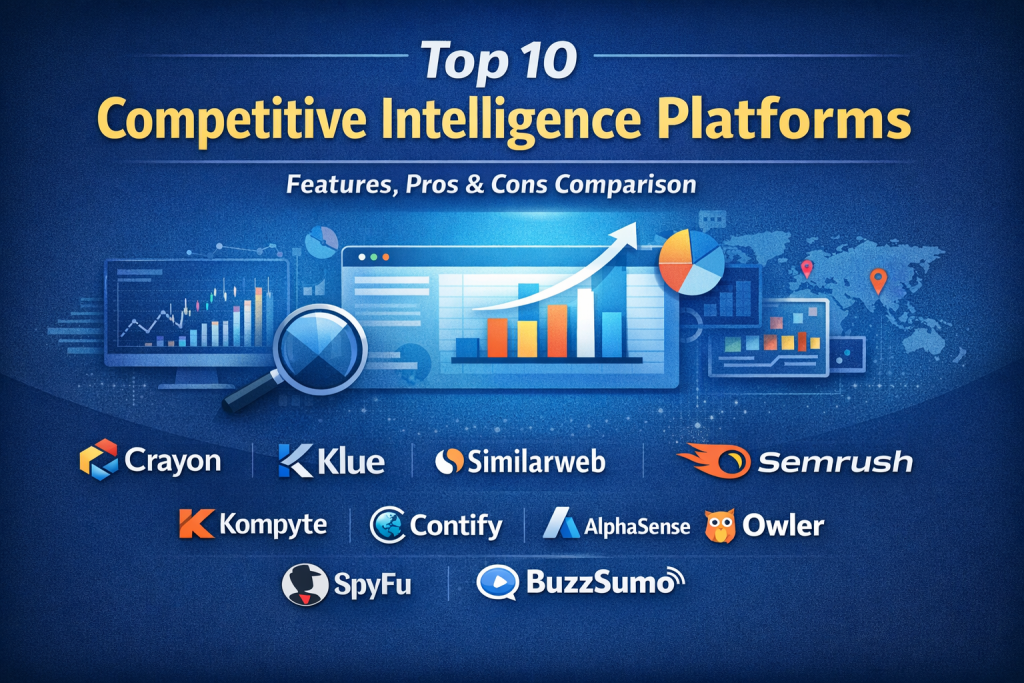
Top 10 Competitive Intelligence Platforms Tools
1 — Crayon
Short description:
Crayon is a leading enterprise-grade competitive intelligence platform focused on tracking competitor activity across digital channels. It is designed for sales, marketing, and product teams in fast-growing organizations.
Key features:
- Automated tracking of competitor websites, pricing, and messaging
- Battlecards for sales enablement
- Real-time alerts on competitor changes
- AI-powered insights and trend detection
- Win/loss analysis support
- CRM and sales tool integrations
Pros:
- Excellent for sales enablement and competitive battlecards
- Highly automated data collection reduces manual effort
Cons:
- Pricing may be high for small teams
- Initial setup requires strategic planning
Security & compliance:
SSO, role-based access, SOC 2, GDPR-aligned practices
Support & community:
Strong onboarding, dedicated customer success managers, enterprise support
2 — Klue
Short description:
Klue focuses on competitive enablement, helping revenue and product teams stay aligned with up-to-date competitor insights.
Key features:
- Centralized competitor intelligence hub
- Sales-ready competitive battlecards
- Slack and CRM integrations
- Internal collaboration and insights sharing
- Win/loss feedback capture
- Market trend analysis
Pros:
- Clean, intuitive interface
- Strong alignment between sales and product teams
Cons:
- Limited non-digital data sources
- Advanced analytics require higher plans
Security & compliance:
SSO, encryption at rest and in transit, GDPR-compliant
Support & community:
High-quality documentation, responsive support, onboarding programs
3 — Similarweb
Short description:
Similarweb provides deep insights into digital traffic, audience behavior, and competitor online performance across industries.
Key features:
- Website and app traffic analysis
- Audience demographics and interests
- Channel and referral breakdowns
- Benchmarking against competitors
- Market and industry trend reports
- Global data coverage
Pros:
- Best-in-class digital traffic intelligence
- Strong market benchmarking capabilities
Cons:
- Less focused on sales enablement
- Premium features can be costly
Security & compliance:
Enterprise-grade security, GDPR-aligned data handling
Support & community:
Enterprise support, training resources, analyst reports
4 — Semrush
Short description:
Semrush is a comprehensive competitive intelligence platform for digital marketing, SEO, content, and paid advertising analysis.
Key features:
- Competitor SEO and keyword tracking
- PPC and ad copy analysis
- Content gap and backlink analysis
- Market share insights
- Social media benchmarking
- Trend and visibility tracking
Pros:
- Extremely versatile for marketing teams
- Large, frequently updated data sets
Cons:
- Interface can feel overwhelming
- Not a full CI solution for sales strategy
Security & compliance:
Standard SaaS security, GDPR-compliant
Support & community:
Large global user community, tutorials, and support resources
5 — Kompyte
Short description:
Kompyte delivers real-time competitor tracking with a focus on sales enablement and marketing intelligence.
Key features:
- Automated competitor monitoring
- Sales battlecards and alerts
- Website, messaging, and pricing tracking
- CRM and enablement tool integrations
- Custom dashboards
- Collaboration tools
Pros:
- Real-time updates are highly reliable
- Strong sales-focused workflows
Cons:
- Reporting customization is limited
- Smaller ecosystem compared to leaders
Security & compliance:
SSO, encryption, GDPR-aligned
Support & community:
Dedicated account managers, onboarding assistance
6 — Contify
Short description:
Contify specializes in AI-driven market and competitive intelligence for strategy, consulting, and enterprise teams.
Key features:
- AI-curated competitor and market news
- Industry and regulatory tracking
- Custom intelligence briefs
- Enterprise dashboards
- Analyst-driven insights
- Global coverage
Pros:
- Strong for strategic and executive insights
- Excellent noise reduction using AI
Cons:
- Less tactical for sales teams
- Setup requires clarity on intelligence goals
Security & compliance:
Enterprise security standards, GDPR-compliant
Support & community:
Dedicated research analysts, enterprise support model
7 — AlphaSense
Short description:
AlphaSense is a powerful market intelligence platform combining AI search with premium content sources.
Key features:
- AI-powered document and earnings call search
- Access to analyst reports and filings
- Competitive benchmarking
- Trend detection across industries
- Collaboration tools
- Alerts and monitoring
Pros:
- Exceptional depth for financial and strategic research
- Trusted by large enterprises and investors
Cons:
- High cost limits accessibility
- Overkill for small teams
Security & compliance:
SOC 2, SSO, enterprise-grade compliance
Support & community:
Dedicated enterprise onboarding and research support
8 — Owler
Short description:
Owler provides easy-to-digest competitive insights focused on company news, funding, and market activity.
Key features:
- Competitor news alerts
- Company profiles and timelines
- Funding and acquisition tracking
- Community-driven insights
- Simple dashboards
- Industry comparisons
Pros:
- Easy to use and affordable
- Good high-level competitive awareness
Cons:
- Limited depth for advanced analysis
- Less automation than enterprise tools
Security & compliance:
Standard SaaS security, GDPR-aligned
Support & community:
Community-driven model with basic support
9 — SpyFu
Short description:
SpyFu focuses on competitor keyword intelligence for SEO and paid search strategies.
Key features:
- Competitor keyword tracking
- PPC and ad history analysis
- Domain comparisons
- SERP analysis
- Exportable reports
- Historical data access
Pros:
- Strong value for SEO-focused teams
- Easy competitor comparisons
Cons:
- Narrow CI scope beyond marketing
- Limited enterprise features
Security & compliance:
Varies / N/A
Support & community:
Online documentation and email support
10 — BuzzSumo
Short description:
BuzzSumo provides competitive intelligence around content performance and social engagement.
Key features:
- Competitor content analysis
- Social engagement tracking
- Influencer discovery
- Trend monitoring
- Alerts for brand mentions
- Content gap insights
Pros:
- Excellent for content and social teams
- Easy-to-understand insights
Cons:
- Limited non-content intelligence
- Not a full CI platform
Security & compliance:
Standard SaaS security
Support & community:
Documentation, tutorials, responsive support
Comparison Table
| Tool Name | Best For | Platform(s) Supported | Standout Feature | Rating |
|---|---|---|---|---|
| Crayon | Enterprise sales & CI teams | Web | Real-time battlecards | N/A |
| Klue | Revenue enablement | Web | Competitive alignment | N/A |
| Similarweb | Market & traffic analysis | Web | Digital benchmarking | N/A |
| Semrush | Marketing intelligence | Web | SEO & PPC insights | N/A |
| Kompyte | Sales intelligence | Web | Live competitor alerts | N/A |
| Contify | Strategic intelligence | Web | AI-curated insights | N/A |
| AlphaSense | Financial & market research | Web | AI search depth | N/A |
| Owler | High-level awareness | Web | Company news tracking | N/A |
| SpyFu | SEO competition | Web | Keyword history | N/A |
| BuzzSumo | Content intelligence | Web | Social engagement data | N/A |
Evaluation & Scoring of Competitive Intelligence Platforms
| Criteria | Weight | Description |
|---|---|---|
| Core features | 25% | Breadth and depth of intelligence capabilities |
| Ease of use | 15% | UI clarity, onboarding speed |
| Integrations & ecosystem | 15% | CRM, marketing, BI tool support |
| Security & compliance | 10% | Enterprise readiness |
| Performance & reliability | 10% | Data freshness and uptime |
| Support & community | 10% | Help quality and resources |
| Price / value | 15% | ROI relative to cost |
Which Competitive Intelligence Platforms Tool Is Right for You?
- Solo users & startups: Lightweight tools like Owler or SpyFu provide sufficient visibility without complexity.
- SMBs: Semrush, BuzzSumo, or Klue balance affordability with insight depth.
- Mid-market teams: Crayon, Kompyte, and Similarweb support structured CI workflows.
- Enterprise organizations: AlphaSense and Contify deliver advanced strategic intelligence.
Budget-conscious vs premium: Marketing-focused tools are more affordable, while enterprise CI platforms demand higher investment.
Feature depth vs ease of use: Deeper analytics often increase complexity—choose based on team maturity.
Integrations & scalability: CRM and sales enablement integrations are critical for revenue teams.
Security & compliance: Enterprises should prioritize SSO, audit logs, and SOC 2 readiness.
Frequently Asked Questions (FAQs)
1. What is a Competitive Intelligence Platform?
It is software that collects and analyzes competitor and market data to support strategic decisions.
2. Are CI platforms only for large enterprises?
No, many tools cater to startups and SMBs with lighter feature sets.
3. How often is competitor data updated?
Most modern platforms update data daily or in near real time.
4. Do these tools replace manual research?
They reduce manual work but strategic interpretation still matters.
5. Are CI platforms secure?
Leading platforms offer enterprise-grade security and compliance.
6. Can sales teams use CI tools directly?
Yes, many tools are built specifically for sales enablement.
7. Do CI tools integrate with CRMs?
Most mid-market and enterprise tools support CRM integrations.
8. Is competitive intelligence legal?
Yes, when based on publicly available and ethical data sources.
9. How long does implementation take?
From a few days for simple tools to weeks for enterprise platforms.
10. What is the biggest mistake buyers make?
Choosing tools with too many features instead of clear use cases.
Conclusion
Competitive Intelligence Platforms empower organizations to see clearly in competitive markets. The best tools do more than track competitors—they turn fragmented data into actionable insight that drives smarter decisions.
When selecting a platform, focus on relevance, usability, integration, and data quality. There is no universal “best” tool—only the one that aligns with your team’s goals, budget, and maturity. With the right choice, competitive intelligence becomes a lasting strategic advantage rather than a reactive exercise.

Find Trusted Cardiac Hospitals
Compare heart hospitals by city and services — all in one place.
Explore Hospitals
Really insightful article — thanks for breaking down the features and pros/cons of each competitive intelligence platform so clearly! With market trends evolving so fast, this side-by-side comparison makes it much easier to see which tools might suit different research needs and strategic goals. I’m curious how others balance depth of data with ease of use in real projects — does anyone prefer platforms with stronger analytics over simpler dashboards? Overall, this guide adds real value for anyone evaluating competitive intelligence solutions!