
Introduction
Municipal Tax Collection Systems are specialized software platforms used by local governments to assess, bill, collect, track, and report taxes and fees such as property tax, water tax, sewer charges, business licenses, penalties, and other municipal revenues. These systems replace fragmented manual processes with centralized, auditable, and citizen-friendly digital workflows.
As cities grow and public expectations rise, municipalities face increasing pressure to improve revenue efficiency, reduce leakage, ensure compliance, and offer convenient payment options. Modern tax collection systems help governments achieve these goals while maintaining transparency, accountability, and regulatory compliance.
Real-world use cases include:
- Property tax assessment and billing
- Online citizen payment portals
- Automated penalties, rebates, and interest calculations
- Integration with GIS, ERP, and accounting systems
- Revenue forecasting and audit-ready reporting
When choosing a Municipal Tax Collection System, buyers should evaluate functional depth, ease of use, scalability, security, integration capabilities, vendor support, and long-term cost of ownership, not just initial pricing.
Best for:
Municipal corporations, city councils, townships, smart city programs, finance departments, revenue officers, and government IT teams managing recurring taxes and citizen payments at scale.
Not ideal for:
Very small rural bodies with minimal tax complexity, temporary project-based revenue collection, or organizations already fully covered by a broader ERP without a tax-specific module.
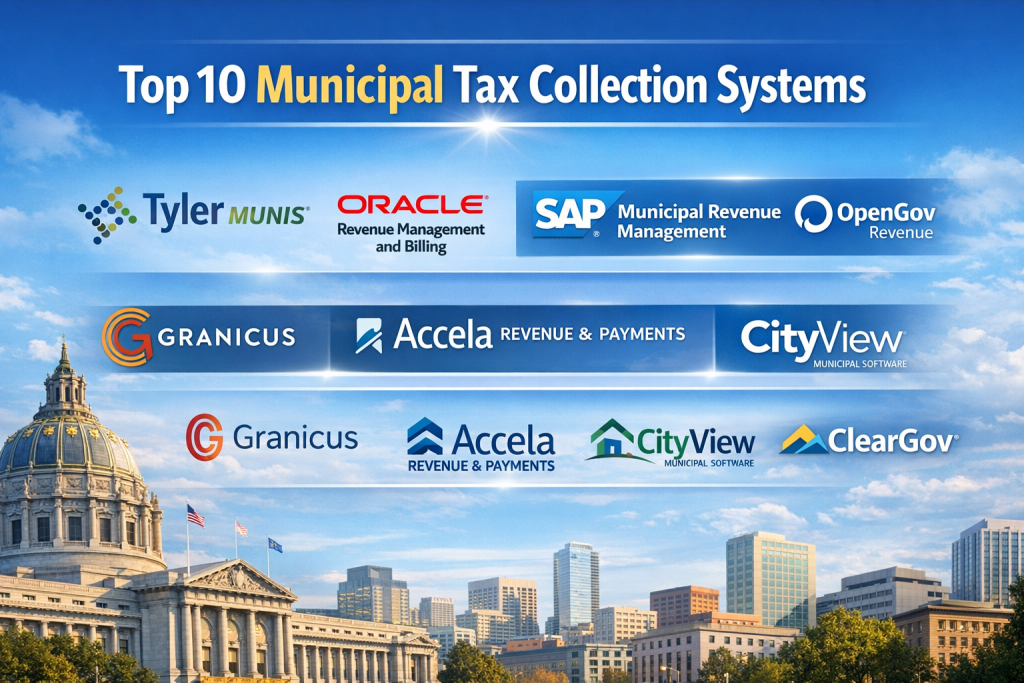
Top 10 Municipal Tax Collection Systems Tools
1 — Tyler Munis
Short description:
A comprehensive municipal finance and tax management platform designed for mid-to-large local governments seeking full revenue lifecycle automation.
Key features:
- Property tax billing and collection
- Citizen self-service payment portals
- Integrated general ledger and budgeting
- Automated penalties, discounts, and adjustments
- Audit trails and financial reporting
- Role-based access control
- Mobile-friendly interfaces
Pros:
- Deep functionality tailored for municipalities
- Strong financial reporting and audit support
- Mature ecosystem with long-term stability
Cons:
- Higher implementation cost
- Steeper learning curve for smaller teams
Security & compliance:
SSO, encryption at rest and in transit, audit logs, regulatory alignment (varies by deployment).
Support & community:
Extensive documentation, structured onboarding, enterprise-grade customer support, strong public-sector user base.
2 — Oracle Revenue Management & Billing
Short description:
An enterprise-grade revenue and billing solution suited for large municipalities with complex tax and utility billing needs.
Key features:
- High-volume transaction processing
- Configurable tax rules and rate structures
- Multi-channel payment handling
- Advanced analytics and dashboards
- ERP and financial system integration
- Scalable cloud architecture
Pros:
- Extremely scalable and reliable
- Strong analytics and compliance controls
- Suitable for complex revenue models
Cons:
- Expensive licensing and implementation
- Requires experienced IT teams
Security & compliance:
Enterprise-grade security, encryption, role-based access, compliance-ready architecture.
Support & community:
Global enterprise support, extensive technical documentation, partner-driven implementation ecosystem.
3 — SAP Municipal Revenue Management
Short description:
A robust revenue and tax management module for governments already invested in the SAP ecosystem.
Key features:
- End-to-end tax assessment and collection
- Integration with SAP Finance and ERP
- Configurable workflows and approvals
- Automated interest and penalty calculation
- Advanced reporting and compliance tools
- High availability architecture
Pros:
- Seamless integration with SAP landscape
- Strong governance and audit readiness
- Scales well for large municipalities
Cons:
- High total cost of ownership
- Requires SAP expertise
Security & compliance:
Enterprise security controls, audit logs, compliance frameworks configurable per region.
Support & community:
Global SAP support network, extensive training materials, large public-sector user community.
4 — OpenGov Revenue
Short description:
A modern, cloud-first municipal revenue solution focused on transparency and citizen experience.
Key features:
- Online tax and fee payments
- Real-time revenue dashboards
- Citizen portals with payment history
- Automated billing and notifications
- Budget and revenue forecasting
- API-based integrations
Pros:
- Intuitive user interface
- Strong transparency and analytics
- Faster deployment compared to legacy systems
Cons:
- Limited deep customization
- Best suited for mid-sized municipalities
Security & compliance:
Cloud security best practices, encryption, access controls, compliance varies by region.
Support & community:
Good onboarding support, responsive customer success teams, growing government user community.
5 — Civica Cx Revenue
Short description:
A configurable tax and revenue management platform widely used by local governments and councils.
Key features:
- Property tax and non-tax revenue management
- Flexible billing cycles
- Integrated payment gateways
- Case management for disputes
- Reporting and compliance tools
- Modular deployment options
Pros:
- Flexible configuration for different tax models
- Strong local government focus
- Modular scalability
Cons:
- Interface can feel dated
- Customization may increase costs
Security & compliance:
Encryption, role-based access, audit trails, compliance aligned to public-sector standards.
Support & community:
Dedicated government support teams, structured onboarding, established public-sector presence.
6 — Granicus Revenue Management
Short description:
A citizen-centric revenue and payment solution designed to improve digital service delivery.
Key features:
- Online tax payments and billing
- Automated reminders and notifications
- Citizen account management
- Reporting and reconciliation
- Integration with finance systems
- Mobile-accessible portals
Pros:
- Excellent citizen experience
- Quick implementation timelines
- Strong communication tools
Cons:
- Limited advanced tax modeling
- Best for straightforward tax structures
Security & compliance:
Standard encryption, access controls, compliance varies by deployment.
Support & community:
Strong customer success focus, helpful documentation, active government user base.
7 — Accela Revenue & Payments
Short description:
A municipal revenue solution often paired with permitting and licensing systems.
Key features:
- Tax and fee collection
- Integrated permitting revenue
- Online and in-person payment support
- Configurable workflows
- Real-time reporting
- Cloud-based architecture
Pros:
- Strong integration with permitting workflows
- Flexible configuration
- Cloud-native deployment
Cons:
- Less specialized for pure property tax
- Customization can be complex
Security & compliance:
Cloud security controls, encryption, audit logging.
Support & community:
Enterprise support options, solid documentation, strong civic technology presence.
8 — CityView Revenue
Short description:
A comprehensive municipal management system with strong tax and revenue modules.
Key features:
- Property tax billing
- Utility and fee collection
- Integrated finance and accounting
- GIS compatibility
- Reporting and compliance tools
- Configurable tax rules
Pros:
- All-in-one municipal platform
- Strong GIS and planning integration
- Reliable reporting
Cons:
- UI modernization may be needed
- Deployment timelines can be long
Security & compliance:
Role-based security, audit trails, encryption.
Support & community:
Dedicated municipal support, structured training, established client base.
9 — eGov SmartTax
Short description:
A smart-city-ready tax collection system popular in emerging markets and digital governance initiatives.
Key features:
- Property and municipal tax collection
- Citizen portals and mobile access
- Automated demand notices
- Integration with GIS and UID systems
- Dashboards and analytics
- Cloud and on-premise options
Pros:
- Affordable and scalable
- Strong smart city alignment
- Mobile-first citizen experience
Cons:
- Limited global support footprint
- Customization varies by region
Security & compliance:
Encryption, access control, compliance depends on government standards.
Support & community:
Regional implementation partners, functional documentation, growing user base.
10 — ClearGov Revenue Tools
Short description:
A financial transparency and revenue optimization platform for small to mid-sized municipalities.
Key features:
- Revenue tracking and forecasting
- Citizen-friendly dashboards
- Budget integration
- Payment data analysis
- Simple configuration
- Cloud-based access
Pros:
- Easy to use
- Strong transparency focus
- Lower entry cost
Cons:
- Limited advanced tax workflows
- Not ideal for complex tax regimes
Security & compliance:
Cloud security best practices, encryption, role-based access.
Support & community:
Helpful onboarding, responsive support, active municipal user community.
Comparison Table
| Tool Name | Best For | Platform(s) Supported | Standout Feature | Rating |
|---|---|---|---|---|
| Tyler Munis | Large municipalities | Web, Cloud | End-to-end municipal finance | N/A |
| Oracle Revenue Management | Enterprise cities | Cloud, On-prem | High-volume scalability | N/A |
| SAP Municipal Revenue | SAP-based governments | Cloud, On-prem | ERP integration | N/A |
| OpenGov Revenue | Mid-sized cities | Cloud | Transparency dashboards | N/A |
| Civica Cx Revenue | Councils & local govts | Cloud, On-prem | Configurable tax models | N/A |
| Granicus Revenue | Citizen-centric cities | Cloud | Digital service delivery | N/A |
| Accela Revenue | Permit-heavy municipalities | Cloud | Permitting integration | N/A |
| CityView Revenue | Full municipal management | Web | GIS integration | N/A |
| eGov SmartTax | Smart city programs | Cloud, On-prem | Mobile-first design | N/A |
| ClearGov Revenue | Small to mid municipalities | Cloud | Revenue forecasting | N/A |
Evaluation & Scoring of Municipal Tax Collection Systems
| Criteria | Weight | Evaluation Focus |
|---|---|---|
| Core features | 25% | Tax types, billing, penalties, reporting |
| Ease of use | 15% | Staff productivity, citizen UX |
| Integrations & ecosystem | 15% | ERP, GIS, payment gateways |
| Security & compliance | 10% | Audit logs, encryption, access controls |
| Performance & reliability | 10% | Uptime, scalability |
| Support & community | 10% | Vendor responsiveness, training |
| Price / value | 15% | Total cost vs functionality |
Which Municipal Tax Collection Systems Tool Is Right for You?
- Solo users / small towns: Lightweight, cloud-first tools with minimal setup and lower cost.
- SMBs and mid-market municipalities: Platforms balancing ease of use with configurable tax rules.
- Large cities and enterprises: ERP-integrated systems with advanced compliance and scalability.
Budget-conscious buyers should prioritize faster deployment and essential features.
Premium buyers benefit from deep analytics, integrations, and long-term scalability.
If your municipality relies heavily on GIS, ERP, or permitting systems, integration capabilities should outweigh cosmetic features. For regulated environments, security, auditability, and vendor stability are critical decision factors.
Frequently Asked Questions (FAQs)
1. What taxes can these systems manage?
Most handle property tax, utilities, licenses, fees, penalties, and interest.
2. Are these systems cloud-based?
Many offer cloud options; some also support on-premise deployments.
3. How long does implementation take?
Anywhere from a few weeks to several months, depending on complexity.
4. Do citizens need accounts to pay taxes?
Typically yes, though guest payments are often supported.
5. Can these systems integrate with GIS?
Many municipal-grade tools support GIS integration.
6. Are mobile payments supported?
Most modern systems offer mobile-friendly portals.
7. How secure is tax data?
Security varies but usually includes encryption and access controls.
8. Can workflows be customized?
Enterprise tools allow deeper customization than lightweight platforms.
9. What is the biggest implementation mistake?
Underestimating data migration and staff training needs.
10. Are there alternatives to dedicated tax systems?
General ERP platforms can work but often lack tax-specific depth.
Conclusion
Municipal Tax Collection Systems play a vital role in financial sustainability, transparency, and citizen trust. The right platform can dramatically improve revenue efficiency while reducing administrative burden and compliance risk.
There is no single “best” solution for every municipality. The optimal choice depends on size, complexity, budget, integration needs, and long-term governance goals. By aligning system capabilities with real operational requirements, municipalities can build resilient, future-ready revenue ecosystems.

Find Trusted Cardiac Hospitals
Compare heart hospitals by city and services — all in one place.
Explore Hospitals