
Introduction
Water Quality Monitoring Software plays a critical role in safeguarding public health, protecting ecosystems, and ensuring regulatory compliance across industries. These platforms collect, analyze, visualize, and report water-related data such as pH, turbidity, dissolved oxygen, conductivity, temperature, chemical contaminants, and biological indicators. By transforming raw sensor data into actionable insights, organizations can detect contamination early, optimize treatment processes, and maintain safe water standards.
The importance of water quality monitoring has grown rapidly due to climate change, urbanization, industrial discharge, and stricter environmental regulations. Municipal utilities rely on these tools to ensure drinking water safety, while industries use them to manage wastewater discharge. Environmental agencies, researchers, and NGOs depend on continuous monitoring to protect rivers, lakes, and coastal ecosystems.
Key real-world use cases
- Drinking water utilities monitoring source water, treatment plants, and distribution networks
- Wastewater treatment plants ensuring effluent compliance
- Industrial facilities tracking discharge quality and environmental impact
- Environmental agencies & researchers monitoring rivers, lakes, and groundwater
- Agriculture & aquaculture managing irrigation water and fish health
What to look for when choosing water quality monitoring software
When evaluating tools, buyers should focus on:
- Data accuracy & sensor integration
- Real-time monitoring and alerts
- Visualization and reporting capabilities
- Scalability for multiple sites
- Compliance and audit readiness
- Ease of use for technical and non-technical users
Best for:
Water utilities, environmental consultancies, industrial operators, research institutions, agriculture & aquaculture operators, and government agencies that require reliable, real-time, and compliant water quality data.
Not ideal for:
Very small teams or short-term projects that only need manual sampling or basic spreadsheets, where full-scale monitoring platforms may be excessive.
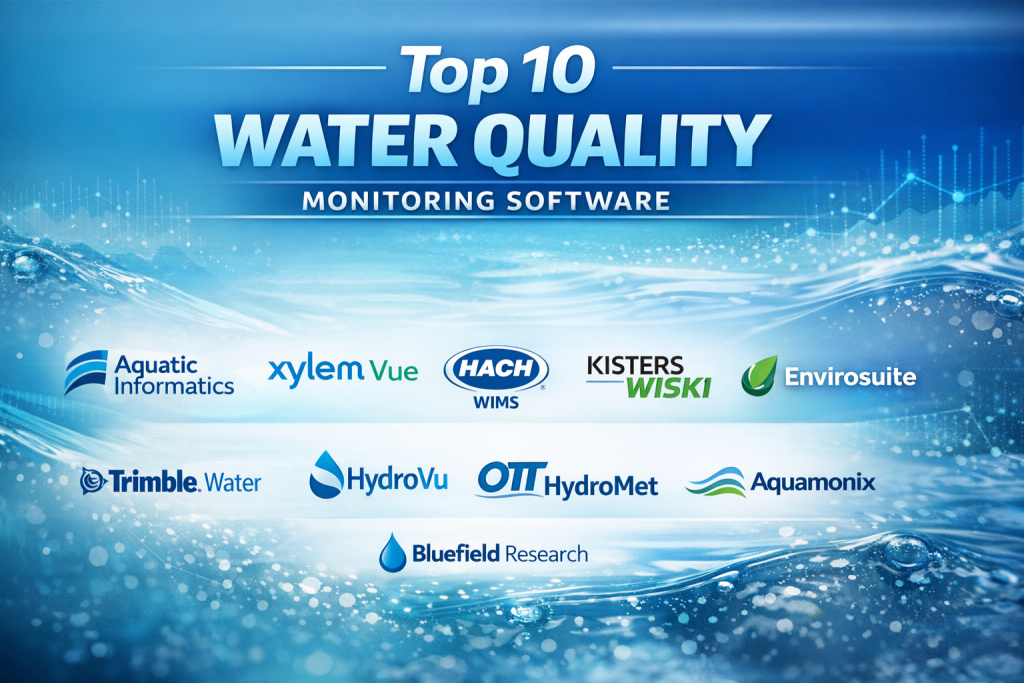
Top 10 Water Quality Monitoring Software Tools
1 — Aquatic Informatics
Short description:
A comprehensive water data management platform designed for utilities, regulators, and environmental organizations handling complex, long-term datasets.
Key features
- Centralized water quality data management
- Time-series analysis and trend detection
- Advanced visualization and dashboards
- Automated reporting and compliance workflows
- Integration with SCADA and sensors
- Quality control and validation tools
Pros
- Excellent for large, complex datasets
- Strong compliance and reporting capabilities
Cons
- Steeper learning curve
- Higher cost for small teams
Security & compliance:
Enterprise-grade security, role-based access, audit logs, GDPR support.
Support & community:
Strong documentation, enterprise onboarding, dedicated support teams.
2 — Xylem Vue
Short description:
An integrated analytics platform combining IoT, analytics, and AI for utilities managing water and wastewater systems.
Key features
- Real-time sensor and IoT integration
- Predictive analytics for water quality events
- GIS-enabled dashboards
- Cloud-based data aggregation
- Alerting and anomaly detection
- Multi-site scalability
Pros
- Powerful predictive insights
- Ideal for smart water initiatives
Cons
- Requires strong data maturity
- Premium pricing
Security & compliance:
Encryption, SSO support, ISO-aligned security practices.
Support & community:
Enterprise support, training programs, strong vendor backing.
3 — Hach WIMS
Short description:
A widely adopted water information management system focused on compliance, laboratory data, and regulatory reporting.
Key features
- Laboratory and field data management
- Automated compliance reports
- Instrument and sensor integration
- Custom workflows and validation
- Historical trend analysis
- Regulatory rule libraries
Pros
- Strong regulatory focus
- Trusted by utilities worldwide
Cons
- Interface feels dated
- Limited advanced analytics
Security & compliance:
Audit trails, role-based access, compliance-ready architecture.
Support & community:
Extensive documentation, global support network.
4 — KISTERS WISKI
Short description:
A robust platform for hydrological and water quality data management, used by environmental agencies and researchers.
Key features
- Time-series water quality data handling
- Multi-source data ingestion
- Advanced analytics and modeling
- Customizable dashboards
- Long-term archival storage
Pros
- Excellent for scientific and research use
- Highly configurable
Cons
- Complex setup
- Requires technical expertise
Security & compliance:
Configurable security controls, audit support.
Support & community:
Professional services, strong user community in research sectors.
5 — Envirosuite
Short description:
A real-time environmental intelligence platform focusing on proactive monitoring and community impact reduction.
Key features
- Real-time water quality monitoring
- Predictive modeling
- Incident and risk management
- Stakeholder reporting dashboards
- Cloud-native deployment
Pros
- Proactive and predictive approach
- Strong visualization
Cons
- Less suitable for lab-heavy workflows
- Subscription cost
Security & compliance:
Cloud security best practices, GDPR-aligned.
Support & community:
Responsive support, onboarding assistance.
6 — Trimble Water
Short description:
A utility-focused solution combining water quality monitoring with asset and network management.
Key features
- Integrated water quality and network data
- GIS-driven insights
- Asset and sensor management
- Field mobility tools
- Reporting and analytics
Pros
- Strong utility integration
- Field-friendly tools
Cons
- Primarily utility-centric
- Limited flexibility for research use
Security & compliance:
Enterprise security, access controls.
Support & community:
Utility-focused support and training.
7 — Hydrovu
Short description:
A cloud-based platform specializing in real-time surface and groundwater quality monitoring.
Key features
- Real-time sensor connectivity
- Interactive dashboards
- Automated alerts
- Data sharing and export
- Easy deployment
Pros
- Very user-friendly
- Fast setup
Cons
- Limited advanced analytics
- Smaller enterprise feature set
Security & compliance:
Cloud security, encrypted data transfer.
Support & community:
Good documentation, responsive support.
8 — OTT Hydromet
Short description:
A professional solution focused on hydrological and water quality monitoring hardware and software integration.
Key features
- Seamless sensor integration
- Reliable data logging
- Environmental monitoring focus
- Long-term data storage
- Visualization tools
Pros
- High data reliability
- Strong hardware compatibility
Cons
- Less modern UI
- Limited customization
Security & compliance:
Standard enterprise security controls.
Support & community:
Global support network, training resources.
9 — Aquamonix
Short description:
An analytics-driven platform designed for industrial water and wastewater optimization.
Key features
- Industrial process analytics
- Real-time performance monitoring
- AI-driven insights
- Cost and efficiency optimization
- Custom dashboards
Pros
- Strong industrial focus
- Actionable optimization insights
Cons
- Narrower use case
- Not ideal for regulators
Security & compliance:
Enterprise security, data encryption.
Support & community:
Dedicated industrial support teams.
10 — Bluefield Research
Short description:
A data and intelligence platform providing insights into water quality trends, markets, and technology adoption.
Key features
- Market and performance analytics
- Water quality benchmarking
- Data visualization
- Strategic insights
- Reporting tools
Pros
- Strong strategic perspective
- Useful for planning and investment
Cons
- Not an operational monitoring tool
- Limited sensor integration
Security & compliance:
Varies / N/A.
Support & community:
Analyst-driven support, research reports.
Comparison Table
| Tool Name | Best For | Platform(s) Supported | Standout Feature | Rating |
|---|---|---|---|---|
| Aquatic Informatics | Utilities & regulators | Web, Cloud | Advanced compliance reporting | N/A |
| Xylem Vue | Smart water utilities | Cloud | Predictive analytics | N/A |
| Hach WIMS | Compliance-driven utilities | Web, On-prem | Regulatory automation | N/A |
| KISTERS WISKI | Researchers & agencies | Web, Server | Scientific data modeling | N/A |
| Envirosuite | Proactive monitoring | Cloud | Predictive risk modeling | N/A |
| Trimble Water | Utilities | Web, Mobile | GIS integration | N/A |
| Hydrovu | Rapid deployments | Cloud | Ease of use | N/A |
| OTT Hydromet | Environmental monitoring | Hybrid | Sensor reliability | N/A |
| Aquamonix | Industrial operators | Cloud | Efficiency optimization | N/A |
| Bluefield Research | Strategy & planning | Web | Market intelligence | N/A |
Evaluation & Scoring of Water Quality Monitoring Software
| Criteria | Weight | Description |
|---|---|---|
| Core features | 25% | Monitoring, analytics, reporting depth |
| Ease of use | 15% | UI, onboarding, learning curve |
| Integrations & ecosystem | 15% | Sensors, SCADA, GIS, APIs |
| Security & compliance | 10% | Access control, audits, standards |
| Performance & reliability | 10% | Data accuracy, uptime |
| Support & community | 10% | Documentation, vendor support |
| Price / value | 15% | Cost vs benefits |
Which Water Quality Monitoring Software Tool Is Right for You?
- Solo users & small teams: Look for easy-to-deploy, cloud-based tools like Hydrovu.
- SMBs & mid-market: Platforms balancing usability and analytics such as Envirosuite are ideal.
- Enterprise & utilities: Robust systems like Aquatic Informatics or Xylem Vue handle scale and compliance.
- Budget-conscious buyers: Focus on essential monitoring features and avoid over-complex platforms.
- High-compliance environments: Prioritize audit logs, validation, and reporting automation.
Frequently Asked Questions (FAQs)
1. What is water quality monitoring software?
It is a digital platform that collects and analyzes water quality data from sensors, labs, and field measurements.
2. Do these tools work in real time?
Most modern platforms support real-time or near real-time monitoring and alerts.
3. Are they suitable for drinking water utilities?
Yes, many are specifically designed for drinking water compliance and safety.
4. Can they integrate with sensors?
Most support common water quality sensors and IoT devices.
5. How secure is water quality data?
Enterprise platforms offer encryption, access controls, and audit logs.
6. Are cloud solutions reliable?
Yes, provided they follow strong security and uptime practices.
7. Do small teams need such tools?
Only if continuous monitoring or compliance reporting is required.
8. Can they help with regulatory reporting?
Yes, many automate compliance and regulatory submissions.
9. Are these tools expensive?
Costs vary widely based on scale, features, and deployment model.
10. What is the biggest mistake buyers make?
Choosing overly complex software without matching their actual needs.
Conclusion
Water Quality Monitoring Software is essential for ensuring safe water, regulatory compliance, and environmental protection. The right platform transforms complex data into clear, actionable insights, helping organizations respond faster and make better decisions.
There is no single “best” solution for everyone. Utilities, industries, researchers, and regulators all have different priorities—from ease of use to advanced analytics and compliance depth. By aligning your choice with your specific goals, scale, and regulatory requirements, you can select a tool that delivers long-term value and confidence in water quality management.

Find Trusted Cardiac Hospitals
Compare heart hospitals by city and services — all in one place.
Explore Hospitals
This is a very informative and practical comparison of water quality monitoring software! Breaking down the key features, strengths, and limitations of each platform makes it much easier for environmental professionals, researchers, and facility managers to choose the right tool for their monitoring needs. With clean water becoming an increasingly critical priority, insights like these help readers make informed decisions about technology that can improve data accuracy, reporting, and overall environmental outcomes. Thanks for putting together such a clear and helpful guide!