
Introduction
Environmental, Social, and Governance (ESG) reporting platforms have become essential tools for organizations navigating today’s sustainability-focused business landscape. These platforms help companies collect, analyze, manage, and disclose ESG data in a structured and auditable way, aligned with global frameworks and regulatory expectations.
As investors, regulators, customers, and employees increasingly demand transparency, ESG reporting is no longer optional. It plays a critical role in risk management, regulatory compliance, investor relations, brand trust, and long-term value creation. Manual spreadsheets and fragmented data sources are no longer sufficient to meet these expectations at scale.
Real-world use cases include:
- Preparing ESG and sustainability reports aligned with GRI, SASB, TCFD, CSRD, and other frameworks
- Tracking carbon emissions, workforce diversity, and governance metrics
- Responding to investor ESG questionnaires and ratings agencies
- Supporting compliance with evolving ESG regulations across regions
When choosing an ESG reporting platform, buyers should evaluate data coverage, reporting flexibility, framework support, automation, audit readiness, security, scalability, and usability. The right platform simplifies compliance while enabling strategic sustainability decisions.
Best for:
ESG reporting platforms are ideal for mid-market and enterprise organizations, sustainability teams, compliance officers, finance leaders, investor relations teams, and ESG consultants across industries such as manufacturing, energy, finance, technology, healthcare, and retail.
Not ideal for:
Very small businesses with minimal regulatory exposure, early-stage startups without formal ESG programs, or organizations seeking only basic carbon calculations may find these platforms more complex than necessary.
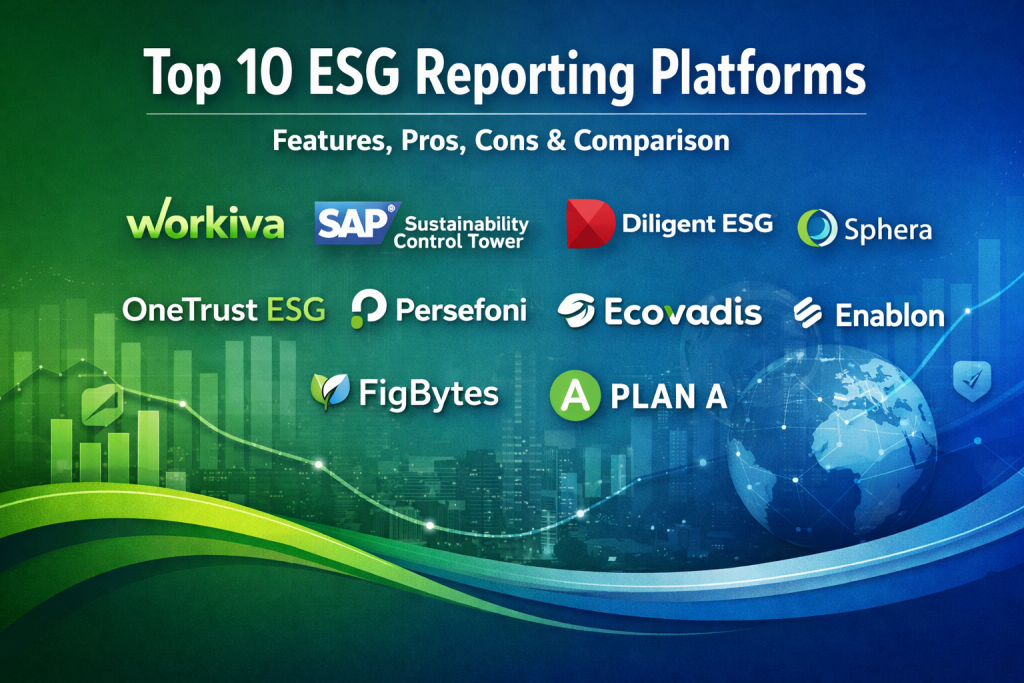
Top 10 ESG Reporting Platforms Tools
1 — Workiva
Short description:
Workiva offers a connected reporting platform that integrates ESG, financial, and risk data into a single collaborative environment, designed primarily for large enterprises and regulated industries.
Key features:
- ESG and financial reporting in a unified platform
- Strong support for regulatory disclosures
- Collaborative workflows with version control
- Automated data linking and validation
- Audit-ready reporting and traceability
- Role-based access and approvals
Pros:
- Excellent data integrity and audit readiness
- Strong alignment with enterprise reporting needs
Cons:
- Premium pricing
- Steeper learning curve for smaller teams
Security & compliance: SOC 2, GDPR, encryption at rest and in transit, SSO, audit logs
Support & community: Enterprise-grade onboarding, strong documentation, dedicated customer success teams
2 — SAP Sustainability Control Tower
Short description:
SAP Sustainability Control Tower integrates ESG metrics into SAP’s broader enterprise ecosystem, ideal for organizations already running SAP systems.
Key features:
- ESG KPI tracking across operations
- Integration with SAP ERP and analytics tools
- Carbon and sustainability metrics monitoring
- Real-time dashboards and insights
- Framework-aligned ESG reporting
Pros:
- Deep integration with SAP environments
- Scalable for global enterprises
Cons:
- Best suited for SAP-centric organizations
- Configuration complexity
Security & compliance: Enterprise-grade SAP security, GDPR, ISO standards
Support & community: Extensive SAP documentation, partner ecosystem, enterprise support
3 — Diligent ESG
Short description:
Diligent ESG combines governance, risk, and ESG reporting, focusing on board-level visibility and compliance-driven organizations.
Key features:
- ESG data collection and benchmarking
- Board-level dashboards and insights
- Risk and compliance integration
- Framework-aligned reporting tools
- Workflow and approval management
Pros:
- Strong governance focus
- Clear executive-level reporting
Cons:
- Less flexible for highly customized ESG metrics
- Premium pricing
Security & compliance: SOC 2, GDPR, role-based security
Support & community: Professional onboarding, strong customer support, governance community
4 — Sphera
Short description:
Sphera delivers ESG, risk, and sustainability performance management solutions, with strong roots in EHS and operational risk.
Key features:
- ESG and sustainability performance tracking
- Risk and compliance integration
- Carbon and environmental data management
- Regulatory reporting support
- Analytics and benchmarking
Pros:
- Strong environmental and risk expertise
- Suitable for complex industrial operations
Cons:
- Interface can feel complex
- Implementation effort required
Security & compliance: ISO standards, GDPR, enterprise security controls
Support & community: Industry-focused support, structured onboarding
5 — Enablon
Short description:
Enablon provides a comprehensive ESG and sustainability management platform, widely used by large multinational organizations.
Key features:
- ESG data management and reporting
- Health, safety, and environmental tracking
- Compliance management workflows
- Audit trails and reporting automation
- Customizable dashboards
Pros:
- Broad ESG and EHS coverage
- Trusted by global enterprises
Cons:
- Higher cost
- Longer deployment timelines
Security & compliance: SOC 2, GDPR, ISO, audit logs
Support & community: Enterprise-level support, extensive training resources
6 — OneTrust ESG
Short description:
OneTrust ESG extends OneTrust’s governance and compliance capabilities into ESG data management and disclosures.
Key features:
- ESG data collection and assessments
- Integration with risk and privacy tools
- Framework mapping and reporting
- Workflow automation
- Executive dashboards
Pros:
- Strong governance and compliance DNA
- Flexible integration options
Cons:
- ESG features still evolving
- Can be complex for non-compliance teams
Security & compliance: SOC 2, GDPR, SSO, encryption
Support & community: Extensive documentation, active user community, enterprise support
7 — Persefoni
Short description:
Persefoni focuses heavily on carbon accounting while supporting broader ESG reporting for finance and sustainability teams.
Key features:
- Carbon footprint measurement and reporting
- Financial-grade ESG data controls
- Regulatory and disclosure alignment
- Data validation and audit trails
- Analytics and scenario modeling
Pros:
- Strong carbon accounting accuracy
- Finance-friendly design
Cons:
- Less comprehensive for social metrics
- Premium pricing
Security & compliance: SOC 2, GDPR, encryption
Support & community: High-touch onboarding, expert support
8 — EcoVadis
Short description:
EcoVadis is widely known for ESG ratings and supplier sustainability assessments, often used in supply-chain-driven ESG programs.
Key features:
- ESG ratings and benchmarking
- Supplier sustainability assessments
- Action plans and scorecards
- Global methodology coverage
- Reporting insights
Pros:
- Strong third-party credibility
- Excellent for supply-chain ESG
Cons:
- Limited customization
- Less suited for internal ESG reporting
Security & compliance: GDPR, secure data handling
Support & community: Global support network, partner ecosystem
9 — FigBytes
Short description:
FigBytes provides a flexible ESG and sustainability reporting platform suitable for mid-market and enterprise organizations.
Key features:
- ESG data management and dashboards
- Framework-aligned reporting
- KPI tracking and analytics
- Custom metrics and workflows
- Visualization tools
Pros:
- User-friendly interface
- Good balance of flexibility and structure
Cons:
- Smaller ecosystem than larger vendors
- Advanced customization may require support
Security & compliance: GDPR, role-based access, encryption
Support & community: Responsive support, guided onboarding
10 — Plan A
Short description:
Plan A combines carbon accounting with ESG performance management, targeting companies focused on climate and sustainability transformation.
Key features:
- Carbon and ESG data tracking
- Decarbonization planning tools
- Framework-aligned reporting
- Analytics and benchmarking
- Sustainability strategy support
Pros:
- Strong climate-focused capabilities
- Intuitive user experience
Cons:
- Less comprehensive governance features
- Best for sustainability-driven teams
Security & compliance: GDPR, encryption, standard SaaS controls
Support & community: Hands-on onboarding, sustainability expertise
Comparison Table
| Tool Name | Best For | Platform(s) Supported | Standout Feature | Rating |
|---|---|---|---|---|
| Workiva | Large enterprises | Web | Audit-ready ESG + financial reporting | N/A |
| SAP Sustainability Control Tower | SAP users | Web | Deep ERP integration | N/A |
| Diligent ESG | Governance-focused orgs | Web | Board-level ESG insights | N/A |
| Sphera | Industrial enterprises | Web | ESG + risk management | N/A |
| Enablon | Multinationals | Web | Comprehensive ESG & EHS | N/A |
| OneTrust ESG | Compliance-driven teams | Web | Governance and ESG integration | N/A |
| Persefoni | Finance & carbon teams | Web | Financial-grade carbon data | N/A |
| EcoVadis | Supply-chain ESG | Web | ESG ratings and benchmarking | N/A |
| FigBytes | Mid-market to enterprise | Web | Flexible ESG dashboards | N/A |
| Plan A | Climate-focused companies | Web | Decarbonization planning | N/A |
Evaluation & Scoring of ESG Reporting Platforms
| Evaluation Criteria | Weight | Description |
|---|---|---|
| Core features | 25% | ESG data coverage, frameworks, reporting depth |
| Ease of use | 15% | UI clarity, onboarding, usability |
| Integrations & ecosystem | 15% | ERP, data sources, APIs |
| Security & compliance | 10% | Certifications, controls, auditability |
| Performance & reliability | 10% | Scalability and system stability |
| Support & community | 10% | Documentation, training, support quality |
| Price / value | 15% | Cost vs features and ROI |
Which ESG Reporting Platforms Tool Is Right for You?
- Solo users: Lightweight ESG or carbon-only tools may be sufficient
- SMBs: Look for user-friendly platforms with flexible pricing and core ESG coverage
- Mid-market: Balance ease of use with framework support and integrations
- Enterprise: Prioritize scalability, audit readiness, and governance features
Budget-conscious vs premium:
Lower-cost tools work for early ESG programs, while premium platforms offer automation, assurance, and global compliance.
Feature depth vs ease of use:
Advanced platforms deliver power but require training; simpler tools enable faster adoption.
Integration and scalability:
ERP and data integration is critical for large, distributed organizations.
Security and compliance:
Highly regulated industries should prioritize certifications, audit logs, and access controls.
Frequently Asked Questions (FAQs)
1. What is an ESG reporting platform?
It is software that helps organizations collect, manage, analyze, and disclose ESG data in line with recognized frameworks.
2. Are ESG reporting platforms mandatory?
They are not universally mandatory, but regulations and investor expectations increasingly require formal ESG disclosures.
3. How long does implementation take?
It can range from a few weeks for simpler tools to several months for enterprise platforms.
4. Do these tools support global ESG frameworks?
Most leading platforms support major global frameworks and standards.
5. Are ESG platforms secure?
Reputable vendors implement strong security controls, encryption, and compliance certifications.
6. Can ESG data be audited?
Yes, many platforms provide audit trails and validation features.
7. Are they suitable for SMEs?
Some platforms are SME-friendly, while others are designed for large enterprises.
8. Do they include carbon accounting?
Many platforms include carbon tracking, though depth varies.
9. What are common implementation mistakes?
Underestimating data complexity and lack of internal ownership are common pitfalls.
10. Can ESG platforms improve decision-making?
Yes, they provide insights that support risk management and strategic planning.
Conclusion
ESG reporting platforms play a vital role in helping organizations meet sustainability expectations, regulatory requirements, and stakeholder demands. The best tools combine robust data management, reporting accuracy, security, and usability while supporting long-term ESG strategy.
There is no single “best” ESG reporting platform for everyone. The right choice depends on organization size, industry, regulatory exposure, budget, and maturity of ESG programs. By aligning platform capabilities with specific needs, companies can turn ESG reporting from a compliance burden into a strategic advantage.

Find Trusted Cardiac Hospitals
Compare heart hospitals by city and services — all in one place.
Explore Hospitals
