
Introduction
Robotics Vision Inspection Tools are specialized software platforms that enable robots and automated systems to see, interpret, and make decisions based on visual data. By combining industrial cameras, sensors, AI-powered vision algorithms, and robotics control systems, these tools allow machines to inspect parts, detect defects, guide robotic arms, verify assembly accuracy, and ensure consistent product quality at scale.
In modern manufacturing, logistics, electronics, automotive, pharmaceuticals, and semiconductor industries, manual inspection is no longer fast, accurate, or scalable enough. Vision inspection tools help organizations reduce human error, increase throughput, improve traceability, and maintain strict quality standards—especially in high-speed or high-precision environments.
Key real-world use cases include:
- Automated defect detection on production lines
- Robotic guidance and part alignment
- Surface inspection and measurement
- Barcode, QR, and text recognition
- Assembly verification and missing-part detection
What to look for when choosing Robotics Vision Inspection Tools:
- Accuracy and reliability under real production conditions
- AI/ML capabilities vs traditional rule-based vision
- Integration with robots, PLCs, MES, and factory systems
- Ease of deployment and ongoing maintenance
- Scalability, performance, and security
Best for:
Robotics Vision Inspection Tools are ideal for manufacturing engineers, quality managers, automation teams, system integrators, and enterprises operating high-volume or precision-driven production environments such as automotive, electronics, medical devices, food processing, and logistics.
Not ideal for:
These tools may not be suitable for small workshops, low-volume manual production, or businesses without automation infrastructure, where simpler visual checks or human inspection may be more cost-effective.
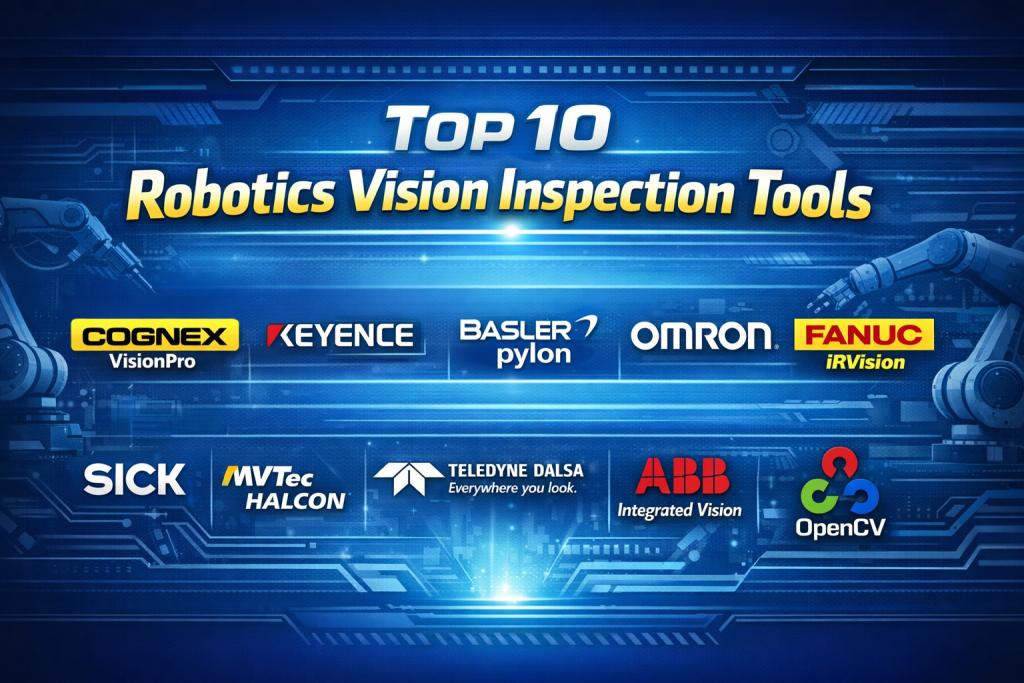
Top 10 Robotics Vision Inspection Tools
1 — Cognex VisionPro
Short description:
A leading industrial vision software platform designed for high-precision inspection, measurement, and robot guidance in complex manufacturing environments.
Key features
- Advanced pattern matching and defect detection
- AI-based deep learning vision tools
- High-speed image processing for production lines
- Robust calibration and measurement capabilities
- Seamless integration with industrial robots and PLCs
- Support for 2D and 3D vision systems
Pros
- Extremely high accuracy and reliability
- Proven performance in demanding industrial settings
- Strong ecosystem and hardware compatibility
Cons
- Premium pricing
- Requires skilled engineers for optimal setup
Security & compliance:
Enterprise-grade access control, encrypted data handling, varies by deployment.
Support & community:
Excellent documentation, strong enterprise support, certified training programs.
2 — Keyence Vision Systems
Short description:
An all-in-one vision inspection solution combining hardware and software for fast deployment on factory floors.
Key features
- Pre-configured inspection tools
- High-speed cameras with built-in lighting
- AI-assisted defect detection
- Simple drag-and-drop configuration
- Real-time inspection feedback
- Compact industrial design
Pros
- Very easy to deploy
- Minimal tuning required
- Strong performance in standardized tasks
Cons
- Less flexible for custom workflows
- Vendor-locked ecosystem
Security & compliance:
N/A (primarily on-premise industrial use).
Support & community:
Strong field support, fast onboarding, limited community forums.
3 — Basler pylon Vision Software
Short description:
A flexible vision software framework optimized for Basler industrial cameras and robotic vision applications.
Key features
- High-performance image acquisition
- Extensive camera control features
- Compatibility with multiple vision libraries
- Real-time image streaming
- Customizable inspection pipelines
Pros
- Excellent camera performance
- Highly customizable
- Cost-effective for advanced setups
Cons
- Requires third-party vision libraries
- Steeper learning curve
Security & compliance:
Varies / N/A.
Support & community:
Good technical documentation, active developer community.
4 — Omron Sysmac Vision
Short description:
A robotics-focused vision inspection platform tightly integrated with Omron automation and control systems.
Key features
- Seamless PLC and robot integration
- High-speed inspection execution
- Advanced positioning and alignment tools
- Multi-camera synchronization
- Real-time defect classification
Pros
- Excellent for Omron-based factories
- Reliable real-time performance
- Strong automation integration
Cons
- Limited outside Omron ecosystems
- Less AI depth compared to newer platforms
Security & compliance:
Industrial access controls, varies by deployment.
Support & community:
Strong enterprise support, training programs available.
5 — FANUC iRVision
Short description:
A native robotic vision solution designed specifically for FANUC industrial robots.
Key features
- Direct robot controller integration
- 2D and 3D vision guidance
- Pick-and-place optimization
- Easy calibration workflows
- Real-time robot correction
Pros
- Seamless FANUC robot integration
- High reliability in robotic guidance
- Minimal latency
Cons
- Limited to FANUC robots
- Less suitable for non-robot inspection tasks
Security & compliance:
N/A (robot controller-based).
Support & community:
Strong vendor support, limited open community.
6 — SICK Visionary Solutions
Short description:
A vision inspection and sensing platform optimized for logistics, safety, and industrial automation.
Key features
- 3D vision and depth sensing
- Object detection and tracking
- Safety-rated vision capabilities
- Integration with AGVs and AMRs
- Real-time environment mapping
Pros
- Excellent for logistics and robotics navigation
- Strong safety focus
- Reliable industrial-grade sensors
Cons
- Less focused on micro-defect inspection
- Higher hardware dependency
Security & compliance:
Industrial safety standards, varies by application.
Support & community:
Strong documentation and enterprise support.
7 — MVTec HALCON
Short description:
A powerful machine vision library widely used for complex inspection, measurement, and robotics applications.
Key features
- Advanced image processing algorithms
- AI and deep learning support
- Multi-platform deployment
- High-performance real-time processing
- Extensive customization options
Pros
- Extremely powerful and flexible
- Industry-proven algorithms
- Scales well for complex systems
Cons
- Requires experienced vision engineers
- Licensing can be expensive
Security & compliance:
Varies / N/A.
Support & community:
Excellent documentation, active professional community.
8 — Teledyne DALSA Sherlock
Short description:
A vision inspection software designed for high-speed manufacturing inspection and quality control.
Key features
- Rule-based and AI inspection tools
- Multi-camera inspection support
- Measurement and defect classification
- Real-time production feedback
- Flexible deployment options
Pros
- High-speed inspection performance
- Reliable for repetitive tasks
- Strong industrial focus
Cons
- UI can feel dated
- Limited low-code capabilities
Security & compliance:
Varies / N/A.
Support & community:
Good enterprise support, limited community presence.
9 — ABB Integrated Vision
Short description:
A robotic vision solution embedded into ABB’s robot and automation ecosystem.
Key features
- Direct robot vision control
- 2D/3D vision integration
- Calibration and guidance tools
- Real-time robotic feedback
- Seamless automation workflows
Pros
- Excellent ABB robot compatibility
- Stable and reliable
- Simplified robotic vision setup
Cons
- Limited cross-platform use
- Less AI-driven inspection
Security & compliance:
Industrial access control, varies by system.
Support & community:
Strong enterprise support, ABB ecosystem users.
10 — OpenCV (Industrial Robotics Use)
Short description:
An open-source computer vision framework widely used as a foundation for custom robotics vision inspection systems.
Key features
- Extensive image processing algorithms
- AI and deep learning integration
- Multi-platform support
- Highly customizable pipelines
- Large open-source ecosystem
Pros
- No licensing cost
- Extremely flexible
- Strong global community
Cons
- Requires significant development effort
- No built-in industrial compliance features
Security & compliance:
N/A (depends on implementation).
Support & community:
Very large community, extensive documentation.
Comparison Table
| Tool Name | Best For | Platform(s) Supported | Standout Feature | Rating |
|---|---|---|---|---|
| Cognex VisionPro | High-precision manufacturing | Windows, Industrial PCs | Industry-leading accuracy | N/A |
| Keyence Vision Systems | Fast deployment factories | Embedded / Industrial | Plug-and-play inspection | N/A |
| Basler pylon | Custom vision systems | Windows, Linux | Camera-level control | N/A |
| Omron Sysmac Vision | Omron automation users | Industrial controllers | PLC integration | N/A |
| FANUC iRVision | FANUC robot users | Robot controllers | Native robot vision | N/A |
| SICK Visionary | Logistics & navigation | Industrial systems | 3D safety vision | N/A |
| MVTec HALCON | Complex vision projects | Windows, Linux | Advanced algorithms | N/A |
| Teledyne DALSA Sherlock | High-speed inspection | Windows | Production QC | N/A |
| ABB Integrated Vision | ABB robot environments | Robot controllers | Embedded robotics vision | N/A |
| OpenCV | Custom AI solutions | Cross-platform | Open-source flexibility | N/A |
Evaluation & Scoring of Robotics Vision Inspection Tools
| Evaluation Criteria | Weight | Description |
|---|---|---|
| Core features | 25% | Inspection accuracy, vision algorithms |
| Ease of use | 15% | Setup, configuration, usability |
| Integrations & ecosystem | 15% | Robots, PLCs, MES compatibility |
| Security & compliance | 10% | Industrial access, data safety |
| Performance & reliability | 10% | Speed, uptime, stability |
| Support & community | 10% | Documentation, vendor support |
| Price / value | 15% | Cost vs delivered value |
Which Robotics Vision Inspection Tools Tool Is Right for You?
- Solo users & startups: OpenCV-based systems for flexibility and low cost
- SMBs: Keyence or Basler for faster deployment with customization
- Mid-market: Cognex, HALCON, or Omron for scalable inspection
- Enterprise: Cognex, ABB, FANUC for mission-critical automation
Budget-conscious: Open-source or modular systems
Premium solutions: Enterprise-grade industrial vision platforms
Choose feature depth if accuracy is critical; choose ease of use if deployment speed matters. Integration and security become essential as systems scale.
Frequently Asked Questions (FAQs)
1. What is robotics vision inspection?
It enables robots to visually inspect, measure, and make decisions using cameras and vision software.
2. Is AI necessary for vision inspection?
AI improves defect detection but traditional rule-based vision still works for stable processes.
3. Can these tools work in real-time?
Yes, most are designed for real-time industrial environments.
4. Do I need programming skills?
Low-code tools require minimal skills; advanced platforms need vision expertise.
5. Are these tools hardware-dependent?
Many integrate tightly with specific cameras or robots.
6. How accurate are robotics vision systems?
Accuracy can exceed human inspection when properly configured.
7. Are they expensive?
Costs vary from free (OpenCV) to premium enterprise licenses.
8. Can they integrate with MES or ERP?
Yes, most enterprise tools support industrial integrations.
9. What industries use them most?
Manufacturing, automotive, electronics, pharma, logistics.
10. What’s the biggest implementation mistake?
Underestimating lighting, calibration, and real-world variability.
Conclusion
Robotics Vision Inspection Tools play a critical role in modern automation, enabling faster, more accurate, and more reliable quality control than manual inspection. From open-source frameworks to enterprise-grade platforms, the market offers solutions for every scale and complexity.
What matters most is alignment with your specific needs—robot compatibility, accuracy requirements, deployment speed, budget, and long-term scalability. There is no single universal winner; the best tool is the one that fits your operational reality and growth plans.
By carefully evaluating your use cases and constraints, you can select a robotics vision inspection solution that delivers lasting value and measurable ROI.

Find Trusted Cardiac Hospitals
Compare heart hospitals by city and services — all in one place.
Explore Hospitals
Great article! I like how you explained the pros and cons of each tool — makes it easier to compare and pick the right one. 😊