
Introduction
Product Traceability Systems are specialized software platforms designed to track products, components, and materials across the entire lifecycle—from raw material sourcing and manufacturing to distribution, retail, and even post-sale recall management. In an era of complex global supply chains, regulatory pressure, and rising consumer expectations, traceability is no longer optional—it is a business-critical capability.
These systems help organizations answer essential questions such as: Where did this product come from? What batch or lot does it belong to? Which suppliers were involved? Where has it been shipped? By providing end-to-end visibility, product traceability systems reduce operational risk, improve quality control, enable faster recalls, and support compliance with food safety, pharmaceutical, automotive, and sustainability regulations.
Key real-world use cases include food safety recalls, pharmaceutical serialization, counterfeit prevention, automotive part genealogy, ESG reporting, cold-chain monitoring, and consumer transparency initiatives like QR-based product histories.
When choosing a Product Traceability System, buyers should evaluate data granularity, scalability, integration with ERP and IoT systems, compliance support, usability, reporting depth, and total cost of ownership—not just basic tracking features.
Best for:
Product Traceability Systems are ideal for manufacturers, food & beverage companies, pharmaceuticals, medical devices, automotive suppliers, consumer goods brands, logistics providers, and regulators—from SMBs needing basic lot tracking to enterprises managing global, multi-tier supply chains.
Not ideal for:
These tools may be unnecessary for very small businesses with simple supply chains, service-only companies, or organizations where products are not regulated, serialized, or batch-controlled. In such cases, basic inventory management systems may be sufficient.
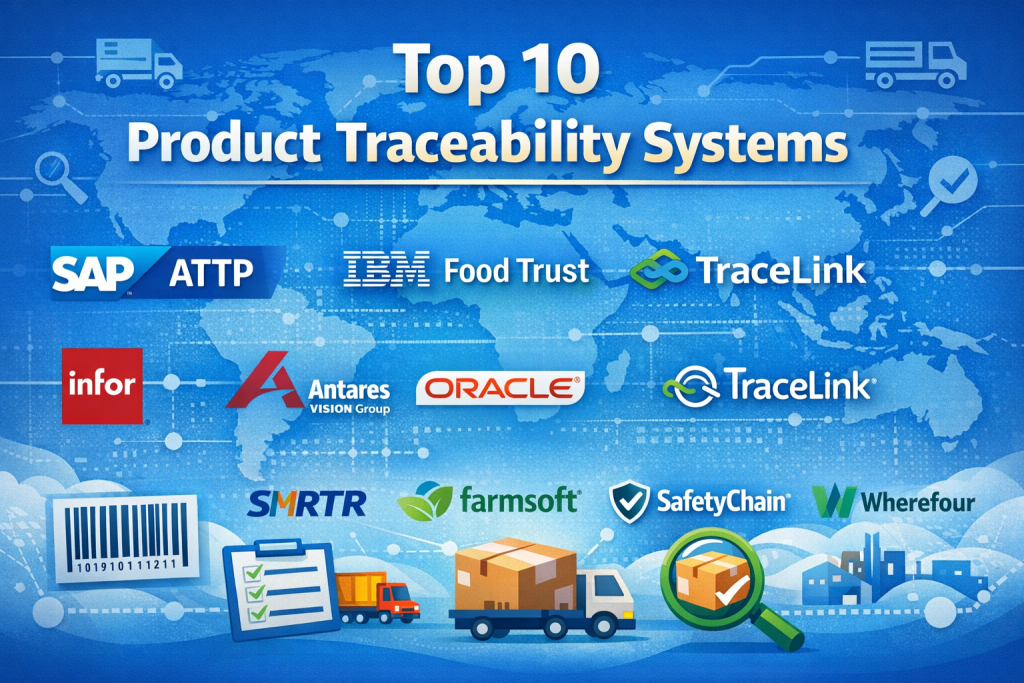
Top 10 Product Traceability Systems Tools
1 — SAP Traceability (SAP ATTP)
Short description:
SAP’s traceability solution provides enterprise-grade product genealogy, serialization, and compliance tracking for highly regulated industries operating at global scale.
Key features:
- End-to-end product genealogy and batch tracking
- Serialization and aggregation management
- Real-time supply chain visibility
- Advanced recall and exception handling
- Integration with SAP ERP and S/4HANA
- Analytics and compliance reporting
Pros:
- Extremely scalable for global enterprises
- Deep integration with SAP ecosystem
Cons:
- High implementation and licensing costs
- Complex setup for smaller teams
Security & compliance:
Strong enterprise security, SSO, role-based access, audit logs, GDPR support, industry-specific compliance.
Support & community:
Extensive documentation, global enterprise support, strong partner ecosystem.
2 — IBM Food Trust
Short description:
A blockchain-based traceability platform designed primarily for food and agriculture supply chains.
Key features:
- Blockchain-backed immutable records
- Farm-to-fork traceability
- Rapid recall execution
- Supplier onboarding workflows
- Data sharing with permission controls
Pros:
- High trust and transparency
- Strong recall speed improvements
Cons:
- Focused mainly on food industry
- Blockchain complexity for some users
Security & compliance:
Enterprise-grade security, blockchain immutability, GDPR-aligned controls.
Support & community:
Good documentation, enterprise support, growing ecosystem in food industry.
3 — Oracle Product Traceability
Short description:
An enterprise solution integrated into Oracle SCM for complex manufacturing and regulated supply chains.
Key features:
- Lot and serial traceability
- Supplier and material genealogy
- Compliance and recall management
- ERP and SCM integration
- Advanced analytics
Pros:
- Powerful for large-scale operations
- Strong analytics and reporting
Cons:
- Steep learning curve
- Higher cost structure
Security & compliance:
Strong enterprise security, role-based access, audit logs, compliance reporting.
Support & community:
Robust enterprise support, extensive documentation.
4 — TraceLink
Short description:
A cloud-based traceability and compliance network focused on life sciences and pharmaceuticals.
Key features:
- Serialization and DSCSA compliance
- Partner network connectivity
- Supply chain visibility dashboards
- Exception and recall management
- Cloud-native deployment
Pros:
- Industry-specific expertise
- Faster partner onboarding
Cons:
- Limited outside life sciences
- Network dependency
Security & compliance:
Strong compliance focus (GDPR, pharmaceutical regulations), audit trails, access controls.
Support & community:
Strong onboarding, dedicated support, active pharma community.
5— Infor Traceability
Short description:
A manufacturing-focused traceability solution embedded within Infor’s ERP and MES ecosystem.
Key features:
- Lot and serial tracking
- Manufacturing genealogy
- Quality and compliance integration
- Recall and audit reporting
- MES and ERP connectivity
Pros:
- Strong manufacturing depth
- Good ERP integration
Cons:
- Best suited to Infor users
- UI less modern than newer tools
Security & compliance:
Enterprise security, compliance reporting, role-based access.
Support & community:
Solid documentation, enterprise support options.
6 — Antares Vision Group
Short description:
A specialized traceability and inspection platform widely used in pharmaceuticals and packaged goods.
Key features:
- Serialization and aggregation
- Vision inspection integration
- Track-and-trace compliance
- Anti-counterfeiting tools
- Global regulatory support
Pros:
- Deep regulatory expertise
- Strong inspection integration
Cons:
- Narrower industry focus
- Higher setup complexity
Security & compliance:
High compliance coverage, audit logs, secure data handling.
Support & community:
Dedicated enterprise support, strong pharma presence.
7 — SMRTR
Short description:
A compliance and traceability platform designed for food, beverage, and distribution industries.
Key features:
- Supplier and batch traceability
- Compliance automation
- Labeling and documentation
- Recall management
- ERP integration
Pros:
- Practical compliance automation
- Industry-aligned workflows
Cons:
- Limited outside food & distribution
- Smaller ecosystem
Security & compliance:
Compliance-focused controls, audit trails, role-based access.
Support & community:
Good customer support, focused industry expertise.
8 — Farmsoft
Short description:
A traceability and compliance solution for agriculture, food production, and sustainability reporting.
Key features:
- Farm and batch traceability
- Compliance record management
- Sustainability and ESG reporting
- Supplier documentation
- Audit readiness tools
Pros:
- Strong agricultural focus
- Easy-to-use compliance records
Cons:
- Limited enterprise scalability
- Fewer integrations
Security & compliance:
Basic security controls, compliance-focused features.
Support & community:
Good documentation, responsive support for SMBs.
9 — SafetyChain
Short description:
A food safety and traceability platform emphasizing quality management and regulatory compliance.
Key features:
- End-to-end food traceability
- Quality and safety workflows
- Supplier compliance tracking
- Recall readiness tools
- Mobile data capture
Pros:
- Strong food safety focus
- Practical quality workflows
Cons:
- Narrow industry scope
- Less flexible for non-food use
Security & compliance:
Compliance-centric design, audit logs, access controls.
Support & community:
Strong onboarding, food industry expertise.
10 — Wherefour
Short description:
A cloud-based traceability and inventory platform built for food manufacturers and co-packers.
Key features:
- Lot and batch tracking
- Ingredient traceability
- Inventory and production management
- Recall simulation
- Cloud deployment
Pros:
- Easy to implement
- SMB-friendly pricing
Cons:
- Limited enterprise features
- Narrow industry focus
Security & compliance:
Standard cloud security, food compliance support.
Support & community:
Good onboarding, helpful customer support.
Comparison Table
| Tool Name | Best For | Platform(s) Supported | Standout Feature | Rating |
|---|---|---|---|---|
| SAP Traceability | Global enterprises | Cloud / On-prem | Deep ERP integration | N/A |
| IBM Food Trust | Food supply chains | Cloud | Blockchain traceability | N/A |
| Oracle Traceability | Large manufacturers | Cloud / On-prem | Advanced analytics | N/A |
| TraceLink | Life sciences | Cloud | Compliance network | N/A |
| Infor Traceability | Manufacturing | Cloud / On-prem | Manufacturing genealogy | N/A |
| Antares Vision | Pharma & packaging | Cloud / Hybrid | Serialization + inspection | N/A |
| SMRTR | Food & distribution | Cloud | Compliance automation | N/A |
| Farmsoft | Agriculture | Cloud | ESG-ready traceability | N/A |
| SafetyChain | Food safety | Cloud | Quality + traceability | N/A |
| Wherefour | SMB food producers | Cloud | Fast implementation | N/A |
Evaluation & Scoring of Product Traceability Systems
| Criteria | Weight | Description |
|---|---|---|
| Core features | 25% | Depth of tracking, genealogy, recall tools |
| Ease of use | 15% | UI clarity, onboarding speed |
| Integrations & ecosystem | 15% | ERP, IoT, partner connectivity |
| Security & compliance | 10% | Controls, audit readiness |
| Performance & reliability | 10% | Scalability and uptime |
| Support & community | 10% | Documentation and assistance |
| Price / value | 15% | ROI and cost alignment |
Which Product Traceability Systems Tool Is Right for You?
- Solo users & SMBs: Look for cloud-based, easy-to-implement tools with strong lot tracking and recall simulation.
- Mid-market companies: Prioritize ERP integration, compliance reporting, and scalability.
- Enterprises: Focus on global scalability, multi-tier supplier visibility, and advanced analytics.
- Budget-conscious teams: Favor modular pricing and quick deployment.
- Highly regulated industries: Choose platforms with proven compliance, audit logs, and serialization support.
Frequently Asked Questions (FAQs)
1. What is a Product Traceability System?
It is software that tracks products and components across sourcing, production, and distribution.
2. Why is traceability important?
It reduces recall risk, improves quality control, and ensures regulatory compliance.
3. Are these systems required by law?
In many industries like food and pharma, traceability is legally required.
4. How long does implementation take?
From a few weeks for SMB tools to several months for enterprise platforms.
5. Do these tools integrate with ERP systems?
Most enterprise-grade tools support ERP integration.
6. Is blockchain always necessary?
No, blockchain is optional and mainly used for trust and transparency use cases.
7. Can traceability systems help with recalls?
Yes, they significantly reduce recall time and scope.
8. Are cloud-based tools secure?
Yes, when they use proper encryption, access controls, and audits.
9. What industries benefit the most?
Food, pharmaceuticals, manufacturing, automotive, and consumer goods.
10. What is the biggest mistake buyers make?
Choosing tools based only on features, not integration and scalability.
Conclusion
Product Traceability Systems are essential for modern, resilient, and compliant supply chains. They provide visibility, accountability, and confidence in product quality—while reducing risk and operational costs.
The most important factors when choosing a solution are industry fit, scalability, integration depth, compliance readiness, and usability. There is no single “best” tool for everyone—the right choice depends on your organization’s size, regulatory environment, and long-term supply chain strategy.
By aligning technology with real operational needs, businesses can turn traceability from a compliance requirement into a competitive advantage.

Find Trusted Cardiac Hospitals
Compare heart hospitals by city and services — all in one place.
Explore Hospitals
