
Introduction
Medical Device Quality Systems (MDQS) are specialized software platforms designed to help medical device companies manage quality, compliance, and risk across the entire product lifecycle—from design and development to manufacturing, post-market surveillance, and audits. Unlike generic quality tools, these systems are built specifically to meet stringent global regulations such as FDA 21 CFR Part 820, ISO 13485, EU MDR, and MDSAP.
In the real world, MDQS platforms are used to control documents, manage CAPAs, track complaints, handle change management, and ensure audit readiness at all times. With increasing regulatory scrutiny, shorter product cycles, and global supply chains, manual spreadsheets or disconnected tools are no longer sufficient.
When choosing a Medical Device Quality System, buyers should evaluate:
- Regulatory coverage (FDA, ISO, EU MDR readiness)
- Core QMS depth (CAPA, NC, audits, complaints)
- Usability and adoption
- Integration with PLM, ERP, and MES
- Security, validation, and audit trails
- Scalability for future growth
Best for:
Medical Device Quality Systems are ideal for quality managers, regulatory affairs teams, R&D leaders, and operations heads in startups, SMBs, and global enterprises manufacturing Class I–III medical devices.
Not ideal for:
They may be excessive for non-regulated consumer products, very early research labs without commercialization plans, or teams needing only lightweight document storage without compliance obligations.
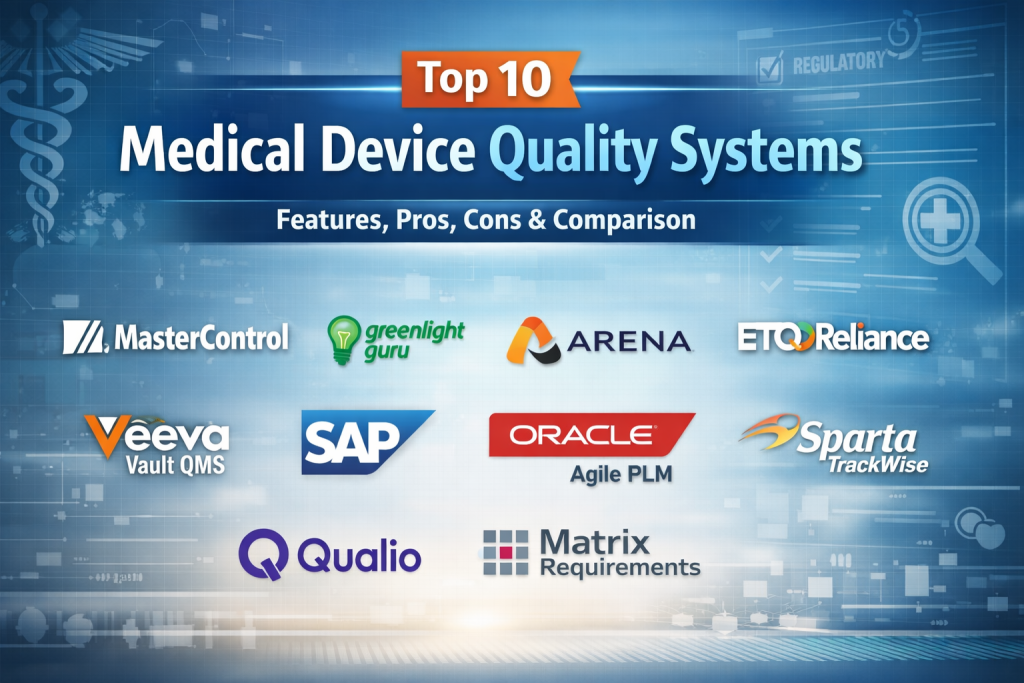
Top 10 Medical Device Quality Systems Tools
1 — MasterControl
Short description:
A comprehensive, enterprise-grade QMS platform widely adopted in regulated life sciences and medical device manufacturing.
Key features:
- End-to-end QMS (CAPA, audits, training, complaints)
- Design controls and DHF management
- Integrated document control with versioning
- Validation-ready workflows
- Advanced analytics and dashboards
- Supplier quality management
Pros:
- Deep regulatory alignment with FDA and ISO
- Highly configurable for complex enterprises
- Strong audit readiness capabilities
Cons:
- Higher cost compared to SMB-focused tools
- Steeper learning curve for new users
Security & compliance:
SOC 2, ISO 27001, encryption at rest/in transit, audit logs, FDA and ISO 13485 support
Support & community:
Enterprise onboarding, strong documentation, dedicated customer success teams
2 — Greenlight Guru
Short description:
A medical-device-first QMS platform built specifically for FDA-regulated product development teams.
Key features:
- Integrated Design Control + QMS
- Risk management aligned with ISO 14971
- DHF automation
- CAPA and complaint handling
- Regulatory guidance built into workflows
Pros:
- Purpose-built for medical devices
- Very intuitive user experience
- Strong support for startups and mid-market teams
Cons:
- Limited customization for very large enterprises
- Fewer non-medical integrations
Security & compliance:
FDA 21 CFR Part 820, ISO 13485, role-based access, audit trails
Support & community:
Highly rated onboarding, responsive support, active customer education programs
3 — Arena QMS
Short description:
A cloud-native QMS closely integrated with product lifecycle management for fast-moving device teams.
Key features:
- Document and change control
- Design history and traceability
- Supplier quality management
- Complaint handling
- Cloud collaboration
Pros:
- Excellent for design-centric teams
- Modern, clean UI
- Faster implementation timelines
Cons:
- Advanced analytics are limited
- Less depth in post-market surveillance
Security & compliance:
ISO 13485 support, encryption, audit trails, role-based permissions
Support & community:
Good documentation, structured onboarding, responsive customer support
4 — ETQ Reliance
Short description:
A flexible enterprise QMS platform used across highly regulated manufacturing industries, including medical devices.
Key features:
- Modular QMS architecture
- CAPA, audits, nonconformance management
- Supplier quality modules
- Workflow customization
- Enterprise reporting
Pros:
- Highly configurable workflows
- Strong cross-industry capabilities
- Scales well for global operations
Cons:
- Configuration complexity
- Requires experienced administrators
Security & compliance:
SOC 2, ISO standards support, audit logs, encryption
Support & community:
Enterprise-level support, training programs, professional services available
5 — Sparta TrackWise
Short description:
A long-standing QMS platform trusted by large regulated manufacturers with complex compliance needs.
Key features:
- CAPA and complaint management
- Audit and inspection readiness
- Change management
- Advanced reporting
- Global compliance support
Pros:
- Proven reliability in regulated environments
- Strong compliance depth
- Suitable for large enterprises
Cons:
- Legacy UI compared to newer tools
- Longer implementation cycles
Security & compliance:
FDA, ISO, GDPR support, robust audit trails, enterprise security controls
Support & community:
Professional support teams, extensive documentation, partner ecosystem
6 — Veeva Vault QMS
Short description:
A modern, cloud-based QMS designed specifically for life sciences and regulated manufacturing.
Key features:
- Unified QMS and document management
- Change control and CAPA
- Regulatory submissions alignment
- Scalable cloud architecture
- Advanced reporting
Pros:
- Strong life sciences focus
- Modern UX and performance
- Seamless scalability
Cons:
- Premium pricing
- Less flexibility outside life sciences
Security & compliance:
SOC 2, ISO 27001, GDPR, audit logs, validated cloud infrastructure
Support & community:
Enterprise support, strong documentation, industry-specific expertise
7 — SAP QM
Short description:
An integrated quality management module within the broader SAP enterprise ecosystem.
Key features:
- Quality planning and inspection
- Nonconformance management
- Supplier quality integration
- ERP-level traceability
- Global compliance support
Pros:
- Deep ERP integration
- Strong scalability
- Ideal for SAP-centric enterprises
Cons:
- Not medical-device-specific out of the box
- Requires significant configuration
Security & compliance:
Enterprise-grade security, ISO standards alignment, audit logs
Support & community:
Extensive global community, partner ecosystem, enterprise support
8 — Oracle Agile PLM
Short description:
A PLM-driven quality and change management solution used by large manufacturers.
Key features:
- Change and configuration management
- Document control
- Product traceability
- Supplier collaboration
- Enterprise reporting
Pros:
- Strong PLM-QMS alignment
- Suitable for complex product portfolios
- Scales globally
Cons:
- Less intuitive UI
- Longer deployment timelines
Security & compliance:
Enterprise security controls, audit logs, compliance frameworks support
Support & community:
Enterprise support, certified partners, extensive documentation
9 — Qualio
Short description:
A modern, easy-to-use QMS designed for growing medical device and life sciences companies.
Key features:
- Document control
- CAPA and risk management
- Training management
- Audit readiness dashboards
- Rapid deployment
Pros:
- Simple and intuitive UX
- Fast implementation
- Cost-effective for SMBs
Cons:
- Limited advanced customization
- Not ideal for very large enterprises
Security & compliance:
ISO 13485, FDA support, encryption, audit trails
Support & community:
Responsive support, good onboarding resources, growing user base
10 — Matrix Requirements
Short description:
A requirements-focused quality and traceability platform supporting regulated product development.
Key features:
- Requirements traceability
- Risk and verification mapping
- Design control support
- Change impact analysis
- Lightweight QMS features
Pros:
- Strong traceability capabilities
- Easy to adopt
- Useful for design-heavy teams
Cons:
- Not a full-scale enterprise QMS
- Limited post-market features
Security & compliance:
ISO and FDA design control support, role-based access
Support & community:
Good documentation, focused support, smaller community
Comparison Table
| Tool Name | Best For | Platform(s) Supported | Standout Feature | Rating |
|---|---|---|---|---|
| MasterControl | Large regulated enterprises | Cloud | End-to-end compliance depth | N/A |
| Greenlight Guru | Medical device startups & SMBs | Cloud | Built-in FDA design controls | N/A |
| Arena QMS | Design-centric teams | Cloud | PLM-QMS integration | N/A |
| ETQ Reliance | Global manufacturers | Cloud / Hybrid | Configurable workflows | N/A |
| Sparta TrackWise | Large enterprises | Cloud / On-prem | Proven regulatory reliability | N/A |
| Veeva Vault QMS | Life sciences enterprises | Cloud | Modern validated platform | N/A |
| SAP QM | SAP-centric organizations | On-prem / Cloud | ERP-level integration | N/A |
| Oracle Agile PLM | Complex product portfolios | On-prem / Cloud | PLM-driven quality | N/A |
| Qualio | Growing SMBs | Cloud | Ease of use | N/A |
| Matrix Requirements | Design & R&D teams | Cloud | Requirements traceability | N/A |
Evaluation & Scoring of Medical Device Quality Systems
| Criteria | Weight | Evaluation Focus |
|---|---|---|
| Core features | 25% | QMS depth, medical device coverage |
| Ease of use | 15% | UI, adoption, learning curve |
| Integrations & ecosystem | 15% | ERP, PLM, MES connectivity |
| Security & compliance | 10% | Validation, audit trails, standards |
| Performance & reliability | 10% | Stability and scalability |
| Support & community | 10% | Onboarding, documentation |
| Price / value | 15% | ROI and total cost of ownership |
Which Medical Device Quality Systems Tool Is Right for You?
- Solo users & startups: Look for intuitive, medical-device-focused platforms with guided compliance.
- SMBs: Balance usability with regulatory depth and fast implementation.
- Mid-market: Prioritize scalability, integrations, and reporting.
- Enterprise: Focus on configurability, global compliance, and validation support.
Budget-conscious teams may prefer simpler SaaS tools, while regulated global manufacturers should invest in enterprise-grade platforms with strong audit readiness.
Frequently Asked Questions (FAQs)
1. Are Medical Device Quality Systems mandatory?
Yes, for regulated device manufacturers, a documented QMS is required to meet FDA and ISO standards.
2. Can small startups use these tools?
Absolutely. Many platforms are designed specifically for early-stage medical device companies.
3. How long does implementation take?
Anywhere from a few weeks for SMB tools to several months for enterprise platforms.
4. Do these systems replace manual SOPs?
They digitize, control, and audit SOPs rather than replace their content.
5. Are cloud-based QMS platforms accepted by regulators?
Yes, if properly validated and compliant with regulatory requirements.
6. What is the biggest implementation mistake?
Over-customization before process maturity.
7. Do these tools support EU MDR?
Most leading platforms offer EU MDR alignment or configuration options.
8. How important is validation?
Critical. Validation ensures system reliability and regulatory acceptance.
9. Can QMS integrate with ERP or PLM?
Yes, many platforms offer native or API-based integrations.
10. Is the most expensive tool always the best?
No. The best tool depends on company size, maturity, and regulatory scope.
Conclusion
Medical Device Quality Systems play a critical role in ensuring compliance, product safety, and operational excellence. While all leading platforms aim to meet regulatory demands, they differ significantly in usability, scalability, and cost.
The most important takeaway is that there is no single “best” solution for everyone. The right choice depends on your organization’s size, regulatory exposure, internal expertise, and growth plans. By aligning tool capabilities with real operational needs, teams can build quality into their products—rather than chasing compliance after the fact.

Find Trusted Cardiac Hospitals
Compare heart hospitals by city and services — all in one place.
Explore Hospitals
This article offers a very practical and well‑structured comparison of medical device quality system software — a crucial category for manufacturers who must meet stringent regulatory requirements while ensuring product safety and consistency. I appreciate how the guide goes beyond basic feature lists to highlight real‑world considerations such as compliance support for ISO 13485 and FDA 21 CFR Part 820, document and change control, audit readiness, supplier quality, and scalability across product lines. The balanced pros and cons format helps quality and regulatory teams match specific tools to their operational needs — whether prioritizing robust CAPA workflows, strong traceability, or ease of integration with PLM/ERP systems. For anyone responsible for quality management in medical device development and manufacturing, this comparison provides clear, actionable insight that supports confident decision‑making.