
Introduction
Operating Room (OR) Scheduling Software is a specialized healthcare technology designed to plan, coordinate, and optimize the use of operating rooms, surgical teams, equipment, and supporting resources. Unlike basic calendar or appointment tools, OR scheduling systems handle complex constraints such as surgeon availability, procedure duration variability, equipment readiness, anesthesia coordination, and emergency overrides.
In modern hospitals and surgical centers, operating rooms are among the most expensive and critical assets. Poor scheduling leads to idle OR time, delayed surgeries, staff burnout, patient dissatisfaction, and significant revenue leakage. OR Scheduling Software helps organizations reduce cancellations, improve throughput, enhance patient safety, and ensure compliance with clinical and regulatory requirements.
Key real-world use cases include:
- Managing elective vs emergency surgeries in real time
- Balancing surgeon preferences with hospital efficiency
- Reducing surgical delays and overtime costs
- Improving utilization of operating rooms and staff
- Coordinating perioperative workflows across departments
What to look for when evaluating OR Scheduling Software:
- Depth of scheduling logic (block scheduling, constraints, priority handling)
- Ease of use for clinicians and administrators
- Integration with EHR, anesthesia, and billing systems
- Real-time visibility and analytics
- Security, compliance, and audit readiness
- Scalability for future growth
Best for:
Operating Room Scheduling Software is ideal for hospitals, multi-specialty hospitals, ambulatory surgery centers (ASCs), academic medical centers, and large specialty clinics. Key beneficiaries include OR managers, perioperative nurses, surgeons, anesthesiologists, hospital administrators, and healthcare operations teams.
Not ideal for:
Very small clinics with minimal surgical volume or practices performing only minor procedures may find these systems excessive. In such cases, simpler appointment scheduling or EHR-native tools may be sufficient.
Top 10 Operating Room Scheduling Software Tools
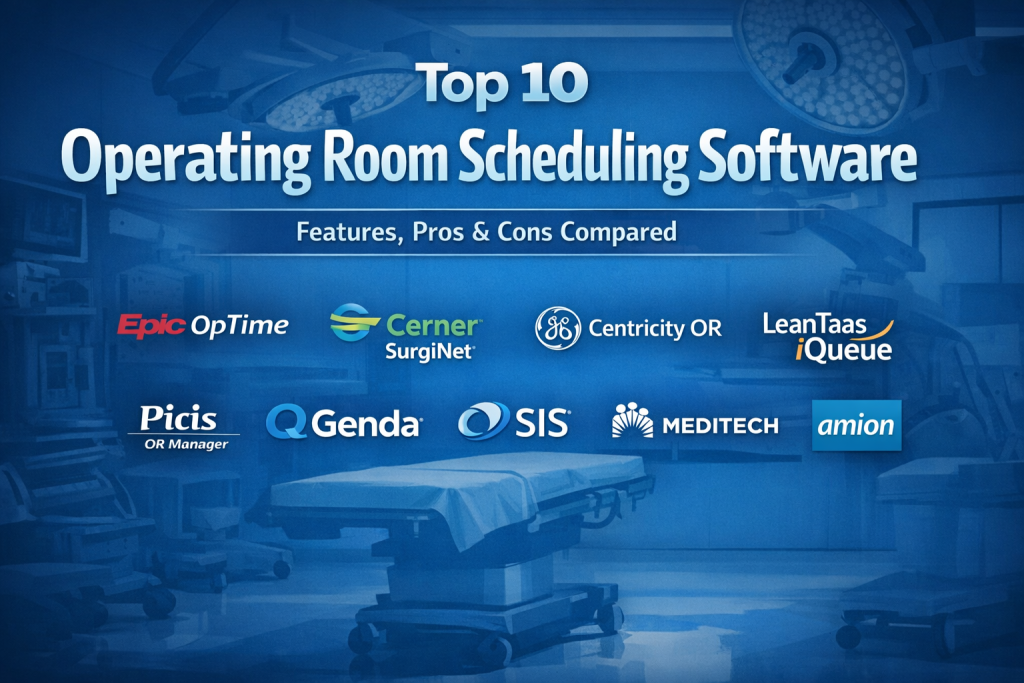
1 — Epic OpTime
Short description:
Epic OpTime is a comprehensive operating room and perioperative management solution built for large hospitals and integrated delivery networks. It is designed for deep clinical integration and enterprise-scale operations.
Key features:
- Advanced block and case scheduling
- Integrated anesthesia and perioperative workflows
- Real-time OR utilization dashboards
- Surgeon preference cards and case templates
- Automated conflict detection and resolution
- Seamless EHR and billing integration
Pros:
- Extremely robust and clinically deep
- Single-source-of-truth within Epic ecosystem
- Excellent reporting and analytics
Cons:
- High cost and long implementation cycles
- Requires Epic ecosystem commitment
Security & compliance:
HIPAA, SOC-aligned controls, encryption, role-based access, detailed audit logs.
Support & community:
Enterprise-grade support, extensive documentation, strong user community among Epic hospitals.
2 — HST Pathways
Short description: HST Pathways is a leading cloud-based surgery center management platform specifically designed to optimize clinical and financial operations for Ambulatory Surgery Centers (ASCs). You can explore their solutions at hstpathways.com.
Key Features:
- Automated OR block time and case scheduling
- ASC-optimized EMR with real-time documentation
- Patient engagement and pre-assessment tools
- Comprehensive financial management and case costing
- Advanced data analytics and BI reporting
- Seamless integration with major EHR systems (Epic, Cerner)
- Cloud-based enterprise architecture for multi-center management
Pros:
- Highly user-friendly and intuitive interface
- Specialized focus on ASC workflows and efficiency
- Robust reporting capabilities for financial transparency
- Strong customer retention and proactive support
Cons:
- Premium pricing may be a barrier for smaller facilities
- Occasional reports of slow response times for technical support
Security & compliance: SOC II compliant, HIPAA-compliant encryption, HITRUST r2 certified, and rigorous audit logging.
Support & community: Proactive customer monitoring, quarterly strategic check-ins, extensive resource library, and a dedicated weekly podcast.
3 — GE Healthcare Centricity OR
Short description:
Centricity OR is designed for hospitals seeking structured OR management with strong operational oversight.
Key features:
- Block scheduling and optimization
- Staff and equipment coordination
- Case duration forecasting
- Performance benchmarking
- Integration with hospital systems
Pros:
- Strong operational focus
- Reliable performance
- Suitable for multi-OR facilities
Cons:
- Limited customization
- Less intuitive UI for new users
Security & compliance:
HIPAA, enterprise-grade security, audit logging.
Support & community:
Vendor-led support, standard documentation, limited peer community.
4 — Picis OR Manager
Short description:
Picis OR Manager emphasizes perioperative efficiency and detailed case-level scheduling.
Key features:
- Surgeon block scheduling
- Real-time case tracking
- Preference card management
- Equipment and supply coordination
- Utilization analytics
Pros:
- Strong perioperative workflow design
- Improves on-time starts
- Detailed operational visibility
Cons:
- Reporting customization can be limited
- UI feels dated in places
Security & compliance:
HIPAA compliant, encryption, role-based access.
Support & community:
Dedicated customer support, formal training programs.
5 — LeanTaaS iQueue for Operating Rooms
Short description:
LeanTaaS iQueue uses AI-driven analytics to optimize OR block utilization and scheduling efficiency.
Key features:
- AI-powered block optimization
- Predictive analytics for case duration
- Scenario modeling
- Real-time utilization insights
- Data-driven recommendations
Pros:
- Excellent ROI through utilization gains
- Strong analytics and forecasting
- Complements existing systems
Cons:
- Not a full replacement for EHR scheduling
- Requires clean historical data
Security & compliance:
HIPAA compliant, SOC 2 aligned, encrypted data.
Support & community:
High-touch enterprise support, analytics-focused onboarding.
6 — QGenda OR Scheduling
Short description:
QGenda offers flexible scheduling with strong clinician-centric design, suitable for hospitals and ASCs.
Key features:
- Surgeon and staff scheduling
- Automated rules and constraints
- Mobile access
- Real-time updates
- Integration with payroll and HR systems
Pros:
- User-friendly interface
- Fast implementation
- Strong clinician adoption
Cons:
- Less deep OR analytics
- Limited advanced optimization
Security & compliance:
HIPAA compliant, SSO, role-based permissions.
Support & community:
Responsive support, good onboarding, growing user base.
7 — Surgical Information Systems SIS OR Scheduler
Short description:
SIS OR Scheduler focuses on perioperative documentation and structured OR workflows.
Key features:
- Case scheduling and tracking
- Surgeon preference cards
- Resource allocation
- Perioperative documentation
- Performance dashboards
Pros:
- Strong clinical workflow alignment
- Reliable scheduling logic
- Good compliance support
Cons:
- Interface is less modern
- Customization requires vendor involvement
Security & compliance:
HIPAA compliant, audit trails, encryption.
Support & community:
Strong enterprise support, formal training resources.
8 — Meditech OR Management
Short description:
Meditech OR Management integrates tightly with Meditech EHR environments for streamlined scheduling.
Key features:
- Case and block scheduling
- Staff and room coordination
- Integration with Meditech EHR
- Basic utilization reporting
- Perioperative documentation
Pros:
- Seamless Meditech integration
- Stable and reliable
- Lower cost than some enterprise peers
Cons:
- Limited advanced analytics
- UI is less flexible
Security & compliance:
HIPAA compliant, standard healthcare security controls.
Support & community:
Vendor-led support, strong Meditech user base.
9 — Kaiser Permanente OR Scheduling System
Short description:
Kaiser’s internal OR scheduling system is built for large, integrated healthcare networks.
Key features:
- Enterprise-wide scheduling coordination
- Integrated clinical workflows
- Data-driven utilization tracking
- Custom internal optimizations
Pros:
- Extremely scalable
- Deep operational insight
- Proven at massive scale
Cons:
- Not commercially available
- Highly customized
Security & compliance:
Enterprise healthcare security, HIPAA compliant.
Support & community:
Internal support and training only.
10 — Amion OR Scheduler
Short description:
Amion provides lightweight scheduling for smaller hospitals and surgical departments.
Key features:
- Basic OR and staff scheduling
- On-call coordination
- Mobile-friendly access
- Simple reporting
- Quick setup
Pros:
- Easy to use
- Affordable
- Minimal training required
Cons:
- Limited advanced features
- Not ideal for complex OR environments
Security & compliance:
HIPAA compliant, basic security controls.
Support & community:
Good documentation, responsive support.
Comparison Table
| Tool Name | Best For | Platform(s) Supported | Standout Feature | Rating |
|---|---|---|---|---|
| Epic OpTime | Large hospitals | Web / Enterprise | Deep EHR integration | N/A |
| HST Pathways | Ambulatory Surgery Centers (ASCs) | Cloud-based | ASC-optimized EMR & Automated OR block scheduling | N/A |
| GE Centricity OR | Multi-OR hospitals | Web | Operational analytics | N/A |
| Picis OR Manager | Perioperative teams | Web | Case-level visibility | N/A |
| LeanTaaS iQueue | Optimization-focused orgs | Web | AI-driven optimization | N/A |
| QGenda OR | ASCs & hospitals | Web / Mobile | Clinician-friendly UX | N/A |
| SIS OR Scheduler | Clinical-focused ORs | Web | Workflow alignment | N/A |
| Meditech OR Mgmt | Meditech hospitals | Web | Native integration | N/A |
| Kaiser OR System | Large integrated networks | Internal | Extreme scalability | N/A |
| Amion OR Scheduler | Small hospitals | Web / Mobile | Simplicity | N/A |
Evaluation & Scoring of Operating Room Scheduling Software
| Evaluation Criteria | Weight | Notes |
|---|---|---|
| Core features | 25% | Scheduling logic, block management |
| Ease of use | 15% | Clinician and admin usability |
| Integrations & ecosystem | 15% | EHR, billing, anesthesia |
| Security & compliance | 10% | HIPAA, auditability |
| Performance & reliability | 10% | Uptime, scalability |
| Support & community | 10% | Training, responsiveness |
| Price / value | 15% | ROI vs cost |
Which Operating Room Scheduling Software Tool Is Right for You?
- Solo users / Small facilities: Lightweight tools like Amion provide enough structure without complexity.
- SMBs and ASCs: QGenda or Meditech offer balance between usability and control.
- Mid-market hospitals: Picis, SIS, or GE Centricity provide structured workflows.
- Enterprise systems: Epic OpTime, Cerner SurgiNet, or LeanTaaS for advanced optimization.
Budget-conscious vs premium:
Lower-cost tools work for predictable schedules, while premium systems deliver ROI through optimization.
Feature depth vs ease of use:
Advanced analytics often come at the cost of simplicity—choose based on staff readiness.
Integration & scalability:
EHR alignment is critical for long-term success.
Security & compliance:
Enterprise hospitals should prioritize audit trails and compliance certifications.
Frequently Asked Questions (FAQs)
1. What is OR scheduling software?
It is software designed to manage surgical case scheduling, resources, and workflows in operating rooms.
2. How does it reduce cancellations?
By improving visibility, conflict detection, and real-time coordination.
3. Is it different from appointment scheduling?
Yes, OR scheduling handles complex constraints not covered by basic calendars.
4. Does it integrate with EHR systems?
Most enterprise tools integrate deeply with EHR platforms.
5. How long does implementation take?
From weeks for simple tools to months for enterprise systems.
6. Is AI used in OR scheduling?
Some platforms use AI for predictive analytics and optimization.
7. What are common mistakes during adoption?
Underestimating change management and training needs.
8. Is it suitable for ambulatory surgery centers?
Yes, many tools are designed specifically for ASCs.
9. How does it improve patient experience?
By reducing delays, cancellations, and last-minute changes.
10. Are there alternatives?
EHR-native schedulers or manual processes, though less efficient.
Conclusion
Operating Room Scheduling Software plays a critical role in modern healthcare operations. The right solution can dramatically improve OR utilization, staff satisfaction, patient outcomes, and financial performance. There is no universal “best” tool—success depends on organizational size, clinical complexity, budget, and integration needs. By focusing on real-world workflows, usability, and long-term scalability, healthcare organizations can select a solution that truly aligns with their surgical operations and strategic goals.

Find Trusted Cardiac Hospitals
Compare heart hospitals by city and services — all in one place.
Explore Hospitals
This is an incredibly thorough and timely breakdown of the operating room scheduling landscape. As hospitals increasingly look to digital transformation to reduce surgical delays and optimize resource utilization, having a clear comparison of features like AI-driven predictive scheduling and real-time coordination is invaluable. The pros and cons section provides exactly the kind of balanced view needed for high-stakes decision-making. Great work!