
Introduction
Order-to-Cash (O2C) platforms play a critical role in how modern businesses operate, grow, and maintain financial health. At its core, the Order-to-Cash process covers everything from receiving a customer order to collecting payment and reconciling revenue. This includes order management, credit checks, invoicing, accounts receivable, collections, and reporting. When these steps are disconnected or manual, businesses face delays, revenue leakage, errors, and poor customer experience.
An Order-to-Cash platform brings all these steps together into a single, streamlined workflow. It ensures faster billing cycles, improved cash flow, better compliance, and real-time visibility into revenue operations. In today’s environment—where subscription billing, usage-based pricing, global customers, and strict compliance requirements are common—manual or fragmented systems simply do not scale.
Real-world use cases include:
- Reducing Days Sales Outstanding (DSO)
- Automating invoice generation and payment reminders
- Managing complex pricing, contracts, and subscriptions
- Improving financial forecasting and revenue recognition
- Supporting audit readiness and regulatory compliance
When choosing an Order-to-Cash platform, buyers should evaluate automation depth, ease of use, integrations with ERP/CRM systems, scalability, security, compliance support, and total cost of ownership.
Best for:
Order-to-Cash platforms are best suited for finance teams, revenue operations leaders, controllers, CFOs, and operations managers in SMBs, mid-market companies, and large enterprises across SaaS, manufacturing, healthcare, telecom, retail, and professional services.
Not ideal for:
Very small businesses or freelancers with simple invoicing needs may find full O2C platforms too complex or expensive. In such cases, basic accounting or invoicing tools may be sufficient.
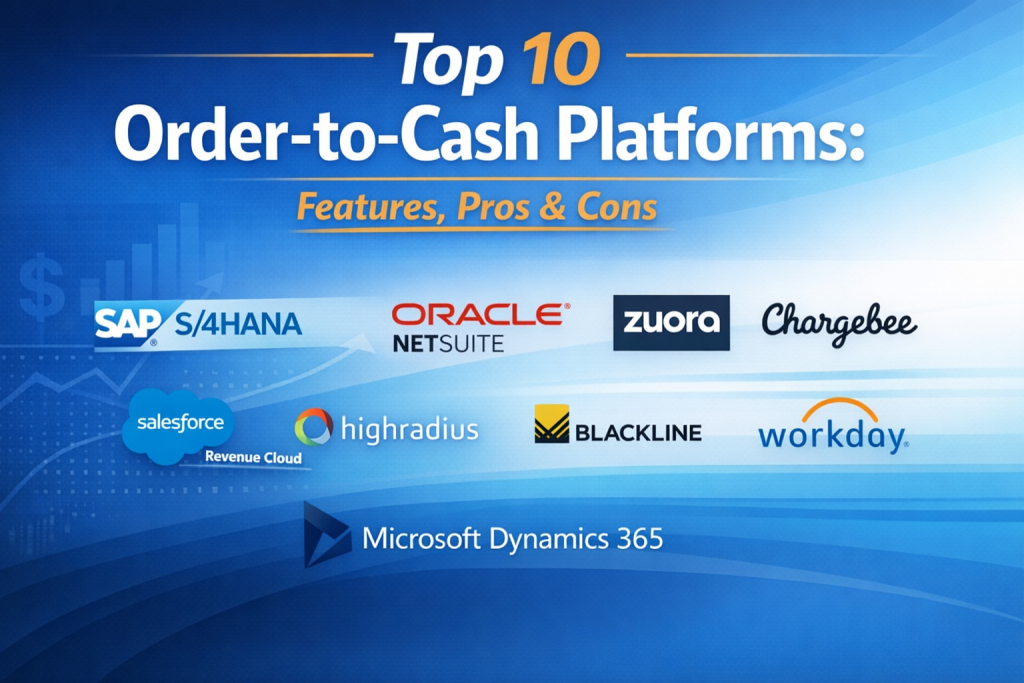
Top 10 Order-to-Cash Platforms Tools
1 — SAP S/4HANA
Short description:
SAP S/4HANA is a comprehensive enterprise-grade platform that supports end-to-end Order-to-Cash processes at global scale, designed for complex, high-volume organizations.
Key features:
- Integrated order management and billing
- Advanced revenue recognition
- Real-time financial reporting
- Credit and risk management
- Multi-currency and global tax handling
- Deep ERP and supply chain integration
Pros:
- Extremely powerful and scalable
- Strong compliance and audit controls
- Industry-specific best practices
Cons:
- High implementation cost
- Steep learning curve
- Requires experienced consultants
Security & compliance:
SOC 1/2, ISO 27001, GDPR, role-based access, audit logs
Support & community:
Extensive enterprise support, global partner ecosystem, large user community
2 — Oracle NetSuite
Short description:
Oracle NetSuite provides a unified cloud ERP with strong Order-to-Cash capabilities for fast-growing and mid-market organizations.
Key features:
- Order and billing automation
- Subscription and usage billing
- Revenue recognition compliance
- Integrated AR and collections
- CRM and financial reporting
- Multi-entity management
Pros:
- All-in-one cloud platform
- Faster deployment than traditional ERP
- Strong financial visibility
Cons:
- Customization can be complex
- Pricing increases with scale
- UI may feel dense for new users
Security & compliance:
SOC 1/2, GDPR, role-based security, audit trails
Support & community:
Enterprise-grade support, training resources, large partner network
3 — Zuora
Short description:
Zuora is purpose-built for subscription and recurring revenue businesses with complex billing and revenue recognition needs.
Key features:
- Subscription lifecycle management
- Usage-based and hybrid pricing
- Automated invoicing and collections
- Revenue recognition automation
- Analytics for churn and retention
Pros:
- Best-in-class for subscription models
- Flexible pricing configurations
- Strong revenue compliance support
Cons:
- Expensive for smaller teams
- Requires integration with ERP
- Initial setup can be time-consuming
Security & compliance:
SOC 2, GDPR, encryption at rest and in transit
Support & community:
Dedicated customer success, extensive documentation, active SaaS community
4 — Chargebee
Short description:
Chargebee is a modern subscription billing and Order-to-Cash platform optimized for SaaS and digital-first companies.
Key features:
- Subscription and recurring billing
- Automated invoicing and payments
- Tax and compliance support
- Dunning and revenue recovery
- CRM and accounting integrations
Pros:
- User-friendly interface
- Fast implementation
- Excellent subscription flexibility
Cons:
- Limited ERP depth
- Less suitable for manufacturing
- Reporting may require add-ons
Security & compliance:
SOC 2, GDPR, PCI-DSS, SSO support
Support & community:
Strong onboarding, responsive support, growing SaaS user base
5 — Aria Systems
Short description:
Aria Systems delivers enterprise-scale billing and monetization solutions for complex usage and transaction-based models.
Key features:
- High-volume transaction billing
- Complex pricing logic
- Global invoicing and taxation
- Revenue recognition tools
- API-first architecture
Pros:
- Extremely flexible billing engine
- Designed for scale
- Strong API capabilities
Cons:
- Technical setup required
- UI less intuitive
- Higher learning curve
Security & compliance:
SOC 2, GDPR, enterprise-grade controls
Support & community:
Enterprise support, technical documentation, smaller community
6 — Salesforce Revenue Cloud
Short description:
Salesforce Revenue Cloud unifies CPQ, billing, and revenue recognition within the Salesforce ecosystem.
Key features:
- Quote-to-order automation
- Billing and invoicing
- Contract and subscription management
- Revenue forecasting
- CRM-native workflows
Pros:
- Seamless Salesforce integration
- Strong automation across sales and finance
- Scales well with growth
Cons:
- Costly at enterprise scale
- Dependent on Salesforce ecosystem
- Configuration complexity
Security & compliance:
SOC 2, ISO 27001, GDPR, SSO
Support & community:
Extensive Salesforce community, enterprise support, training ecosystem
7 — HighRadius
Short description:
HighRadius focuses on automating accounts receivable, collections, and cash application using AI-driven insights.
Key features:
- Automated collections workflows
- Cash application automation
- Credit risk management
- AI-based forecasting
- AR analytics dashboards
Pros:
- Strong AR specialization
- Improves cash flow efficiency
- AI-driven insights
Cons:
- Not a full O2C platform alone
- Requires ERP integration
- Enterprise-focused pricing
Security & compliance:
SOC 2, GDPR, ISO standards
Support & community:
Dedicated enterprise support, training programs
8 — BlackLine
Short description:
BlackLine enhances the Order-to-Cash process by automating reconciliation, financial close, and compliance tasks.
Key features:
- Account reconciliation
- AR automation
- Journal entry management
- Compliance tracking
- Audit-ready reporting
Pros:
- Strong financial governance
- Reduces close cycles
- Improves accuracy
Cons:
- Not end-to-end O2C
- Best as a complement tool
- Limited billing features
Security & compliance:
SOC 2, ISO 27001, GDPR
Support & community:
Enterprise support, finance-focused user community
9 — Workday Financial Management
Short description:
Workday Financial Management offers integrated financials and revenue management for large, people-centric organizations.
Key features:
- Order and contract management
- Revenue recognition
- Real-time analytics
- Multi-entity accounting
- Cloud-native architecture
Pros:
- Modern UI and analytics
- Strong HR-finance integration
- Real-time insights
Cons:
- Premium pricing
- Less flexible billing logic
- Best for large enterprises
Security & compliance:
SOC 1/2, ISO 27001, GDPR
Support & community:
Enterprise support, Workday community, partner network
10 — Microsoft Dynamics 365 Finance
Short description:
Microsoft Dynamics 365 Finance provides a flexible Order-to-Cash solution tightly integrated with the Microsoft ecosystem.
Key features:
- Order processing and invoicing
- Credit and collections management
- Financial analytics
- ERP and CRM integration
- Automation via Power Platform
Pros:
- Familiar Microsoft interface
- Flexible customization
- Competitive mid-market pricing
Cons:
- Customization requires expertise
- Performance tuning needed at scale
- UI consistency varies
Security & compliance:
ISO 27001, GDPR, Microsoft security framework
Support & community:
Strong partner ecosystem, extensive documentation
Comparison Table
| Tool Name | Best For | Platform(s) Supported | Standout Feature | Rating |
|---|---|---|---|---|
| SAP S/4HANA | Large enterprises | Cloud / On-prem | Real-time ERP integration | N/A |
| Oracle NetSuite | Mid-market growth | Cloud | Unified ERP & O2C | N/A |
| Zuora | Subscription businesses | Cloud | Subscription flexibility | N/A |
| Chargebee | SaaS startups & SMBs | Cloud | Fast subscription billing | N/A |
| Aria Systems | High-volume billing | Cloud | API-first billing engine | N/A |
| Salesforce Revenue Cloud | Salesforce users | Cloud | Native CRM integration | N/A |
| HighRadius | AR automation | Cloud | AI-driven collections | N/A |
| BlackLine | Finance governance | Cloud | Reconciliation automation | N/A |
| Workday Financial Management | Enterprises | Cloud | Real-time analytics | N/A |
| Microsoft Dynamics 365 Finance | Mid-market & enterprise | Cloud | Microsoft ecosystem | N/A |
Evaluation & Scoring of Order-to-Cash Platforms
| Criteria | Weight | Average Score |
|---|---|---|
| Core features | 25% | High |
| Ease of use | 15% | Medium |
| Integrations & ecosystem | 15% | High |
| Security & compliance | 10% | High |
| Performance & reliability | 10% | High |
| Support & community | 10% | Medium |
| Price / value | 15% | Medium |
Which Order-to-Cash Platforms Tool Is Right for You?
- Solo users & SMBs: Look for ease of use, fast setup, and lower cost (e.g., Chargebee).
- Mid-market companies: Balance automation, integrations, and scalability (e.g., NetSuite, Dynamics 365).
- Enterprises: Prioritize compliance, customization, and scale (e.g., SAP, Workday).
- Budget-conscious teams: Avoid over-engineered ERP platforms.
- Integration-heavy environments: Choose platforms aligned with your CRM and ERP stack.
- Highly regulated industries: Focus on audit trails, security certifications, and compliance readiness.
Frequently Asked Questions (FAQs)
- What is Order-to-Cash automation?
It automates the entire process from order placement to payment collection and revenue reporting. - How long does implementation take?
Anywhere from a few weeks for SMB tools to several months for enterprise ERP platforms. - Do O2C platforms replace accounting software?
Some do, while others integrate with existing ERP or accounting systems. - Are these tools secure?
Most leading platforms offer enterprise-grade security and compliance certifications. - Can small businesses use O2C platforms?
Yes, but they should choose lighter, subscription-focused solutions. - Do they support global billing?
Many platforms support multi-currency, taxation, and localization. - Is customization required?
Complex businesses often need configuration, but modern tools reduce custom code needs. - What is the biggest benefit of O2C platforms?
Faster cash flow and reduced revenue leakage. - Can O2C platforms integrate with CRM systems?
Yes, CRM integration is a core feature for most platforms. - What mistakes should buyers avoid?
Overbuying features, ignoring integrations, and underestimating change management.
Conclusion
Order-to-Cash platforms are no longer optional for growing and complex organizations. They directly impact cash flow, customer experience, compliance, and financial visibility. The right solution depends on company size, business model, industry requirements, and existing technology stack.
Rather than searching for a universal “best” platform, decision-makers should focus on alignment with business needs, scalability, integration readiness, and long-term value. When chosen thoughtfully, an Order-to-Cash platform becomes a strategic asset—not just a finance tool.

Find Trusted Cardiac Hospitals
Compare heart hospitals by city and services — all in one place.
Explore Hospitals