
Introduction
Bias & Fairness Testing Tools are specialized platforms and libraries designed to detect, measure, explain, and mitigate bias in machine learning (ML) and artificial intelligence (AI) systems. As AI increasingly influences hiring decisions, credit scoring, healthcare diagnostics, insurance pricing, marketing personalization, and law enforcement analytics, ensuring fair, transparent, and accountable models has become a critical responsibility rather than an optional best practice.
These tools help organizations identify unfair treatment across protected attributes such as gender, race, age, ethnicity, disability, or socioeconomic status, both at the data level and during model predictions. Beyond ethics, bias testing is now deeply tied to regulatory compliance, brand trust, and risk management, especially with emerging AI governance frameworks worldwide.
In real-world use cases, Bias & Fairness Testing Tools are applied to:
- Audit datasets before training models
- Validate fairness metrics during model development
- Monitor drift and bias in production systems
- Generate explainability and compliance-ready reports
When evaluating tools in this category, users should look for:
- Breadth of fairness metrics
- Explainability and transparency
- Integration with ML workflows
- Automation and scalability
- Governance, auditability, and compliance support
Best for:
Bias & Fairness Testing Tools are most valuable for data scientists, ML engineers, AI product managers, compliance officers, risk teams, and ethics boards working in regulated or high-impact domains such as finance, healthcare, HR tech, insurance, public sector, and large-scale consumer platforms.
Not ideal for:
These tools may be unnecessary for rule-based systems, non-ML applications, early-stage prototypes, or teams experimenting with AI where fairness risks are minimal and models are not deployed in real-world decision-making contexts.
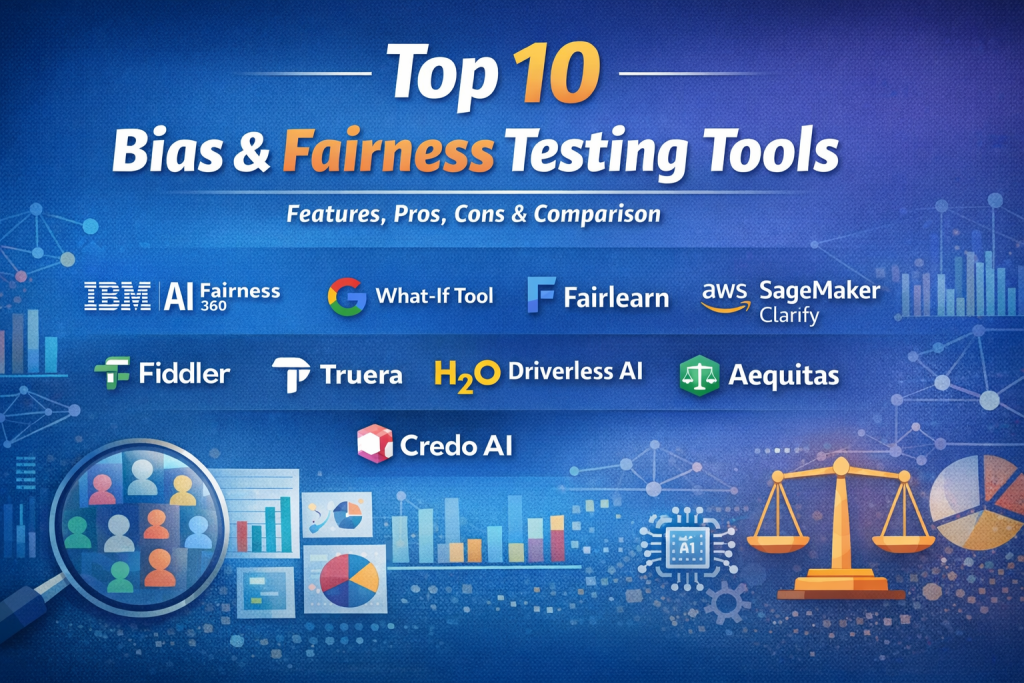
Top 10 Bias & Fairness Testing Tools
1 — IBM AI Fairness 360
Short description:
An open-source fairness evaluation and mitigation toolkit designed for data scientists and ML engineers building responsible AI systems.
Key features:
- Extensive library of fairness metrics
- Pre-processing, in-processing, and post-processing bias mitigation
- Supports structured datasets
- Compatible with Python ML workflows
- Visualization and reporting utilities
- Active academic and enterprise adoption
Pros:
- Extremely comprehensive metrics coverage
- Strong research-backed methodologies
- Free and open source
Cons:
- Requires strong ML expertise
- Limited UI for non-technical users
Security & compliance:
Varies / N/A (open-source library)
Support & community:
Strong documentation, academic references, active open-source community
2 — Google What-If Tool
Short description:
An interactive visual tool for exploring model behavior, fairness, and feature impact without writing code.
Key features:
- Interactive fairness and counterfactual analysis
- Feature importance visualization
- Model comparison
- Bias inspection across slices
- TensorFlow ecosystem integration
- No-code interface
Pros:
- Excellent for visual exploration
- Beginner-friendly
- Strong explainability
Cons:
- Limited automation
- Primarily exploratory, not enterprise-grade governance
Security & compliance:
Varies / N/A
Support & community:
Good documentation, strong community adoption
3 — Fairlearn
Short description:
A Python-based fairness assessment toolkit focused on ML model evaluation and trade-off analysis.
Key features:
- Fairness metrics by demographic groups
- Disparity and parity evaluation
- Model comparison dashboards
- Mitigation algorithms
- Integration with Scikit-learn
- Visualization components
Pros:
- Clean API and focused scope
- Strong statistical grounding
- Lightweight and flexible
Cons:
- Requires coding knowledge
- Limited enterprise governance features
Security & compliance:
Varies / N/A
Support & community:
Good documentation, active open-source contributors
4 — Amazon SageMaker Clarify
Short description:
A managed AWS service for detecting bias and explaining ML models across the full lifecycle.
Key features:
- Pre- and post-training bias detection
- Feature attribution and explainability
- Seamless AWS integration
- Automated reporting
- Scalable cloud infrastructure
- Production monitoring support
Pros:
- Enterprise-ready scalability
- Minimal setup for AWS users
- Strong compliance alignment
Cons:
- AWS lock-in
- Less flexible outside SageMaker
Security & compliance:
SOC 2, GDPR-ready, enterprise-grade AWS security controls
Support & community:
Enterprise AWS support, strong documentation
5 — Microsoft Responsible AI Toolbox
Short description:
A comprehensive suite of tools focused on fairness, explainability, error analysis, and governance.
Key features:
- Fairness and error analysis dashboards
- Interpretability tools
- Integration with Azure ML
- Responsible AI scorecards
- Model monitoring
- Open-source components
Pros:
- Broad responsible AI coverage
- Strong enterprise governance focus
- Rich visualization
Cons:
- Azure-centric
- Moderate setup complexity
Security & compliance:
SOC 2, ISO-aligned via Azure ecosystem
Support & community:
Strong documentation, enterprise support available
6 — Fiddler AI
Short description:
A commercial AI observability platform with strong fairness and explainability capabilities.
Key features:
- Bias and drift detection
- Model explainability
- Production monitoring
- Alerting and dashboards
- Governance workflows
- Enterprise APIs
Pros:
- Production-grade monitoring
- Strong enterprise UX
- Real-time insights
Cons:
- Premium pricing
- Requires onboarding effort
Security & compliance:
SOC 2, GDPR-ready, enterprise security controls
Support & community:
Dedicated customer success, enterprise support
7 — Truera
Short description:
An enterprise AI quality and fairness validation platform designed for regulated industries.
Key features:
- Bias detection across lifecycle
- Explainability and transparency
- Model quality metrics
- Automated compliance reports
- Governance workflows
- Scalable enterprise deployment
Pros:
- Strong compliance focus
- High accuracy diagnostics
- Enterprise-friendly
Cons:
- Not ideal for small teams
- Higher cost
Security & compliance:
SOC 2, GDPR, enterprise governance-ready
Support & community:
Enterprise onboarding, dedicated support teams
8 — H2O Driverless AI
Short description:
An automated ML platform with built-in fairness and interpretability features.
Key features:
- Automated feature engineering
- Fairness metrics
- Explainable ML
- Model validation
- Enterprise scalability
- On-prem and cloud deployment
Pros:
- Automation-driven productivity
- Strong enterprise adoption
- Balanced performance and fairness
Cons:
- Less granular control
- Commercial licensing
Security & compliance:
SOC 2, GDPR-ready
Support & community:
Enterprise support, strong documentation
9 — Aequitas
Short description:
An open-source bias auditing toolkit focused on fairness evaluation and reporting.
Key features:
- Bias and disparity analysis
- Group-based fairness metrics
- Visual reports
- Customizable audits
- Lightweight deployment
- Transparency-focused
Pros:
- Simple and focused
- Good for audits and reporting
- Open source
Cons:
- Limited automation
- Smaller ecosystem
Security & compliance:
Varies / N/A
Support & community:
Basic documentation, niche community
10 — Credo AI
Short description:
A governance-first AI platform with fairness, risk, and compliance management capabilities.
Key features:
- Bias and risk assessment
- Policy and control mapping
- Audit-ready documentation
- Model inventory management
- Enterprise workflows
- Regulatory alignment
Pros:
- Governance-centric approach
- Strong compliance tooling
- Executive visibility
Cons:
- Less technical depth
- Best suited for mature AI programs
Security & compliance:
SOC 2, GDPR, enterprise governance standards
Support & community:
Enterprise onboarding, professional services
Comparison Table
| Tool Name | Best For | Platform(s) Supported | Standout Feature | Rating |
|---|---|---|---|---|
| IBM AI Fairness 360 | Data scientists | Python | Deep fairness metrics | N/A |
| Google What-If Tool | Analysts, beginners | Web, TensorFlow | Visual exploration | N/A |
| Fairlearn | ML engineers | Python | Metric clarity | N/A |
| Amazon SageMaker Clarify | AWS teams | Cloud (AWS) | Managed scalability | N/A |
| Microsoft Responsible AI Toolbox | Enterprises | Azure, Python | Responsible AI suite | N/A |
| Fiddler AI | Production ML teams | Cloud, On-prem | Real-time monitoring | N/A |
| Truera | Regulated industries | Enterprise platforms | Compliance diagnostics | N/A |
| H2O Driverless AI | AutoML users | Cloud, On-prem | Automated fairness | N/A |
| Aequitas | Auditors | Python | Audit reports | N/A |
| Credo AI | Governance teams | Enterprise SaaS | Policy alignment | N/A |
Evaluation & Scoring of Bias & Fairness Testing Tools
| Tool | Core Features (25%) | Ease of Use (15%) | Integrations (15%) | Security (10%) | Performance (10%) | Support (10%) | Price/Value (15%) | Total Score |
|---|---|---|---|---|---|---|---|---|
| IBM AI Fairness 360 | 23 | 10 | 12 | 6 | 8 | 8 | 14 | 81 |
| Google What-If Tool | 18 | 14 | 10 | 5 | 7 | 8 | 15 | 77 |
| Fairlearn | 20 | 11 | 11 | 5 | 8 | 8 | 14 | 77 |
| SageMaker Clarify | 22 | 13 | 14 | 9 | 9 | 9 | 11 | 86 |
| Microsoft Toolbox | 23 | 12 | 14 | 9 | 9 | 9 | 12 | 88 |
| Fiddler AI | 24 | 13 | 13 | 9 | 9 | 9 | 10 | 87 |
| Truera | 24 | 11 | 13 | 9 | 9 | 9 | 10 | 85 |
| H2O Driverless AI | 22 | 13 | 12 | 8 | 9 | 9 | 11 | 84 |
| Aequitas | 17 | 11 | 9 | 4 | 7 | 7 | 15 | 70 |
| Credo AI | 21 | 12 | 13 | 9 | 8 | 9 | 11 | 83 |
Which Bias & Fairness Testing Tool Is Right for You?
- Solo users & researchers: Open-source tools like IBM AI Fairness 360 or Fairlearn
- SMBs: Google What-If Tool or Aequitas for lightweight audits
- Mid-market: Microsoft Responsible AI Toolbox or H2O Driverless AI
- Enterprise: Fiddler AI, Truera, Credo AI, or SageMaker Clarify
Budget-conscious: Open-source libraries
Premium needs: Enterprise observability and governance platforms
Deep features: Research-grade toolkits
Ease of use: Visual, no-code tools
Compliance-heavy environments: Governance-first platforms
Frequently Asked Questions (FAQs)
1. What is bias in machine learning?
Bias occurs when a model unfairly favors or disadvantages specific groups based on sensitive attributes.
2. Are bias testing tools mandatory?
Not legally everywhere, but increasingly required in regulated industries.
3. Can bias be fully eliminated?
No, but it can be measured, mitigated, and managed responsibly.
4. Do these tools slow down ML workflows?
Initially yes, but they reduce long-term risk and rework.
5. Are open-source tools reliable?
Yes, especially for research and internal validation.
6. When should bias testing be done?
Before training, after training, and during production monitoring.
7. Do these tools support deep learning models?
Most do, though support varies by framework.
8. Is fairness the same across all use cases?
No, fairness definitions depend on context and risk tolerance.
9. Can small teams afford fairness tooling?
Yes, open-source options are cost-effective.
10. What’s the biggest mistake teams make?
Treating fairness as a one-time checkbox instead of an ongoing process.
Conclusion
Bias & Fairness Testing Tools are now a core pillar of responsible AI development. They help organizations build trust, meet regulatory expectations, and reduce ethical and legal risks. The right tool depends on technical maturity, scale, budget, and governance requirements. There is no single universal winner—only solutions that best align with your specific AI strategy and organizational goals.

Find Trusted Cardiac Hospitals
Compare heart hospitals by city and services — all in one place.
Explore Hospitals
This article is a very informative and practical guide to the top bias and fairness testing tools, and it’s great to see both capabilities and limitations clearly explained for each solution. Evaluating models for fairness is increasingly important as AI systems are used in real-world decisions, and understanding key features like metric coverage, explainability, ease of integration, and support for different data types helps practitioners choose the right tool for their needs. Highlighting pros and cons enables readers to weigh trade-offs — such as simplicity versus depth of analysis or automated checks versus custom audits — rather than just picking based on popularity. For teams serious about responsible and ethical AI development, this comparison makes it much easier to identify tools that will help detect and mitigate bias throughout the ML lifecycle.