
Introduction
Adversarial Robustness Testing Tools are specialized solutions designed to evaluate, stress-test, and harden machine learning (ML) and AI models against adversarial attacks—inputs crafted to intentionally mislead models into making incorrect predictions. As AI systems increasingly power critical business, financial, healthcare, and security decisions, ensuring their resilience against such attacks has become a top priority.
These tools simulate real-world attack scenarios such as evasion attacks, poisoning attacks, membership inference, and model extraction, helping teams understand how models behave under hostile conditions. Beyond security, adversarial testing also improves model reliability, fairness, and trustworthiness, which are essential for regulated industries and enterprise AI adoption.
Why adversarial robustness matters
- AI models are vulnerable even when accuracy is high
- Regulatory pressure is growing around AI safety and accountability
- Adversarial failures can cause financial loss, reputational damage, or legal risk
Common real-world use cases
- Securing fraud detection and credit scoring models
- Hardening computer vision systems in autonomous vehicles
- Testing NLP models used in customer support or moderation
- Evaluating healthcare and diagnostic AI for edge-case failures
What to look for when choosing a tool
When evaluating Adversarial Robustness Testing Tools, buyers should focus on:
- Attack coverage (evasion, poisoning, inference, extraction)
- Framework compatibility (TensorFlow, PyTorch, scikit-learn, ONNX)
- Ease of integration into ML pipelines
- Explainability and reporting depth
- Enterprise security and compliance readiness
Best for:
ML engineers, data scientists, AI security teams, compliance officers, and enterprises deploying AI in finance, healthcare, defense, automotive, retail, and SaaS platforms.
Not ideal for:
Teams building simple, low-risk models, early experimentation projects, or organizations without production AI workloads where adversarial threats are minimal.
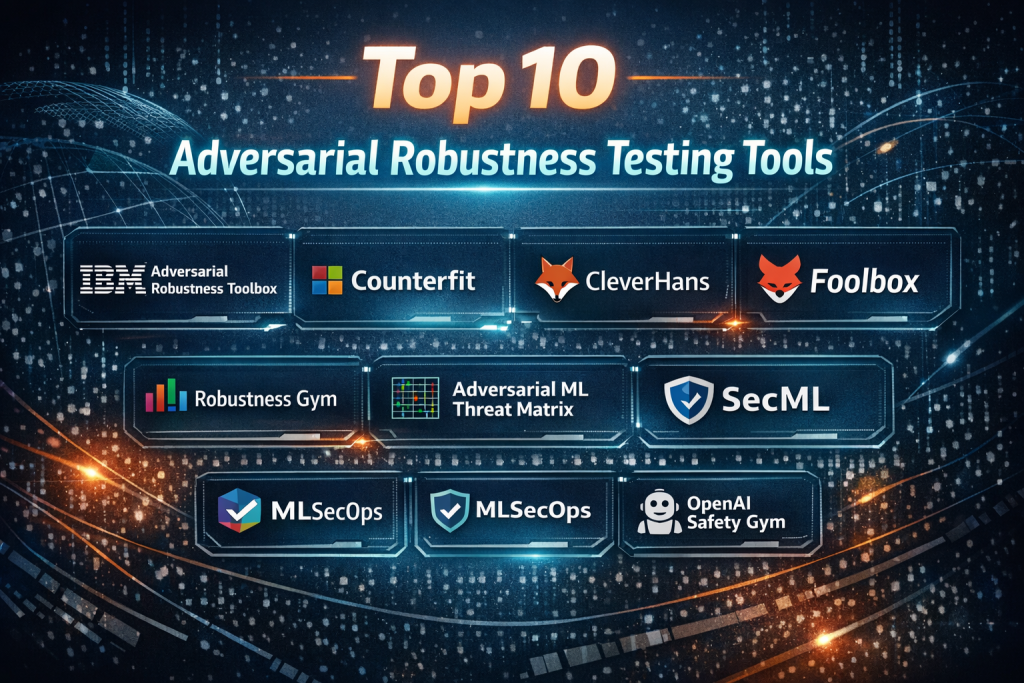
Top 10 Adversarial Robustness Testing Tools
1 — IBM Adversarial Robustness Toolbox
Short description:
A widely adopted open-source library for evaluating and improving the robustness of machine learning models against adversarial threats. Designed for research and enterprise-grade ML pipelines.
Key features:
- Supports evasion, poisoning, inference, and extraction attacks
- Framework-agnostic (TensorFlow, PyTorch, scikit-learn, Keras)
- Built-in adversarial defenses and preprocessing techniques
- Model-agnostic attack APIs
- Strong benchmarking and reproducibility support
- Works with tabular, image, and text data
Pros:
- Extremely comprehensive attack coverage
- Strong community adoption and research credibility
- Flexible for both experimentation and production
Cons:
- Steeper learning curve for beginners
- Requires ML security expertise for optimal use
Security & compliance:
Varies / N/A (open-source; enterprise controls depend on deployment)
Support & community:
Excellent documentation, large open-source community, strong research backing, enterprise support via IBM ecosystem
2 — Microsoft Counterfit
Short description:
An AI security assessment tool focused on automating adversarial testing workflows for machine learning systems, especially in red-team scenarios.
Key features:
- Modular attack framework with automation support
- CLI-driven testing workflows
- Supports common ML model types and APIs
- Designed for AI red teaming
- Integrates with security testing pipelines
Pros:
- Strong focus on real-world threat modeling
- Automation-friendly design
- Ideal for security teams
Cons:
- Less beginner-friendly
- Limited built-in defenses compared to others
Security & compliance:
Varies / N/A
Support & community:
Growing open-source community, good technical documentation, strong backing from Microsoft research
3 — CleverHans
Short description:
A research-oriented adversarial testing library focused on generating and evaluating adversarial examples for deep learning models.
Key features:
- Classic and modern adversarial attack algorithms
- Deep learning-focused (TensorFlow, PyTorch)
- Benchmarking for robustness evaluation
- Strong academic validation
- Lightweight and modular
Pros:
- Well-established in academic research
- Reliable implementations of standard attacks
- Easy to extend for experiments
Cons:
- Limited enterprise tooling
- Not optimized for large-scale production pipelines
Security & compliance:
N/A
Support & community:
Active research community, solid documentation, limited commercial support
4 — Foolbox
Short description:
A Python library specializing in adversarial attacks with a clean, unified API for robustness benchmarking.
Key features:
- Unified interface for many attack algorithms
- Supports PyTorch, TensorFlow, JAX
- High-performance attack execution
- Model-agnostic design
- Strong benchmarking focus
Pros:
- Clean and consistent API
- High-quality implementations
- Good performance on large models
Cons:
- Focuses mainly on attacks, not defenses
- Limited governance features
Security & compliance:
N/A
Support & community:
Good documentation, active GitHub community, research-oriented support
5 — Robustness Gym
Short description:
A robustness evaluation toolkit emphasizing stress-testing models across distribution shifts, noise, and adversarial perturbations.
Key features:
- Scenario-based robustness evaluation
- Supports NLP and vision models
- Dataset perturbation pipelines
- Emphasis on fairness and reliability
- Research-grade benchmarking
Pros:
- Excellent for robustness benchmarking
- Strong evaluation methodology
- Ideal for research-driven teams
Cons:
- Less focused on adversarial defenses
- Limited enterprise deployment tooling
Security & compliance:
N/A
Support & community:
Academic-focused documentation, smaller but engaged community
6 — Adversarial ML Threat Matrix
Short description:
A structured framework for identifying and categorizing adversarial threats across the ML lifecycle rather than executing attacks directly.
Key features:
- Threat taxonomy for ML systems
- Lifecycle-based risk modeling
- Complements testing tools
- Helps align security and ML teams
- Strong governance alignment
Pros:
- Excellent for strategic planning
- Improves cross-team communication
- Security-first approach
Cons:
- Not an execution engine
- Requires pairing with testing tools
Security & compliance:
Supports governance and audit readiness
Support & community:
Strong documentation, security community adoption
7 — DeepSec
Short description:
An enterprise-grade platform focused on securing deep learning models through adversarial testing and vulnerability analysis.
Key features:
- Automated adversarial attack simulation
- Model vulnerability scoring
- Enterprise reporting dashboards
- Supports vision and NLP models
- CI/CD pipeline integration
Pros:
- Enterprise-ready workflows
- Strong reporting and visualization
- Designed for production AI
Cons:
- Commercial pricing
- Less transparent algorithms
Security & compliance:
SOC 2, enterprise-grade controls, audit logs
Support & community:
Dedicated enterprise support, onboarding assistance
8 — SecML
Short description:
A Python library for secure and adversarial machine learning with strong mathematical foundations.
Key features:
- Evasion and poisoning attack simulation
- Robust optimization techniques
- Focus on theoretical guarantees
- Modular ML components
- Strong evaluation metrics
Pros:
- Strong theoretical rigor
- Ideal for security research
- Flexible experimentation
Cons:
- Steep learning curve
- Less user-friendly for production teams
Security & compliance:
N/A
Support & community:
Research-driven community, detailed technical docs
9 — MLSecOps Frameworks
Short description:
A category of tools and practices integrating adversarial testing into secure ML lifecycle management.
Key features:
- ML pipeline security integration
- Continuous robustness validation
- Policy enforcement
- Monitoring and alerting
- Governance alignment
Pros:
- Holistic security coverage
- Scales well in enterprises
- Aligns ML and DevSecOps
Cons:
- Requires mature ML operations
- Often complex to implement
Security & compliance:
SOC 2, ISO-aligned (varies by vendor)
Support & community:
Enterprise vendor support, emerging best practices community
10 — OpenAI Safety Gym
Short description:
A research environment for evaluating robustness and safety in reinforcement learning systems.
Key features:
- Safety constraint evaluation
- Adversarial environment design
- RL-focused robustness testing
- Research benchmarks
- Simulation-based testing
Pros:
- Strong RL safety focus
- Excellent for experimentation
- Trusted research foundation
Cons:
- Narrow use case
- Not enterprise-ready
Security & compliance:
N/A
Support & community:
Active research community, academic documentation
Comparison Table
| Tool Name | Best For | Platform(s) Supported | Standout Feature | Rating |
|---|---|---|---|---|
| IBM Adversarial Robustness Toolbox | Enterprise & research ML teams | Python, multi-framework | Broadest attack coverage | N/A |
| Microsoft Counterfit | AI red teams | CLI, Python | Automated adversarial workflows | N/A |
| CleverHans | Academic research | TensorFlow, PyTorch | Standardized attack implementations | N/A |
| Foolbox | Robustness benchmarking | PyTorch, TensorFlow, JAX | Unified attack API | N/A |
| Robustness Gym | Reliability testing | Python | Scenario-based evaluation | N/A |
| Adversarial ML Threat Matrix | Governance & planning | Framework-agnostic | Threat taxonomy | N/A |
| DeepSec | Enterprise AI security | SaaS, Python | Vulnerability scoring | N/A |
| SecML | Secure ML research | Python | Theoretical robustness | N/A |
| MLSecOps Frameworks | Large enterprises | Multi-platform | Lifecycle security | N/A |
| OpenAI Safety Gym | RL researchers | Python | Safety-focused simulation | N/A |
Evaluation & Scoring of Adversarial Robustness Testing Tools
| Tool | Core Features (25%) | Ease of Use (15%) | Integrations (15%) | Security (10%) | Performance (10%) | Support (10%) | Price/Value (15%) | Total |
|---|---|---|---|---|---|---|---|---|
| IBM ART | 24 | 12 | 14 | 8 | 9 | 9 | 13 | 89 |
| Microsoft Counterfit | 22 | 11 | 13 | 7 | 8 | 8 | 12 | 81 |
| CleverHans | 20 | 12 | 10 | 6 | 8 | 7 | 14 | 77 |
| Foolbox | 21 | 13 | 11 | 6 | 9 | 7 | 14 | 81 |
| Robustness Gym | 19 | 12 | 10 | 6 | 8 | 7 | 13 | 75 |
| DeepSec | 23 | 14 | 13 | 9 | 9 | 9 | 10 | 87 |
Which Adversarial Robustness Testing Tool Is Right for You?
- Solo users & researchers: CleverHans, Foolbox, SecML
- SMBs: IBM ART, Robustness Gym
- Mid-market: Microsoft Counterfit, Foolbox
- Enterprises: IBM ART, DeepSec, MLSecOps platforms
Budget-conscious: Open-source libraries
Premium needs: Enterprise security platforms
Feature depth vs ease:
- Deep security → IBM ART, DeepSec
- Simplicity → Foolbox, Robustness Gym
Compliance-heavy industries:
- Favor tools with governance alignment and audit support
Frequently Asked Questions (FAQs)
- Are adversarial attacks realistic threats?
Yes. Real-world systems have been exploited using adversarial inputs across vision, NLP, and tabular models. - Do these tools slow down model development?
Initially yes, but they reduce long-term risk and rework. - Are open-source tools safe for enterprises?
Yes, when combined with proper security controls. - Do I need ML security expertise?
Basic understanding helps, but many tools provide templates. - Can adversarial testing improve accuracy?
Indirectly, by improving generalization and robustness. - Are these tools required for compliance?
Increasingly yes, especially in regulated sectors. - Do they support cloud ML platforms?
Most integrate with cloud-based pipelines. - Is adversarial training mandatory?
Not always, but recommended for high-risk models. - What is the biggest mistake teams make?
Testing only accuracy and ignoring robustness. - Can one tool cover everything?
No. Most teams use a combination of tools.
Conclusion
Adversarial Robustness Testing Tools are no longer optional for organizations deploying AI at scale. They play a critical role in securing models, improving reliability, meeting compliance demands, and building trust in AI systems.
There is no universal “best” tool. The right choice depends on team maturity, risk profile, industry requirements, and deployment scale. Open-source libraries excel in flexibility and research depth, while enterprise platforms provide governance, automation, and support.
By focusing on attack coverage, integration ease, and long-term security alignment, teams can confidently deploy AI models that perform not just accurately—but safely and reliably.

Find Trusted Cardiac Hospitals
Compare heart hospitals by city and services — all in one place.
Explore Hospitals
This is a very clear and practical overview of the top adversarial robustness testing tools, especially useful for data scientists and AI engineers focused on building resilient models. The article does a great job of not just listing tools, but breaking down key features like attack simulation coverage, integration with ML pipelines, ease of use, and reporting capabilities — which are all critical when evaluating robustness solutions. Highlighting both pros and cons helps readers understand trade-offs such as scalability versus customization needs, or out-of-the-box functionality versus research-oriented flexibility. In a landscape where adversarial attacks can significantly undermine model reliability in production, having this structured comparison makes it much easier to choose tools that fit your project requirements and risk tolerance.