
Introduction
Confidential Computing Platforms represent one of the most important shifts in modern cloud and enterprise security. Traditionally, data protection focused on encryption at rest and encryption in transit, but data often remained exposed while being processed in memory. Confidential computing closes this gap by ensuring that sensitive data remains encrypted even during execution.
At the core of confidential computing are Trusted Execution Environments (TEEs), which create hardware-isolated secure enclaves. These enclaves prevent cloud providers, system administrators, malicious insiders, and attackers from accessing sensitive workloads. As data sharing, AI training, cross-organization analytics, and regulated workloads continue to grow, confidential computing has become a foundational security capability.
Real-world use cases include:
- Privacy-preserving data analytics across organizations
- Secure AI model training on sensitive datasets
- Financial transactions and risk modeling
- Healthcare data processing under strict regulations
- Secure multi-party computation and data clean rooms
When evaluating confidential computing platforms, users should consider:
- Hardware support and enclave technology
- Cloud or on-prem deployment flexibility
- Ease of development and tooling
- Integration with existing cloud and security stacks
- Compliance certifications and auditability
- Performance overhead and scalability
Best for:
Security-focused enterprises, regulated industries (finance, healthcare, government), AI and data science teams handling sensitive data, SaaS providers offering privacy-first services, and organizations collaborating across trust boundaries.
Not ideal for:
Small teams with non-sensitive workloads, applications where encryption overhead outweighs risk, legacy systems that cannot be containerized or virtualized, or environments where hardware-based isolation is unavailable.
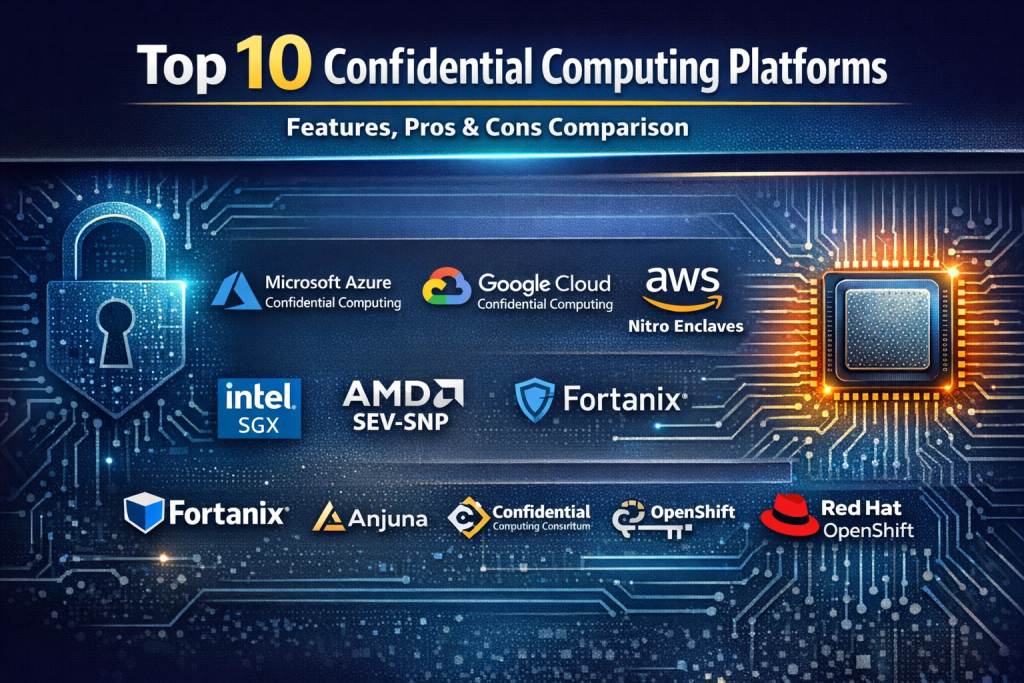
Top 10 Confidential Computing Platforms Tools
1 — Microsoft Azure Confidential Computing
Short description:
A mature, enterprise-grade confidential computing offering integrated across Azure VMs, containers, and AI services, designed for regulated and large-scale workloads.
Key features
- Hardware-backed TEEs using Intel SGX and AMD SEV-SNP
- Confidential virtual machines and confidential containers
- Encrypted memory and secure boot
- Confidential AI and data analytics services
- Native integration with Azure Key Vault
- Attestation and policy-based access control
Pros
- Deep integration with Azure ecosystem
- Strong enterprise compliance and governance
Cons
- Azure-centric design limits portability
- Configuration complexity for advanced scenarios
Security & compliance
SOC 2, ISO 27001, GDPR, HIPAA support, encryption, audit logs, SSO
Support & community
Extensive documentation, enterprise support plans, strong developer ecosystem
2 — Google Cloud Confidential Computing
Short description:
A privacy-first confidential computing platform emphasizing open standards, workload isolation, and secure data collaboration.
Key features
- Confidential VMs using AMD SEV
- Confidential GKE (Kubernetes) support
- Secure boot and memory encryption
- Attestation APIs for workload trust verification
- Integration with Google Cloud IAM
- Support for privacy-preserving analytics
Pros
- Strong Kubernetes and container support
- Transparent security architecture
Cons
- Limited enclave customization compared to Azure
- Smaller enterprise compliance footprint
Security & compliance
Encryption, IAM, audit logs, GDPR, ISO (varies by region)
Support & community
Good documentation, active cloud-native community, enterprise support available
3 — Amazon Web Services Nitro Enclaves
Short description:
A lightweight enclave solution enabling isolated computation within EC2 instances for highly sensitive workloads.
Key features
- Hardware-isolated Nitro Enclaves
- No persistent storage or network access
- Secure key handling and cryptographic operations
- Integration with AWS KMS
- Minimal attack surface
- Fine-grained enclave lifecycle control
Pros
- Strong isolation guarantees
- Well-suited for cryptographic and signing workloads
Cons
- Limited general-purpose computing support
- Requires architectural changes
Security & compliance
SOC 2, ISO, GDPR, encryption, audit logs
Support & community
Excellent documentation, large AWS community, enterprise support
4 — Duality Technologies
Duality Technologies is a confidential computing platform focused on enabling secure data collaboration and privacy-preserving analytics. That makes it particularly valuable for industries handling highly regulated data such as finance, healthcare, and government.
Key Features:
- Fully Homomorphic Encryption (FHE) for computation on encrypted data
- Secure data collaboration across multiple parties without data exposure
- Support for machine learning and analytics on sensitive datasets
- Integration with existing enterprise data environments and workflows
- Strong compliance support for GDPR and other data protection regulations
Pros:
- Enables true “data-in-use” encryption, enhancing security beyond traditional methods
- Ideal for cross-organization collaboration without sharing raw data
- Strong focus on privacy-preserving AI and advanced analytics
- Suitable for highly regulated industries with strict compliance needs
Cons:
- Computational overhead can be higher compared to traditional processing methods
- Implementation may require specialized expertise and infrastructure
- Not as widely adopted as some larger cloud-native confidential computing providers
Best For:
Enterprises and organizations that need to analyze sensitive data securely while maintaining strict privacy, compliance, and data sovereignty requirements.
5 — Intel SGX
Short description:
A hardware-level enclave technology enabling developers to build applications with fine-grained trusted execution.
Key features
- Secure enclaves isolated from OS and hypervisor
- Memory encryption at runtime
- Remote attestation
- Fine-grained trust boundaries
- Broad research and tooling ecosystem
Pros
- Strong hardware-level guarantees
- Widely supported by cloud providers
Cons
- Limited enclave memory size
- Complex development model
Security & compliance
Hardware-level encryption, attestation, compliance varies by deployment
Support & community
Extensive documentation, academic and enterprise adoption
6 — AMD SEV-SNP
Short description:
A confidential VM technology protecting virtual machines from hypervisor and host-level attacks.
Key features
- Full VM memory encryption
- Secure nested paging
- Strong isolation from host OS
- Transparent to most applications
- Supported by major clouds
Pros
- Minimal application changes required
- Strong VM-level security
Cons
- Less granular than enclave-based models
- Limited developer control
Security & compliance
Encryption, attestation, compliance depends on platform
Support & community
Growing ecosystem, vendor documentation
7 — Fortanix Confidential Computing Manager
Short description:
A multi-cloud and hybrid confidential computing management platform focused on key management and policy enforcement.
Key features
- Centralized enclave and key management
- Multi-cloud support
- Policy-based access control
- Runtime attestation
- Integration with HSMs
- Developer-friendly APIs
Pros
- Cloud-agnostic approach
- Strong key management capabilities
Cons
- Additional licensing cost
- Learning curve for advanced policies
Security & compliance
SOC 2, GDPR, encryption, audit logs
Support & community
Good documentation, enterprise support, smaller community
8 — Anjuna Confidential Computing Platform
Short description:
A runtime-focused platform enabling confidential applications without major code changes.
Key features
- Lift-and-shift confidential workloads
- Enclave runtime abstraction
- Cloud-agnostic deployment
- Secure secrets injection
- Runtime policy enforcement
Pros
- Minimal refactoring required
- Faster adoption
Cons
- Limited low-level control
- Smaller ecosystem
Security & compliance
Encryption, attestation, compliance varies
Support & community
Enterprise support, limited public community
9 — Confidential Computing Consortium Frameworks
Short description:
An open ecosystem of projects advancing confidential computing standards and tooling.
Key features
- Open standards and specifications
- Cross-vendor collaboration
- Reference implementations
- Interoperability focus
- Research-driven innovation
Pros
- Vendor-neutral approach
- Strong industry backing
Cons
- Not a turnkey platform
- Requires integration effort
Security & compliance
Varies / N/A
Support & community
Strong open-source community, research-oriented support
10 — Red Hat OpenShift Confidential Containers
Short description:
A Kubernetes-native confidential computing solution for containerized workloads.
Key features
- Confidential containers with hardware isolation
- Kubernetes-native workflows
- Multi-cloud and hybrid support
- Secure workload scheduling
- Integration with enterprise DevOps tools
Pros
- Ideal for cloud-native teams
- Strong enterprise Kubernetes integration
Cons
- Requires Kubernetes expertise
- Performance overhead for some workloads
Security & compliance
SOC 2, ISO, encryption, audit logs
Support & community
Excellent enterprise support, strong open-source community
Comparison Table
| Tool Name | Best For | Platform(s) Supported | Standout Feature | Rating |
|---|---|---|---|---|
| Azure Confidential Computing | Regulated enterprises | Azure | Confidential VMs & AI | N/A |
| Google Cloud Confidential | Cloud-native teams | GCP | Confidential GKE | N/A |
| AWS Nitro Enclaves | Crypto & key isolation | AWS | Minimal attack surface | N/A |
| IBM Hyper Protect | Financial institutions | IBM Cloud | LinuxONE security | N/A |
| Intel SGX | Enclave development | Multi-platform | Fine-grained enclaves | N/A |
| AMD SEV-SNP | Secure VMs | Multi-cloud | VM-level encryption | N/A |
| Fortanix CCM | Multi-cloud security | Hybrid | Centralized key mgmt | N/A |
| Anjuna Platform | Fast adoption | Multi-cloud | Lift-and-shift | N/A |
| CCC Frameworks | Standards & research | Cross-vendor | Open standards | N/A |
| OpenShift Confidential | Kubernetes workloads | Hybrid | Confidential containers | N/A |
Evaluation & Scoring of Confidential Computing Platforms
| Tool | Core Features (25%) | Ease of Use (15%) | Integrations (15%) | Security (10%) | Performance (10%) | Support (10%) | Price/Value (15%) | Total |
|---|---|---|---|---|---|---|---|---|
| Azure | 23 | 12 | 14 | 10 | 9 | 9 | 11 | 88 |
| Google Cloud | 21 | 13 | 13 | 9 | 9 | 8 | 12 | 85 |
| AWS | 20 | 11 | 14 | 10 | 9 | 9 | 12 | 85 |
| IBM | 22 | 9 | 10 | 10 | 8 | 9 | 8 | 76 |
| Intel SGX | 21 | 8 | 12 | 9 | 8 | 8 | 10 | 76 |
| AMD SEV | 20 | 14 | 12 | 8 | 9 | 7 | 13 | 83 |
| Fortanix | 19 | 11 | 13 | 9 | 8 | 8 | 10 | 78 |
| Anjuna | 18 | 14 | 11 | 8 | 8 | 7 | 11 | 77 |
| CCC | 15 | 10 | 14 | 7 | 7 | 9 | 15 | 77 |
| OpenShift | 20 | 11 | 14 | 9 | 8 | 9 | 10 | 81 |
Which Confidential Computing Platforms Tool Is Right for You?
- Solo users & startups: Open standards or VM-level encryption solutions with minimal overhead
- SMBs: Cloud-native confidential VMs with managed services
- Mid-market: Kubernetes-based or multi-cloud platforms
- Enterprises: Full-stack confidential computing with compliance and governance
Budget-conscious teams should favor VM-level encryption, while premium solutions deliver deeper enclave control. Feature-rich platforms suit regulated industries, whereas simpler tools reduce operational friction.
Frequently Asked Questions (FAQs)
- What problem does confidential computing solve?
It protects data while in use, not just at rest or in transit. - Does confidential computing impact performance?
Yes, but modern hardware minimizes overhead. - Is confidential computing cloud-only?
No, it can be deployed on-prem or hybrid. - Do applications need rewriting?
Some platforms require changes; others are transparent. - Is it compliant with regulations?
Most enterprise platforms support major compliance standards. - Can cloud providers access my data?
Confidential computing prevents provider access. - Is it suitable for AI workloads?
Yes, especially for sensitive training data. - What is remote attestation?
A mechanism to verify enclave integrity before execution. - Is it expensive?
Costs vary based on hardware and cloud usage. - What are common mistakes?
Ignoring performance testing and over-engineering security.
Conclusion
Confidential computing platforms fundamentally change how organizations protect sensitive data. By securing data in use, they unlock safer collaboration, privacy-preserving analytics, and trustworthy cloud adoption. The right choice depends on workload sensitivity, operational maturity, budget, and compliance needs. There is no universal winner—only platforms that best align with your specific goals and risk profile.

Find Trusted Cardiac Hospitals
Compare heart hospitals by city and services — all in one place.
Explore Hospitals
Great article! I like how you explained the pros and cons of each platform — makes it much easier to compare and choose the right one. 😊