
Introduction
Federated Learning Platforms are advanced machine learning systems that enable organizations to train models collaboratively without moving or centralizing sensitive data. Instead of sending raw data to a central server, training happens locally on devices, edge nodes, or secure data silos, and only model updates are shared. This approach dramatically reduces privacy risks while still allowing organizations to benefit from large-scale, distributed learning.
Federated learning has become increasingly important due to strict data protection regulations, rising cybersecurity threats, and the growing need to use sensitive data such as healthcare records, financial transactions, and personal user behavior. Industries that were once unable to leverage AI due to privacy concerns can now build powerful models safely and compliantly.
Common real-world use cases include healthcare diagnostics, fraud detection in finance, personalized recommendations, IoT and edge AI, and cross-organization analytics. When evaluating federated learning platforms, buyers should focus on privacy guarantees, scalability, orchestration capabilities, model performance, security controls, ease of deployment, and ecosystem integrations.
Best for:
Federated Learning Platforms are best suited for data scientists, ML engineers, research teams, enterprises handling sensitive data, regulated industries, and organizations operating across distributed environments such as hospitals, banks, telecom providers, and IoT networks.
Not ideal for:
These platforms may not be ideal for small teams with limited ML maturity, projects that do not involve sensitive or distributed data, or use cases where centralized cloud training is simpler, cheaper, and sufficient.
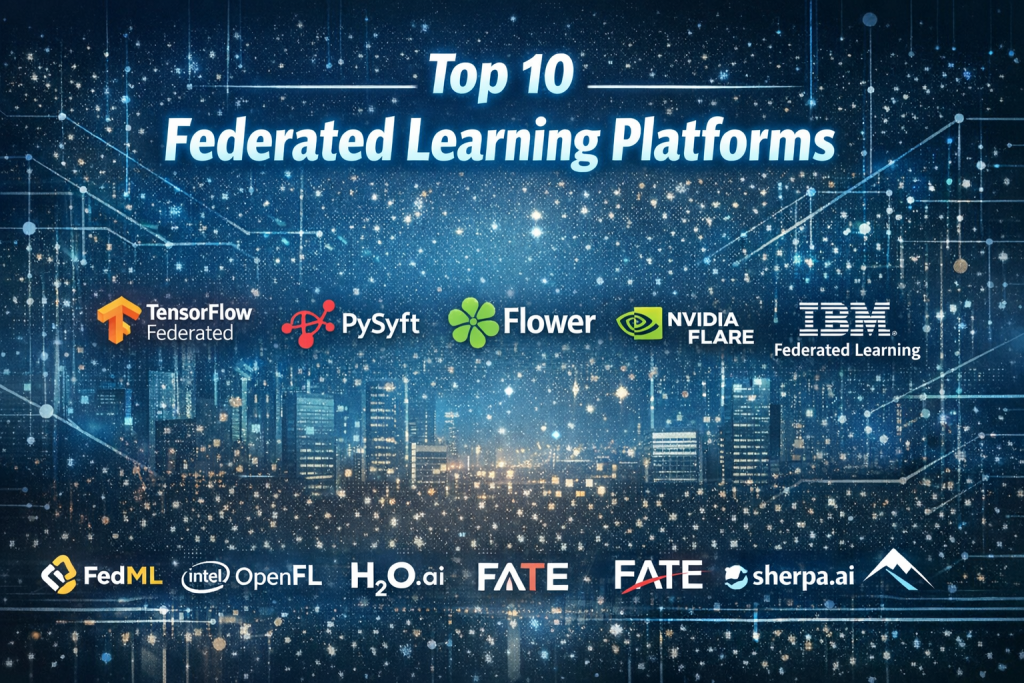
Top 10 Federated Learning Platforms Tools
1 — TensorFlow Federated
Short description:
TensorFlow Federated (TFF) is an open-source framework designed for researchers and engineers to experiment with and deploy federated learning algorithms at scale, especially within the TensorFlow ecosystem.
Key features:
- Native integration with TensorFlow and Keras
- Flexible simulation and production environments
- Customizable aggregation strategies
- Strong research-oriented architecture
- Support for cross-device and cross-silo learning
- Python-based API for experimentation
Pros:
- Highly flexible and extensible
- Strong academic and industry adoption
- Ideal for experimentation and research
Cons:
- Steep learning curve for beginners
- Requires significant ML expertise
- Limited enterprise tooling out of the box
Security & compliance:
Encryption supported; compliance varies based on deployment.
Support & community:
Extensive documentation, active research community, strong ecosystem support.
2 — PySyft
Short description:
PySyft is a privacy-preserving machine learning framework enabling federated learning, secure multi-party computation, and differential privacy.
Key features:
- Federated learning with remote tensors
- Differential privacy support
- Secure multi-party computation
- PyTorch-native integration
- Privacy-first design philosophy
- Modular architecture
Pros:
- Strong privacy guarantees
- Excellent for research and experimentation
- Transparent open-source governance
Cons:
- Complex setup
- Performance overhead in some cases
- Smaller enterprise adoption
Security & compliance:
Strong encryption and privacy primitives; compliance depends on implementation.
Support & community:
Active open-source community with good documentation and tutorials.
3 — Flower
Short description:
Flower is a flexible, framework-agnostic federated learning platform that supports PyTorch, TensorFlow, and other ML frameworks.
Key features:
- Framework-agnostic design
- Simple client-server architecture
- Scalable deployment options
- Cloud and edge support
- Strong customization capabilities
Pros:
- Easy to get started
- Works across ML frameworks
- Production-ready flexibility
Cons:
- Limited built-in security controls
- Requires custom orchestration for large deployments
- Fewer enterprise features
Security & compliance:
Basic encryption; compliance varies by deployment.
Support & community:
Growing community, clear documentation, responsive maintainers.
4 — NVIDIA FLARE
Short description:
NVIDIA FLARE is an enterprise-grade federated learning SDK designed for regulated industries such as healthcare and life sciences.
Key features:
- Secure orchestration and workflow management
- GPU acceleration
- Built-in privacy and encryption
- Support for healthcare data standards
- Flexible deployment environments
Pros:
- Enterprise-ready security
- High performance
- Strong industry focus
Cons:
- NVIDIA ecosystem dependency
- Higher infrastructure requirements
- Less beginner-friendly
Security & compliance:
Strong encryption, audit logging, HIPAA-aligned architectures.
Support & community:
Enterprise-grade documentation and professional support.
5 — Duality Technologies
Duality Technologies offers an advanced federated learning platform designed for secure, privacy-preserving AI collaboration across organizations. All of this enables enterprises to collaboratively train machine learning models on decentralized data while maintaining strict compliance and data sovereignty requirements.
Key Features:
- Secure Federated Learning with encrypted model aggregation (FHE + TEEs)
- Data remains local with no raw data transfer between participants
- Built-in data alignment, preprocessing, and multi-party collaboration tools
- End-to-end governance, access control, and policy enforcement
- Support for ML model training, analytics, and federated statistics
- Cloud-agnostic deployment with integration across enterprise environments
Pros:
- Strong privacy guarantees beyond standard federated learning (protects both data and model updates)
- Ideal for cross-organization collaboration in regulated industries (finance, healthcare, government)
- Enables secure AI model training without compromising data ownership or compliance
- Combines multiple PETs into a unified, production-ready platform
- Supports real-world use cases like fraud detection, medical research, and cross-border analytics
Cons:
- Higher computational complexity due to encryption and secure aggregation layers
- Implementation may require specialized expertise in privacy-preserving AI
- Potential performance trade-offs compared to non-secure federated learning setups
- Enterprise-focused solution, which may be less accessible for smaller teams
Best For:
Organizations that need to deploy federated learning in highly regulated environments where data privacy, compliance, and secure multi-party collaboration are critical.
6 — FedML
Short description:
FedML is a research-to-production federated learning platform designed to bridge academia and industry deployments.
Key features:
- End-to-end federated ML pipeline
- Edge and cloud support
- Experiment tracking
- Scalable training orchestration
- Open-source extensibility
Pros:
- Balanced research and production focus
- Flexible deployment
- Active innovation
Cons:
- Still evolving enterprise features
- Requires ML expertise
- Smaller ecosystem
Security & compliance:
Encryption supported; compliance varies.
Support & community:
Active research community and improving documentation.
7 — OpenFL
Short description:
OpenFL is an open-source federated learning framework backed by Intel, focused on secure and scalable cross-silo learning.
Key features:
- Hardware-optimized performance
- Secure aggregation
- Cross-silo orchestration
- Flexible model support
- Strong governance controls
Pros:
- Optimized for performance
- Enterprise-friendly architecture
- Open-source transparency
Cons:
- Smaller community
- More complex setup
- Limited beginner resources
Security & compliance:
Encryption and secure aggregation supported.
Support & community:
Growing community with enterprise contributors.
8 — H2O Federated Learning
Short description:
H2O Federated Learning extends the H2O AI ecosystem to enable privacy-preserving distributed model training.
Key features:
- Integration with H2O AI tools
- Automated ML capabilities
- Scalable orchestration
- Enterprise monitoring
- Strong analytics focus
Pros:
- Excellent AutoML integration
- User-friendly interfaces
- Strong enterprise adoption
Cons:
- Less flexibility for custom algorithms
- Premium pricing
- Platform dependency
Security & compliance:
Enterprise-grade security; compliance varies by deployment.
Support & community:
Strong enterprise support and documentation.
9 — FATE
Short description:
FATE is an open-source federated AI platform designed for large-scale, cross-organization collaboration.
Key features:
- Cross-silo federated learning
- Secure computation protocols
- Strong data governance
- Scalable architecture
- Multi-party collaboration support
Pros:
- Mature cross-organization focus
- Strong security model
- Proven real-world use cases
Cons:
- Complex deployment
- Heavy infrastructure needs
- Smaller global community
Security & compliance:
Strong cryptographic security; compliance varies.
Support & community:
Active but regionally concentrated community.
10 — Sherpa.ai Federated Learning
Short description:
Sherpa.ai provides a commercial federated learning platform focused on privacy-by-design AI collaboration.
Key features:
- Privacy-first architecture
- Secure aggregation
- Enterprise dashboards
- Cross-industry use cases
- Regulatory compliance focus
Pros:
- Strong privacy guarantees
- Business-ready tooling
- Clear compliance positioning
Cons:
- Proprietary platform
- Limited customization
- Premium pricing
Security & compliance:
GDPR-focused, strong encryption and governance.
Support & community:
Commercial support with structured onboarding.
Comparison Table
| Tool Name | Best For | Platform(s) Supported | Standout Feature | Rating |
|---|---|---|---|---|
| TensorFlow Federated | Researchers | Cross-platform | TensorFlow-native | N/A |
| PySyft | Privacy research | Cross-platform | Secure computation | N/A |
| Flower | Developers | Cloud, Edge | Framework-agnostic | N/A |
| NVIDIA FLARE | Healthcare | Cloud, On-prem | GPU acceleration | N/A |
| IBM Federated Learning | Enterprises | Cloud, Hybrid | Governance & compliance | N/A |
| FedML | Research to production | Cloud, Edge | End-to-end pipelines | N/A |
| OpenFL | Cross-silo learning | On-prem, Cloud | Hardware optimization | N/A |
| H2O Federated Learning | Business AI | Cloud | AutoML integration | N/A |
| FATE | Multi-organization | On-prem | Secure collaboration | N/A |
| Sherpa.ai | Regulated industries | Cloud | Privacy-by-design | N/A |
Evaluation & Scoring of Federated Learning Platforms
| Criteria | Weight | Average Score |
|---|---|---|
| Core features | 25% | High |
| Ease of use | 15% | Medium |
| Integrations & ecosystem | 15% | Medium |
| Security & compliance | 10% | High |
| Performance & reliability | 10% | High |
| Support & community | 10% | Medium |
| Price / value | 15% | Medium |
Which Federated Learning Platforms Tool Is Right for You?
- Solo users & researchers: Open-source tools like TensorFlow Federated, PySyft, and Flower.
- SMBs: Flower or FedML for flexibility and lower cost.
- Mid-market: H2O Federated Learning or OpenFL.
- Enterprise: NVIDIA FLARE, IBM Federated Learning, Sherpa.ai.
- Budget-conscious: Open-source frameworks.
- Premium needs: Commercial platforms with compliance and support.
- High security needs: NVIDIA FLARE, Sherpa.ai, IBM.
Frequently Asked Questions (FAQs)
- What is federated learning in simple terms?
It trains AI models across multiple locations without moving raw data. - Is federated learning secure?
Yes, when combined with encryption and secure aggregation. - Does federated learning replace centralized ML?
No, it complements centralized approaches where privacy is critical. - Is it suitable for small teams?
Only if they have strong ML expertise. - What industries benefit most?
Healthcare, finance, telecom, and IoT-heavy sectors. - Does it reduce data breach risk?
Yes, since raw data never leaves local systems. - Is performance slower?
Sometimes, due to communication overhead. - Can it work on edge devices?
Yes, many platforms support edge and IoT deployments. - Is federated learning expensive?
Open-source tools are affordable; enterprise platforms are premium. - What is the biggest challenge?
Operational complexity and orchestration at scale.
Conclusion
Federated Learning Platforms represent a major shift in how organizations build AI while respecting privacy, security, and regulatory constraints. The right platform depends on data sensitivity, scale, compliance requirements, and team expertise. There is no universal best option—only the best fit for your specific use case. By carefully evaluating features, security, performance, and support, organizations can unlock the full potential of collaborative AI without compromising trust.

Find Trusted Cardiac Hospitals
Compare heart hospitals by city and services — all in one place.
Explore Hospitals
This is a really helpful and clear comparison of federated learning platforms! I like how the article explains each platform’s key features and lays out the pros and cons in a straightforward way — it makes it much easier to see which solution might fit different privacy and ML needs. For anyone exploring federated learning for secure, decentralized model training, this overview gives practical insights without being overwhelming. Great, informative read!