
Introduction
Device Fingerprinting Tools are specialized security and analytics solutions designed to identify, recognize, and track devices based on a unique combination of hardware, software, and behavioral attributes. Instead of relying only on cookies or IP addresses, these tools analyze signals such as browser configuration, operating system, screen resolution, fonts, network patterns, and behavioral traits to create a persistent device identity.
In today’s digital environment—where fraud, account takeovers, fake accounts, bot attacks, and policy abuse are rising—device fingerprinting has become a critical layer of defense. It is widely used in fraud prevention, cybersecurity, ad fraud detection, identity verification, risk-based authentication, and compliance-driven environments.
Key real-world use cases include:
- Preventing account takeovers and credential stuffing
- Detecting bots, emulators, and spoofed devices
- Enforcing multi-account and abuse policies
- Enhancing risk-based authentication flows
- Improving trust and fraud scoring in payments and fintech
When choosing a device fingerprinting tool, buyers should evaluate accuracy, resistance to spoofing, scalability, privacy compliance, ease of integration, performance impact, and cost-to-value ratio. The right tool balances strong identification with respect for user privacy and regulatory obligations.
Best for:
Security teams, fraud prevention teams, fintech companies, SaaS platforms, e-commerce businesses, gaming platforms, ad-tech vendors, and enterprises managing high-risk user interactions.
Not ideal for:
Small static websites, blogs with no user authentication, low-risk internal tools, or teams that only need basic analytics where device-level identification is unnecessary.
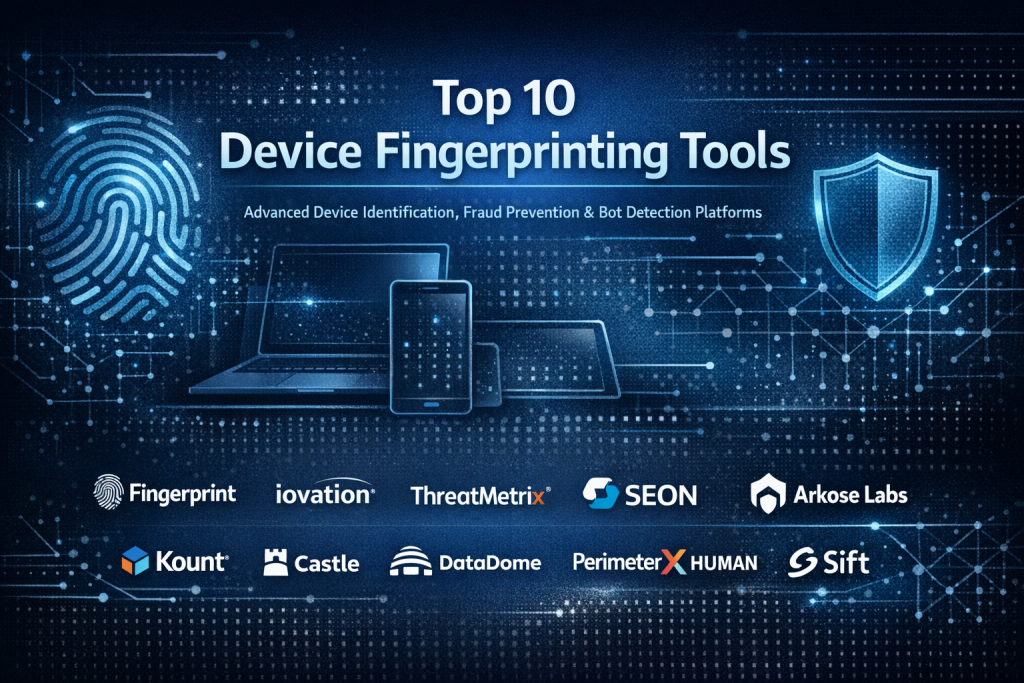
Top 10 Device Fingerprinting Tools
1 — Fingerprint
Short description:
Fingerprint is a developer-focused device identification platform built to deliver high-accuracy, long-lasting device fingerprints even in challenging environments.
Key features
- Advanced browser and device fingerprinting
- High resistance to VPNs, incognito mode, and spoofing
- Real-time device intelligence API
- Bot and fraud detection capabilities
- Mobile and desktop coverage
- Lightweight SDKs for web and backend
Pros
- Very high accuracy and stability
- Developer-friendly documentation
Cons
- Pricing may be high for startups
- Requires engineering involvement
Security & compliance:
GDPR support, encryption in transit, SOC-aligned controls (varies by plan)
Support & community:
Strong documentation, active developer community, responsive enterprise support
2 — iovation
Short description:
iovation is an enterprise-grade device intelligence platform focused on fraud prevention and digital identity trust.
Key features
- Persistent device reputation database
- Fraud network detection
- Risk scoring and decision rules
- Integration with identity and payment platforms
- Cross-industry threat intelligence
- Global device graph
Pros
- Proven at enterprise scale
- Strong fraud intelligence network
Cons
- Complex onboarding
- Enterprise-level pricing
Security & compliance:
SOC 2, GDPR, ISO-aligned controls
Support & community:
Dedicated account teams, enterprise onboarding, professional services
3 — ThreatMetrix
Short description:
ThreatMetrix provides digital identity and device intelligence for financial services and high-risk industries.
Key features
- Behavioral biometrics
- Device fingerprinting and profiling
- Real-time fraud scoring
- Global threat network
- Adaptive authentication support
- API-first architecture
Pros
- Excellent for financial fraud detection
- Strong global threat data
Cons
- Heavy enterprise focus
- Less suitable for small teams
Security & compliance:
SOC 2, GDPR, financial-grade compliance
Support & community:
Enterprise support, training programs, limited community presence
4 — SEON
Short description:
SEON is a flexible fraud prevention platform combining device fingerprinting with behavioral and transactional signals.
Key features
- Device and browser fingerprinting
- Email, IP, and phone risk signals
- Rule-based and ML-based scoring
- No-code workflow builder
- E-commerce and fintech integrations
Pros
- Easy to configure
- Balanced pricing for SMBs
Cons
- Less advanced spoofing resistance
- Some features locked behind tiers
Security & compliance:
GDPR-ready, encryption in transit
Support & community:
Good documentation, responsive customer support, onboarding assistance
5 — Arkose Labs
Short description:
Arkose Labs focuses on bot mitigation and abuse prevention, using device fingerprinting as part of a broader defense strategy.
Key features
- Device fingerprinting for bot detection
- Risk-based challenges
- Behavioral analysis
- Global attack telemetry
- Real-time abuse prevention
Pros
- Strong bot defense capabilities
- Low friction for legitimate users
Cons
- Not pure fingerprinting-only
- Higher cost for advanced plans
Security & compliance:
SOC 2, GDPR, ISO-aligned controls
Support & community:
Enterprise-grade support, onboarding specialists
6 — Kount
Short description:
Kount delivers identity trust and device intelligence primarily for e-commerce and payments.
Key features
- Device fingerprinting and identity trust
- Machine learning fraud models
- Omnichannel fraud detection
- Payment and checkout protection
- Risk scoring dashboards
Pros
- Strong e-commerce focus
- Mature analytics and reporting
Cons
- Less flexible for custom use cases
- Enterprise pricing
Security & compliance:
PCI DSS, SOC 2, GDPR
Support & community:
Dedicated account managers, enterprise documentation
7 — Castle
Short description:
Castle provides real-time device fingerprinting and user behavior analysis for SaaS products.
Key features
- Passive device fingerprinting
- Account takeover detection
- Session anomaly detection
- Developer-friendly APIs
- SaaS-focused workflows
Pros
- Easy SaaS integration
- Low user friction
Cons
- Limited offline analytics
- Smaller ecosystem
Security & compliance:
SOC 2, GDPR-ready
Support & community:
Good onboarding, responsive support team
8 — DataDome
Short description:
DataDome specializes in real-time bot detection using device fingerprinting and behavioral signals.
Key features
- Advanced device fingerprinting
- AI-based bot classification
- CDN and API protection
- Real-time dashboards
- Low latency processing
Pros
- Excellent performance
- Strong bot accuracy
Cons
- Focused mainly on bots
- Less identity-centric
Security & compliance:
GDPR, SOC 2-aligned practices
Support & community:
Enterprise support, technical onboarding
9 — PerimeterX (now Human Security)
Short description:
PerimeterX delivers client-side security and device intelligence for web and mobile applications.
Key features
- Device fingerprinting
- Client-side attack detection
- Behavioral analytics
- API and mobile protection
- Threat intelligence feeds
Pros
- Strong mobile protection
- Advanced behavioral analysis
Cons
- Complex setup
- Premium pricing
Security & compliance:
SOC 2, GDPR, ISO-aligned
Support & community:
Enterprise support, limited open community
10 — Sift
Short description:
Sift combines device fingerprinting, behavioral analytics, and machine learning for fraud prevention.
Key features
- Cross-device identity tracking
- Machine-learning fraud models
- Behavioral fingerprinting
- Marketplace and SaaS focus
- Risk-based decisioning
Pros
- Powerful ML models
- Scales well for marketplaces
Cons
- Less transparency in scoring
- Higher learning curve
Security & compliance:
SOC 2, GDPR, ISO-aligned controls
Support & community:
Strong enterprise support, training resources
Comparison Table
| Tool Name | Best For | Platform(s) Supported | Standout Feature | Rating |
|---|---|---|---|---|
| Fingerprint | Developers, SaaS | Web, API | High-accuracy fingerprinting | N/A |
| iovation | Enterprises | Web, Mobile | Global device reputation | N/A |
| ThreatMetrix | Financial services | Web, Mobile | Digital identity intelligence | N/A |
| SEON | SMBs, E-commerce | Web, API | No-code fraud rules | N/A |
| Arkose Labs | Bot mitigation | Web, Mobile | Risk-based challenges | N/A |
| Kount | E-commerce | Web, Payments | Identity trust network | N/A |
| Castle | SaaS platforms | Web, API | Passive fingerprinting | N/A |
| DataDome | Bot protection | Web, API | Low-latency detection | N/A |
| PerimeterX | App security | Web, Mobile | Client-side protection | N/A |
| Sift | Marketplaces | Web, API | ML-driven trust scores | N/A |
Evaluation & Scoring of Device Fingerprinting Tools
| Criteria | Weight | Score Explanation |
|---|---|---|
| Core features | 25% | Accuracy, spoofing resistance, device stability |
| Ease of use | 15% | SDKs, documentation, setup effort |
| Integrations & ecosystem | 15% | APIs, SDKs, platform compatibility |
| Security & compliance | 10% | Regulatory readiness, encryption |
| Performance & reliability | 10% | Latency, uptime, scalability |
| Support & community | 10% | Onboarding, documentation |
| Price / value | 15% | ROI relative to cost |
Which Device Fingerprinting Tool Is Right for You?
- Solo users & startups: Lightweight, developer-friendly tools with simple APIs and predictable pricing
- SMBs: Balanced platforms combining fingerprinting with fraud rules and dashboards
- Mid-market: Tools offering scalability, integrations, and configurable workflows
- Enterprise: Platforms with global intelligence networks, compliance certifications, and SLAs
Budget-conscious teams should prioritize ease of use and pricing transparency.
Premium buyers benefit from higher accuracy, global data, and enterprise support.
Security-driven organizations should focus on compliance, auditability, and spoofing resistance.
Frequently Asked Questions (FAQs)
1. What is device fingerprinting?
It is a technique used to uniquely identify devices based on technical and behavioral attributes.
2. Is device fingerprinting legal?
Yes, when implemented with transparency and compliance with privacy regulations.
3. How accurate is device fingerprinting?
Accuracy varies by tool, data signals, and resistance to spoofing.
4. Does it replace cookies?
It complements or replaces cookies in environments where cookies are unreliable.
5. Can users block device fingerprinting?
Advanced tools are designed to remain effective despite common evasion methods.
6. Is device fingerprinting GDPR-compliant?
Most vendors provide compliance features, but implementation matters.
7. Does it impact website performance?
High-quality tools are optimized for low latency.
8. Is it suitable for mobile apps?
Many platforms support both web and mobile environments.
9. How long do fingerprints last?
Persistence depends on signal stability and user behavior.
10. What are common mistakes?
Over-reliance on a single signal and ignoring privacy requirements.
Conclusion
Device fingerprinting has become a core capability in modern digital security and fraud prevention strategies. The tools covered in this guide vary widely—from developer-centric APIs to enterprise-scale intelligence networks.
The most important takeaway is that there is no universal “best” tool. The right choice depends on your risk profile, scale, regulatory obligations, technical resources, and budget. By aligning your requirements with the strengths of each platform, you can build a secure, scalable, and privacy-aware defense against fraud and abuse.

Find Trusted Cardiac Hospitals
Compare heart hospitals by city and services — all in one place.
Explore Hospitals
Device fingerprinting tools help businesses identify devices and spot unusual activity across digital platforms. Features like accurate device recognition, fraud detection, risk scoring, and real-time monitoring are important to compare. Privacy protection and integration with existing systems also deserve attention. A good solution should reduce suspicious activity while keeping the experience simple for genuine users.
Device fingerprinting becomes more effective when teams combine device intelligence with behavioral signals rather than relying on identification accuracy alone. Tracking false positives, fingerprint stability after browser updates, and spoofing resistance can reveal how tools perform under real conditions. Privacy safeguards and clear risk-scoring rules also deserve attention, as they help prevent fraud without creating unnecessary friction for legitimate users.
Device fingerprinting tools add a silent layer of fraud detection, and this article covers the best ones. I appreciate the focus on accuracy and privacy considerations. Fraud prevention teams will find this insightful.
Implementing device fingerprinting tools requires balancing high-accuracy fraud detection with strict user privacy regulations. While comprehensive enterprise platforms offer advanced behavioral tracking and multi-layered identifier synthesis, they can introduce complex regulatory hurdles regarding data compliance. Lighter or specialized solutions often provide a more practical approach for teams looking to mitigate risk without overloading their architecture. This breakdown highlights the importance of weighing detection efficacy against data governance requirements.
Device fingerprinting tools help businesses recognize devices by analyzing signals such as browser settings, operating system details, and device characteristics. These insights can support fraud detection, suspicious login monitoring, and account security without relying solely on passwords or cookies. When comparing solutions, organizations should consider detection accuracy, integration options, scalability, and the ability to adapt to changing fraud patterns. I believe device fingerprinting works best when combined with other verification methods rather than used as the only security measure. Businesses should also be transparent about data collection and ensure their approach respects user privacy.
Device fingerprinting tools need to balance accurate device recognition with user privacy. One important factor is how well they handle browser updates, shared devices, and changing network conditions without misidentifying users. I would also suggest checking how clearly they explain data collection and retention practices. Regular accuracy testing and privacy reviews can help teams reduce fraud while avoiding unnecessary tracking or false flags.
When evaluating device fingerprinting tools, I would consider how well they handle legitimate changes to a device’s configuration over time. Browser updates, operating system upgrades, privacy settings, and hardware replacements can all change the signals used to recognize a returning device. If the platform treats every change as a completely new device, users may face unnecessary verification steps, while overly aggressive matching can create incorrect associations. It is worth comparing how each tool handles fingerprint confidence, device history, and gradual changes in identifying signals. This balance is important for maintaining reliable recognition without making the user experience frustrating or creating misleading risk assessments.
Device fingerprinting tools help organizations recognize devices based on a combination of technical attributes, browser characteristics, and environmental signals. They are widely used in fraud prevention, account security, bot detection, and risk-based authentication to identify suspicious activity without relying solely on traditional identifiers. When comparing platforms, important factors include fingerprint accuracy, detection of device spoofing, cross-browser compatibility, real-time risk scoring, integration capabilities, and privacy compliance. Choosing the right solution can strengthen fraud detection and improve account protection, while responsible implementation helps balance security needs with user privacy and transparency.
Device fingerprinting tools can help identify unusual login patterns and reduce account abuse, but accuracy and privacy need equal attention. I’d compare how well each solution distinguishes returning devices from shared or frequently updated devices without flagging too many legitimate users. Clear data retention policies and compliance with regional privacy rules are also important considerations. Combining device signals with other risk indicators usually provides a more reliable picture than relying on a fingerprint alone.
Device fingerprinting tools can help identify suspicious access patterns by analyzing browser, device, and network characteristics. Their effectiveness improves when fingerprint signals are combined with behavioral analytics and risk-based authentication rather than used as the sole basis for security decisions. Organizations should also prioritize transparency, data minimization, and privacy compliance to balance fraud prevention with responsible handling of user information.
Device fingerprinting tools can help businesses identify suspicious activity by examining signals linked to a device or browser. However, these signals are not always stable or unique, especially when users change devices, update browsers, or use privacy tools. Businesses should combine fingerprinting with other risk signals instead of treating it as proof of identity. It is also important to review privacy requirements and explain how device information supports fraud prevention. When comparing platforms, teams should consider detection quality, false positives, and integration needs. A balanced approach can help identify risky activity without unfairly blocking legitimate customers.
Device fingerprinting systems should also be assessed for how easily their signals can be explained during a security review. When a transaction gets flagged, investigators need to understand which device changes influenced the decision, not just see a risk score. Keeping clear event records can help teams separate genuine threats from harmless changes in browser or device settings. It is also useful to define how long fingerprint data remains stored and who can access it. Regular audits of these controls can reduce unnecessary data collection and support compliance needs. This gives security teams better evidence when they need to justify or revisit a decision.
Device fingerprinting also raises questions about how long fingerprint records should be retained and who can access them. Keeping this data without clear limits can create privacy and compliance risks as systems grow. Engineering teams should define retention rules and review access permissions on a regular basis. It is also useful to document how fingerprint data influences decisions, especially when several services share risk signals. When a vendor changes its fingerprinting method, teams need a way to detect unexpected shifts in results. These controls help keep the system understandable, auditable, and easier to maintain over time.
Device fingerprinting becomes more effective when security teams can measure whether its signals lead to better decisions over time. A fingerprint that looks suspicious does not always indicate fraud, and confirmed attacks may still come from devices that appear trustworthy. Teams should compare risk assessments with verified investigation results, track missed attacks, and review cases that were incorrectly flagged. It is also important to account for delayed fraud reports, since a transaction may appear legitimate before a chargeback or account takeover is discovered. Regular reviews of these outcomes can help refine detection rules and reveal weaknesses that simple accuracy metrics overlook. This creates a more reliable fraud prevention process without relying too heavily on any single device signal.
Device fingerprinting tools help identify devices through a combination of technical signals, supporting fraud detection and account security. When comparing platforms, teams should evaluate detection accuracy, integration options, and their ability to recognize suspicious changes without blocking legitimate users. Privacy safeguards, transparent data practices, and regular testing are equally important for using these tools responsibly.
Analyzing hardware, software, and behavioral attributes to generate persistent device identifiers detects spoofing, botnets, and credential stuffing across digital interactions without relying on fragile cookies, strengthening risk-based authentication and stopping fraud before financial or data compromise occurs.
Device fingerprinting tools help businesses recognize devices, detect suspicious activity, and identify potential fraud across digital platforms. When comparing options, I would focus on detection accuracy, integration capabilities, real-time analysis, and privacy controls. These features can strengthen fraud prevention and improve risk assessment. The right tool should provide reliable device insights while respecting user privacy and applicable data protection requirements.
Organizations should examine how device fingerprinting data is stored, shared, and deleted throughout its lifecycle. Collecting browser and hardware signals may create privacy risks when teams retain identifiers longer than necessary or combine them with unrelated customer records. Before deployment, engineers should document which signals the system collects, restrict access to fingerprint data, and define retention periods based on legitimate business needs. They should also verify that consent settings and privacy requests work across analytics systems, backups, and third-party integrations. Regular audits can reveal unexpected data collection or retention practices before they become compliance problems. This approach helps businesses balance fraud prevention with responsible handling of user information.
Beyond choosing the right software vendor, the real challenge with device fingerprinting often lies in balancing robust fraud detection against the constant evolution of browser privacy controls and anti-tracking extensions. As modern browsers tighten restrictions on canvas and audio fingerprinting to protect user privacy, relying solely on static hardware signals can lead to higher false positive rates over time. Integrating behavioral biometrics alongside traditional device attributes is becoming essential for maintaining long-term identification stability without compromising user experience or regulatory compliance.
Device fingerprinting tools can help identify suspicious devices and detect repeated fraud attempts, even when users change certain browser or network details. However, fingerprints are not always stable, and shared devices or browser updates can lead to incorrect matches. I would recommend combining fingerprint signals with behavioral analysis and other risk indicators rather than using them as the sole basis for blocking access. Clear data retention rules and privacy safeguards are equally important. How can organizations use device fingerprinting effectively while minimizing false positives and protecting user privacy?
Device fingerprinting tools can help identify suspicious activity when fraudsters switch accounts or clear browser cookies to avoid detection. The challenge is distinguishing genuine returning users from people whose devices or browser settings have changed naturally. Comparing detection accuracy, privacy controls, and false-positive handling is important so businesses can investigate unusual behavior without unnecessarily blocking legitimate customers.
Good list and a useful comparison for anyone exploring device fingerprinting solutions. It helps readers understand how these tools support device identification, fraud detection, and account security. One provider worth considering is Fingerprint, which offers device identification technology to help businesses detect suspicious activity, reduce fraud, and recognize returning visitors across digital platforms.