
Introduction
Bug Bounty Platforms are structured programs that allow organizations to invite ethical hackers and security researchers to discover vulnerabilities in their applications, networks, and digital assets. Instead of relying only on internal security teams or periodic penetration tests, these platforms enable continuous, real-world security testing by a diverse global community of experts.
The importance of bug bounty programs has grown rapidly as attack surfaces expand across cloud infrastructure, APIs, mobile apps, and third-party integrations. Modern cyberattacks are sophisticated, fast-moving, and often exploit overlooked edge cases. Bug bounty platforms help organizations identify vulnerabilities before attackers do, reducing breach risk, downtime, and reputational damage.
Common real-world use cases include:
- Discovering critical vulnerabilities missed by automated scanners
- Validating security posture before major product launches
- Meeting compliance and security maturity goals
- Scaling security testing without building large in-house teams
When choosing a Bug Bounty Platform, buyers should evaluate researcher quality, program management features, reporting workflows, integrations, pricing models, compliance readiness, and enterprise governance controls.
Best for:
Security teams, CISOs, DevSecOps teams, SaaS companies, fintech firms, healthcare platforms, e-commerce businesses, and enterprises with complex digital environments.
Not ideal for:
Very small teams with no public-facing assets, organizations without internal remediation capacity, or teams seeking only one-time vulnerability scans rather than continuous testing.
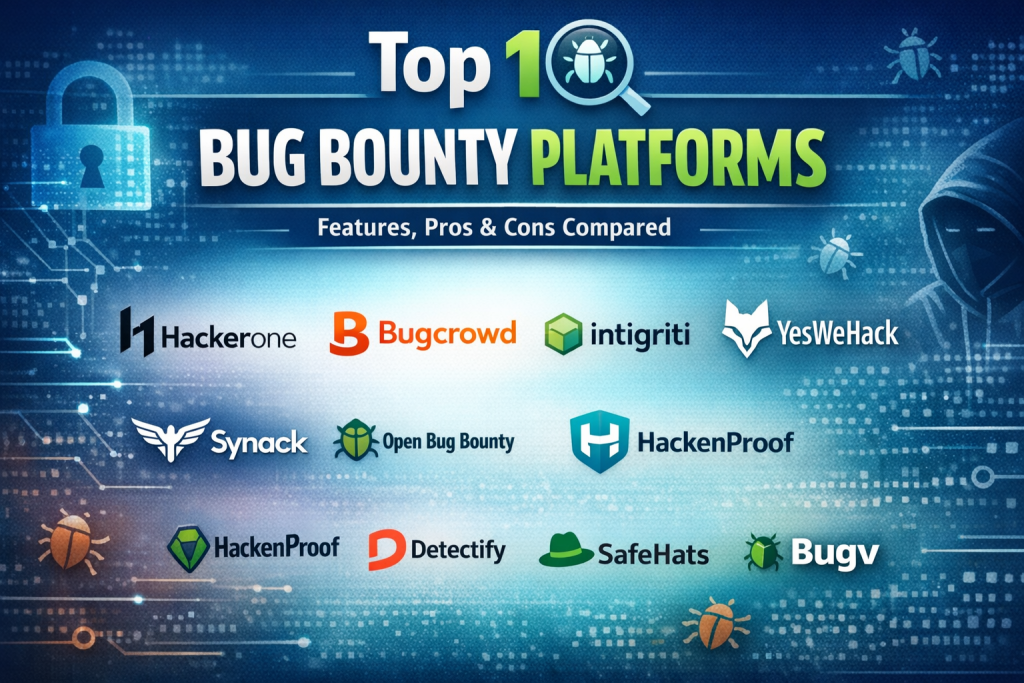
Top 10 Bug Bounty Platforms Tools
1 — HackerOne
Short description:
A leading bug bounty and vulnerability disclosure platform trusted by global enterprises and government agencies.
Key features:
- Access to one of the largest vetted hacker communities
- Public and private bounty programs
- Vulnerability disclosure and coordinated disclosure workflows
- Automated triage and severity scoring
- Rich analytics and reporting dashboards
- Integrations with popular DevSecOps tools
Pros:
- Extremely mature ecosystem and processes
- High-quality vulnerability submissions
Cons:
- Premium pricing for enterprise plans
- Requires internal maturity to manage volume
Security & compliance:
SOC 2, GDPR, SSO, encryption, audit logs
Support & community:
Extensive documentation, enterprise onboarding, strong global researcher community
2 — Bugcrowd
Short description:
A crowdsourced security platform offering bug bounty, penetration testing, and attack surface management.
Key features:
- Curated researcher access
- Flexible program scopes
- Integrated penetration testing services
- Advanced vulnerability triage
- Risk-based prioritization
- Attack surface discovery
Pros:
- Strong balance between quality and control
- Enterprise-friendly workflows
Cons:
- Higher cost compared to smaller platforms
- Less suitable for very small teams
Security & compliance:
SOC 2, GDPR, SSO, encryption
Support & community:
Dedicated success managers, active researcher base, solid enterprise support
3 — Intigriti
Short description:
A Europe-focused bug bounty platform emphasizing quality research and strong privacy standards.
Key features:
- Carefully vetted ethical hackers
- Private and public bounty programs
- Compliance-focused workflows
- Structured disclosure processes
- Real-time reporting dashboards
Pros:
- High signal-to-noise ratio
- Strong GDPR alignment
Cons:
- Smaller community than US-based giants
- Limited third-party integrations
Security & compliance:
GDPR, ISO-aligned practices, encryption
Support & community:
Responsive support, curated researcher community
4 — YesWeHack
Short description:
A European bug bounty and vulnerability disclosure platform focused on trust, transparency, and compliance.
Key features:
- Public and private programs
- Vulnerability disclosure programs (VDP)
- Compliance-oriented workflows
- Researcher reputation scoring
- Reporting and analytics
Pros:
- Strong governance model
- Ideal for regulated industries
Cons:
- Smaller hacker pool
- Less automation than premium platforms
Security & compliance:
GDPR, ISO 27001-aligned, audit logs
Support & community:
Good documentation, growing European security community
5 — Synack
Short description:
A managed bug bounty-style platform combining vetted researchers with enterprise oversight.
Key features:
- Invite-only elite researcher network
- Managed vulnerability testing
- Continuous security validation
- Strong governance and reporting
- Compliance-ready workflows
Pros:
- Very high quality findings
- Strong enterprise trust
Cons:
- Expensive compared to open platforms
- Less community-driven flexibility
Security & compliance:
SOC 2, ISO, HIPAA-ready, GDPR
Support & community:
White-glove enterprise support, limited but elite researcher base
6 — Open Bug Bounty
Short description:
An open vulnerability disclosure platform focused on responsible disclosure without monetary rewards.
Key features:
- Free vulnerability disclosure
- Community-driven reporting
- Public transparency model
- Basic vulnerability tracking
- No bounty payments
Pros:
- Cost-effective for disclosure programs
- Easy to start
Cons:
- No financial incentives for researchers
- Limited enterprise features
Security & compliance:
Varies / N/A
Support & community:
Community-based support, limited enterprise assistance
7 — HackenProof
Short description:
A bug bounty platform popular in blockchain, Web3, and crypto ecosystems.
Key features:
- Crypto-focused security researchers
- Smart contract testing support
- Public and private bounties
- Integrated disclosure workflows
- Reporting dashboards
Pros:
- Strong Web3 expertise
- Competitive pricing
Cons:
- Less suited for traditional enterprises
- Smaller overall community
Security & compliance:
Varies by program, encryption supported
Support & community:
Active Web3 community, moderate documentation
8 — Detectify Crowdsource
Short description:
A crowdsourced testing add-on complementing automated vulnerability scanning.
Key features:
- Hybrid automated + human testing
- Continuous security assessments
- Rapid feedback loops
- Web application focus
- Simple reporting interface
Pros:
- Easy to integrate with existing workflows
- Good for web apps
Cons:
- Limited scope beyond web applications
- Smaller researcher diversity
Security & compliance:
GDPR, encryption
Support & community:
Good documentation, responsive support
9 — SafeHats
Short description:
A cost-effective bug bounty platform targeting startups and mid-sized organizations.
Key features:
- Public and private programs
- Simple vulnerability workflows
- Affordable pricing tiers
- Researcher ranking system
- Reporting dashboards
Pros:
- Budget-friendly
- Simple onboarding
Cons:
- Limited enterprise governance features
- Smaller researcher pool
Security & compliance:
Basic encryption, varies by plan
Support & community:
Basic support, growing community
10 — Bugv
Short description:
An emerging bug bounty platform focusing on accessibility and flexible program management.
Key features:
- Public and private programs
- Flexible reward models
- Researcher collaboration tools
- Reporting and tracking
- Simple UI
Pros:
- Easy to use
- Flexible program design
Cons:
- Limited enterprise references
- Smaller ecosystem
Security & compliance:
Varies / N/A
Support & community:
Basic documentation, early-stage community
Comparison Table
| Tool Name | Best For | Platform(s) Supported | Standout Feature | Rating |
|---|---|---|---|---|
| HackerOne | Large enterprises | Web | Largest hacker community | N/A |
| Bugcrowd | Enterprise security teams | Web | Crowdsourced + pentest | N/A |
| Intigriti | GDPR-focused orgs | Web | High-quality EU researchers | N/A |
| YesWeHack | Regulated industries | Web | Compliance-first approach | N/A |
| Synack | Highly regulated enterprises | Web | Managed elite testing | N/A |
| Open Bug Bounty | Disclosure programs | Web | Free vulnerability disclosure | N/A |
| HackenProof | Web3 & blockchain | Web | Smart contract expertise | N/A |
| Detectify Crowdsource | Web apps | Web | Hybrid testing model | N/A |
| SafeHats | SMBs & startups | Web | Affordable pricing | N/A |
| Bugv | Emerging teams | Web | Flexible workflows | N/A |
Evaluation & Scoring of Bug Bounty Platforms
| Criteria | Weight | Description |
|---|---|---|
| Core features | 25% | Program management, reporting, triage |
| Ease of use | 15% | Setup, UI, workflows |
| Integrations & ecosystem | 15% | DevSecOps and ticketing tools |
| Security & compliance | 10% | SSO, audit logs, certifications |
| Performance & reliability | 10% | Platform stability, response times |
| Support & community | 10% | Researcher base and vendor support |
| Price / value | 15% | ROI, flexibility, transparency |
Which Bug Bounty Platforms Tool Is Right for You?
- Solo users / startups: Look for affordable, simple platforms with low overhead
- SMBs: Balanced pricing with private programs and managed triage
- Mid-market: Strong integrations, analytics, and researcher quality
- Enterprise: Managed programs, compliance certifications, and governance controls
Choose based on budget vs depth, community size vs quality, and integration needs vs operational simplicity.
Frequently Asked Questions (FAQs)
- What is a bug bounty platform?
A service that connects organizations with ethical hackers to discover security vulnerabilities. - Are bug bounties better than penetration tests?
They complement each other. Bug bounties provide continuous testing, while pentests are time-bound. - Do I need to pay rewards?
Most platforms require bounties, but disclosure-only models exist. - Is it safe to invite external hackers?
Yes, when programs are well-scoped and rules are clearly defined. - How long does it take to see results?
Some vulnerabilities are reported within hours of launch. - Can small companies run bug bounties?
Yes, with private or invite-only programs. - What skills do researchers have?
Researchers range from web security experts to cloud and API specialists. - Are bug bounty platforms compliant with regulations?
Many support GDPR, SOC 2, and enterprise security requirements. - How do I avoid low-quality reports?
Use vetted researchers and strong triage workflows. - Can bug bounties replace internal security teams?
No. They enhance, not replace, internal security efforts.
Conclusion
Bug Bounty Platforms have become a critical component of modern cybersecurity strategies. They provide continuous, real-world testing that traditional tools and audits often miss. However, the best platform is not universal—it depends on organizational size, budget, compliance needs, and internal security maturity.
By focusing on researcher quality, governance features, integration capabilities, and value for money, organizations can select a platform that significantly strengthens their security posture while maximizing return on investment.

Find Trusted Cardiac Hospitals
Compare heart hospitals by city and services — all in one place.
Explore Hospitals
This is a great comparison of bug bounty platforms — it clearly outlines the key features, advantages, and limitations of each option, which makes it easier for security professionals and organizations to evaluate what fits their needs. Understanding differences in reward models, vulnerability visibility, community size, and tooling support can help teams choose a platform that aligns with their risk profile and security goals. Overall, the breakdown offers useful insights for anyone looking to strengthen their security posture through ethical hacking and responsible disclosure programs.