
Introduction
Root Cause Analysis (RCA) tools help teams identify the true underlying causes of incidents, failures, defects, and recurring problems—rather than just treating symptoms. In modern IT, manufacturing, healthcare, aviation, finance, and operations-heavy environments, incidents are complex and interconnected. A single outage, quality issue, or safety event can cascade across systems, teams, and customers.
RCA tools bring structure, repeatability, and evidence-based analysis to post-incident reviews. They combine methodologies like 5 Whys, Fishbone (Ishikawa), Fault Tree Analysis (FTA), timelines, correlations, and data-driven insights to pinpoint why something happened and what must change to prevent recurrence.
Why RCA tools matter
- Reduce repeat incidents and operational waste
- Improve reliability, safety, and customer trust
- Enable learning-driven cultures and blameless postmortems
- Support compliance, audits, and continuous improvement
Common real-world use cases
- IT incidents, outages, and performance degradation
- Manufacturing defects and quality escapes
- Healthcare adverse events and patient safety
- Aviation, energy, and infrastructure failure analysis
- Process inefficiencies and recurring operational errors
What to look for when choosing an RCA tool
- Depth of RCA methodologies supported
- Ease of use for cross-functional teams
- Data ingestion and integrations
- Collaboration, reporting, and auditability
- Security, compliance, and scalability
Best for:
DevOps teams, SREs, quality engineers, safety officers, healthcare administrators, manufacturing leaders, and enterprises managing complex systems with recurring incidents.
Not ideal for:
Very small teams with infrequent issues, ad-hoc problem solving needs, or scenarios where simple checklists or spreadsheets are sufficient.
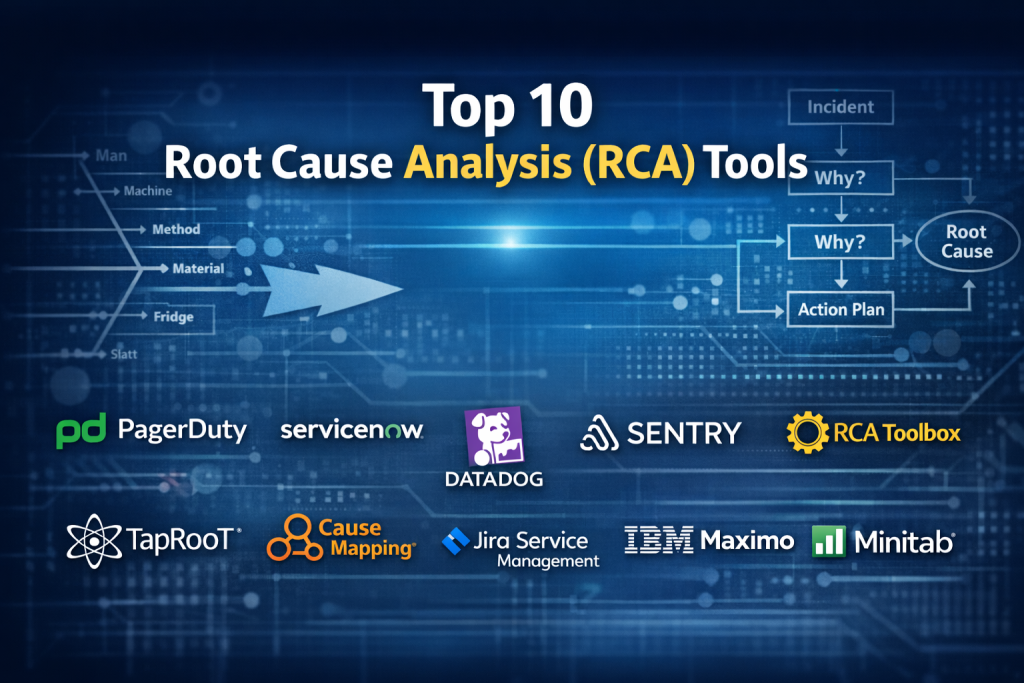
Top 10 Root Cause Analysis (RCA) Tools
1 — PagerDuty
Short description:
An incident response and operations platform with strong post-incident analysis and RCA workflows, widely used by DevOps and SRE teams.
Key features
- Incident timelines and event correlation
- Post-incident review templates
- Automation-driven root cause insights
- Integration with monitoring and alerting tools
- Collaboration and stakeholder reporting
- Historical incident trend analysis
Pros
- Excellent for real-time IT incidents
- Strong ecosystem and integrations
Cons
- Less suitable for non-IT RCA use cases
- Can be expensive for smaller teams
Security & compliance:
SSO, RBAC, encryption, audit logs, SOC 2, GDPR
Support & community:
High-quality documentation, enterprise support, strong user community
2 — ServiceNow
Short description:
Enterprise service management platform with advanced RCA capabilities embedded into ITSM and ITOM workflows.
Key features
- Built-in RCA and problem management
- CMDB-driven dependency mapping
- Automated root cause suggestions
- Cross-team workflow orchestration
- Advanced reporting and dashboards
- Enterprise-scale customization
Pros
- Extremely powerful for large organizations
- Deep operational visibility
Cons
- Steep learning curve
- High implementation and licensing cost
Security & compliance:
ISO 27001, SOC 1/2, GDPR, HIPAA support
Support & community:
Extensive documentation, certified partners, global enterprise support
3 — Datadog
Short description:
Observability platform that enables fast RCA through metrics, logs, traces, and dependency analysis.
Key features
- End-to-end system observability
- Automatic anomaly detection
- Distributed tracing for causal analysis
- Unified dashboards and timelines
- AI-assisted insights
- Scalable cloud-native design
Pros
- Fast RCA for performance issues
- Excellent visualization
Cons
- Focused primarily on technical RCA
- Costs grow with data volume
Security & compliance:
SOC 2, ISO 27001, encryption, RBAC
Support & community:
Strong docs, active community, enterprise support
4 — Sentry
Short description:
Error tracking and application monitoring tool designed to identify the root causes of software crashes and bugs.
Key features
- Stack trace analysis
- Error grouping and trends
- Release-based RCA
- Context-rich debugging data
- Developer-centric workflows
- Integration with CI/CD tools
Pros
- Excellent for developers
- Fast debugging cycles
Cons
- Limited outside application errors
- Not full enterprise RCA
Security & compliance:
SOC 2, GDPR, encryption
Support & community:
Strong developer documentation, community forums
5 — RCA Toolbox
Short description:
Specialized RCA software supporting classic problem-solving methodologies across industries.
Key features
- 5 Whys, Fishbone, Fault Tree
- Structured RCA workflows
- Evidence and cause mapping
- Root cause validation
- Report generation
- Offline-friendly usage
Pros
- Methodology-focused
- Suitable for non-IT teams
Cons
- Limited automation
- Basic integrations
Security & compliance:
Varies / N/A
Support & community:
Documentation-driven support, smaller user base
6 — TapRooT
Short description:
A well-known RCA system used heavily in safety-critical industries like energy, aviation, and healthcare.
Key features
- TapRooT methodology
- Human performance analysis
- Equipment and process failure RCA
- Evidence-based investigation
- Compliance-ready reporting
- Training and certification support
Pros
- Proven in regulated environments
- Strong safety focus
Cons
- Requires training investment
- Less flexible outside methodology
Security & compliance:
ISO-aligned, audit support
Support & community:
Professional training, enterprise consulting
7 — Cause Mapping
Short description:
Visual RCA approach that focuses on cause-and-effect chains rather than assumptions.
Key features
- Visual cause mapping
- Evidence-backed analysis
- Team collaboration
- Repeat incident prevention focus
- Clear action tracking
- Industry-neutral design
Pros
- Easy to understand visually
- Strong learning culture support
Cons
- Less automation
- Limited analytics
Security & compliance:
Varies / N/A
Support & community:
Training-led support, practitioner community
8— Jira Service Management
Short description:
ITSM tool with integrated post-incident reviews and RCA documentation, ideal for agile teams.
Key features
- Incident and problem management
- Post-incident templates
- Issue linking and timelines
- Agile-friendly workflows
- Integration with Dev tools
- Custom reporting
Pros
- Easy adoption
- Strong ecosystem
Cons
- Limited advanced RCA analytics
- Requires discipline in use
Security & compliance:
SOC 2, ISO 27001, GDPR
Support & community:
Extensive documentation, large global community
9 — IBM Maximo
Short description:
Enterprise asset management platform with built-in RCA for equipment and maintenance failures.
Key features
- Asset-centric RCA
- Failure mode tracking
- Maintenance history analysis
- Predictive insights
- Enterprise reporting
- Industry compliance support
Pros
- Excellent for asset-heavy industries
- Strong analytics
Cons
- Complex implementation
- Enterprise pricing
Security & compliance:
ISO, SOC, industry compliance support
Support & community:
Enterprise-grade support and training
10 — Minitab
Short description:
Statistical analysis platform widely used for quality improvement and data-driven RCA.
Key features
- Statistical root cause identification
- Pareto and regression analysis
- Six Sigma support
- Data visualization
- Hypothesis testing
- Reporting tools
Pros
- Strong quantitative analysis
- Ideal for quality engineers
Cons
- Requires statistical knowledge
- Less workflow automation
Security & compliance:
Encryption, enterprise security options
Support & community:
Strong documentation, training resources
Comparison Table
| Tool Name | Best For | Platform(s) Supported | Standout Feature | Rating |
|---|---|---|---|---|
| PagerDuty | IT incident RCA | Web, Cloud | Incident timelines | N/A |
| ServiceNow | Enterprise ITSM | Web | CMDB-driven RCA | N/A |
| Datadog | Observability RCA | Cloud | Unified telemetry | N/A |
| Sentry | App error RCA | Web, Cloud | Stack trace clarity | N/A |
| RCA Toolbox | Method-based RCA | Desktop | Classic methodologies | N/A |
| TapRooT | Safety-critical RCA | Desktop, Enterprise | Safety methodology | N/A |
| Cause Mapping | Visual RCA | Web | Evidence-based maps | N/A |
| Jira Service Management | Agile teams | Web, Cloud | Post-incident reviews | N/A |
| IBM Maximo | Asset failures | Enterprise | Asset intelligence | N/A |
| Minitab | Statistical RCA | Desktop, Cloud | Data-driven insights | N/A |
Evaluation & Scoring of Root Cause Analysis (RCA) Tools
| Criteria | Weight | Evaluation Focus |
|---|---|---|
| Core features | 25% | RCA depth, methodologies |
| Ease of use | 15% | Learning curve, UX |
| Integrations & ecosystem | 15% | Data sources, APIs |
| Security & compliance | 10% | Enterprise readiness |
| Performance & reliability | 10% | Scalability, speed |
| Support & community | 10% | Docs, training |
| Price / value | 15% | ROI vs cost |
Which Root Cause Analysis (RCA) Tool Is Right for You?
- Solo users / small teams: Visual or methodology-focused tools with low overhead
- SMBs: Jira Service Management, Sentry, or Datadog for balanced features
- Mid-market: PagerDuty or Datadog for scale and automation
- Enterprise: ServiceNow, IBM Maximo, TapRooT
Budget-conscious: Method-based or open analysis tools
Premium solutions: Enterprise ITSM and observability platforms
Feature depth vs ease: Advanced tools offer power but need training
Integration needs: Choose tools that fit existing monitoring or asset systems
Security requirements: Regulated industries should prioritize compliance-ready platforms
Frequently Asked Questions (FAQs)
- What is an RCA tool used for?
It identifies underlying causes of incidents to prevent recurrence. - Are RCA tools only for IT?
No, they’re used in healthcare, manufacturing, aviation, and more. - Do RCA tools replace human judgment?
No, they support structured analysis and evidence gathering. - Can RCA tools reduce downtime?
Yes, by preventing repeat failures. - Are RCA tools expensive?
Costs vary from affordable to enterprise-grade. - Do they support compliance audits?
Many provide audit trails and reports. - Is training required?
Advanced tools often require onboarding. - Can RCA tools integrate with monitoring systems?
Most modern tools do. - What’s the biggest mistake in RCA?
Stopping at symptoms instead of root causes. - Is there a single best RCA tool?
No—fit depends on use case and scale.
Conclusion
Root Cause Analysis tools are essential for organizations serious about reliability, safety, and continuous improvement. The best tools go beyond documenting incidents—they enable learning, accountability, and prevention.
There is no universal winner. The right RCA tool depends on industry, team size, complexity, regulatory needs, and budget. By focusing on structured analysis, strong integrations, and usability, teams can turn failures into long-term operational strength.

Find Trusted Cardiac Hospitals
Compare heart hospitals by city and services — all in one place.
Explore Hospitals
Really helpful article! I like how you clearly explained the pros and cons of each root cause analysis tool — it makes comparing options much easier for anyone dealing with troubleshooting and reliability work. In my experience, picking the right RCA tool can save a lot of time and help teams understand patterns and issues faster, especially when systems are complex. I’d be curious to hear how others balance depth of analysis with ease of use in their real‑world workflows. Overall, this breakdown gives a great overview and is super useful for anyone exploring RCA solutions.