
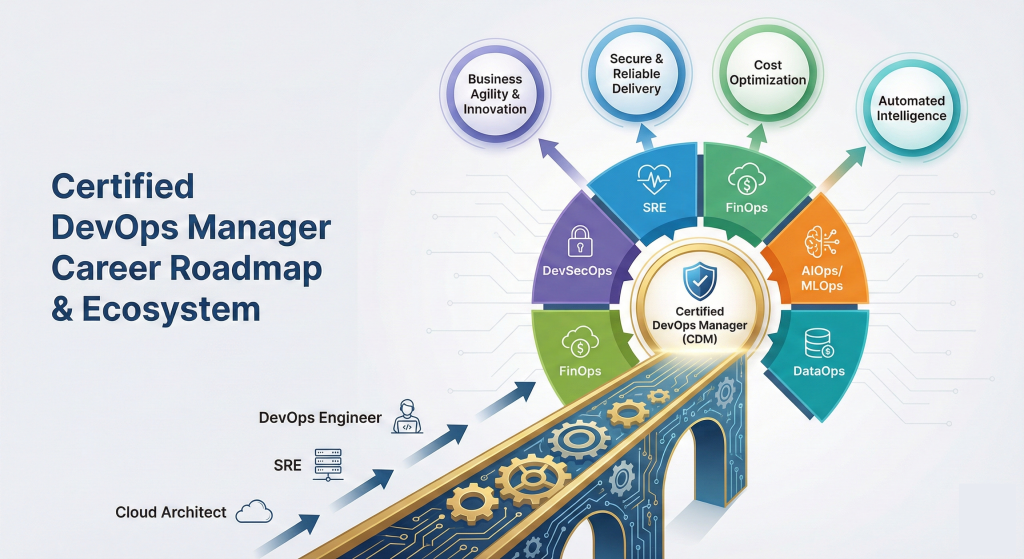
The IT industry has reached a tipping point. For years, we focused on “Engineering”—writing better code and building faster pipelines. But today, the challenge isn’t just the technology; it’s the management of that technology. Companies are struggling to find people who can bridge the gap between technical teams and business goals.
Being a DevOps Manager isn’t about being the best coder in the room. It’s about being the person who understands how code, culture, and cost all work together. This guide is designed to help you navigate the Certified DevOps Manager program and understand where the industry is heading.
The Certification Landscape
If you are looking at the professional landscape, you need to know which track fits your current skills and your future goals. Here is a breakdown of the core certifications available today.
| Track | Level | Who it’s for | Prerequisites | Skills Covered | Recommended Order |
| DevOps | Professional | Engineers / Leads | Basic Linux & Git | CI/CD, Docker, K8s, Ansible | Foundation → Manager |
| SRE | Specialist | Ops Engineers | DevOps Basics | Error Budgets, SLIs, SLOs | DevOps → SRE |
| DevSecOps | Specialist | Security / Devs | Pipeline Basics | SAST, DAST, Compliance | DevOps → DevSecOps |
| AIOps | Advanced | Data / Ops | Python & DevOps | ML for Monitoring, Automation | SRE → AIOps |
| FinOps | Specialist | Finance / Managers | Cloud Basics | Cost Optimization, Governance | Manager → FinOps |
| DataOps | Specialist | Data Engineers | SQL & DevOps | Data Pipelines, Quality | Data Eng → DataOps |
Deep Dive: Certified DevOps Manager (CDM)
This is the flagship program for anyone aiming for a leadership role. Let’s break down exactly what this certification entails.
What it is
The Certified DevOps Manager program is a leadership-centric certification. While most certifications focus on how to use a tool (like Jenkins or Terraform), this one focuses on how to manage the people and the strategy using those tools. It is about organizational transformation and high-level architecture.
Who should take it & Provider Deep Intro
This program is provided by DevOpsSchool, one of the oldest and most respected training institutions in the DevOps space. DevOpsSchool has spent years training thousands of engineers from top Fortune 500 companies. They don’t just teach theory; they provide a “lab-first” approach.
This certification is specifically built for:
- Senior Software Engineers looking to move into management.
- Current IT Managers who need to understand the modern DevOps culture.
- Project Managers and Scrum Masters who want to lead technical delivery teams.
- CTOs and Directors of small-to-medium startups.
Skills you’ll gain
- Strategic ROI Analysis: Learn how to prove the value of DevOps to the Board of Directors.
- Team Building: How to hire, train, and retain high-performing DevOps engineers.
- Process Engineering: Designing end-to-end SDLC workflows that remove bottlenecks.
- Governance & Security: Implementing guardrails so teams can move fast without breaking things.
- Budget Management: Managing cloud costs and tool licensing at scale.
Real-world projects you should be able to do
- Global CI/CD Strategy: Designing a unified pipeline architecture for a company with 50+ different microservices.
- Legacy to Cloud Migration: Leading the management side of moving an old on-prem application to a serverless architecture.
- Security Audit Implementation: Automating compliance checks across all development environments.
- Incident Management Framework: Building an SRE-style incident response team from scratch.
Preparation Plan
- 7–14 Days (The Expert Path): For those who are already leading teams. Spend 2 hours a day reviewing the management frameworks (Calms, Westrum) and taking mock exams.
- 30 Days (The Professional Path): Recommended for most engineers. Dedicate 1 hour every weekday to video modules and 4 hours on weekends for hands-on management labs.
- 60 Days (The Transition Path): For those coming from non-Ops backgrounds. Spend the first 30 days learning the “lingo” of tools, and the second 30 days on the leadership and strategy modules.
Common Mistakes in the Journey
Even the most seasoned engineers trip up when moving into a DevOps Manager role. Here are the pitfalls I see most often:
- The “Technician” Trap: Trying to remain the primary person who fixes every pipeline bug. Your job is now to ensure the process prevents the bug, not to fix the code yourself.
- Ignoring the Cloud Bill: Treating cloud resources as “infinite.” A manager who doesn’t understand the financial impact of their architecture is a liability.
- Tool-First Thinking: Choosing a tool because it’s “cool” or “trending” rather than because it solves a specific business problem for the team.
- Neglecting “Soft” Security: Focusing only on automated scanners while ignoring the human elements of security, like access management and team permissions.
- Burnout Blindness: Pushing for faster deployments without measuring team velocity and mental health. DevOps is a marathon, not a sprint.
Best next certification after this
Once you have the Manager title, you should look into Certified FinOps Professional to master the financial side of the cloud, or Certified SRE Professional to master reliability.
Choose Your Path
- DevOps Path: This is the “Generalist” route. You learn the full lifecycle of software—from the first line of code to the final deployment. It is perfect for those who like to see the big picture.
- DevSecOps Path: The “Protector” route. This is for people who care about security. You learn how to bake security into every step so that you don’t have to “fix” it later.
- SRE Path: The “Reliability” route. Inspired by Google’s practices, this is for those who love high availability. You focus on uptime, performance, and monitoring.
- AIOps/MLOps Path: The “Future” route. Here, you use artificial intelligence to manage your systems. You also learn how to deploy machine learning models efficiently.
- DataOps Path: The “Flow” route. This is about making sure data gets from point A to point B without errors. It’s essential for modern data-driven companies.
- FinOps Path: The “Economist” route. This is the newest and fastest-growing track. You focus on saving the company money by optimizing cloud resources.
Role → Recommended Certifications
| If your role is… | You should take… |
| DevOps Engineer | Certified DevOps Professional + Kubernetes Expert |
| SRE | Certified SRE Professional + Observability Expert |
| Platform Engineer | Infrastructure as Code (IaC) Specialist + Cloud Architect |
| Security Engineer | Certified DevSecOps Professional |
| Data Engineer | Certified DataOps Professional + Big Data Architect |
| FinOps Practitioner | Certified FinOps Professional |
| Engineering Manager | Certified DevOps Manager + FinOps Basics |
Leading Institutions for Training & Certification
Finding the right place to study is just as important as the certification itself. Based on industry reputation and student feedback, here are the top institutions:
- DevOpsSchool: The leader in this field. They provide the official Certified DevOps Manager program. They are known for their deep technical library and trainers who actually work in the industry.
- Cotocus: A highly specialized training provider that focuses on boutique bootcamps. They are excellent if you want small class sizes and direct mentorship from experts.
- Scmgalaxy: A massive community platform that provides resources, blogs, and tutorials. It is the go-to place for technical deep-dives into tools like Git, Jenkins, and Maven.
- BestDevOps: Known for providing high-quality, streamlined training for busy professionals. Their curriculum is updated very frequently to match the latest market trends.
- DevSecOpsSchool: A niche institution focusing entirely on the security side of DevOps. If you want to specialize in shifting security left, this is your home.
- Sreschool: Dedicated to the Site Reliability Engineering path. They focus heavily on Google’s SRE principles and modern observability tools.
- Aiopsschool: The place to go for the intersection of AI and Operations. They teach you how to use ML to predict outages before they happen.
- Dataopsschool: They specialize in the lifecycle of data. They bridge the gap between data science and traditional DevOps.
- Finopsschool: A specialized provider focusing on cloud financial management. They help you understand how to talk to the finance department about cloud bills.
FAQs on Certified DevOps Manager
1. Is the exam very difficult for someone with no management experience?
It is challenging but fair. The course is designed to teach you the management skills you might be missing. If you follow the labs, you will be fine.
2. How much time do I need to commit each week?
Most working professionals find that 8-10 hours a week is the “sweet spot” to finish the certification in about a month.
3. Are there any prerequisites for the Manager track?
While anyone can take the course, it is highly recommended to have at least 3 years of experience in the IT industry to fully understand the scenarios.
4. In what order should I take the certifications?
Start with DevOps Professional, then move to DevOps Manager. After that, pick a specialty like DevSecOps or FinOps.
5. What is the value of this certification in the global market?
Companies in the US, Europe, and India are all looking for “Certified” managers because it proves you have a standardized understanding of the DevOps framework.
6. Does the certification cover specific tools like AWS or Azure?
It is “Cloud Agnostic,” meaning it teaches you principles that work on any cloud. However, the labs usually use AWS or Azure for demonstration.
7. Can I get a salary hike after this?
While a certificate alone doesn’t guarantee a hike, the knowledge you gain usually allows you to apply for “Lead” or “Manager” roles which pay 30-50% more.
8. Is the training live or recorded?
Most providers like DevOpsSchool offer both. Live sessions are great for asking questions, while recordings are perfect for busy schedules.
9. Does the CDM program cover Agile?
Yes, it covers how DevOps and Agile work together to create a high-velocity engineering culture.
10. What if I fail the exam?
Most reputable providers offer a second attempt or additional coaching to help you pass the next time.
11. Is there a community for CDM graduates?
Yes, when you certify through DevOpsSchool or Scmgalaxy, you gain access to a global network of alumni who share job leads and advice.
12. Why choose Certified DevOps Manager over a regular MBA?
An MBA is broad. This certification is “surgical”—it gives you the specific management tools needed for the tech industry in a fraction of the time.
Next Certifications to Take
Once you have your Manager certification, you shouldn’t stop. Based on current market data, here are three strategic next steps:
- Same Track (Deep Leadership): Certified Cloud Architect. This solidifies your ability to lead large-scale infrastructure designs.
- Cross-Track (Specialized Tech): Certified DevSecOps Professional. This is the most in-demand “secondary” skill for managers today—ensuring everything built is secure by design.
- Leadership (Executive Path): Certified FinOps Professional. This move transitions you from a “Technical Lead” to a “Business Leader” by giving you mastery over the cloud economy.
FAQs: Certified DevOps Manager (Specific)
1. Is the Certified DevOps Manager exam more about tools or theory? It is a balance, but it leans heavily toward strategy and framework. You need to know how tools work, but the exam tests your ability to lead a team through a technical migration.
2. Does this certification help with career growth in the Indian market? Absolutely. With the massive growth of SaaS and Fintech in India, companies are looking for “Managers” who actually understand the technical depth of DevOps.
3. What is the recommended preparation time for a working professional? Most candidates find that 30 days of consistent study (1 hour a day) is sufficient to pass the CDM exam comfortably.
4. Can I jump straight to the Manager certification? While possible, it is highly recommended to have a Professional level certification or 3-5 years of hands-on experience first so you have the context required for the management scenarios.
5. Who provides the official training for this program? DevOpsSchool is the primary provider, offering comprehensive labs and expert-led sessions specifically for the Manager track.
6. Does the CDM program include FinOps training? Yes, it introduces the core concepts of cloud cost management, as a manager is expected to be responsible for the infrastructure budget.
7. Is there a practical project involved in the certification? Yes. You are typically expected to design a high-level architecture or a migration strategy as part of the graduation process.
8. How does this certification compare to a standard PMP? A PMP is for general project management. The CDM is “Surgical IT Management”—it focuses specifically on the technical and cultural nuances of modern software delivery.
Conclusion
Becoming a Certified DevOps Manager is about more than a piece of paper. It is about proving that you can handle the pressure of modern IT delivery. In my 20 years of experience, I’ve seen that the most successful leaders are those who never stop learning and who understand that people and processes are just as important as the code.
Whether you are in Bangalore, San Francisco, or London, the principles of the CDM program will give you the authority to lead your team into the future of automated, secure, and cost-effective software delivery.

Find Trusted Cardiac Hospitals
Compare heart hospitals by city and services — all in one place.
Explore Hospitals