
Introduction
AI Corporate Training Recommendation Engines are intelligent learning platforms that recommend courses, practice activities, learning paths, mentors, and development opportunities to employees. Instead of presenting every worker with the same training catalog, these systems analyze job roles, skills, career goals, completed courses, assessment results, interests, and organizational priorities to suggest more relevant learning.
These platforms matter because companies are dealing with rapidly changing skill requirements, short content lifecycles, distributed workforces, and increasing pressure to prove the business impact of training. Modern recommendation engines are also moving beyond simple course suggestions. They can identify skill gaps, generate personalized pathways, recommend learning in the flow of work, support AI coaching, and connect development opportunities with internal mobility.
Common use cases include employee onboarding, role-based upskilling, leadership development, compliance reinforcement, reskilling, sales enablement, technical training, career planning, and personalized content discovery.
Buyers should evaluate recommendation relevance, skills intelligence, content coverage, LMS and HR integrations, explainability, administrative control, privacy, multilingual support, analytics, cost, scalability, and the ability to measure learning outcomes.
Best for: mid-sized and large businesses, distributed organizations, corporate learning teams, HR departments, talent management leaders, sales enablement teams, regulated enterprises, and companies managing large learning catalogs.
Not ideal for: very small teams with only a few mandatory courses, organizations without reliable employee or skills data, and businesses that need simple course administration rather than personalized learning recommendations.
What’s Changed in AI Corporate Training Recommendation Engines
- Recommendation engines increasingly use skills, job architecture, and business priorities instead of relying only on course history.
- Generative AI is being used to summarize content, create learning paths, generate assessments, and support conversational discovery.
- AI learning assistants can now answer questions and recommend resources during an employee’s workflow.
- Skills graphs are becoming central to connecting employees, roles, learning content, projects, and career opportunities.
- Platforms are adding AI coaching and roleplay simulations for sales, leadership, customer service, and compliance training.
- Learning recommendations are appearing inside collaboration and productivity applications rather than only inside the LMS.
- Enterprises expect explainable recommendations that show why a course or skill was suggested.
- Human review is becoming essential for regulated, compliance-sensitive, and career-impacting recommendations.
- Organizations are demanding controls over AI-generated content, employee data retention, model usage, and access permissions.
- Recommendation quality is increasingly evaluated through skill improvement and job performance rather than clicks or course completions.
- Content deduplication and catalog governance are becoming important as organizations connect multiple libraries.
- Model routing and AI cost controls are gaining importance as conversational assistants and content generation increase usage.
- Companies want recommendation engines that work across internal, commercial, user-generated, and instructor-led content.
- AI-generated skill inference is reducing manual profile work but creates new accuracy and bias risks.
- Internal mobility recommendations are connecting learning plans with jobs, projects, mentors, and development assignments.
Quick Buyer Checklist
- Does the platform recommend learning based on verified skills and job roles?
- Can employees understand why a course or pathway was recommended?
- Can administrators control which content sources influence recommendations?
- Does it support your LMS, HRIS, talent platform, and content libraries?
- Can it identify skill gaps without relying completely on self-assessments?
- Does it support internal, external, formal, and informal learning resources?
- Can recommendations be aligned with business priorities and role frameworks?
- Does it include human approval for high-impact learning decisions?
- Can learners dismiss, rate, or improve recommendations?
- Are AI-generated pathways and summaries clearly identified?
- Does it provide testing, evaluation, and recommendation-quality analytics?
- Are SSO, role-based access, audit logs, and retention controls available?
- Can data be exported if you change vendors?
- Does it support global languages, regions, and accessibility requirements?
- Can administrators monitor AI usage, adoption, cost, and learner outcomes?
- Does the vendor provide transparent information about employee data use?
- Can the system distinguish mandatory training from optional recommendations?
- Is the platform suitable for your current content volume and employee scale?
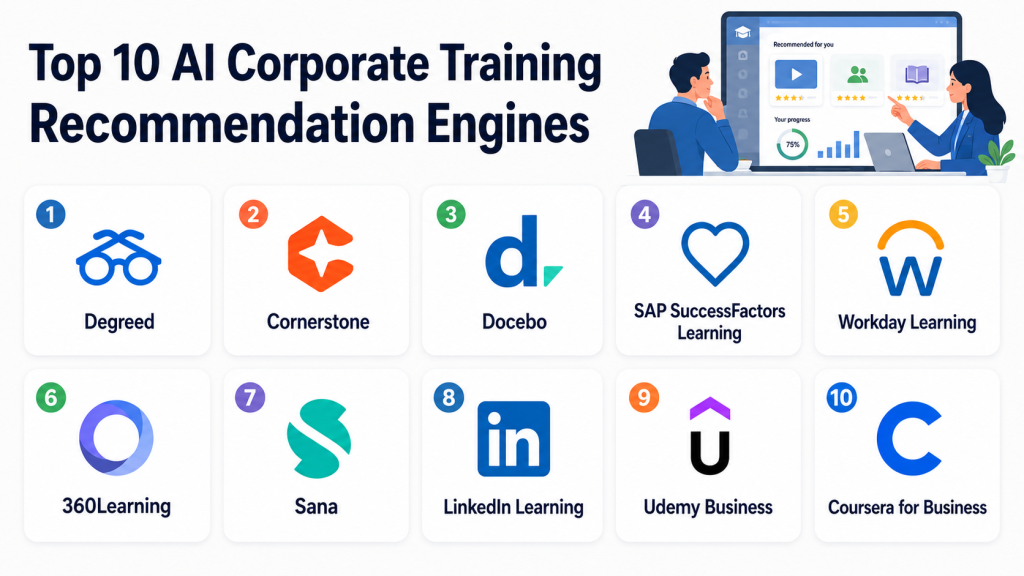
Top 10 AI Corporate Training Recommendation Engines
#1 — Degreed
One-line verdict: Best for enterprises building skills-based learning and personalized employee development at scale.
Short description:
Degreed is a learning experience and upskilling platform that brings together courses, articles, videos, internal resources, and other development opportunities. It uses employee interests, skills, roles, activity, and organizational context to deliver personalized learning recommendations.
Standout Capabilities
- Skills-based content recommendations
- Personalized employee learning feeds
- Support for formal and informal learning
- Skills profile and development tracking
- Learning pathways and curated plans
- AI-powered learning assistance
- Broad content aggregation capabilities
- Connections between skills and career development
AI-Specific Depth
- Model support: Proprietary AI and platform-managed models
- RAG / knowledge integration: Supports organizational content aggregation and contextual discovery
- Evaluation: Skills progress, engagement, and learning activity analytics
- Guardrails: Administrative curation, permissions, and content governance
- Observability: Learning, content, skills, and usage analytics
Pros
- Strong skills intelligence and personalized discovery
- Works across multiple learning content sources
- Suitable for complex enterprise learning ecosystems
Cons
- Implementation may require significant taxonomy and integration work
- Can be excessive for organizations with small content catalogs
- Recommendation quality depends on employee and skills data quality
Security & Compliance
Enterprise identity, administrative controls, and permission management are available depending on configuration. Exact certifications, residency options, audit capabilities, and retention controls should be confirmed directly for the selected plan and region.
Deployment & Platforms
- Web
- Mobile access
- Cloud-based
- Enterprise learning integrations
Integrations & Ecosystem
Degreed is designed to sit across a broad learning ecosystem rather than function only as a traditional LMS. It can aggregate internal and external content while connecting learning activity with skills and workforce development.
- Learning management systems
- Human resource platforms
- Commercial content libraries
- Internal knowledge repositories
- Collaboration applications
- Skills and talent systems
- APIs and enterprise connectors
Pricing Model
Enterprise subscription pricing. Costs generally depend on employee count, products, integrations, services, and deployment scope. Exact pricing is not publicly stated.
Best-Fit Scenarios
- Enterprise-wide skills transformation
- Aggregating fragmented learning libraries
- Personalized career and role development
#2 — Cornerstone
One-line verdict: Best for large organizations combining personalized learning, skills intelligence, and talent management.
Short description:
Cornerstone provides enterprise learning and talent management capabilities for employee development, compliance, performance, and workforce planning. Its AI capabilities help organizations connect skills, roles, content, and development opportunities.
Standout Capabilities
- AI-assisted learning recommendations
- Skills intelligence and role alignment
- Enterprise learning management
- Compliance and mandatory training
- Content aggregation and discovery
- Talent and performance connections
- Career development support
- Global workforce administration
AI-Specific Depth
- Model support: Proprietary and platform-managed AI
- RAG / knowledge integration: Organizational content and learning catalog discovery
- Evaluation: Learning outcomes, completions, skills, and talent analytics
- Guardrails: Administrative controls, assignments, approval workflows, and permissions
- Observability: Enterprise learning and workforce reporting
Pros
- Broad learning and talent management suite
- Suitable for regulated and complex enterprises
- Connects development with wider talent processes
Cons
- Implementation and configuration can be complex
- May be too broad for smaller organizations
- User experience can depend heavily on deployment design
Security & Compliance
Enterprise security, identity, role management, and governance capabilities vary by product and contract. Buyers should validate SSO, audit logs, encryption, data residency, retention, and certifications for their deployment.
Deployment & Platforms
- Web
- Mobile access
- Cloud-based
- Enterprise deployment
Integrations & Ecosystem
Cornerstone integrates learning with broader employee and talent workflows. It is especially relevant for organizations seeking one environment for formal training, skills development, compliance, and workforce planning.
- HR information systems
- Talent management tools
- Content providers
- Collaboration applications
- Identity systems
- Business intelligence platforms
- APIs and connectors
Pricing Model
Enterprise subscription model. Pricing varies according to workforce size, selected modules, content, integrations, and services.
Best-Fit Scenarios
- Global enterprise learning
- Regulated workforce training
- Integrated talent and skills development
#3 — Docebo
One-line verdict: Best for enterprises needing AI-powered recommendations across employee, customer, and partner training.
Short description:
Docebo is an AI-enabled learning platform for internal training, customer education, partner enablement, and extended-enterprise programs. It uses skills, roles, learning behavior, and content analysis to personalize discovery and recommend relevant resources.
Standout Capabilities
- AI-powered content recommendations
- Skills-based personalized learning
- Employee and extended-enterprise training
- Automated content organization
- AI-assisted content creation
- Virtual coaching and simulation capabilities
- Multilingual learning support
- Detailed learning analytics
AI-Specific Depth
- Model support: Proprietary AI with platform-managed cloud AI services
- RAG / knowledge integration: Enterprise content and knowledge capabilities vary by module
- Evaluation: Learner activity, skills, completion, and performance analytics
- Guardrails: Administrative AI settings, permissions, and content workflows
- Observability: Reporting on learning activity, content, audiences, and programs
Pros
- Strong recommendation and automation capabilities
- Supports multiple training audiences
- Scales well for global learning programs
Cons
- Configuration can be demanding
- Advanced modules can increase platform complexity
- May be unnecessarily broad for basic employee training
Security & Compliance
Enterprise security and administrative controls are available, but exact certification, data residency, retention, SSO, audit, and encryption details should be verified for the selected package and deployment.
Deployment & Platforms
- Web
- Mobile applications
- Cloud-based
- Extended-enterprise portals
Integrations & Ecosystem
Docebo supports connections across learning, content, HR, collaboration, and business systems. Its ecosystem is useful for companies that train employees as well as partners and customers.
- HRIS and talent systems
- CRM platforms
- Content providers
- Video and virtual classroom tools
- Collaboration applications
- E-commerce systems
- APIs and integration services
Pricing Model
Enterprise subscription model. Pricing normally depends on active users, modules, audience types, implementation, and support requirements.
Best-Fit Scenarios
- Global employee training
- Customer and partner education
- Skills-based personalized learning
#4 — SAP SuccessFactors Learning
One-line verdict: Best for SAP-centered enterprises connecting workforce data with learning and skills development.
Short description:
SAP SuccessFactors Learning is an enterprise learning management solution within the broader SAP human experience management ecosystem. It supports formal training, compliance, role-based assignments, development planning, and personalized learning discovery.
Standout Capabilities
- Connection with employee and job data
- Role-based training assignments
- Compliance learning management
- Skills and development alignment
- Enterprise reporting
- Learning catalog management
- Global organizational structures
- Integration with wider SAP talent processes
AI-Specific Depth
- Model support: SAP-managed AI capabilities
- RAG / knowledge integration: Varies by SAP products and configuration
- Evaluation: Learning completion, compliance, performance, and skills reporting
- Guardrails: Enterprise permissions, workflows, and administrative policies
- Observability: Reporting and analytics across learning and HR data
Pros
- Deep fit for SAP enterprise customers
- Strong formal and compliance training workflows
- Uses rich workforce and organizational context
Cons
- Best results generally require broader SAP adoption
- Configuration can be complicated
- User experience depends on implementation and connected modules
Security & Compliance
Enterprise security capabilities vary according to SAP service, region, and contract. Organizations should confirm identity, role management, auditability, encryption, retention, residency, and applicable certifications.
Deployment & Platforms
- Web
- Mobile support
- Cloud-based
- SAP enterprise ecosystem
Integrations & Ecosystem
The strongest advantage is its connection to SAP employee, role, organizational, talent, and workforce data.
- SAP SuccessFactors modules
- SAP business applications
- Content providers
- Virtual learning tools
- Identity providers
- Reporting platforms
- APIs and integration middleware
Pricing Model
Enterprise subscription and module-based licensing. Exact pricing is not publicly stated and varies by configuration.
Best-Fit Scenarios
- SAP-centered organizations
- Compliance-heavy enterprises
- Role-based workforce development
#5 — Workday Learning
One-line verdict: Best for Workday customers linking employee development with skills, careers, and workforce data.
Short description:
Workday Learning brings employee learning into the wider Workday workforce environment. It helps organizations manage formal training while using employee, role, skills, and career information to improve content discovery and development planning.
Standout Capabilities
- Connection with employee records
- Personalized learning discovery
- Role and career development context
- Compliance training support
- User-generated learning content
- Skills-based workforce planning
- Manager and employee dashboards
- Mobile learning access
AI-Specific Depth
- Model support: Workday-managed AI capabilities
- RAG / knowledge integration: Varies by connected Workday services
- Evaluation: Skills, learning activity, completion, and workforce analytics
- Guardrails: Enterprise roles, permissions, and administrative workflows
- Observability: Learning and workforce reporting
Pros
- Strong connection with Workday employee data
- Supports learning within talent and career workflows
- Suitable for large organizations with complex structures
Cons
- Most attractive to existing Workday customers
- Limited flexibility outside the Workday ecosystem
- Implementation can require cross-functional HR and IT work
Security & Compliance
Enterprise security and privacy capabilities depend on the Workday contract and deployment. SSO, permissions, retention, auditability, residency, encryption, and certifications should be confirmed directly.
Deployment & Platforms
- Web
- Mobile access
- Cloud-based
- Workday ecosystem
Integrations & Ecosystem
Workday Learning connects most naturally with Workday’s HR, skills, talent, and workforce capabilities.
- Workday Human Capital Management
- Skills and talent data
- Content providers
- Collaboration applications
- Identity providers
- Reporting and analytics tools
- APIs and enterprise integrations
Pricing Model
Enterprise subscription model. Pricing varies by Workday products, workforce size, implementation, and service requirements.
Best-Fit Scenarios
- Workday-centered enterprises
- Career-linked employee development
- Workforce skills transformation
#6 — 360Learning
One-line verdict: Best for organizations combining AI recommendations with collaborative, expert-led learning creation.
Short description:
360Learning is a collaborative learning platform that helps internal experts create, share, and improve employee training. Its AI-assisted capabilities support content creation, skills development, search, personalization, and learning administration.
Standout Capabilities
- Collaborative course creation
- Internal subject-matter expert workflows
- AI-assisted content development
- Skills-based learning experiences
- Employee feedback and social learning
- Cohort and group learning
- Training needs identification
- Fast content iteration
AI-Specific Depth
- Model support: Platform-managed AI
- RAG / knowledge integration: Internal knowledge and content capabilities vary
- Evaluation: Learner engagement, feedback, course performance, and completion analytics
- Guardrails: Author review, permissions, and administrative workflows
- Observability: Content, learner, and program analytics
Pros
- Strong collaborative learning model
- Helps organizations capture internal expertise
- Faster content creation and feedback cycles
Cons
- Less suitable for buyers wanting only a recommendation API
- Recommendation quality depends on content structure and participation
- Advanced enterprise requirements may require additional configuration
Security & Compliance
Business and enterprise controls vary by plan. Buyers should confirm SSO, role permissions, audit logs, data retention, residency, encryption, and certifications.
Deployment & Platforms
- Web
- Mobile applications
- Cloud-based
Integrations & Ecosystem
360Learning integrates collaborative course development with HR, productivity, content, and enterprise workflows.
- HR information systems
- Collaboration tools
- Content libraries
- Virtual meeting platforms
- Identity providers
- APIs and automation services
- Learning and talent systems
Pricing Model
Subscription pricing, typically based on users and selected capabilities. Enterprise pricing is customized.
Best-Fit Scenarios
- Internal expert-led training
- Rapidly changing product or process education
- Collaborative employee upskilling
#7 — Sana
One-line verdict: Best for AI-native organizations seeking intelligent search, content creation, and personalized learning.
Short description:
Sana is an AI-oriented learning and knowledge platform that helps organizations create training, discover internal information, manage learning programs, and personalize employee development. It is designed for organizations seeking an experience built around AI rather than adding AI to a traditional LMS.
Standout Capabilities
- AI-assisted learning content creation
- Personalized learning recommendations
- Enterprise search and knowledge discovery
- Collaborative training workflows
- Automated summaries and learning support
- Interactive learning experiences
- Multilingual capabilities
- Modern learner interface
AI-Specific Depth
- Model support: Platform-managed AI; additional flexibility varies
- RAG / knowledge integration: Enterprise knowledge search and connected content
- Evaluation: Learning analytics and user feedback; advanced evaluation details vary
- Guardrails: Permissions, source controls, and administrative oversight vary by deployment
- Observability: Learning usage and knowledge engagement analytics
Pros
- AI-native user experience
- Combines knowledge discovery with learning
- Strong content creation productivity
Cons
- Less established than some traditional enterprise suites
- Detailed model and governance flexibility should be validated
- Migration from a mature LMS may require planning
Security & Compliance
Enterprise security capabilities are available, but buyers should verify certifications, data retention, model-training policies, regional hosting, SSO, RBAC, encryption, and audit logs for their specific deployment.
Deployment & Platforms
- Web
- Mobile access may vary
- Cloud-based
Integrations & Ecosystem
Sana is designed to connect learning with organizational knowledge and employee workflows.
- Enterprise knowledge sources
- HR systems
- Collaboration tools
- Identity providers
- Content repositories
- Productivity applications
- APIs and connectors
Pricing Model
Enterprise subscription pricing. Exact prices are not publicly stated and vary by products, users, and implementation.
Best-Fit Scenarios
- AI-first corporate learning
- Connecting knowledge management with training
- Rapid course creation and personalized discovery
#8 — LinkedIn Learning
One-line verdict: Best for broad professional skills content with role- and interest-based recommendations.
Short description:
LinkedIn Learning offers a large library covering business, technology, creative, leadership, and professional skills. Recommendations use learner interests, activity, selected skills, and professional context to surface relevant courses and learning paths.
Standout Capabilities
- Large professional content library
- Role- and skill-oriented recommendations
- Expert-led video courses
- Learning paths and collections
- Professional profile connections
- Business administration tools
- Broad technical and soft-skill coverage
- Frequently updated content catalog
AI-Specific Depth
- Model support: Proprietary recommendation systems
- RAG / knowledge integration: N/A for customer-controlled enterprise RAG
- Evaluation: Viewing, completion, engagement, and skill analytics
- Guardrails: Administrative curation and content controls
- Observability: Learner and organizational usage reporting
Pros
- Extensive professional learning catalog
- Easy for employees to adopt
- Strong business, technology, and career coverage
Cons
- Primarily recommends content from its own ecosystem
- Less control over underlying recommendation models
- Not a complete replacement for compliance-focused LMS functions
Security & Compliance
Enterprise administration and identity capabilities vary by agreement. Buyers should verify SSO, permissions, reporting, retention, residency, and applicable certifications.
Deployment & Platforms
- Web
- iOS
- Android
- Cloud-based
Integrations & Ecosystem
LinkedIn Learning can complement an existing LMS or learning experience platform by supplying professional content and learner activity data.
- Learning management systems
- Human resource platforms
- Microsoft ecosystem
- Single sign-on providers
- Reporting exports
- Professional profiles
- Enterprise learning portals
Pricing Model
Subscription-based for individuals and organizations. Enterprise pricing varies by workforce size and agreement.
Best-Fit Scenarios
- Broad professional development
- Technology and business upskilling
- Supplementing an existing LMS catalog
#9 — Udemy Business
One-line verdict: Best for companies needing extensive on-demand content and personalized technical skill development.
Short description:
Udemy Business provides organizations with a curated collection of business, technology, leadership, and professional courses. It uses learner behavior, skills interests, searches, and organizational context to help employees discover relevant training.
Standout Capabilities
- Large on-demand content library
- Technical and business skills coverage
- Personalized course discovery
- Curated learning paths
- Hands-on technical practice in supported offerings
- Organizational content collections
- Learning analytics
- Global and multilingual catalog coverage
AI-Specific Depth**
- Model support: Proprietary recommendation systems and platform-managed AI
- RAG / knowledge integration: Varies by product; not primarily an enterprise RAG platform
- Evaluation: Engagement, completion, assessment, and skills analytics
- Guardrails: Administrative content selection and learning assignment controls
- Observability: Learner, course, and organizational reporting
Pros
- Broad technical and professional course selection
- Fast access to content for emerging skills
- Useful for self-directed employee development
Cons
- Content experience can vary by instructor and topic
- Recommendations are centered largely on the available catalog
- Requires governance to avoid duplicated or inconsistent learning paths
Security & Compliance
Enterprise controls vary by package and region. Buyers should validate SSO, permissions, encryption, auditability, retention, residency, and certifications directly.
Deployment & Platforms
- Web
- iOS
- Android
- Cloud-based
Integrations & Ecosystem
Udemy Business commonly functions as a content provider connected to an organization’s wider learning technology stack.
- Learning management systems
- Learning experience platforms
- HR platforms
- Identity providers
- Skills development programs
- APIs and reporting exports
- Technical practice environments
Pricing Model
Enterprise subscription model, commonly based on users and selected products. Exact pricing is not publicly stated.
Best-Fit Scenarios
- Technical workforce upskilling
- Self-directed professional learning
- Rapid access to emerging-topic courses
#10 — Coursera for Business
One-line verdict: Best for structured, university-backed learning in technical, leadership, and professional disciplines.
Short description:
Coursera for Business provides enterprise access to courses, professional certificates, projects, and structured programs from universities and industry partners. Its platform helps learners discover content based on skills, goals, interests, and organizational programs.
Standout Capabilities
- University and industry partner content
- Professional certificate programs
- Technical and business learning paths
- Guided projects and applied exercises
- Skills development analytics
- Role-aligned learning programs
- Global course availability
- Structured long-form development options
AI-Specific Depth
- Model support: Proprietary recommendation and personalization systems
- RAG / knowledge integration: N/A for customer-controlled enterprise RAG
- Evaluation: Assessments, completions, skill development, and engagement analytics
- Guardrails: Administrative curation, assignments, and program controls
- Observability: Learner, program, and organizational reporting
Pros
- Strong structured learning from recognized providers
- Useful for deeper reskilling programs
- Broad coverage of technical and leadership disciplines
Cons
- Longer courses may reduce completion for time-constrained employees
- Recommendations primarily use the Coursera content ecosystem
- Not designed as a complete enterprise talent platform
Security & Compliance
Enterprise identity, reporting, and administration vary by agreement. Buyers should verify security certifications, data residency, retention, permissions, auditability, and encryption for their region.
Deployment & Platforms
- Web
- iOS
- Android
- Cloud-based
Integrations & Ecosystem
Coursera for Business can be connected with enterprise learning and workforce systems to support structured development initiatives.
- Learning management systems
- Learning experience platforms
- Human resource systems
- Identity providers
- Skills programs
- Reporting tools
- Enterprise APIs and connectors
Pricing Model
Enterprise subscription or program-based pricing. Costs vary by employee population, content access, and contract.
Best-Fit Scenarios
- Large-scale technical reskilling
- Professional certificate programs
- University-backed employee education
Comparison Table
| Tool Name | Best For | Deployment | Model Flexibility | Strength | Watch-Out | Public Rating |
|---|---|---|---|---|---|---|
| Degreed | Enterprise skills development | Cloud | Hosted | Skills-based recommendations | Requires strong skills data | N/A |
| Cornerstone | Learning and talent management | Cloud | Hosted | Broad enterprise suite | Implementation complexity | N/A |
| Docebo | Multi-audience training | Cloud | Hosted | AI learning automation | Module complexity | N/A |
| SAP SuccessFactors Learning | SAP enterprises | Cloud | Hosted | Workforce-data alignment | SAP ecosystem dependency | N/A |
| Workday Learning | Workday enterprises | Cloud | Hosted | Career-linked development | Best within Workday | N/A |
| 360Learning | Collaborative learning | Cloud | Hosted | Internal expert content | Not recommendation-only | N/A |
| Sana | AI-native learning | Cloud | Hosted | Knowledge and learning convergence | Validate governance depth | N/A |
| LinkedIn Learning | Broad professional skills | Cloud | Hosted | Large career content library | Catalog-centered recommendations | N/A |
| Udemy Business | Technical and business upskilling | Cloud | Hosted | Broad current content | Content consistency varies | N/A |
| Coursera for Business | Structured reskilling | Cloud | Hosted | University-backed programs | Longer learning commitment | N/A |
Scoring and Evaluation
The following scores are comparative rather than absolute product ratings. They are intended to help buyers understand the relative positioning of each platform based on corporate learning recommendations, skills intelligence, integrations, usability, governance, and scalability.
Scores use a 1–10 scale and the weighted total follows the published rubric. A platform can score highly while still being unsuitable for a particular company because ecosystem fit, content strategy, workforce size, and implementation capacity affect results. Buyers should validate recommendation quality through a controlled pilot using their own roles, employee data, content, and skill taxonomy. Security, AI governance, and contractual terms should also be reviewed separately.
| Tool | Core | Reliability and Eval | Guardrails | Integrations | Ease | Performance and Cost | Security and Admin | Support | Weighted Total |
| Degreed | 9 | 8 | 8 | 9 | 8 | 7 | 8 | 8 | 8.25 |
| Cornerstone | 9 | 8 | 9 | 9 | 7 | 7 | 9 | 8 | 8.25 |
| Docebo | 9 | 8 | 8 | 9 | 8 | 8 | 8 | 8 | 8.30 |
| SAP SuccessFactors Learning | 8 | 8 | 9 | 9 | 7 | 7 | 9 | 8 | 8.05 |
| Workday Learning | 8 | 8 | 9 | 9 | 8 | 7 | 9 | 8 | 8.15 |
| 360Learning | 8 | 7 | 8 | 8 | 9 | 8 | 8 | 8 | 8.00 |
| Sana | 8 | 7 | 8 | 8 | 9 | 8 | 8 | 7 | 7.90 |
| LinkedIn Learning | 8 | 7 | 8 | 8 | 9 | 8 | 8 | 8 | 8.00 |
| Udemy Business | 8 | 7 | 7 | 8 | 9 | 8 | 8 | 8 | 7.90 |
| Coursera for Business | 8 | 8 | 8 | 8 | 8 | 7 | 8 | 8 | 7.85 |
Top 3 for Enterprise
- Cornerstone: Best for combining learning recommendations with talent, compliance, and workforce processes.
- Degreed: Best for skills-based learning discovery across fragmented enterprise content.
- Docebo: Best for AI-powered training across employees, customers, partners, and other audiences.
Top 3 for SMB
- 360Learning: Strong for collaborative training and internal expert-led content.
- LinkedIn Learning: Easy way to provide broad professional development content.
- Udemy Business: Suitable for fast technical and business upskilling with limited content creation.
Top 3 for Developers
- Docebo: Offers enterprise integration options and programmable learning workflows.
- Degreed: Strong for connecting multiple learning and skills data sources.
- Sana: Useful for AI-native learning, knowledge search, and connected content experiences.
Which AI Corporate Training Recommendation Engine Is Right for You?
Solo or Freelancer
A full enterprise recommendation engine is rarely necessary for an individual consultant or independent professional. LinkedIn Learning, Udemy Business, or Coursera may provide sufficient personalized discovery without requiring HR integrations or skills architecture.
Choose LinkedIn Learning for broad professional development, Udemy for practical and emerging technical subjects, or Coursera for structured programs and certificates.
SMB
Small and medium-sized businesses should prioritize ease of implementation, relevant content, simple administration, and predictable costs.
LinkedIn Learning and Udemy Business are practical when the company needs ready-made content. Coursera is suitable for structured reskilling. 360Learning is a stronger option when internal experts must create and share company-specific training.
Avoid purchasing a complex skills platform unless the business has enough employee, role, and content data to support meaningful personalization.
Mid-Market
Mid-market companies often need a balance of personalized discovery, centralized administration, internal content, external libraries, and HR integrations.
Docebo is suitable for organizations training several audiences. 360Learning works well for collaborative internal programs. Degreed becomes attractive when multiple learning systems and content providers must be unified.
The selection should be based on whether the primary challenge is content access, skills development, compliance, internal knowledge, or extended-enterprise training.
Enterprise
Enterprises should evaluate Degreed, Cornerstone, Docebo, SAP SuccessFactors Learning, and Workday Learning.
Degreed is strong for content aggregation and skills-based discovery. Cornerstone is appropriate for integrated talent and learning operations. Docebo supports complex learning audiences. SAP and Workday are logical candidates when the organization already uses their broader HR ecosystems.
Enterprise buyers should treat recommendation quality as a data and governance program rather than a simple software feature.
Regulated Industries
Financial services, healthcare, government, energy, and other regulated organizations require stronger oversight.
Mandatory training should never be replaced by optional AI recommendations. Administrators need clear assignment controls, audit records, completion evidence, access management, retention settings, and human review.
Organizations should also examine whether employee data is used to train models, how inferred skills are generated, where data is processed, and whether recommendations could influence promotions or employment opportunities.
Budget vs Premium
Content subscriptions such as LinkedIn Learning, Udemy Business, and Coursera can be more affordable than implementing a complete skills and learning platform.
Premium platforms such as Degreed, Cornerstone, Docebo, Workday, and SAP generally offer stronger administration, integrations, skills intelligence, and organizational scalability. However, they require more implementation effort and data governance.
The lowest subscription price does not always produce the lowest total cost. Buyers should include integration, migration, administration, content licensing, change management, and support in the calculation.
Build vs Buy
Most organizations should buy a platform rather than develop a recommendation engine internally.
A reliable internal system requires employee identity integration, content metadata, skills taxonomies, recommendation models, feedback loops, security controls, data pipelines, analytics, bias testing, and long-term maintenance.
A custom build may make sense for a technology company with a highly specialized skills model, an existing learning platform, a mature machine-learning team, and strict requirements that commercial systems cannot meet.
A practical middle path is to buy a learning platform while maintaining an internal abstraction layer for skills, employee data, and content integrations. This reduces lock-in and makes future migration easier.
Implementation Playbook
First 30 Days: Define the Pilot
- Select one business unit or role family.
- Define the business problem before selecting recommendation metrics.
- Identify target skills and role expectations.
- Audit available employee, course, skills, and performance data.
- Remove duplicate, outdated, or low-quality content.
- Create a small trusted content catalog.
- Define baseline metrics such as search success, course relevance, completion, and skill confidence.
- Establish data privacy and retention requirements.
- Identify mandatory training that must remain rule-based.
- Configure SSO, user roles, and pilot permissions.
- Document which data signals influence recommendations.
- Create a process for employees to report irrelevant or inappropriate suggestions.
First 60 Days: Evaluate and Harden
- Compare AI recommendations with expert-curated learning plans.
- Evaluate recommendation relevance across roles, locations, seniority levels, and demographic groups.
- Test new employees with limited historical data.
- Review inferred skills for accuracy.
- Create human approval workflows for sensitive pathways.
- Connect the platform to the primary HRIS and LMS.
- Add a second content provider only after the first catalog is governed.
- Introduce recommendation feedback such as useful, not useful, and already known.
- Red-team conversational assistants and generated content.
- Test for prompt injection if the system connects to internal knowledge.
- Establish prompt and configuration version control where applicable.
- Define an AI incident-handling process.
- Train managers to interpret recommendations as guidance rather than verified employee capability.
First 90 Days: Optimize and Scale
- Measure skill improvement, time to proficiency, performance support, and internal mobility signals.
- Compare recommendation acceptance with actual learning outcomes.
- Remove content that is frequently abandoned or rated irrelevant.
- Tune skill mappings and job-role definitions.
- Introduce additional departments gradually.
- Monitor AI usage, latency, and cost.
- Review integrations and synchronization errors.
- Create quarterly model and recommendation-quality reviews.
- Establish an employee appeals process for incorrect skill inferences.
- Document data lineage and recommendation logic.
- Create executive dashboards tied to business outcomes.
- Review vendor lock-in, data export, and migration options.
- Scale only after recommendation relevance and governance meet agreed thresholds.
Common Mistakes and How to Avoid Them
- Starting with technology instead of a skills strategy: Define target capabilities and business outcomes before configuring recommendations.
- Using poor content metadata: Recommendations cannot be reliable when courses are incorrectly tagged or duplicated.
- Treating course completion as skill mastery: Combine learning data with assessments, practice, observation, and workplace evidence.
- Ignoring cold-start users: New employees may have insufficient history, so role-based and manager-approved recommendations are necessary.
- Allowing AI to assign mandatory compliance training: Use explicit rules and auditable assignments for regulated content.
- Failing to explain recommendations: Employees should know whether a suggestion came from their role, skills, interests, manager, or activity.
- Collecting unnecessary employee data: Use only data required for legitimate learning and development purposes.
- Assuming inferred skills are accurate: Give employees and managers the ability to review and correct profiles.
- Creating too many recommendations: A small, prioritized set is more useful than an endless personalized feed.
- Ignoring catalog quality: Personalization cannot fix outdated, low-quality, or irrelevant content.
- Over-automating career decisions: Course recommendations should not become hidden promotion or performance scores.
- Skipping fairness testing: Check whether particular employee groups receive systematically different development opportunities.
- Failing to monitor cost: Conversational AI, content generation, and external libraries can create unexpected expenses.
- Ignoring latency and reliability: Slow recommendations and unavailable assistants reduce adoption.
- Using engagement as the only success metric: Measure performance, skill gain, retention, productivity, and time to proficiency.
- Connecting confidential knowledge without access controls: Recommendation engines must respect source permissions.
- Skipping human review of generated content: Subject-matter experts should verify technical, legal, safety, and compliance material.
- Creating vendor lock-in: Maintain exportable employee, skills, content, and learning activity data.
- Launching company-wide immediately: Begin with one role, audience, or business outcome.
- Failing to retrain administrators: AI features change learning operations, content governance, and reporting responsibilities.
FAQs
1. What is an AI corporate training recommendation engine?
It is a system that analyzes employee, role, skills, content, and learning data to recommend relevant courses or development activities. The goal is to reduce search effort and personalize employee learning.
2. How is it different from a traditional LMS?
A traditional LMS primarily assigns, delivers, and tracks training. A recommendation engine adds personalized discovery based on skills, roles, behavior, goals, or organizational priorities. Many modern platforms combine both capabilities.
3. What data is used to generate recommendations?
Common signals include job role, department, selected skills, assessments, completed courses, searches, interests, manager input, career goals, and content engagement. The exact data varies by platform and configuration.
4. Can employees see why a course was recommended?
Some platforms provide recommendation context, while others show only the suggested content. Explainability should be evaluated during the pilot because it improves trust and helps employees identify incorrect profile data.
5. Can these platforms recommend internal content?
Yes. Many enterprise systems can combine internal courses, documents, videos, articles, expert resources, and external libraries. Integration and access-control support vary by vendor.
6. Do recommendation engines replace learning managers?
No. They reduce manual discovery and curation work, but learning professionals still need to govern content, validate recommendations, manage compliance, measure outcomes, and align programs with business priorities.
7. Can an organization bring its own AI model?
Most corporate learning platforms use hosted, platform-managed AI. Bring-your-own-model support is uncommon or varies by vendor. Buyers requiring model control should validate architecture and contractual options.
8. Can these platforms be self-hosted?
Most leading enterprise learning recommendation platforms are cloud-based. Self-hosting is generally limited or unavailable. Organizations with strict hosting requirements should confirm deployment options before procurement.
9. How should recommendation quality be evaluated?
Create a test group, define realistic employee profiles, and compare AI suggestions with expert-curated plans. Measure relevance, diversity, completion, skill improvement, search success, and employee feedback.
10. What are the main privacy risks?
Risks include excessive employee profiling, incorrect skill inference, unclear model-training practices, long data retention, unauthorized access, and using learning data for unrelated employment decisions.
11. Can recommendations be biased?
Yes. Bias can enter through employee history, job architecture, content availability, manager input, or model design. Organizations should test recommendation distribution and provide correction and appeal mechanisms.
12. How do these tools handle mandatory training?
Mandatory training should usually be assigned using explicit administrative rules. AI recommendations can supplement compliance programs but should not determine whether legally required training is assigned.
13. What integrations are most important?
The most valuable integrations are typically HRIS, LMS, identity management, content libraries, collaboration tools, talent systems, skills platforms, and business intelligence tools.
14. How much do corporate recommendation engines cost?
Pricing varies widely by employee count, active users, modules, content libraries, implementation, integrations, and support. Most enterprise vendors provide customized quotations rather than standard public pricing.
15. Are content subscriptions the same as recommendation platforms?
No. A content provider recommends resources primarily from its own library. A learning experience or skills platform can usually aggregate multiple sources and connect recommendations with organizational skills and roles.
16. Can these systems recommend mentors or internal jobs?
Some broader talent and skills platforms can connect learning with mentors, projects, roles, and internal opportunities. The exact capability depends on the selected modules and employee data.
17. What is the cold-start problem?
The cold-start problem occurs when a new employee has little learning history. The system must rely on role, department, selected interests, manager input, assessments, or organizational standards to make initial recommendations.
18. Should employees be allowed to reject recommendations?
Yes. Employees should be able to dismiss irrelevant suggestions and provide feedback. These controls improve trust and can help the system produce better future recommendations.
19. What alternatives exist for small companies?
Small companies can use a straightforward LMS, curated role-based learning paths, manager recommendations, content subscriptions, mentoring, and scheduled skills reviews without deploying a complex recommendation engine.
20. How can vendor lock-in be reduced?
Maintain a portable skills taxonomy, require data exports, document integrations, use standard identity and learning formats where possible, and avoid storing the only authoritative employee skills record inside one vendor platform.
Conclusion
AI Corporate Training Recommendation Engines can transform an overcrowded learning catalog into a focused employee development experience. The strongest platforms combine recommendations with skills intelligence, content governance, enterprise integrations, analytics, and human oversight. Degreed is particularly effective for skills-based learning across multiple content sources, while Cornerstone connects learning with broader talent processes. Docebo is strong for AI-enabled training across employees, customers, and partners. SAP SuccessFactors Learning and Workday Learning are logical choices for organizations already using those HR ecosystems. Sana and 360Learning offer more modern approaches to AI-assisted and collaborative learning, while LinkedIn Learning, Udemy Business, and Coursera provide broad ready-made content.
There is no universal winner. The right platform depends on workforce size, content strategy, HR ecosystem, regulatory requirements, available skills data, and implementation capacity. Organizations should first shortlist platforms that fit their existing technology environment, then run a pilot using real roles and employees. During the pilot, verify recommendation relevance, privacy controls, fairness, content quality, integration reliability, and measurable skill improvement. Scale only after the platform demonstrates that it can guide employees toward useful learning without creating opaque profiling, unnecessary complexity, or unmanageable costs.

Find Trusted Cardiac Hospitals
Compare heart hospitals by city and services — all in one place.
Explore Hospitals
A valuable topic to consider is the long-term effectiveness of AI-powered learning recommendation engines in dynamic workplace environments. As business goals shift and employees take on new responsibilities, recommendation models must be continuously refined to keep training content aligned with emerging skill requirements. It would also be useful to explore how these platforms integrate with HR ecosystems, safeguard sensitive employee information, and measure the real impact of personalized learning through indicators such as skill progression, course completion rates, and employee retention, ensuring recommendations contribute to measurable workforce development outcomes.