
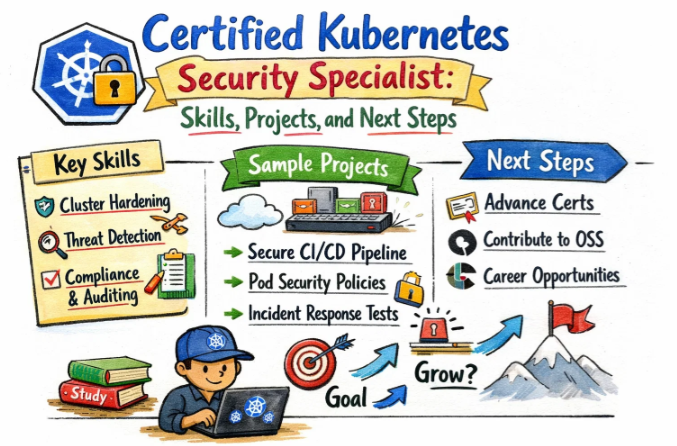
Securing a Kubernetes cluster is very different from securing a traditional server. When you move to containers, the “surface area” for an attack changes. You aren’t just looking at a firewall anymore; you are looking at the container image, the code inside it, the way the pod talks to other pods, and how the underlying Linux kernel handles it all.
The Certified Kubernetes Security Specialist (CKS) is the gold standard for proving you actually know how to defend these environments. If you are a software engineer or a manager in India or anywhere else in the world, this guide will show you why this certification is a pillar of the Master in Observability Engineering Certifications Program and how to actually pass it.
The Landscape of Professional Certifications
Before we dive into the CKS, it is helpful to see where it sits in the bigger picture of cloud-native engineering. I always tell my mentees that you shouldn’t just collect badges; you should build a logical progression of skills.
| Track | Level | Who it’s for | Prerequisites | Skills Covered | Recommended Order |
| DevOps | Associate | Developers, Ops | Basic Linux | CI/CD, Git, Docker | 1 |
| SRE | Specialist | SREs, Admins | CKA | Monitoring, SLOs, SLIs | 2 |
| Kubernetes | Professional | Admins, Engineers | CKA | Cluster Admin | 3 |
| Security | Expert | Security Engineers | CKA | CKS, Hardening, Auditing | 4 |
| DevSecOps | Expert | Security/DevOps | CKS/CKA | App Security, Scanning | 5 |
| Observability | Master | Architects, Leads | SRE/CKS | Tracing, Logging, Metrics | 6 |
Certified Kubernetes Security Specialist (CKS): A Deep Dive
The CKS isn’t a test you can just memorize. It is a performance-based exam. This means you are given a real terminal and a real cluster, and you have to fix real security holes. It’s stressful, but it’s the best way to prove you have the “hands-on” chops.
What it is
The CKS is an advanced certification that focuses on securing the entire build, deploy, and runtime lifecycle of a Kubernetes application. While the CKA (Administrator) proves you can build a cluster, the CKS proves you can make that cluster “production-ready” from a security perspective. It covers everything from the hardware level up to the application layer.
Who should take it
This is for people who are already comfortable with Kubernetes. If you are a Software Engineer, a DevOps Specialist, or a Security Engineer, this is your next step. Managers should also understand this path to better lead their technical teams through the complex world of cloud-native security. You must have an active CKA certification before you can attempt the CKS.
Skills you’ll gain
Working through the CKS curriculum changes how you look at code and infrastructure. You stop assuming things are secure just because they are running in a “private” cloud. You start thinking about “Zero Trust.”
- Cluster Setup and Hardening: You will learn how to secure the API server, use CIS Benchmarks to find holes, and manage administrative access using RBAC (Role-Based Access Control) with extreme precision.
- System Hardening: You’ll master tools like AppArmor and Seccomp to limit what a container can actually do on the host machine.
- Microservice Security: You will learn to use Network Policies to stop pods from talking to things they shouldn’t, and how to use Mutual TLS for secure communication.
- Supply Chain Security: This is a big one. You’ll learn to scan images for vulnerabilities, sign them so they can’t be tampered with, and use Admission Controllers to block “bad” pods from ever starting.
Real-world projects you should be able to do after it
Once you have this certification, you aren’t just an “exam passer.” You are a practitioner who can handle high-stakes security tasks in a real company.
- Building a Secure CI/CD Pipeline: You can set up a system that automatically scans every container image. If a “High” or “Critical” vulnerability is found, the pipeline stops. No more “leaky” containers in production.
- Implementing Runtime Security: You can configure tools like Falco to watch your clusters in real-time. If a shell is opened inside a production container, you’ll know instantly and can automate a response.
- Hardening the Kubernetes Control Plane: You will be able to audit your API server logs to find out who did what and when. You can also encrypt your secrets at rest so even if your database is stolen, the passwords are safe.
Preparation Plan
7–14 Days (The “Quick Refresh” for Experts):
If you use Kubernetes daily for security, focus on the niche tools.
- Days 1-5: Focus on Falco, Trivy, and Cosign. Practice the exact syntax for these tools.
- Days 6-10: Drill down into AppArmor and Seccomp profiles. These are often the hardest for engineers to remember under pressure.
- Days 11-14: Run at least three full-length mock exams to get your speed up.
30 Days (The Standard Path):
- Week 1: Review CKA basics and master RBAC and Network Policies.
- Week 2: Deep dive into Image Scanning and Admission Controllers.
- Week 3: Focus on Host-level security (Linux kernel hardening).
- Week 4: Practice, practice, practice. Use the official documentation only, as that is all you get during the exam.
60 Days (The Comprehensive Path):
- Month 1: Spend time building clusters from scratch. Break them. Try to bypass security settings you’ve put in place. Read the Kubernetes documentation from start to finish.
- Month 2: Follow the 30-day path above, but spend double the time on “Runtime Security” and “Audit Logging.”
Common Mistakes
Many smart engineers fail the CKS on their first try. It’s usually not because they don’t know the tech—it’s because they don’t know the “exam.”
- Bad Time Management: You have 2 hours for about 15-16 tasks. If you spend 20 minutes trying to fix one AppArmor profile, you will fail. You have to learn when to move on.
- Relying on “Search”: The documentation search is slow. If you don’t know where the “Network Policy” example is located in the official docs, you’ll waste too much time looking for it.
- Typing Errors: One wrong character in a YAML file can break a whole cluster. Always use
kubectl dry-runto check your work before you apply it.
Best Next Certification After CKS
After you finish the CKS, you are at a crossroads. Depending on your career goals, here are the best moves:
- Same Track: Certified DevSecOps Professional (CDP). This takes the CKS concepts and applies them to the whole development lifecycle.
- Cross-Track: AWS or Google Cloud Security Specialty. This proves you know the “platform” security as well as the “container” security.
- Leadership: Master in Observability Engineering. This is the peak. It teaches you how to see everything happening in your system so you can stop problems before they become outages.
Choose Your Path: 6 Learning Tracks
The tech world is broad. Don’t try to learn everything at once. Pick a path that fits your interest.
- DevOps Path: Focuses on speed and reliability. CKS helps you make sure that “speed” doesn’t lead to “security holes.”
- DevSecOps Path: This is the direct evolution of CKS. You become the bridge between the developers and the security team.
- SRE Path: Focuses on uptime. You use security tools to ensure that attacks don’t take your site down.
- AIOps/MLOps Path: High-level automation. You learn how to use AI to find security threats faster than a human could.
- DataOps Path: Focuses on the security of data pipelines. CKS is vital here because many data tools run on Kubernetes.
- FinOps Path: The “security” of the cloud bill. You ensure that your infrastructure is both secure and cost-effective.
Role → Recommended Certifications
| If you are a… | Start with… | Move to… | Master with… |
| DevOps Engineer | CKA | CKS | DevSecOps Professional |
| SRE | CKA | Prometheus/Grafana | Observability Master |
| Platform Engineer | CKA | Terraform | CKS |
| Cloud Engineer | AWS/Azure Associate | CKA | CKS |
| Security Engineer | CKA | CKS | CISSP |
| Data Engineer | Python/SQL | CKA | CKS (for Spark/K8s) |
| FinOps Practitioner | FinOps Cert | CKA | Cloud Architect |
| Engineering Manager | CKA | CKS | Management/Leadership |
Top Institutions for CKS Training
If you want to get through this, you need good mentors. Here are the top places that provide specific training for the CKS.
DevOpsSchool is a great choice for those who need a structured environment. They offer live sessions that cover the CKS domains in a very logical way. Their labs are designed to mimic the actual exam environment, which is a huge help for reducing “exam day” nerves.
Cotocus focuses on the technical depth required for the CKS. Their curriculum is very “hands-on,” and they provide a lot of real-world scenarios that go beyond what you see on the exam. It’s a solid choice for working engineers who want to apply these skills immediately.
Scmgalaxy has been around for a long time and has a massive library of resources. Their CKS training is built on years of feedback from students. They provide excellent community support, which is vital when you get stuck on a difficult technical concept.
BestDevOps provides a very streamlined approach to the CKS. They focus on exactly what you need to know to pass and be effective. Their training is highly recommended for busy managers and senior engineers who need to learn quickly.
Devsecopsschool lives and breathes security. Their CKS training is integrated with their broader DevSecOps programs. This makes it an ideal place if you are looking at the CKS as part of a long-term career shift into dedicated security roles.
Sreschool approaches the CKS from the perspective of reliability. They teach you not just how to secure a pod, but how to make sure that security doesn’t break your application’s performance. It’s a very practical, “engineering-first” approach.
Aiopsschool is perfect for those looking at the future. They show you how to take the security foundations of the CKS and eventually apply AI and machine learning to manage those security logs at a massive scale.
Dataopsschool helps data professionals understand the Kubernetes layer. If your job involves running big data workloads on a cluster, their CKS-related training will show you how to keep that sensitive data isolated and safe.
Finopsschool connects infrastructure security with cost. They help you understand that a secure cluster is often a more efficient one. Their training is unique because it looks at the financial impact of your technical security decisions.
FAQs: Career and Outcomes
- Is the CKS exam harder than the CKA? Yes, significantly. The CKA covers “how to use” Kubernetes. The CKS covers “how to protect” it, which requires a deeper understanding of Linux and third-party security tools.
- How long does it take to get the results? Usually, you get your results via email within 24 hours of finishing the exam.
- Does CKS increase my salary? In many markets, especially in India and the US, a CKS certification can lead to a 15-25% increase in salary because security experts are so rare.
- Can I take CKS without CKA? No. You can take the training, but you cannot sit for the official CNCF exam without an active CKA.
- Is the CKS exam multiple-choice? No. It is 100% performance-based. You will be using a command line for the entire duration.
- How long is the certification valid? It is valid for 2 years. The tech moves fast, so you have to keep your skills fresh.
- What is the passing score? You typically need a 67% or higher to pass.
- Can I use Google during the exam? No. You are only allowed to access specific domains like
kubernetes.io/docs. - Are the questions the same for everyone? The tasks are drawn from a pool, so your exam will likely be different from your colleague’s.
- Is there a free retake? Yes, the official CNCF exam voucher usually includes one free retake if you fail the first time.
- Do I need to know programming? You don’t need to be a software developer, but you must be comfortable reading YAML and some basic shell scripts.
- What is the best way to practice? Use environments like “Killer.sh” which provide simulated exams that are actually harder than the real thing.
FAQs: CKS Specific Technicals
- What version of Kubernetes does the exam use? It usually stays within one or two versions of the most recent stable release.
- Do I need to know Falco? Yes. Falco is a major part of the runtime security domain. You should know how to read and write basic rules.
- How much Linux knowledge do I need? You need to know how to use
grep,find,systemctl, and how to look at logs in/var/log. - Is OPA (Open Policy Agent) on the exam? It is often mentioned in the curriculum, but you should focus heavily on the built-in Admission Controllers first.
- Do I have to install Kubernetes? You might have to troubleshoot a cluster that won’t start, so knowing
kubeadmis very important. - Will I need to use
strace? Yes,straceis a key tool for debugging what a process is doing at the system level. - How important is RBAC? It is foundational. If you cannot fix a “Permission Denied” error in a ServiceAccount, you will struggle.
- Is image scanning only about finding vulnerabilities? No, it’s also about ensuring that images are small, don’t run as root, and don’t contain hardcoded secrets.
Conclusion
The journey to becoming a Certified Kubernetes Security Specialist is a challenging one, but it is one of the most rewarding paths an engineer can take today. By mastering the CKS, you aren’t just adding a line to your resume; you are gaining the ability to protect the digital infrastructure that the world relies on every day. This certification is a critical milestone within the Master in Observability Engineering Certifications Program, bridging the gap between simply running a system and truly understanding its behavior and safety. Whether you are aiming to be a lead SRE or a DevSecOps Architect, the skills you learn here—from cluster hardening to runtime defense—will serve as the bedrock of your technical expertise for years to come. Take the time to practice, choose a mentor that fits your learning style, and remember that in the world of security, the learning never really stops.

Find Trusted Cardiac Hospitals
Compare heart hospitals by city and services — all in one place.
Explore Hospitals
Great and informative guide! I really liked how this article explains the skills, project ideas, and next steps for becoming a Certified Kubernetes Security Specialist. Very helpful for anyone looking to advance their cloud‑native security career.