
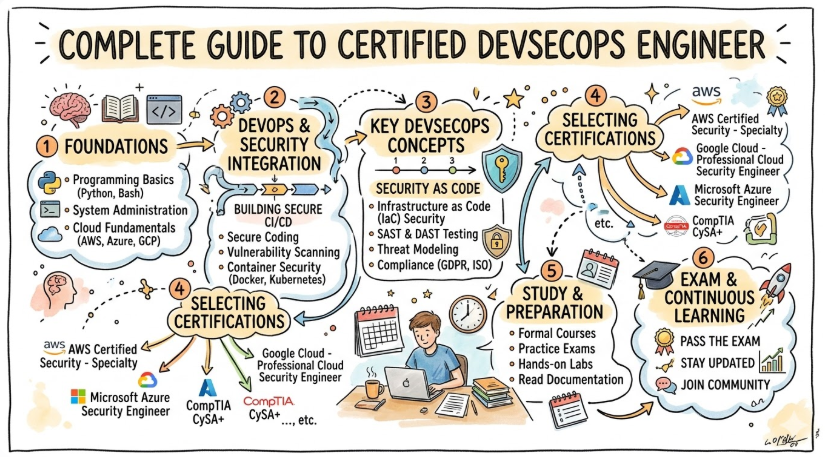
Securing software is no longer a task that happens at the end of a project. In modern environments, security is woven into every part of the process. A Certified DevSecOps Engineer is a professional who understands how to merge development, security, and operations. This role ensures that security checks are automated and continuous. By doing this, teams can release software quickly without compromising safety.
In this guide, the focus is on the path to becoming a recognized expert in this field. It is designed for engineers and managers who want to understand the requirements, skills, and career benefits of this certification.
Master in Observability Engineering Certifications Program
Before diving into specific security certifications, it is important to understand the broader context of modern systems. One of the most critical areas today is Observability. The Master in Observability Engineering Certifications Program is designed to teach professionals how to gain deep insights into their systems.
Observability goes beyond simple monitoring. It involves understanding the internal state of a system by looking at the data it produces. This program covers logging, tracing, and metrics in great detail. For a DevSecOps engineer, observability is a key skill because it helps identify security breaches and performance bottlenecks in real-time. By completing this program, an engineer is prepared to handle complex, distributed environments where traditional tools might fail.
A Deep Dive : Certified DevSecOps Engineer
The Certified DevSecOps Engineer credential is a standard for those who want to prove their ability to secure the CI/CD pipeline.
What it is
The Certified DevSecOps Engineer program is a comprehensive training and certification track. It focuses on integrating security practices into the DevOps lifecycle. It covers everything from secure coding and automated testing to infrastructure security and compliance. The goal is to create a “shift-left” culture where security issues are found and fixed as early as possible.
Who should take it
This certification is ideal for Software Engineers, DevOps Professionals, Security Analysts, and System Administrators. It is also highly recommended for Engineering Managers who need to oversee secure digital transformations. If a professional is involved in building, deploying, or managing cloud-native applications, this track provides the necessary technical depth.
Skills you’ll gain
Participants develop a wide range of technical and cultural skills. The program ensures that the underlying principles of security-as-code are fully understood.
- Pipeline Security: Knowledge of how to insert security scans (SAST, DAST, IAST) into automated workflows.
- Infrastructure as Code (IaC) Security: Learning to secure tools like Terraform and Ansible.
- Container and Kubernetes Security: Understanding how to protect containerized workloads.
- Compliance Automation: Automating checks for standards like GDPR, HIPAA, and PCI-DSS.
- Cloud Security: Mastering security configurations for AWS, Azure, and Google Cloud.
Real-world projects you should be able to do after it
After completing the certification, an engineer is expected to handle practical, high-stakes tasks in a production environment.
- Building a Secure CI/CD Pipeline: Setting up a pipeline that automatically fails builds if a high-severity vulnerability is detected.
- Hardening Kubernetes Clusters: Implementing network policies and pod security standards to protect microservices.
- Automated Vulnerability Management: Creating dashboards that track security risks across multiple applications.
- Implementing Secrets Management: Setting up tools like HashiCorp Vault to manage sensitive data securely.
Preparation plan
Success in this certification requires a structured approach. Depending on the current knowledge level, the following timelines are recommended:
- 7–14 days: This is for those who already have a strong background in DevOps and basic security. The focus should be on specific exam objectives and taking practice tests.
- 30 days: This is the standard path for most working engineers. It allows for two hours of study per day, covering one major domain (like SAST/DAST or Container Security) each week.
- 60 days: Recommended for beginners or those moving from traditional IT roles. It provides enough time to build a lab environment and practice with every tool mentioned in the syllabus.
Common mistakes
Many candidates fail to see the full picture of DevSecOps, which can lead to mistakes during the certification process.
- Focusing only on tools: Tools are important, but understanding the security mindset and culture is equally vital.
- Ignoring the “Ops” part: Security cannot break the deployment flow. Solutions must be scalable and automated.
- Skipping hands-on labs: Theoretical knowledge is not enough. Practice is required to understand how different tools interact in a pipeline.
Best next certification after this
Once this certification is achieved, the Master in Observability Engineering is the most logical next step. Understanding how to observe a secure system ensures that security remains intact during high-scale operations.
Comparison of Top Certifications for Software Engineers
The following table provides a clear view of various certifications available in the industry to help professionals choose the right track.
| Track | Level | Who it’s for | Prerequisites | Skills Covered | Recommended Order |
| DevSecOps | Intermediate | Security & DevOps Engineers | Basic Linux & CI/CD | Pipeline Security, SAST/DAST, Compliance | 1st in Security |
| SRE | Intermediate | Reliability Engineers | System Admin knowledge | Error Budgets, SLIs/SLOs, Automation | After DevOps |
| AIOps | Advanced | Data & Ops Engineers | Python & Data basics | Machine Learning for Ops, Anomaly Detection | After SRE |
| Cloud Architect | Expert | Senior Engineers | Cloud Fundamentals | Infrastructure Design, Cost Optimization | After Cloud Associate |
| Kubernetes | Intermediate | Cloud Engineers | Container basics | Orchestration, Troubleshooting, Security | Before DevSecOps |
Choose Your Path: 6 Learning Journeys
Selecting a career path depends on personal interest and the needs of the organization. Here are six distinct directions:
- DevOps Path: Focuses on the speed of delivery. It is about CI/CD, automation, and removing silos between teams.
- DevSecOps Path: Prioritizes security within the delivery flow. It is for those who want to specialize in cyber defense and automated compliance.
- SRE Path: Focuses on system reliability and scalability. This is a highly technical path involving deep coding and system internals.
- AIOps/MLOps Path: Uses artificial intelligence to manage operations. It involves building models that can predict and fix system issues automatically.
- DataOps Path: Streamlines the delivery of data and analytics. It ensures that data pipelines are reliable and secure.
- FinOps Path: Manages the cost of cloud infrastructure. It is a mix of finance, engineering, and business strategy to optimize cloud spending.
Role → Recommended Certifications Mapping
To help with career planning, the following mapping shows which certifications are most valuable for specific roles:
- DevOps Engineer: Certified DevOps Professional, Kubernetes Administrator.
- SRE: SRE Certified Professional, Observability Specialist.
- Platform Engineer: Infrastructure as Code Expert, Certified Kubernetes Security Specialist.
- Cloud Engineer: AWS/Azure Solutions Architect, Cloud Security Engineer.
- Security Engineer: Certified DevSecOps Engineer, Penetration Testing Professional.
- Data Engineer: DataOps Professional, Big Data Specialty.
- FinOps Practitioner: Certified FinOps Associate.
- Engineering Manager: DevOps Leader, Cloud Business Professional.
Next Certifications to Take
After earning the Certified DevSecOps Engineer title, there are three main directions to expand:
- Same Track (Specialization): Advanced Container Security or Cloud-Specific Security (e.g., AWS Certified Security – Specialty).
- Cross-Track (Broadening): SRE Certified Professional. This helps in understanding how to maintain the systems that have been secured.
- Leadership (Growth): DevOps Leader or Engineering Management certifications. These are for those moving into people and project management roles.
Top Training Institutions for Certified DevSecOps Engineer
Several organizations provide high-quality training and support for this certification. Each has a unique approach to teaching.
DevOpsSchool is a well-known name in the training industry. They provide deep, instructor-led sessions that cover the entire DevSecOps ecosystem. Their programs are designed to be practical, ensuring that participants can apply what they learn immediately in their jobs.
Cotocus specializes in high-end consulting and training. They focus on providing customized learning paths for corporate teams. Their approach is highly collaborative, making them a good choice for organizations looking to upskill entire departments at once.
Scmgalaxy is a community-driven platform that offers extensive resources and training for software configuration management and DevOps. They are known for their technical depth and a wide library of video tutorials that help in self-paced learning.
BestDevOps provides focused bootcamps for those who want to learn quickly. Their courses are designed to be intensive, covering the most critical tools and practices in a short amount of time, which is helpful for busy professionals.
DevSecOpsSchool is a dedicated platform for security-focused training. They offer specialized courses that go deep into the “Sec” part of DevOps, providing learners with the latest techniques in threat modeling and automated security.
Sreschool focuses entirely on site reliability engineering. For a DevSecOps engineer, this institution provides the perfect bridge to learn about system uptime, performance, and advanced troubleshooting.
Aiopsschool is the go-to place for learning how to integrate artificial intelligence into operations. They teach how to use data and machine learning to make systems smarter and more resilient.
Dataopsschool offers specialized training for data professionals. They teach how to apply DevOps principles to data pipelines, ensuring that data is delivered accurately and securely.
Finopsschool focuses on the financial side of the cloud. They help engineers and managers understand how to track and optimize cloud costs, which is a vital skill in modern business.
FAQs on Certified DevSecOps Engineer
1. How difficult is the Certified DevSecOps Engineer exam? The exam is considered moderately difficult. It requires a solid understanding of both DevOps workflows and security principles. Hands-on experience with tools is essential for success.
2. How much time is needed to prepare? Most professionals find that 30 to 60 days of consistent study is sufficient. This allows for a deep dive into the labs and a thorough review of the theoretical concepts.
3. Are there any prerequisites? While there are no strict formal prerequisites, having a basic understanding of Linux, Git, and at least one cloud provider (AWS or Azure) is highly recommended.
4. In what sequence should I take DevOps certifications? It is usually best to start with a general DevOps certification, followed by Kubernetes, and then move into a specialty like DevSecOps or SRE.
5. What is the value of this certification in the market? It is highly valued. As companies move more workloads to the cloud, the demand for engineers who can secure those workloads automatically is growing rapidly.
6. What are the career outcomes after getting certified? Certified individuals often move into roles like DevSecOps Lead, Security Architect, or Senior DevOps Engineer. It also typically leads to a significant increase in salary.
7. Can I take the exam online? Yes, the certification provider offers online proctored exams, making it convenient for professionals globally.
8. How long does the certification remain valid? The certification is typically valid for two to three years. After this, a renewal or an advanced certification is required to stay current with industry changes.
9. Is the certification recognized globally? Yes, it is recognized by major tech companies in India and around the world, as it follows industry-standard security frameworks.
10. What tools are covered in the training? The training covers a variety of tools, including Jenkins, SonarQube, Docker, Kubernetes, Terraform, and various security scanning tools like OWASP ZAP.
11. Does the certification cover cloud-native security? Yes, a major portion of the program is dedicated to securing applications in cloud environments like AWS, Azure, and Google Cloud.
12. Is there support for job placement? Many of the training institutions, like DevOpsSchool, provide interview preparation and career guidance as part of their programs.
13. What is the cost of the certification? The cost can vary based on the training package chosen. It is best to check the official website for the most current pricing.
14. Are there practice exams available? Yes, most training providers include practice tests that mimic the format and difficulty of the actual exam.
15. Can a manager benefit from this technical certification? Absolutely. It helps managers understand the technical challenges their teams face, leading to better decision-making and project planning.
16. Does the course include live projects? Yes, the training is designed to be hands-on, with several real-world projects that simulate the tasks of a DevSecOps engineer.
17. What is the passing score for the exam? The passing score is usually around 70%, but this can change depending on the specific version of the exam.
18. How does this differ from a standard Cyber Security certification? While traditional cyber security focuses on defense and penetration testing, DevSecOps focuses specifically on the automation of security within the software development process.
19. Is AI covered in the DevSecOps track? Basic AI-driven security tools are introduced, but for a deeper dive, the AIOps track is recommended.
20. What is the first step to get started? The first step is to visit the official certification page and review the syllabus to see how it aligns with your current skills and career goals.
Conclusion
Becoming a Certified DevSecOps Engineer is a significant achievement that places a professional at the intersection of three vital fields: development, security, and operations. In a world where software releases happen daily or even hourly, the ability to ensure that every release is secure is a rare and valuable skill. This journey requires dedication, a willingness to learn a wide range of tools, and a commitment to a “shift-left” philosophy. By following the structured paths and utilizing the resources provided by expert training institutions, any determined engineer can reach this level of expertise. The reward is a career that is not only financially stable but also central to the success and safety of modern digital organizations.

Find Trusted Cardiac Hospitals
Compare heart hospitals by city and services — all in one place.
Explore Hospitals