
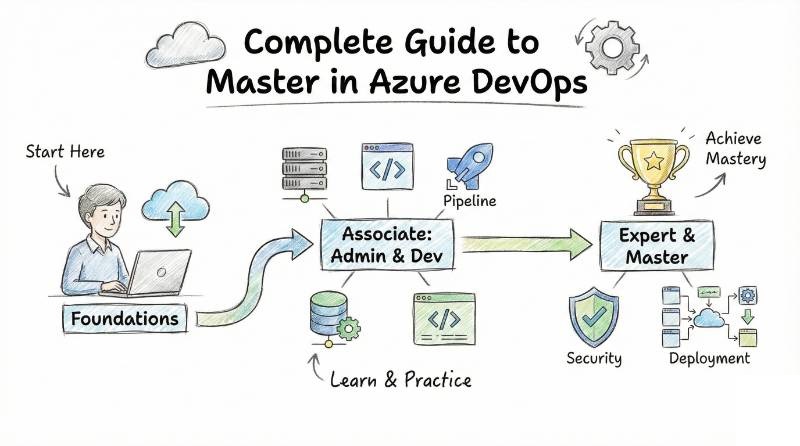
The shift from traditional software delivery to modern cloud-native systems has changed everything. I have watched the industry move from manual server setups to a world where entire environments are created with a single script. In this fast-moving landscape, Azure DevOps has stood out as the most reliable platform for enterprises.
This guide is for those who aren’t just looking for a new title, but who want to truly master the craft of delivery. The Master in Azure DevOps certification is the ultimate proof that you can handle the pressure of modern software engineering.
The Master in Azure DevOps Certification Overview
The Master in Azure DevOps program, provided by DevOpsSchool, is an expert-level track. It doesn’t just focus on one tool; it covers the entire lifecycle of a product.
| Track | Level | Who it’s for | Prerequisites | Skills Covered | Recommended Order |
| Azure Fundamentals | Foundational | Beginners, Managers | None | Cloud concepts, Security, Privacy, Pricing | 1st |
| Azure Administrator | Associate | SysAdmins, Engineers | AZ-900 | VM, VNet, Storage, Identity (IAM) | 2nd |
| Azure DevOps Expert | Expert | Engineers, Architects | AZ-104 or AZ-204 | CI/CD, IaC, Git, Pipelines, Security | 3rd |
Master in Azure DevOps (CDE)
What it is
The Master in Azure DevOps (Certified DevOps Engineer) is a high-level program that combines several Microsoft certifications into one path. It focuses on using Azure tools to bring developers and operations teams together.
Who should take it
- Software Engineers: To automate their code delivery.
- Working Engineers: To transition into cloud and automation roles.
- Engineering Managers: To lead teams using modern DevOps standards.
Skills you’ll gain
- Automated Pipelines: Building CI/CD flows that test and deploy code automatically.
- Infrastructure as Code (IaC): Using tools like Terraform to manage servers like they are software.
- Security Integration: Adding automated security checks into the pipeline (DevSecOps).
- Monitoring: Using Azure Monitor to catch issues before they affect the user.
Real-world projects you can handle
- End-to-End Pipeline: Setting up a pipeline that takes code from a developer’s laptop to a production website without manual work.
- Kubernetes Orchestration: Deploying complex apps into Azure Kubernetes Service (AKS).
- Cloud Migration: Moving an old application from a physical server into a scalable Azure environment.
Common Mistakes
- Focusing only on the UI: Real masters use the CLI (Command Line) and code. Don’t rely on clicking buttons in the portal.
- Ignoring Security: Many engineers add security at the very end. In a master program, security must be built into the very first step.
- Skipping the “Admin” Basics: You cannot automate infrastructure if you don’t understand how networking and storage work.
Expanded Preparation Plan
To master this domain, you need a mix of theory and heavy lab practice. Here is how you should break down your time.
7–14 Days: The Foundation Phase
- Daily Focus: Understanding the Azure ecosystem.
- Key Tasks: * Set up a free Azure account.
- Learn the differences between IaaS (Servers) and PaaS (Web Apps).
- Learn how to set up a Virtual Network (VNet) so your resources can talk to each other.
- Goal: Pass the AZ-900 (Fundamentals) level content.
30 Days: The Operational Phase
- Daily Focus: Administration and Security.
- Key Tasks: * Spend time every day on Identity management (who can access what).
- Practice setting up storage and backups.
- Learn basic scripting in PowerShell or Bash. Automation starts with simple scripts.
- Goal: Gain the knowledge required for the AZ-104 (Administrator) level.
60 Days: The Mastery Phase
- Daily Focus: Pipelines and Automation.
- Key Tasks: * Build your first “YAML” pipeline. This is where you write code to build your software.
- Learn Docker. Containers are the heart of modern DevOps.
- Use Terraform to create a database and a web server automatically.
- Goal: Complete the AZ-400 (DevOps Expert) curriculum and the Master CDE requirements.
Choose Your Path: 6 Specialized Learning Tracks
Once you have the Master certification, you can choose a specific “flavor” of DevOps based on your interests:
- DevOps Path: Focus on the core cycle of building and releasing software.
- DevSecOps Path: Focus on hacking your own systems to make them unhackable.
- SRE Path: Focus on making systems so stable they never go down.
- AIOps/MLOps Path: Use Artificial Intelligence to manage your cloud and deploy machine learning models.
- DataOps Path: Focus on the flow of data and analytics.
- FinOps Path: Focus on the “business” side—saving the company money on cloud costs.
Role → Recommended Certifications Mapping
- DevOps Engineer: Master in Azure DevOps + Kubernetes (CKAD).
- SRE: Master in Azure DevOps + SRE Certified Professional.
- Platform Engineer: Master in Azure DevOps + Terraform Associate.
- Cloud Engineer: Master in Azure DevOps + AZ-104.
- Security Engineer: Master in Azure DevOps + AZ-500.
- Data Engineer: Master in Azure DevOps + DP-203.
- FinOps Practitioner: Master in Azure DevOps + FinOps Certified.
- Engineering Manager: Master in Azure DevOps + Certified DevOps Manager.
Top Institutions for Training and Certification
Choosing where to learn is as important as what you learn. These institutions provide the labs and expert help you need:
- DevOpsSchool: A pioneer in the field, offering a rigorous “Master” program. Their curriculum is heavily project-driven, focusing on real-world scenarios rather than just exam questions. They provide lifetime access to materials and expert mentorship.
- Cotocus: Highly regarded for corporate training and enterprise-scale digital transformation. They specialize in upskilling large teams and focus on the practical integration of Azure with complex legacy systems.
- Scmgalaxy: A community-centric platform that provides a wealth of free resources alongside structured training. It is excellent for those who want to supplement their learning with forum discussions and open-source contributions.
- BestDevOps: Known for its highly focused, tool-specific bootcamps. If you need to master a specific part of the Azure stack (like AKS or Terraform) quickly, this is a top choice.
- devsecopsschool: The go-to destination for security-focused engineers. They dive deep into the “Sec” part of DevOps, covering everything from compliance-as-code to automated penetration testing.
- sreschool: Dedicated entirely to the principles of reliability. Their training focuses on making systems resilient, scalable, and observable using Azure-native tools and open-source stacks.
- aiopsschool: Leads the way in teaching the application of AI and ML to IT operations. They help engineers leverage predictive analytics to prevent outages before they happen.
- dataopsschool: Focuses on the intersection of data engineering and DevOps. They teach how to build “data factories” that are as automated and reliable as software pipelines.
- finopsschool: Specializes in cloud financial management. Their courses are essential for anyone responsible for the bottom line of a cloud budget.
FAQs: Career & Value Outcomes
1. How difficult is the Master in Azure DevOps certification?
It is challenging because it requires both a broad understanding of Azure services and a deep knowledge of DevOps processes. It is not just about multiple-choice questions; it requires hands-on lab experience.
2. How much time does it take to complete the program?
For a working professional, a balanced approach usually takes about 3 to 4 months. This includes the time needed for AZ-104 and AZ-400, followed by the Master-level tool integrations.
3. Are there any prerequisites?
There are no “hard” blocks to entry, but we highly recommend having a basic understanding of computer networking, Linux/Windows administration, and at least one scripting language (like PowerShell or Bash).
4. What is the recommended sequence of exams?
Start with AZ-900 (Fundamentals), move to AZ-104 (Administrator), then AZ-400 (DevOps Expert), and finally the Master program projects.
5. What is the market value of this certification?
DevOps is consistently one of the highest-paying roles in tech globally. Having a “Master” designation validates that you can lead a team and architect complex systems, not just follow instructions.
6. Will I get a job after this?
While no certification guarantees a job, this program makes you “job-ready” by forcing you to work on real projects. In regions like India, the US, and Europe, Azure DevOps experts are in extremely high demand.
7. Do I need to be a developer to do this?
No. You need to understand the development process, but you don’t need to be a senior Java or Python developer. You will focus more on automation scripts and YAML pipelines.
8. Is the certification recognized globally? Yes. The skills and the certification from providers like DevOpsSchool are recognized by MNCs and startups worldwide as they align with the official Microsoft curriculum and industry best practices.
9. Can I skip the Fundamentals (AZ-900)?
If you already have 2-3 years of cloud experience, you can skip the exam, but it is still worth reviewing the material to ensure you have a solid conceptual foundation.
10. How often do I need to renew?
Microsoft certifications typically require an annual online renewal (which is free) to stay current with the fast-moving Azure platform.
11. What tools will I learn beyond Azure DevOps?
You will gain experience with Git, Docker, Kubernetes, Terraform, Ansible, and Jenkins to ensure you can operate in a multi-tool environment.
12. Is there a lab environment provided?
Yes, leading providers like DevOpsSchool provide lab environments and credits to ensure you can practice without incurring high personal costs.
FAQs on Master in Azure DevOps
1. How difficult is the Master in Azure DevOps compared to others?
It is rigorous. Unlike some basic certifications, this one requires you to actually build things in a lab environment.
2. Is there a mandatory prerequisite?
You need to pass either the Administrator (AZ-104) or Developer (AZ-204) exam to be officially recognized as an Azure DevOps Expert.
3. Is coding required?
You will need to learn YAML (for pipelines) and basic scripting. You don’t need to write complex applications.
4. How long is the certification valid?
It is valid for one year, but Microsoft allows you to renew it for free every year through a simple online check.
5. What is the recommended sequence for a beginner?
Start with Azure Fundamentals, then Administrator, then the DevOps Expert track.
6. What is the average time commitment for this program?
Expect to spend about 120 hours total, including study time and hands-on lab work.
7. Is the “Master” program different from the AZ-400 exam?
Yes. The AZ-400 is the exam, while the Master program includes extra tools like Terraform and Kubernetes that are used in real jobs.
8. Can I get a remote job after this?
Yes. DevOps is one of the most remote-friendly roles in the tech industry today.
Testimonials
“I had been an engineer for years, but the Master in Azure DevOps program gave me the structure I was missing. I now lead a team of 10 engineers in our cloud division.” — Amit V.
“The hands-on projects were the best part. I wasn’t just reading slides; I was building real pipelines that actually worked.” — Jessica M.
Conclusion
Mastering Azure DevOps is more than just a career move; it is a mindset shift. Throughout my years in this field, I have seen many tools come and go, but the ability to automate, secure, and scale a system is a skill that will always be in demand.
If you want to be the person who knows how to solve the most complex problems in a software company, this is your path. The cloud is the future, and this certification is your key to it. Start today, stay consistent, and you will see your career reach new heights.

Find Trusted Cardiac Hospitals
Compare heart hospitals by city and services — all in one place.
Explore Hospitals
I like how you laid out the Azure DevOps roadmap step by step — it makes the learning path feel much clearer and less overwhelming. The practical tips and examples are especially useful for someone trying to build real skills instead of just theory.