
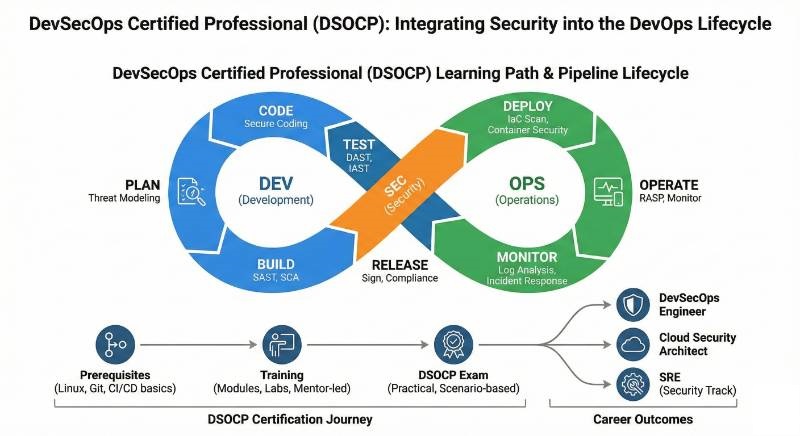
In today’s software landscape, releasing fast is not enough. You must release securely. A single vulnerability in a library, a leaked secret, or a misconfigured cloud permission can bring down an entire system. This is where DevSecOps comes in. It is the practice of building security into your daily development and operations work, ensuring that security checks happen automatically inside your CI/CD pipeline.
For working engineers and managers, the DevSecOps Certified Professional (DSOCP) is more than just a certificate. It is a validation that you can build a secure delivery system that moves fast without breaking things. This guide covers everything you need to know about the certification, from preparation plans to career paths.
Master Guide: Certification Overview
| Certification | Track | Level | Who it’s for | Prerequisites | Skills Covered | Recommended Order |
| DevSecOps Certified Professional (DSOCP) | DevSecOps | Professional | DevOps, Security Engineers, SREs | CI/CD, Git, Basic Linux | Secure Pipelines, SAST/DAST, Container Security, Compliance | 2 |
| Master in DevOps Engineering (MDE) | DevOps | Master | Engineers/Managers needing end-to-end skills | None | DevOps, SRE, Cloud, Tools & Projects | 4 |
| Docker Certified Associate (DCA) | Containers | Associate | Developers using Docker daily | Docker Basics | Images, Registries, Runtime, Troubleshooting | 1 |
| Certified Kubernetes Administrator (CKA) | Kubernetes | Professional | Platform Admins, SREs | Docker, Linux, YAML | Cluster Operations, Networking, Troubleshooting | 3 |
DevSecOps Certified Professional (DSOCP)
What it is
The DevSecOps Certified Professional (DSOCP) is a hands-on training and certification program designed to bridge the gap between development, operations, and security. It focuses on “shifting security left,” meaning you learn to automate security checks early in the lifecycle rather than treating security as a final gate.
Who should take it
- DevOps Engineers: Who need to secure their pipelines and infrastructure.
- Security Engineers: Who want to move from manual audits to automated guardrails.
- Software Engineers: Who want to ship cleaner code and understand deployment risks.
- Engineering Managers: Who need to reduce “security surprises” before release.
Skills you’ll gain
- Secure CI/CD Design: Building pipelines that test, scan, and validate every change.
- Automated Security Gates: Defining rules for when to block a release versus when to warn.
- Secrets Management: Preventing credentials and API keys from leaking into code or logs.
- Container Hardening: Scanning images for vulnerabilities and reducing the attack surface.
- Compliance as Code: Automating checks for industry standards (like CIS benchmarks).
- Vulnerability Management: Handling dependencies and patching without slowing down the team.
Real-world projects you should be able to do after it
- Secure CI/CD Pipeline: Build a Jenkins or GitLab pipeline that runs SAST/DAST scans and blocks builds with critical issues.
- Container Security Workflow: Implement a registry scanner that prevents insecure Docker images from being deployed.
- Secrets Rotation System: Set up a vault to dynamically inject secrets, ensuring no hard-coded passwords exist.
- Kubernetes Security Baseline: Configure RBAC (Role-Based Access Control) and network policies to isolate workloads.
- Compliance Dashboard: Create a reporting view that shows the real-time security posture of your infrastructure.
Preparation Plan
7–14 Days (Fast Track)
- Focus: Ideal for existing DevOps engineers.
- Plan: Spend days 1-3 on “Shift Left” concepts. Days 4-10 on tools (SonarQube, Trivy, Vault). Days 11-14 on the capstone project.
- Goal: Understand how to glue security tools into an existing pipeline.
30 Days (Standard)
- Focus: Best for developers or admins.
- Plan: Week 1: Linux and Git basics. Week 2: CI/CD deep dive. Week 3: Security tools and automation. Week 4: Final project and review.
- Goal: Build a project from scratch, starting with code and ending with a secure deployment.
60 Days (Relaxed)
- Focus: Recommended for beginners or those transitioning roles.
- Plan: Weeks 1-2: Strong foundations in Linux and Networking. Weeks 3-4: Master Docker and Kubernetes basics. Weeks 5-6: Security automation. Weeks 7-8: Advanced scenarios and troubleshooting.
- Goal: thorough understanding of both the “Ops” and “Sec” parts of DevSecOps.
Common Mistakes
- Over-blocking: Failing builds for every minor issue. This causes teams to ignore security.
- Tool Fatigue: Trying to learn 20 tools instead of mastering the concepts (SAST, DAST, SCA).
- Ignoring Culture: Tools don’t fix broken communication. You must learn to collaborate with developers.
- Secrets in Code: Even after training, people often forget to remove old secrets from git history.
- Skipping Runtime Security: Focusing only on the pipeline and forgetting to monitor the running application.
Best next certification after this
- Certified Kubernetes Security Specialist (CKS): To deepen your expertise specifically in securing container orchestration.
Choose Your Path: 6 Learning Paths
Not every engineer needs to be a security specialist. Choose the track that fits your career goals.
- DevOps Path: Focus on automation, CI/CD, and Infrastructure as Code.
- Goal: Release faster and more reliably.
- DevSecOps Path: Focus on pipeline security, compliance, and vulnerability management.
- Goal: Secure the software supply chain.
- SRE Path: Focus on reliability, observability, and incident response.
- Goal: Keep systems up and running.
- AIOps/MLOps Path: Focus on AI-driven operations and managing ML pipelines.
- Goal: Automate operations using data and intelligence.
- DataOps Path: Focus on data pipeline orchestration and quality.
- Goal: Deliver reliable data for analytics.
- FinOps Path: Focus on cloud cost management and optimization.
- Goal: Maximize value and control cloud spend.
Role → Recommended Certifications Mapping
| Current Role | Recommended Certification | Why? |
| DevOps Engineer | DSOCP | Security is the next logical step to becoming a Senior or Lead. |
| SRE | SRE Professional | Focus on stability and observability first. |
| Platform Engineer | CKA + DSOCP | You build the platform; you must know how to secure it. |
| Cloud Engineer | FinOps + DSOCP | Manage both the cost and the security of the cloud environment. |
| Security Engineer | DSOCP + CKS | Learn the engineering side of security to automate your policies. |
| Data Engineer | DataOps Professional | Apply DevOps rigor to your data workflows. |
| FinOps Practitioner | FinOps Certified | Specialize in the financial operations of the cloud. |
| Engineering Manager | DevOps Master | Gain a broad view to manage cross-functional teams effectively. |
Next Certifications to Take
Once you have the DSOCP, consider these options to continue your growth:
- Same Track (Deep Dive): Certified Kubernetes Security Specialist (CKS) – Master the security of the orchestration layer.
- Cross-Track (Broaden): Certified Cloud Security Professional (CCSP) – Move into high-level cloud security governance.
- Leadership Track: Project Management Professional (PMP) or Agile Master – Move from technical execution to team leadership.
Top Institutions for Training & Certification
Finding the right training partner is critical. Here are the top institutions that provide help in Training cum Certifications for DevSecOps Certified Professional Online Training.
- DevOpsSchool: A market leader known for its mentor-led, project-based training. They focus heavily on real-world scenarios and “learning by doing.”
- Cotocus: specialized in consulting and corporate training, they bring enterprise-level case studies into the classroom.
- Scmgalaxy: A massive community-driven platform offering resources, tutorials, and peer support for learners.
- BestDevOps: A curated portal for reviews and career paths, helping you choose the right tools and training.
- devsecopsschool: A niche provider dedicated entirely to security in DevOps, focusing on threat modeling and compliance.
- sreschool: The go-to for Site Reliability Engineering, offering strong overlap with DevSecOps in reliability and automation.
- aiopsschool: Pioneers in AI-driven operations, perfect for those looking to integrate AI into their security workflows.
- dataopsschool: Focused on the unique challenges of securing and automating data pipelines.
- finopsschool: Essential for understanding the cost implications of your security and infrastructure decisions.
General FAQs
1. Is coding experience required? You don’t need to be a developer, but you should be able to read code and write basic scripts (Bash, Python, YAML) to automate tasks.
2. How difficult is the exam? It is considered intermediate to hard because it is practical. You need to demonstrate you can actually fix a pipeline, not just answer multiple-choice questions.
3. Can a fresher take this? Yes, but it is recommended to have some foundational knowledge of Linux and DevOps first. The “60 Days” plan is best for freshers.
4. How does this differ from CKS? CKS is specific to Kubernetes. DSOCP covers the entire software lifecycle—coding, building, testing, deploying, and monitoring.
5. What tools will I learn? Expect to work with Jenkins (or GitLab CI), Docker, Kubernetes, SonarQube, Trivy, Vault, and basic cloud security tools.
6. Is the certification recognized globally? Yes, the skills and tools covered are the industry standard for modern software engineering teams worldwide.
7. How much time does it take to prepare? For a working professional, 30 days (spending 1-2 hours a day) is usually sufficient to complete the training and the project.
8. What is the value of this certification? It validates that you have “T-shaped” skills—deep knowledge in DevOps with a strong capability in Security. This is highly valued by employers.
9. Do I need to renew it? Most technical certifications suggest recertification every 2-3 years as tools change, but the core concepts of DevSecOps remain stable.
10. Can I do this self-paced? Yes, many providers offer recorded sessions, but live mentorship (like at DevOpsSchool) is often better for clearing doubts.
11. What if I fail? Most providers allow a retake or a remedial project submission. The goal is to ensure you have the skills, not just to pass a test.
12. Will this help me become an Architect? Absolutely. Security is a primary concern for Architects. Understanding how to automate it is a key requirement for the role.
FAQs: DevSecOps Certified Professional Online Training
1. What is the DevSecOps Certified Professional training? It is a practical training program that teaches you how to integrate security into every stage of the software delivery lifecycle. The focus is on “shifting security left”—automating security checks within the CI/CD pipeline.
2. Who should enroll in this certification? This training is ideal for DevOps Engineers, Security Professionals, Software Developers, and Release Managers. If you build, deploy, or secure software, this course bridges the gap between your teams.
3. Do I need to know how to code? You don’t need to be a developer, but you must be comfortable reading code and writing basic scripts (Bash, Python, YAML). The focus is on automation, not application development.
4. How does this differ from standard DevOps training? DevOps focuses on speed and deployment. DevSecOps adds the security layer, teaching you how to plug tools like SonarQube and Trivy into the pipeline to catch vulnerabilities before they hit production.
5. What tools will I master? You will gain hands-on proficiency with industry standards: Jenkins (pipelines), Docker & Kubernetes (container security), SonarQube (code analysis), OWASP ZAP (dynamic testing), and HashiCorp Vault (secrets).
6. Is the exam difficult? It is considered Intermediate to Hard. The exam is practical and scenario-based, requiring you to fix broken pipelines or secure infrastructure rather than just answering multiple-choice questions.
7. Will this boost my salary? Yes. DevSecOps is a high-demand niche. Professionals with these skills often see a 20% to 40% salary increase compared to generalist DevOps engineers due to the critical nature of security.
8. Does the training include real-world projects? Yes. You will complete a Capstone Project where you build a secure CI/CD pipeline from scratch—handling code commits, automated scanning, and secure cloud deployment.
Conclusion
The DevSecOps Certified Professional (DSOCP) is a practical, career-defining certification for those who want to lead in the modern IT world. It moves you away from manual, reactive security to automated, proactive security.
By mastering these skills, you become a bridge between developers and security teams—a role that is critical, high-value, and in high demand. Whether you are looking to fix broken pipelines or lead a digital transformation, this training provides the blueprint.

Find Trusted Cardiac Hospitals
Compare heart hospitals by city and services — all in one place.
Explore Hospitals
Super helpful and well-structured! I appreciate how it links certification goals with real technical practices — great for planning your DevSecOps journey!