
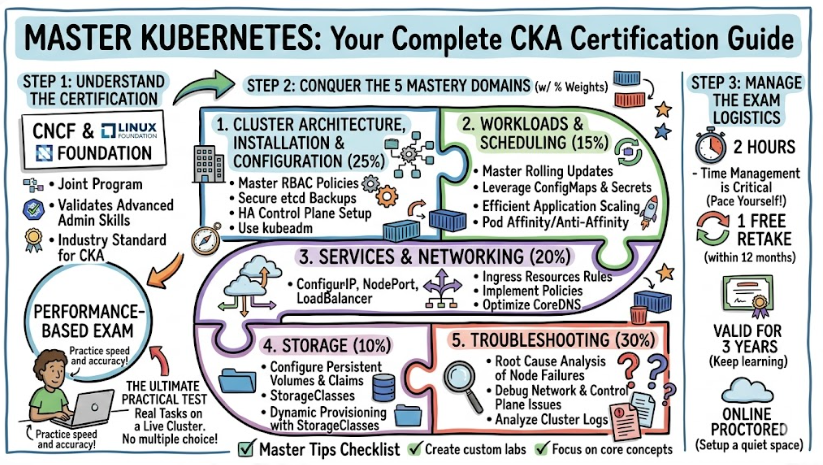
Containerization has completely changed how we build, deploy, and manage software. At the heart of this shift is Kubernetes. It is the gold standard for container orchestration. For years, I have seen infrastructure move from racks in a basement to dynamic, code-driven cloud environments. Kubernetes is the tool driving that change.
If you are a working engineer or an engineering manager, whether in India or globally, understanding Kubernetes is no longer optional. It is essential. However, learning it is one thing; proving you know it is another. That is where the Certified Kubernetes Administrator (CKA) Certification Training Course comes in.
This certification is special. It is practical. It tests your ability to solve real problems, not just answer multiple-choice questions. In this guide, I will walk you through exactly what this certification entails, how to prepare for it, and how it fits into your broader career path in DevOps, SRE, and modern platform engineering.
Understanding the Landscape of Modern IT Certifications
When I advise engineers on their career growth, they often ask which certification they should pursue first. The sheer number of options is overwhelming. You have cloud-specific tracks (AWS, Azure, GCP), security tracks (DevSecOps), and data tracks. It is crucial to see where the CKA fits into this broader picture.
Below is a comprehensive table mapping out key certifications across different specialized tracks. This gives you a bird’s-eye view of the landscape and helps you understand where you are now and where you can go next after achieving your CKA.
Master Certification Overview Table
This table outlines various certification tracks based on industry standards, illustrating where the Certified Kubernetes Administrator (CKA) Certification Training Course stands among its peers in related domains.
| Certification Name | Track | Level | Who it’s for | Prerequisites | Skills Covered | Recommended Order |
| Certified Kubernetes Administrator (CKA) | Kubernetes/DevOps | Associate/Intermediate | System Admins, DevOps Engineers, SREs | Basic Linux & Container knowledge | Core implementation, networking, security, and cluster maintenance. | High Priority for Ops roles. Take after learning Linux/Container basics. |
| Cloud Practitioner / Fundamentals | Cloud Computing | Entry | Anyone new to Cloud | None | Core cloud services, pricing, security models, and governance. | First step for any cloud journey. |
| Associate Solutions Architect | Cloud Computing | Associate | Engineers, Architects | Basic Cloud knowledge | Designing scalable, highly available systems on a specific cloud. | Pre-requisite for advanced cloud work. |
| DevOps Engineer Professional | DevOps | Professional | DevOps Engineers, SREs | Associate level cloud cert, years of experience | Continuous delivery, automation, logging, and monitoring at scale. | Highly advanced. Take after considerable field experience. |
| Certified Kubernetes Application Developer (CKAD) | Kubernetes/DevOps | Associate/Intermediate | Software Developers | Basic Kubernetes concepts | Building, deploying, and troubleshooting applications on Kubernetes. | High Priority for Dev roles. Can be taken before or after CKA. |
| Certified Kubernetes Security Specialist (CKS) | Kubernetes/Security | Advanced | Security Engineers, Senior SREs | Must have CKA | Cluster hardening, system hardening, minimizing microservice vulnerabilities. | Crucial Next Step after passing the CKA. |
| DevSecOps Certified Professional | DevSecOps | Intermediate/Advanced | Security Engineers, DevOps Engineers | Fundamental Security & DevOps knowledge | Integrating security practices into modern CI/CD pipelines. | Recommended after gaining base DevOps skills. |
| Site Reliability Engineering (SRE) Foundation | SRE | Associate | Ops Engineers, SREs | IT background | SLOs, SLIs, error budgets, toil reduction, and incident management. | Essential for moving from traditional Ops to SRE. |
| MLOps Engineering Certificate | MLOps/AIOps | Advanced | Data Scientists, Machine Learning Engineers | ML knowledge + basic Ops | Deploying, monitoring, and managing machine learning models in production. | Advanced niche. Take after mastering basic Ops and Data Science. |
| Data Engineer Associate | DataOps | Associate | Data Engineers, Database Admins | Basic Data concepts | Data ingestion, storage solutions, and data processing services. | Key for those focusing on DataOps. |
| FinOps Certified Practitioner | FinOps | Associate | Finance professionals, Ops Managers, SREs | None (Cloud knowledge helps) | Understanding cloud costs, visibility, optimization, and allocation. | Important for managers and senior engineers focusing on cost. |
Deep Dive: Certified Kubernetes Administrator (CKA)
The Certified Kubernetes Administrator (CKA) Certification Training Course is one of the most respected credentials in the industry. It doesn’t just show you know definitions; it shows you can act. The Linux Foundation and the Cloud Native Computing Foundation (CNCF) designed this to ensure that administrators have the practical skills necessary to manage real Kubernetes environments.
What it is
The Certified Kubernetes Administrator (CKA) Certification Training Course program validates that you have the skills to build, configure, and manage production-grade Kubernetes clusters. The exam itself is a remote-proctored, hands-on performance-based assessment. You do not answer multiple-choice questions. Instead, you are given multiple scenarios, like a broken cluster or a deployment error, and you must use the command line to fix them or complete specific tasks within a given time-frame. It is intense, but it is also one of the most fair reflections of your actual skills.
Who should take it
This certification is designed primarily for professionals responsible for infrastructure, deployment, and ongoing operation of Kubernetes environments.
- System Administrators: Who are transitioning from managing physical or virtual servers to managing containerized infrastructure.
- DevOps Engineers: Who need to build and maintain the CI/CD pipelines that deploy onto Kubernetes.
- Site Reliability Engineers (SREs): Who focus on the reliability, scalability, and performance of Kubernetes clusters.
- Platform Engineers: Who build internal developer platforms that abstract away Kubernetes complexity.
- Engineering Managers: Who want a deeper technical understanding of the technology their teams use daily.
Skills you’ll gain
Completing the CKA training and passing the exam equips you with a robust set of operational skills. You move beyond theoretical knowledge and understand how Kubernetes components interact under the hood. It changes the way you look at infrastructure. You will become proficient in everything from bootstrapping a cluster to troubleshooting complex networking issues.
Key Skills Covered:
- Storage and Networking: Configuring persistent storage volumes and mastering CNI (Container Network Interface) plugins, service networking, and CoreDNS.
- Cluster Installation and Configuration: Building Kubernetes clusters from scratch using tools like
kubeadm, managing highly available (HA) setups, and understanding etcd backups. - Workloads and Scheduling: Managing DaemonSets, Deployments, ReplicaSets, and understanding how the scheduler assigns pods to nodes.
- Security: Implementing Role-Based Access Control (RBAC), managing service accounts, and defining network policies for pod communication.
- Troubleshooting: Expertly diagnosing and fixing issues within cluster nodes, networking components, and specific application deployments.
Real-world projects you should be able to do
The real value of this certification training is applying it. I always tell my teams that certification is just the starting line. These are the kinds of projects you will be ready to tackle in your daily job. You shouldn’t just know how to use kubectl to get a list of pods; you should be able to build robust solutions that solve critical business problems.
Project Examples:
- Production Cluster Setup: Successfully design, bootstrap, and secure a multi-node Kubernetes cluster using
kubeadmon private cloud or public cloud virtual machines. - Securing a Multi-Tenant Environment: Use RBAC and Network Policies to ensure that different application teams cannot access each other’s resources or even see each other’s namespaces.
- Automating Cluster Backups: Create a reliable system for taking frequent backups of the etcd data store and test restoring from those backups to a new cluster.
- Implementing Persistent Application Storage: Configure dynamic volume provisioning using a cloud provider’s storage class and mount it to a stateful application.
- Configuring Advanced Ingress: Set up an Ingress Controller and configure rules to route external traffic to specific services based on hostname or path.
Preparation plan (7–14 days / 30 days / 60 days)
The time you need to prepare depends entirely on your starting point. Kubernetes is complex, so be realistic about your current knowledge. Don’t rush. This is an investment in your career, not a race. You need hands-on practice more than anything else.
- 7–14 Days Plan (The Crash Course): This is only for those who are already running Kubernetes in production. Focus on identifying your weak areas based on the CNCF curriculum. Dive deep into official documentation for those topics and practice timed labs obsessively.
- 30 Days Plan (The Dedicated Study): This is for working engineers who use containers but are relatively new to Kubernetes operations. Week 1-2: Architecture and core objects. Week 3: Storage and Security (RBAC). Week 4: Troubleshooting and mock exams.
- 60 Days Plan (The Deep Dive): For developers or engineers entirely new to container orchestration. Month 1: Linux fundamentals, Docker/container basics, and understanding what Kubernetes solves. Month 2: Follow the regular 30-day plan.
Common mistakes
In my years of mentoring engineers through the CKA process, I see the same mistakes repeatedly. The exam tests how you perform under pressure. Most people who fail do not fail because they don’t know the material; they fail because they run out of time.
Common Mistake Examples:
- Ignoring the Imperative Commands: Trying to write full YAML files from scratch is the fastest way to fail. You must use
kubectl runandkubectl create --dry-run=client -o yamlto generate templates. - Poor Time Management: Getting stuck on a single difficult question for 30 minutes. The exam has many questions; skip the hard ones and come back later.
- Not Learning to Use Official Docs Effectively: You get access to the official documentation, but you don’t have time to read a page for the first time. You must know exactly what to search for.
- Neglecting the Context: Always check that you are in the correct cluster context (
kubectl config use-context) before running any command. Applying a valid solution in the wrong cluster gets you zero points.
Strategic Career Mapping
Obtaining certifications like the CKA is about strategically positioning yourself in the job market. You want to align your skills with the roles that provide the highest value to organizations and the best growth for your career.
Best next certification after this
Once you have successfully achieved the CKA, your choice of “what’s next” should align directly with your desired career path. You are now at a crossroads.
Next certifications to take:
- Option 1 (Same track): Certified Kubernetes Security Specialist (CKS). This is the ultimate validation of your ability to secure a Kubernetes cluster. You must have a valid CKA to even take this exam.
- Option 2 (Cross-track): Certified Kubernetes Application Developer (CKAD). If your role involves both Dev and Ops, this is a natural fit, focusing on designing and deploying applications.
- Option 3 (Leadership): FinOps Certified Practitioner. Moving towards strategy? You need to understand how to manage the significant costs associated with running large Kubernetes clusters.
Choose your path
The “Ops” world is now highly specialized. Kubernetes is the foundation for all these modern specializations.
- DevOps: Focuses on integration of Dev and Ops using CI/CD and IaC.
- DevSecOps: DevOps with security built-in from the start.
- SRE: Focuses on availability, scalability, and performance through methodologies like SLOs.
- AIOps/MLOps: Managing the unique lifecycle of machine learning models on Kubernetes.
- DataOps: Streamlining data delivery and processing platforms.
- FinOps: Merging finance and engineering to optimize cloud spend.
Role → Recommended certifications mapping
- DevOps Engineer: CKA (Core), CKAD, Associate Cloud Architect.
- SRE: CKA (Core), CKS, SRE Foundation.
- Platform Engineer: CKA (Core), CKAD, CKS.
- Cloud Engineer: CKA, Associate Cloud Solutions Architect.
- Security Engineer: CKS (Must), CKA, DevSecOps Professional.
- Data Engineer: Data Engineer Associate, CKA.
- FinOps Practitioner: FinOps Certified Practitioner, CKA.
- Engineering Manager: FinOps Practitioner, SRE Foundation, Cloud Fundamentals.
Top Training Institutions
For the Certified Kubernetes Administrator (CKA) Certification Training Course, choosing the right mentor makes a world of difference. These institutions provide the structure and labs needed to succeed.
- DevOpsSchool: This institution is a fantastic resource, offering comprehensive, hands-on training specifically designed to help you pass the CKA. Their courses are practical and tailored for working professionals, focusing heavily on real-world scenarios.
- Cotocus: Known for its strong technical curriculum and expertise in modern platform technologies. They provide deep-dive CKA training with a focus on enterprise-grade implementations.
- Scmgalaxy: Offers training with a major focus on the CI/CD and automation aspects of the DevOps lifecycle. Their CKA training program integrates Kubernetes administration into the broader automation narrative.
- BestDevOps: Aims to offer high-quality, practical training to prepare engineers for the real-world demands of DevOps roles, focusing on producing competent administrators.
- devsecopsschool: Specializes in the intersection of DevOps and Security. Their CKA training provides an excellent foundation with a distinct perspective on security best practices.
- sreschool: Focuses purely on Site Reliability Engineering, helping you understand Kubernetes from the perspective of reliability, monitoring, and maintaining cluster health.
- aiopsschool: Integrates core CKA knowledge with the specific challenges of deploying and managing AI and Machine Learning models at scale on Kubernetes.
- dataopsschool: Covers CKA with a focus on data management, teaching you how to administer clusters that support data-intensive applications.
- finopsschool: Ideal for managers and senior leads, focusing on the cost management aspect of Kubernetes infrastructure.
FAQ : Career, Value, and Strategy
1. How difficult is the CKA exam for a beginner?
It is quite challenging because it is 100% hands-on. If you don’t have command-line experience, it will take significant practice to get up to speed.
2. How much time should I dedicate daily to preparation?
If you are aiming for a 30-day goal, dedicate at least 2 hours on weekdays and 4-5 hours on weekends for labs.
3. What are the key prerequisites for starting CKA training?
You must know basic Linux administration (file systems, editing files) and have a fundamental understanding of what containers are.
4. In what sequence should I take Kubernetes certifications?
Most engineers start with CKA to understand the cluster, then move to CKAD for application development, and finally CKS for security.
5. What is the value of CKA in the global job market?
It is one of the highest-paying certifications because it proves practical competence in a high-demand technology that most large companies now use.
6. Does the CKA certification expire?
Yes, it is valid for three years. You will need to retake the exam or move to an advanced certification like CKS to stay current.
7. Is CKA more important than cloud-specific certifications?
Cloud certs teach you how to use a specific provider (like AWS). CKA teaches you the orchestration layer that works on any cloud, making it more versatile.
8. Can I pass the CKA without using a training course?
It is possible through self-study, but training courses provide the pre-configured environments and mentorship that save dozens of hours of frustration.
9. What are the common career outcomes after getting a CKA?
Common roles include Senior DevOps Engineer, SRE, Platform Lead, and Infrastructure Architect.
10. How does CKA help an Engineering Manager?
It allows a manager to speak the same language as their engineers and make realistic estimates for infrastructure projects.
11. Is there a difference between CKA and the Certified DevOps Engineer (CDE)?
Yes. CKA is focused specifically on Kubernetes administration, while CDE covers a broader range of tools like Jenkins, Terraform, and Ansible.
12. Can I use external websites during the exam?
No. You are limited to the official Kubernetes documentation domain and a few specific subdomains like the CNCF blog.
FAQ : CKA Training Course Specifics
1. What version of Kubernetes is used in the CKA training and exam?
Training usually follows the most recent stable release. The exam is updated regularly, usually within a few weeks of a new Kubernetes minor release.
2. Do I need to buy my own cloud servers for the training labs?
Most training providers like DevOpsSchool provide their own cloud-based lab environments, so you don’t need to incur extra costs for servers.
3. Does the training cover both kubeadm and managed services like EKS?
The CKA focuses on the “hard way” or kubeadm because you need to understand the components. Once you know this, managing EKS or GKE becomes very easy.
4. How many hours of video content are typically in the training?
A comprehensive CKA course usually has 25-40 hours of core video content, supplemented by double that amount in lab practice.
5. Is the exam voucher included in the training cost?
This depends on the package you choose. Some institutions offer bundles that include the exam fee, while others offer the training separately.
6. Will the training help me with the CKS (Security) exam later?
Absolutely. CKA is a mandatory prerequisite for CKS, and much of the fundamental security knowledge is introduced in the CKA syllabus.
7. Are the mock exams in the training representative of the real exam?
Yes, top training schools use simulator environments that mimic the real exam interface and difficulty level.
8. Is there support available if I get stuck on a lab?
Institutions like DevOpsSchool offer mentorship and community forums where you can get help from instructors and fellow students.
Conclusion
The Certified Kubernetes Administrator (CKA) Certification Training Course is the single best way to prove you have mastered the complexities of modern container orchestration. It is a demanding journey, but it is one that pays off immediately in terms of technical confidence and career opportunities. By focusing on hands-on practice, understanding the core components of the cluster, and choosing a structured training path, you can join the ranks of elite engineers who power the world’s most scalable systems. Remember, the goal isn’t just to pass an exam; it’s to become the kind of administrator who can walk into any production incident and solve it with precision.

Find Trusted Cardiac Hospitals
Compare heart hospitals by city and services — all in one place.
Explore Hospitals
This is a really helpful guide to mastering Kubernetes and preparing for the CKA certification! 🧠 I like how the article explains the key topics and study approach — it makes the whole process much clearer for anyone planning to take the exam. Thanks for putting this together!