
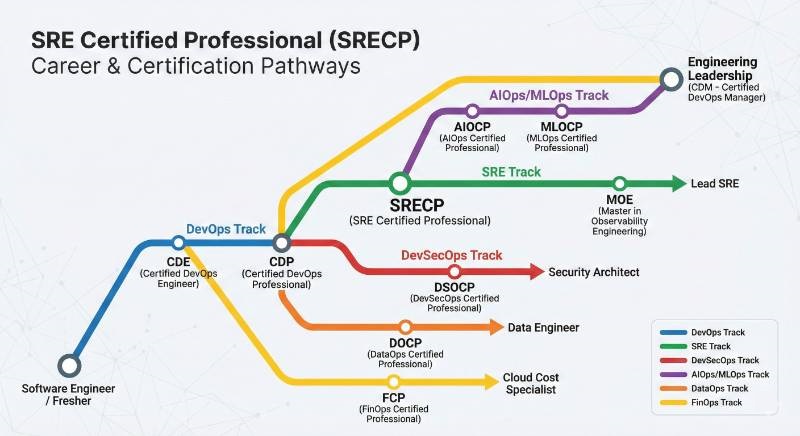
In the fast-paced world of modern digital infrastructure, the ability to maintain rock-solid system stability while shipping features at high speed is the ultimate competitive advantage. Site Reliability Engineering (SRE) has emerged as the definitive discipline for achieving this balance, transforming traditional operations into a data-driven, automated engineering practice. Whether you are a software engineer looking to master production environments, a DevOps professional specializing in observability, or a manager building high-performance teams, the SRE Certified Professional (SRECP) program provides the essential roadmap to bridge the gap between development and reliability. This guide serves as your comprehensive resource for navigating the training, certification, and career paths that will establish you as a top-tier expert in ensuring global system uptime.
SRE Certified Professional (SRECP) Master Table
Choosing a certification track is about mapping your current skills to your long-term career goals. Here is the complete landscape of programs offered via DevOpsSchool.
| Track | Certification | Level | Who it’s for | Prerequisites | Skills Covered | Recommended Order |
| SRE | SRECP | Professional | SREs, DevOps, SysAdmins | Basic Linux, Git | SLOs/SLIs, Error Budgets, Incident Mgmt, Toil Reduction | After CDE/CDP |
| DevOps | Certified DevOps Engineer (CDE) | Foundation | Freshers, Software Eng | Basic Programming | CI/CD, Git, Docker, Ansible, Maven | 1st Step |
| DevOps | Certified DevOps Professional (CDP) | Professional | Working Engineers | CDE or 1yr Exp | Advanced Jenkins, K8s, Terraform, Prometheus | 2nd Step |
| DevSecOps | DSOCP | Professional | Security/DevOps Eng | Basic DevOps | SonarQube, Vault, Trivy, Compliance as Code | After CDP |
| MLOps | MLOCP | Professional | Data Scientists, ML Eng | Python, ML Basics | Model deployment, Monitoring, ML Pipelines | After CDP |
| AIOps | AIOCP | Professional | SREs, Data Engineers | Ops experience | Predictive analytics, Auto-remediation, Log AI | After SRECP |
| DataOps | DOCP | Professional | Data Eng, DBAs | SQL, Data Pipelines | Data quality, Orchestration, Pipeline automation | After CDE |
| K8s | KCAD | Professional | Cloud/Platform Eng | Docker Basics | Pods, Services, Ingress, Scheduling, Troubleshooting | Standalone |
Detailed Guide: SRE Certified Professional (SRECP)
What it is
The SRE Certified Professional (SRECP) is an advanced program that teaches you how to apply software engineering principles to operations. It moves you away from “firefighting” and toward a world of automated, data-driven system management.
Who should take it
- Software Engineers who want to build more resilient applications.
- DevOps Professionals looking to specialize in site reliability and observability.
- System Administrators transitioning into cloud-native, automated roles.
- Technical Managers who need to implement SRE cultures within their organizations.
Skills you’ll gain
- Mastery of Service Level Objectives (SLOs) and Service Level Indicators (SLIs).
- Implementing and managing Error Budgets to balance innovation and stability.
- Professional-level Monitoring and Observability using Prometheus and Grafana.
- Strategic Incident Management and conducting blameless post-mortems.
- Automating manual tasks (Toil Reduction) using Python, Ansible, and Terraform.
- Building Scalable and Resilient microservices architectures.
Real-world projects you should be able to do
- Design an automated dashboard that tracks user-facing performance in real-time.
- Build a self-healing infrastructure that automatically scales or restarts based on health checks.
- Implement a CI/CD pipeline that includes automated “gates” for reliability.
- Orchestrate complex multi-cloud environments using Kubernetes and Terraform.
Preparation Plan
7–14 Days (The Reviewer): Best if you already use SRE tools. Focus on the core theory: SLOs, Error Budgets, and the cultural pillars of SRE.
30 Days (The Practitioner): The ideal timeline. Spend two weeks on the hands-on labs (Prometheus, K8s, Python) and two weeks on the SRE architectural principles.
60 Days (The Career Shifter): Spend the first 30 days mastering Linux and basic automation, then spend the next 30 days on the SRECP-specific toolset and methodologies.
Common Mistakes
- The Tool Trap: Thinking that installing Prometheus makes you an SRE. SRE is a mindset, not just a list of tools.
- Alert Fatigue: Creating too many alerts for minor issues. If an alert doesn’t require immediate human action, it shouldn’t be an alert.
- Ignoring Toil: Letting manual work stack up until your team has no time for engineering.
- Blaming People, Not Systems: If an engineer makes a mistake, the system should have prevented it. Focus on the code, not the person.
Best next certification after this
After mastering SRE, you can take three different directions:
Leadership: Certified DevOps Manager (CDM) to lead larger organizational transformations.
Specialization: AIOps Certified Professional (AIOCP) to automate your monitoring using AI.
Broadening: DevSecOps Certified Professional (DSOCP) to ensure your reliable systems are also hack-proof.
Choose Your Path: 6 Learning Tracks
- DevOps Path: Focuses on the end-to-end lifecycle, bridging the gap between developers and IT operations.
- DevSecOps Path: Integrates security at every stage of the pipeline, ensuring that “security as code” is a reality.
- SRE Path: Prioritizes system reliability, uptime, and performance using software engineering discipline.
- AIOps/MLOps Path: Applies Artificial Intelligence to IT operations or focuses on the lifecycle of machine learning models.
- DataOps Path: Streamlines the delivery of data and analytics, ensuring high-quality data pipelines.
- FinOps Path: Manages and optimizes cloud spending, bringing financial accountability to the cloud.
Role → Recommended Certifications
- DevOps Engineer: CDE → CDP → KCAD
- SRE: SRECP → Master in Observability Engineering
- Platform Engineer: CDP → KCAD → Master in DevOps Engineering (MDE)
- Cloud Engineer: CDP → AWS/Azure/GCP Architect Professional
- Security Engineer: CDP → DSOCP → Certified DevSecOps Architect
- Data Engineer: DataOps Foundation → DOCP → CDP
- FinOps Practitioner: FinOps Foundation → CDP → Certified FinOps Professional
- Engineering Manager: Master in DevOps Engineering (MDE) → Certified DevOps Manager (CDM)
Training & Certification Support Institutions
Choosing where to train is as important as the certification itself. These institutions are the leaders in SRE and DevOps education:
- DevOpsSchool: The primary provider for the SRECP certification, offering live instructor-led sessions and hands-on labs with industry veterans.
- Cotocus: Focuses on high-end enterprise consulting and specialized technical training for large engineering teams.
- Scmgalaxy: A vast resource center and community platform providing in-depth tutorials on configuration management and CI/CD.
- BestDevOps: Known for their job-oriented programs that bridge the gap between academic learning and industry requirements.
- DevSecOpsSchool: The specialized wing for security integration, helping SREs build secure, compliant systems.
- SRESchool: A dedicated portal that lives and breathes site reliability, from monitoring to chaos engineering.
- AIOpsSchool: Leads the way in teaching predictive maintenance and intelligent automation using AI.
- DataOpsSchool: Focuses specifically on the automation and reliability of big data and analytics pipelines.
- FinOpsSchool: The authority on cloud financial management, helping organizations optimize their cloud ROI.
Next Certifications to Take
Once you finish your SRECP, keep the momentum going. Based on your goals, consider these options:
- Same Track: Master in Observability Engineering (MOE). Go beyond basic monitoring into the deep world of traces and logs.
- Cross-Track: DevSecOps Certified Professional (DSOCP). Add security to your reliability toolkit.
- Leadership: Certified DevOps Manager (CDM). Move from the terminal to strategic decision-making.
General FAQs (Career & Outcomes)
1. Is SRECP difficult? It is a professional-level course. It challenges your technical skills and your architectural thinking. If you put in the lab time, you will succeed.
2. How long does the certification take? Most people finish the training and exam within 4 to 8 weeks, depending on their starting level.
3. Are there prerequisites? You should know the basics of Linux and how a CI/CD pipeline works. If you’re new, start with the CDE certification.
4. What is the value of SRE in the market? SREs are among the highest-paid engineers because they protect a company’s most valuable asset: its service availability.
5. Can a manager take this? Yes. It is vital for managers to understand SRE principles to build healthy, high-performing teams.
6. Does it cover cloud platforms? Yes, the principles apply to AWS, Azure, and GCP, with a focus on cloud-native tools like Kubernetes.
7. Is the exam multiple-choice or practical? It is a mix. It tests your knowledge of the SRE mindset and your ability to apply tools to solve problems.
8. Will this help me transition from SysAdmin to SRE? This is the fastest path to making that transition. It modernizes your skills from manual work to automated engineering.
9. Is the certification globally recognized? Yes, DevOpsSchool certifications are recognized by major tech companies across India and the globe.
10. How do I maintain the certification? By staying active in the community and participating in advanced modules or refresher sessions every few years.
11. Is there a focus on coding? Yes. SRE is about using code to solve ops problems. You’ll learn how to use Python and Bash for automation.
12. What is the biggest benefit? Peace of mind. You’ll learn how to build systems that don’t break, and if they do, you’ll know exactly how to fix them—fast.
SRECP Specific FAQs
1. What is the core tool of the SRECP? Prometheus and Grafana are the heavy hitters for observability, along with Kubernetes for orchestration.
2. Do we learn about SLOs in detail? Absolutely. Defining SLOs is the heartbeat of this certification.
3. Is “Toil” a major topic? Yes. We spend significant time learning how to identify and eliminate manual work through automation.
4. Does the course cover “Chaos Engineering”? Yes, you’ll learn how to proactively break things to ensure your systems are truly resilient.
5. How much hands-on lab time is included? The program is roughly 70% hands-on labs and 30% theory.
6. Is there support for interview prep? Yes, most programs at DevOpsSchool include an interview kit and project guidance.
7. Can I take the exam online? Yes, the entire process—from training to the final exam—is available online.
8. What if I fail the exam? Most programs offer a retake option after a short cooling-off period to let you study more.
Conclusion
The transition to Site Reliability Engineering represents a fundamental shift from reactive troubleshooting to a proactive, engineering-first approach to system health. By mastering the SRE Certified Professional (SRECP) certification, you gain the precise technical toolkit and cultural mindset needed to balance rapid innovation with rock-solid stability. In an era where digital uptime is the ultimate currency, this program empowers you to eliminate manual toil, leverage data-driven observability, and build the resilient infrastructures that define industry leaders. Whether you are advancing your career in India or on a global stage, becoming a certified SRE professional is your definitive path to becoming an indispensable architect of the modern digital world.

Find Trusted Cardiac Hospitals
Compare heart hospitals by city and services — all in one place.
Explore Hospitals
Great read for anyone interested in SRE! The way the guide covers certification paths and real-world best practices makes it very useful.