
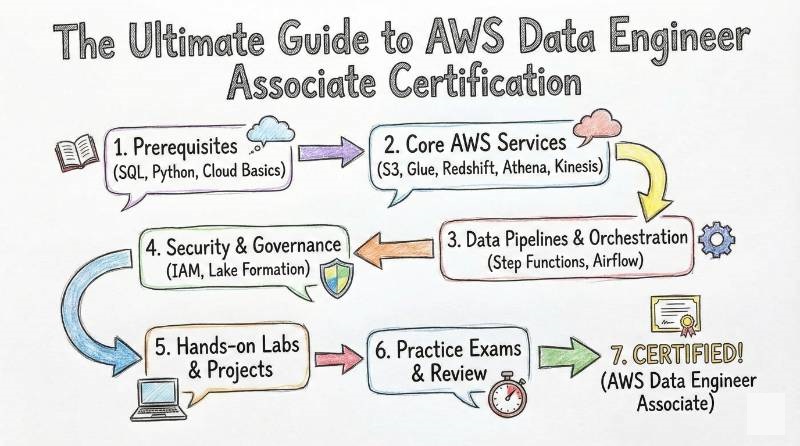
In the current technology landscape, data is not just an asset; it is the lifeblood of modern business. As an industry veteran who has navigated the evolution from on-premise server racks to serverless cloud architectures, I have witnessed a massive shift. Companies are no longer struggling to store data; they are struggling to make sense of the petabytes they generate daily. This has created an unprecedented demand for skilled professionals who can build robust, scalable, and secure data pipelines. It is no longer enough to just be a “Software Engineer.” The industry needs specialists who understand the intersection of code, infrastructure, and data flow.
For working engineers, managers, and software developers across India and the globe, validating your skills is crucial. The cloud computing market is fierce. A specialized certification is often the differentiator that lands you a promotion, a new role, or the confidence to lead complex projects. Among the various credentials available, the AWS Certified Data Engineer – Associate stands out as a critical benchmark. It validates your ability to design and implement data systems on the world’s leading cloud platform.
This guide is written for those ready to move beyond general cloud knowledge and establish themselves as experts in cloud data infrastructure. We will break down what this certification is, why it matters to your career path (whether that’s DataOps, SRE, or Platform Engineering), and provide a concrete plan to achieve it.
The Landscape of Key Cloud & Data Certifications
Before diving deep into the AWS Data Engineer Associate, it is helpful to understand where it fits in the broader ecosystem of professional certifications. The table below outlines key certifications across different tracks and levels, helping you visualize your potential career journey.
| Certification Name | Track/Domain | Level | Who it’s for | Prerequisites (Recommended) | Skills Covered |
| AWS Certified Cloud Practitioner | Cloud Fundamentals | Foundational | Non-tech roles, beginners | None | Basic cloud concepts, AWS services overview, pricing. |
| AWS Certified Solutions Architect – Associate | Architecture | Associate | Solutions Architects, Generalists | 1 year AWS experience | Designing resilient, high-performing architectures. |
| AWS Certified Data Engineer – Associate | Data Engineering / DataOps | Associate | Data Engineers, Developers | 1-2 years AWS data & coding | Data ingestion, transformation, security, data lakes. |
| AWS Certified DevOps Engineer – Professional | DevOps | Professional | DevOps Engineers, SREs | 2+ years managing AWS environments | CI/CD, infrastructure as code, monitoring, automation. |
| Certified Kubernetes Administrator (CKA) | Container Orchestration | Intermediate | Platform Engineers, SREs | Linux and container basics | Kubernetes internals, cluster management, troubleshooting. |
| Terraform Associate | Infrastructure as Code | Associate | Cloud Engineers, DevOps | Basic terminal & cloud knowledge | IaC concepts, Terraform syntax, state management. |
Deep Dive: AWS Certified Data Engineer – Associate
What it is
The AWS Certified Data Engineer – Associate (DEA-C01) is a specialized certification that focuses on the core technical skills required to build and maintain data pipelines on AWS. It moves beyond general cloud architecture and dives deep into how data moves, how it is stored, and how it is secured. It validates your ability to choose the right tool for the right job—whether that is real-time streaming with Kinesis or massive batch processing with AWS Glue.
Who should take it
This certification is ideal for Software Engineers who want to pivot into data, ETL Developers looking to modernize their skills in the cloud, and Data Architects who need a formal validation of their AWS expertise. If you are a manager, this certification provides the technical baseline your team needs to build reliable, cost-effective data platforms.
Skills you’ll gain
By preparing for this exam, you develop a “pipeline-first” mindset. You learn to stop seeing data as a static asset and start seeing it as a dynamic stream.
- Ingestion & Transformation: Mastering batch and streaming patterns to move data from anywhere into your data lake.
- Data Store Management: Learning how to optimize S3, Redshift, and DynamoDB for performance and cost.
- Orchestration: Using tools like AWS Step Functions and Managed Workflows for Apache Airflow (MWAA) to automate complex workflows.
- Governance & Security: Implementing fine-grained access control with AWS Lake Formation and encryption with KMS.
- Monitoring & Support: Setting up CloudWatch alarms and logs to catch pipeline failures before they impact the business.
Real-world projects you should be able to do
After completing this training, you won’t just know the theory; you will have the technical muscle to build actual production systems.
- Real-Time Dashboarding: Build a pipeline that ingests clickstream data via Kinesis, processes it with Lambda, and visualizes it in QuickSight within seconds.
- Serverless Data Lake: Design a multi-tier S3 data lake (Raw, Cleaned, Curated) using AWS Glue for automated schema discovery and partitioning.
- Automated Data Governance: Set up a centralized governance layer where you can manage permissions across multiple databases and accounts from a single console.
- Cloud Data Migration: Move legacy on-premise SQL databases to Amazon Redshift using AWS DMS (Database Migration Service) with minimal downtime.
Preparation Plan
| Timeline | Focus Area |
| 7–14 Days (Intensive) | Focus on “gap-filling.” Review AWS Glue, Redshift, and Lake Formation. Take 3-4 full-length practice exams to identify weak spots. |
| 30 Days (Standard) | Week 1-2: Ingestion & Storage (S3, Kinesis, Redshift). Week 3: Transformation & Orchestration (Glue, Step Functions). Week 4: Security & Mock Exams. |
| 60 Days (Comprehensive) | Spend the first 30 days doing hands-on labs for every service. Use the remaining 30 days for deep-dive theory, whitepapers, and rigorous practice testing. |
Common Mistakes
Even experienced engineers often trip up on specific areas of the AWS data stack.
Ignoring Non-AWS Solutions: The exam focuses on AWS, but in the real world, you might use Apache Kafka instead of Kinesis, or Airflow instead of Step Functions. Don’t ignore open-source standards, as AWS services are often managed versions of them.
Overlooking Security: It is easy to focus only on making the data flow. However, a significant portion of the exam tests your ability to secure that data. If you cannot configure IAM roles or S3 bucket policies correctly, you will not pass.
Forgetting Cost Optimization: A good data engineer doesn’t just build systems; they build cost-effective systems. You need to understand S3 storage classes, DynamoDB capacity modes, and Redshift node types to make efficient architectural decisions.
Choose Your Path
The technology field has diversified into specialized operational domains. The AWS Data Engineer Associate certification is a powerful asset in several of these paths.
1. DevOps (Development Operations) Focuses on bridging the gap between writing code and deploying it. A DevOps engineer with data skills can better manage the infrastructure supporting data-heavy applications and understand the specific CI/CD needs of data pipelines.
2. DevSecOps (Development, Security, and Operations) Integrates security practices early in the development lifecycle. Data is often the primary target for attacks. A DevSecOps professional needs to understand how data is ingested and stored to secure it effectively using encryption and access controls.
3. SRE (Site Reliability Engineering) Treats operations as a software problem. SREs are responsible for system uptime and performance. As applications rely more on data, SREs must understand data pipeline reliability, monitoring latency in streams, and database failover strategies.
4. AIOps/MLOps (Artificial Intelligence / Machine Learning Operations) Focuses on deploying and maintaining machine learning models in production. This is adjacent to data engineering. MLOps requires robust data pipelines to feed models for training and inference. A strong data engineering foundation is essential for success here.
5. DataOps (Data Operations) This is the direct home domain for this certification. DataOps focuses on improving the communication, integration, and automation of data flows between data managers and data consumers across an organization.
6. FinOps (Financial Operations) Focuses on managing and optimizing cloud costs. Data storage and processing (especially analytics and warehousing) are often the biggest drivers of cloud bills. A FinOps practitioner needs to understand these architectures to recommend cost-saving measures.
Role → Recommended Certifications Mapping
| Role | Primary Certification | Secondary/Support Certs |
| Data Engineer | AWS Data Engineer Assoc. | AWS Solutions Architect Assoc. |
| DevOps Engineer | AWS DevOps Engineer Prof. | AWS Developer Assoc. |
| SRE | AWS SysOps Admin Assoc. | AWS DevOps Engineer Prof. |
| Platform Engineer | AWS Solutions Architect Prof. | Certified Kubernetes Administrator (CKA) |
| Security Engineer | AWS Security Specialty | AWS Solutions Architect Assoc. |
| Cloud Engineer | AWS Solutions Architect Assoc. | AWS SysOps Admin Assoc. |
| FinOps Practitioner | AWS Cloud Practitioner | FinOps Certified Practitioner |
| Engineering Manager | AWS Cloud Practitioner | AWS Solutions Architect Assoc. |
Next Certifications to Take (Top 3 Options)
Based on industry trends for software engineers, these are the top follow-up credentials to consider:
- Option 1 (Same Track): AWS Certified Machine Learning – Associate. This allows you not just to move the data, but to build the models that use it.
- Option 2 (Cross-Track): AWS Certified Solutions Architect – Associate. This provides the foundational “big picture” of how data services interact with networking and compute.
- Option 3 (Leadership): PMP (Project Management Professional). For those moving into management, this bridges the gap between technical execution and business strategy.
Top Institutions for AWS Data Engineer Training
If you are looking for guided training and certification support, these institutions are highly recommended:
DevOpsSchool A premier institution focusing on cloud and DevOps technologies. They offer comprehensive training programs tailored to certification objectives, featuring real-world project scenarios and experienced instructors.
Cotocus Known for deep-dive technical training, Cotocus provides specialized courses aimed at bridging the gap between theoretical knowledge and practical industry implementation in the cloud data space.
Scmgalaxy Focuses on the broader spectrum of software supply chain and configuration management, offering training that complements data engineering by emphasizing reliable and repeatable deployment processes.
BestDevOps Provides targeted training modules aimed at helping professionals upskill quickly in specific cloud domains, including AWS data services and associated tools.
devsecopsschool Integrates security into every aspect of their training. For data engineers, their courses emphasize securing pipelines, managing encryption, and ensuring compliance within AWS.
sreschool Focuses on reliability and scalability. Their approach to data engineering training highlights building resilient systems that can withstand failures and scale automatically.
aiopsschool Specializes in the intersection of AI and IT operations. Their training is ideal for data engineers looking to understand how their pipelines feed into AIOps and machine learning workflows.
dataopsschool Dedicated specifically to the DataOps domain, offering highly focused training on the lifecycle of data, from ingestion to delivery, aligning perfectly with the goals of the AWS Data Engineer certification.
finopsschool Focuses on the financial aspects of cloud computing. Their training helps data engineers understand the cost implications of their architectural choices, a critical skill for senior roles.
FAQs : Career, Difficulty, and Strategy
1. How difficult is the AWS Certified Data Engineer Associate compared to the Solutions Architect Associate?
It is more technically narrow but significantly deeper. While Solutions Architect covers a broad range of networking and compute, the Data Engineer exam requires specific, expert-level knowledge of data transformations, SQL optimizations, and schema design in AWS Glue and Redshift.
2. How much time do I need to commit to passing this?
If you are already working with data, 40-60 hours of focused study is usually sufficient. For those new to data engineering, you should plan for 100+ hours to account for hands-on lab time.
3. Are there any mandatory prerequisites?
No. AWS no longer requires you to hold a lower-level certification before taking an Associate exam. However, I highly recommend having a basic understanding of cloud computing (equivalent to the Cloud Practitioner level).
4. What is the best sequence for taking AWS certifications?
The ideal path is Cloud Practitioner -> Solutions Architect Associate -> Data Engineer Associate. This ensures you understand how the “pipes” work before you try to run “water” through them.
5. Does this certification hold value for managers?
Absolutely. It gives managers the technical vocabulary to lead data teams effectively, helps in accurately estimating project timelines, and ensures they can vet the technical decisions made by their architects.
6. What are the career outcomes after getting certified?
Professionals often see a shift toward higher-paying roles like Senior Data Engineer, Analytics Architect, or DataOps Lead. In India and global markets, this certification is frequently a filter for recruiters hiring for specialized cloud data teams.
7. How long is the certification valid?
It is valid for three years. After that, you must either retake the exam or move up to a Professional-level certification to stay current.
8. Is this better than the old AWS Certified Data Analytics – Specialty?
The Associate level is more accessible and focuses more on the engineering (moving and storing data) rather than just the analytics (visualizing and querying). It is the modern baseline for the industry.
9. Can a Software Engineer pivot to Data Engineering using this?
Yes. This certification is specifically designed to bridge that gap by teaching software developers how to apply their coding skills to distributed data systems on AWS.
10. How does this help with global relocation or remote work?
AWS certifications are globally recognized. Having this credential makes it much easier to pass technical screenings for remote roles in the US, Europe, or the Middle East.
11. What is the passing score for the exam?
The exam is scored on a scale of 100–1,000, and you need a minimum of 720 to pass.
12. Is there a lab portion in the actual exam?
Currently, the exam consists of multiple-choice and multiple-response questions. While there are no live labs during the test, the questions are designed to be “scenario-based,” meaning you cannot pass without having hands-on experience.
FAQs : Technical Training & Exam Content
1. Which AWS service is most heavily weighted in the training?
AWS Glue is the star of the show. You must understand Crawlers, Data Catalog, ETL jobs (Spark and Python), and how Glue interacts with S3 and Redshift.
2. Do I need to know how to code in Python or Scala?
You don’t need to be a senior developer, but you must be able to read and understand basic Python/Spark code snippets, as they often appear in questions regarding AWS Glue and Lambda.
3. How much focus is there on “Streaming” data?
Significant. You will need to know the difference between Kinesis Data Streams (low latency) and Kinesis Data Firehose (near real-time delivery to S3/Redshift).
4. Does the training cover SQL?
Yes. You should be comfortable with SQL, specifically for querying data in Amazon Athena and performing optimizations (like distribution keys and sort keys) in Amazon Redshift.
5. What is the role of “Data Lakes” in this certification?
The “Data Lake” concept (specifically S3 and Lake Formation) is foundational. You’ll be tested on how to secure a data lake and how to move data through different zones (Bronze, Silver, Gold).
6. Is cost optimization a major part of the training?
Yes. You will learn when to use S3 Lifecycle policies, how to choose the right Redshift node type, and how to use Athena to reduce query costs.
7. How are security and compliance handled?
The exam covers “Security by Design.” This includes KMS encryption, IAM roles for service-to-service communication, and using Macie to find sensitive data in your S3 buckets.
8. What kind of orchestration tools are covered?
The training focuses on AWS Step Functions for serverless orchestration and Amazon MWAA (Managed Apache Airflow) for complex, code-based data workflows.
Conclusion
The shift toward data-driven decision-making is not a temporary trend; it is the new operating standard for global business. By earning the AWS Certified Data Engineer – Associate certification, you are doing more than just adding a logo to your LinkedIn profile. You are demonstrating a commitment to mastering the tools that define modern infrastructure. Whether you are a software engineer looking to specialize, or a manager aiming to better understand your team’s challenges, this training provides the knowledge needed to build secure, scalable, and cost-effective data systems. In a competitive job market, investing in specialized skills is the surest path to career advancement. The cloud is built on data; take the step today to become one of its architects.

Find Trusted Cardiac Hospitals
Compare heart hospitals by city and services — all in one place.
Explore Hospitals
The explanation of the AWS Data Engineer Associate certification and preparation tips is clear and practical — very helpful for anyone planning to pursue it.
I appreciate how clearly you broke down the AWS Data Engineer Associate path — it makes preparing for the certification feel much less overwhelming. The practical tips and suggested resources are especially useful for anyone starting their cloud data journey. Thanks for putting this together in a way that feels easy to follow!