
Introduction
The software industry has moved past the era of manual deployments and siloed teams. Today, speed and stability are the twin pillars of any successful digital enterprise. As systems grow in complexity, the demand for professionals who can bridge the gap between development and operations has reached an all-time high.
However, simply knowing a few tools like Git or Docker is no longer enough to stand out in a global market. Companies in India and across the world are looking for validated expertise—professionals who understand the entire lifecycle of a product. The DevOps Certified Professional (DCP) program has emerged as the gold standard for those looking to formalize their skills and lead technical transformations.
This guide serves as a comprehensive roadmap for software engineers and managers. It breaks down the certification ecosystem, the learning paths available, and how to strategically plan your career in the DevOps domain.
Master Certification Ecosystem for Software Engineers
Navigating the various tracks in the modern infrastructure landscape requires a clear map. Below is a comprehensive list of certifications that define the current industry standards.
| Track | Level | Who it’s for | Prerequisites | Skills Covered | Recommended Order |
| DevOps | Professional | Software Engineers, Admins, Managers | Basic Linux & SDLC | CI/CD, Docker, K8s, Terraform, Git | 1 (Foundational) |
| DevSecOps | Specialist | Security Engineers, DevOps Leads | DevOps Basics | Pipeline Security, Compliance, Auditing | 2 (Post-DevOps) |
| SRE | Specialist | Reliability Engineers, Ops Leads | Cloud & Ops Exp | SLOs, Error Budgets, Incident Mgmt | 2 (Post-DevOps) |
| AIOps/MLOps | Specialist | Data Scientists, ML Engineers | Python & Ops Basics | Model Deployment, Predictive Ops | 3 (Niche) |
| DataOps | Specialist | Data Engineers, DBAs | Data Pipeline Exp | Data Lifecycle, Automated Testing | 3 (Niche) |
| FinOps | Leadership | Finance Leads, Cloud Architects | Cloud Fundamentals | Cost Optimization, Cloud Economics | 3 (Leadership) |
Deep Dive: DevOps Certified Professional (DCP)
What it is
The DevOps Certified Professional (DCP) is an industry-recognized training and certification program that validates a candidate’s mastery over the entire DevOps lifecycle. It is designed to move beyond theory, focusing on the practical integration of various tools to create a seamless, automated software delivery pipeline.
Who should take it
This certification is ideal for Software Engineers who want to own the deployment process, System Administrators modernizing their skill sets, and Engineering Managers who need to implement DevOps culture within their organizations. It is equally valuable for professionals in India looking for domestic growth and those targeting global roles.
Skills you’ll gain
- Advanced Version Control: Managing complex branching strategies and collaborative workflows in Git.
- Continuous Integration (CI): Building and automating test suites using Jenkins and GitLab CI.
- Containerization & Orchestration: Mastering Docker for packaging and Kubernetes for scaling applications.
- Infrastructure as Code (IaC): Using Terraform and Ansible to provision and configure environments automatically.
- Continuous Monitoring: Setting up observability stacks with Prometheus, Grafana, and ELK.
Real-world projects you should be able to do after it
- End-to-End Pipeline Construction: Build a CI/CD pipeline that triggers on code commit and ends with a production-ready container deployment.
- Hybrid Cloud Provisioning: Use Terraform to setup identical environments across multiple cloud providers (AWS/Azure/GCP).
- Self-Healing Infrastructure: Configure Kubernetes clusters that automatically restart failed services and scale based on traffic spikes.
Preparation plan
- 7–14 Day Sprint: Focus exclusively on the certification blueprint. Run 4 hours of labs daily, specifically focusing on the integration of Jenkins with Kubernetes.
- 30-Day Standard Path: Dedicate 1.5 hours daily. Spend one week on each major pillar: Source Control/CI, Containers, IaC, and Monitoring. Use the final weekend for a capstone project.
- 60-Day Foundation Path: Spend the first 20 days mastering Linux and Scripting (Bash/Python). Spend the remaining 40 days following the standard path to ensure a deep conceptual understanding.
Common mistakes
- Over-focusing on a single tool: Many fail because they learn Jenkins but ignore the underlying networking or Linux fundamentals.
- Skipping “Hands-on” work: Watching videos is not enough; the exam and the job require you to solve real configuration errors.
- Ignoring the “Culture” aspect: DevOps is about breaking silos. Candidates often ignore the methodology and focus only on the code.
Best next certification after this
- Same Track: Certified Kubernetes Administrator (CKA).
- Cross-Track: DevSecOps Certified Professional to add a security layer to your profile.
- Leadership: Site Reliability Engineering (SRE) for those aiming for principal engineer roles.
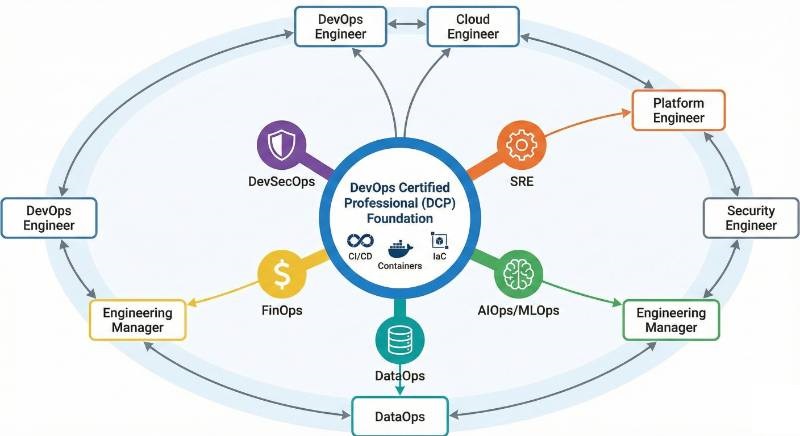
Choose Your Path: 6 Specialized Domains
- DevOps: The core path focused on the automation of software delivery and the cultural shift between teams.
- DevSecOps: A specialized track that integrates security protocols (SAST/DAST/Compliance) into the automated pipeline.
- SRE (Site Reliability Engineering): Focuses on the “Operations” side using software engineering principles to ensure system uptime and scalability.
- AIOps/MLOps: Tailored for the modern era of AI, focusing on the deployment and lifecycle management of machine learning models.
- DataOps: Aimed at data professionals to bring the agility of DevOps to data analytics and big data pipelines.
- FinOps: A critical path for management, focusing on the financial accountability and cost-optimization of cloud resources.
Role → Recommended Certifications
| Current Role | Recommended Path |
| DevOps Engineer | DevOps Certified Professional (DCP) + Kubernetes |
| SRE | DCP + SRE Certified Professional |
| Platform Engineer | DCP + Terraform Specialist |
| Cloud Engineer | DCP + AWS/Azure Solutions Architect |
| Security Engineer | DevSecOps Certified Professional |
| Data Engineer | DataOps Certified Professional |
| FinOps Practitioner | FinOps Certified Professional |
| Engineering Manager | DCP + FinOps Specialist |
Next Certifications to Take: Scaling Your Career
Once the foundation is set with the DCP, engineers should look to diversify their expertise based on the following three categories:
- Same Track (Specialization): For those wanting to be the ultimate technical expert, focus on Advanced Kubernetes (CKA/CKAD) or Docker Certified Associate.
- Cross-Track (Versatility): To become a T-shaped professional, look toward DevSecOps or Cloud Architect certifications to understand how infrastructure interacts with security and design.
- Leadership (Management): For those moving into Director or VP roles, SRE Certified Professional or FinOps certifications are essential for managing large-scale budgets and organizational reliability.
Top Institutions for Training & Certification
DevOpsSchool
DevOpsSchool is a leading global provider known for its high-impact, project-based learning. They offer an extensive curriculum for the DevOps Certified Professional (DCP) program, featuring live instructor-led sessions, a robust LMS, and a 24/7 support system to ensure candidates are job-ready for top MNCs.
Cotocus
Cotocus focuses on corporate-grade training solutions that bridge the gap between academic knowledge and industry requirements. Their programs are highly structured, catering to both individuals and large engineering teams looking to implement scalable DevOps and Cloud architectures.
Scmgalaxy
Scmgalaxy is a community-centric platform that has become a go-to resource for Source Code Management and Build automation. They provide in-depth training on the foundational aspects of DevOps, making them an excellent choice for engineers wanting to master the “Dev” in DevOps.
BestDevOps
BestDevOps specializes in career-oriented training paths that are frequently updated to reflect the latest market trends. Their focus on practical assignments and mock interviews makes them a preferred institution for professionals aiming for immediate career transitions.
devsecopsschool
This institution is the premier choice for professionals looking to specialize in “Shift-Left” security. They provide specialized training on integrating security tools and compliance checks directly into the DevOps workflow.
sreschool
Sreschool is dedicated to the principles of Site Reliability Engineering. Their curriculum is tailored for engineers who want to manage complex, high-traffic systems, focusing on observability, incident management, and error budgeting.
aiopsschool
Aiopsschool provides niche training at the intersection of Artificial Intelligence and IT Operations. They help professionals learn how to use machine learning to automate remediation and predict system failures before they occur.
dataopsschool
Dataopsschool focuses on the emerging field of DataOps, teaching data engineers how to apply agile and DevOps practices to data pipelines to ensure high quality and faster delivery cycles.
finopsschool
Finopsschool addresses the growing need for cloud financial management. They provide training that helps engineers and finance teams collaborate to optimize cloud spend and maximize the business value of cloud investments.
Frequently Asked Questions (FAQs)
General Career & Value FAQs
Q1: How difficult is the DCP certification?
The certification is moderately challenging. It requires a balance of conceptual understanding and practical tool knowledge. It is designed to be achievable for anyone who completes the hands-on lab requirements.
Q2: What is the average time required to complete the training?
For most working professionals, 30 to 45 days of consistent study (roughly 8-10 hours a week) is sufficient to feel confident for the certification.
Q3: Are there any specific prerequisites?
While there are no mandatory certificates required beforehand, a basic understanding of the Linux command line and the Software Development Life Cycle (SDLC) is highly recommended.
Q4: In what sequence should I take these certs?
Always start with the DevOps Certified Professional (DCP). It provides the core foundation. After that, you can branch into DevSecOps for security or SRE for operations management.
Q5: What is the career value of this certification?
Being DCP certified validates that you can handle the complexities of modern software delivery. It often leads to higher visibility during hiring, salary increments of 20-40%, and opportunities in senior engineering roles.
Q6: Does this certification help with global opportunities?
Yes. The DCP curriculum is based on global industry standards, making it highly relevant for roles in North America, Europe, and the Middle East, as well as the Indian market.
Q7: Is coding required for DevOps?
You don’t need to be a professional developer, but you must be comfortable with “Infrastructure as Code.” This involves writing configuration files in YAML/JSON and basic scripting in Bash or Python.
Q8: How long is the certification valid?
Most certifications in this track are valid for 2-3 years, but many providers like DevOpsSchool offer lifetime validity for their core professional certifications.
Q9: Can I transition from a non-IT background?
Yes, but it requires a longer preparation path (60-90 days). You must first master Linux and networking basics before diving into the DevOps tools.
Q10: What is the role of a DevOps Manager?
A DevOps Manager focuses on the “People” and “Process” aspects. This certification helps managers understand the “Technology” so they can make better strategic decisions.
Q11: How does this differ from cloud-specific certs (like AWS/Azure)?
Cloud certs teach you how to use a specific provider. The DCP teaches you the methodology and tools (like Terraform/K8s) that work across all clouds.
Q12: Is there a job guarantee with these programs?
While no certification can “guarantee” a job, the DCP program includes intensive interview preparation and project portfolios that significantly increase your chances of landing a high-paying role.
DevOps Certified Professional (DCP) Specific FAQs
Q1: What is the official provider of the DCP?
The primary provider and certifying body for the DevOps Certified Professional program is DevOpsSchool.
Q2: Does the DCP training include live projects?
Yes. The training is built around real-world scenarios, including setting up automated pipelines for Java, Python, and Node.js applications.
Q3: Can I take the DCP exam online?
Yes, the exam is typically conducted through an online proctored environment, allowing professionals to get certified from anywhere in the world.
Q4: What is the passing score for the DCP?
While it can vary slightly by version, the standard passing score is usually 70%.
Q5: Is the DCP recognized by major MNCs?
Yes, companies like TCS, Infosys, Cognizant, and global firms like Amazon and Google recognize the skills validated by this professional track.
Q6: What tools are mandatory to learn for the DCP?
The core curriculum focuses on Git, Jenkins, Docker, Kubernetes, Ansible, and Terraform.
Q7: Are there retake options if I fail?
Most training providers offer at least one retake option, but it is always best to check the specific terms at the time of registration.
Q8: Does the DCP cover Cloud platforms?
Yes, the program typically involves deploying applications to major cloud providers like AWS or Azure to ensure students understand cloud-native DevOps.
Conclusion
The transition to a DevOps-centric model is the most significant shift in IT over the last decade. For software engineers and managers, the DevOps Certified Professional program offers a clear, structured path to staying relevant in an increasingly automated world.
By choosing the right institution, committing to hands-on practice, and strategically planning your next steps into specialized domains like DevSecOps or SRE, you are not just earning a certificate—you are future-proofing your career. The journey from a traditional role to a DevOps professional is challenging, but the career outcomes and professional growth make it one of the most rewarding paths in the modern tech landscape.

Find Trusted Cardiac Hospitals
Compare heart hospitals by city and services — all in one place.
Explore Hospitals
This is a fantastic and detailed guide! 👍 The breakdown of the DevOps Certified Professional journey makes it easy to understand what skills and steps are needed.