
Introduction
AI Agent Platforms are transforming how businesses design, deploy, and manage intelligent systems that can reason, act, and collaborate autonomously. Unlike traditional chatbots or static AI tools, AI agents are capable of handling multi-step tasks, making decisions based on context, integrating with external systems, and continuously improving through feedback loops.
These platforms are becoming essential as organizations move toward automation-first operations, AI-driven customer experiences, and intelligent internal workflows. From automating customer support and IT operations to running complex data analysis, AI agent platforms reduce manual effort, increase speed, and unlock entirely new ways of working.
When choosing an AI Agent Platform, users should evaluate factors such as agent orchestration capabilities, ease of building workflows, integration with existing systems, security controls, scalability, and cost-effectiveness. The right platform should not only support today’s needs but also scale as AI maturity grows across the organization.
Best for:
AI Agent Platforms are ideal for product teams, software engineers, data teams, operations leaders, startups, SMBs, and large enterprises looking to automate workflows, build intelligent assistants, or deploy multi-agent systems across departments such as customer support, DevOps, HR, finance, healthcare, and e-commerce.
Not ideal for:
They may not be suitable for individual users with simple automation needs, organizations with no technical resources, or teams that only require basic chatbots or rule-based automation without reasoning or tool integration.
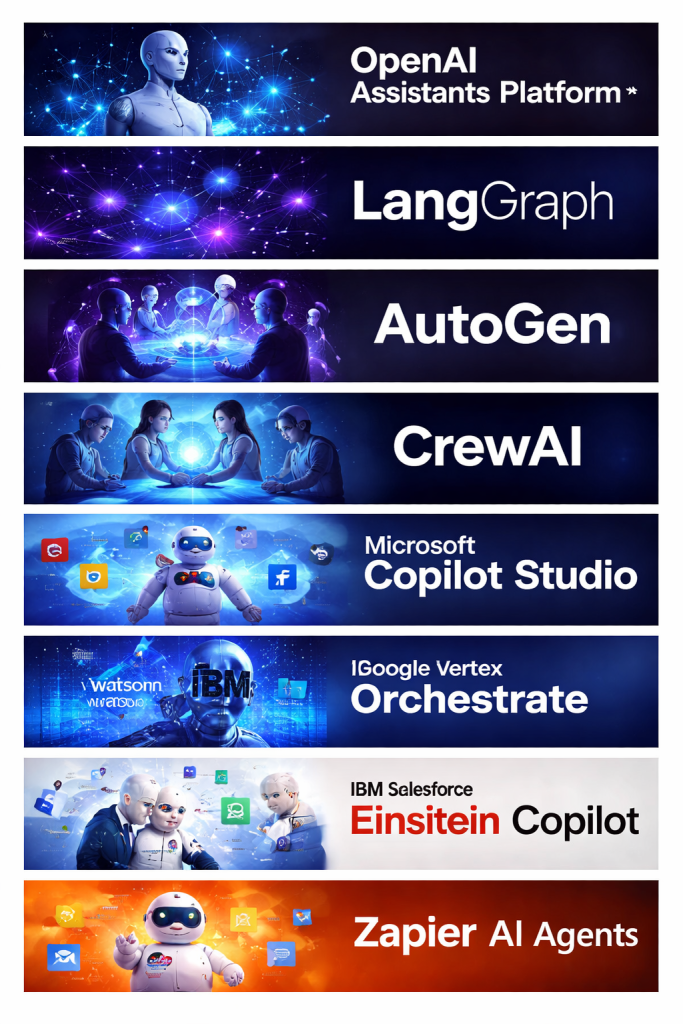
Top 10 AI Agent Platforms Tools
1 — OpenAI Assistants Platform
Short description:
A powerful platform for building AI agents that can reason, call tools, manage memory, and handle complex workflows. Designed for developers and enterprises building advanced AI-driven applications.
Key features
- Tool calling and function execution
- Persistent agent memory and state
- Multi-step reasoning and planning
- Support for code execution and data analysis
- Integration with enterprise systems
- Scalable API-based architecture
Pros
- Highly flexible and developer-friendly
- Strong reasoning and task orchestration
Cons
- Requires technical expertise
- Cost can scale with heavy usage
Security & compliance:
Enterprise-grade encryption, SSO, audit logs, GDPR-ready (varies by deployment).
Support & community:
Extensive documentation, strong developer community, enterprise support available.
2 — LangGraph (LangChain Ecosystem)
Short description:
A graph-based framework for building reliable, stateful AI agents with explicit control over agent flows and decisions.
Key features
- Graph-based agent orchestration
- Deterministic and controllable flows
- Multi-agent collaboration
- Native integration with LangChain tools
- Debugging and observability support
Pros
- Excellent control over agent behavior
- Ideal for complex workflows
Cons
- Steeper learning curve
- Requires engineering effort
Security & compliance:
Varies based on hosting and integrations.
Support & community:
Strong open-source community, detailed documentation.
3 — AutoGen
Short description:
A multi-agent conversation framework enabling AI agents to collaborate, debate, and solve problems together.
Key features
- Multi-agent communication
- Role-based agent design
- Autonomous task delegation
- Human-in-the-loop support
- Flexible LLM integration
Pros
- Powerful for collaborative agent systems
- Research-backed architecture
Cons
- Less user-friendly for beginners
- Limited UI tooling
Security & compliance:
Varies / N/A depending on implementation.
Support & community:
Growing research and developer community.
4 — CrewAI
Short description:
A structured AI agent platform focused on role-based teamwork and task orchestration.
Key features
- Role-driven agent design
- Task pipelines and dependencies
- Tool integration
- Clear agent responsibility modeling
- Lightweight and modular
Pros
- Easy to conceptualize agent roles
- Clean, logical architecture
Cons
- Smaller ecosystem
- Fewer enterprise features
Security & compliance:
Varies / N/A.
Support & community:
Active open-source contributors, improving documentation.
5 — Microsoft Copilot Studio (Agent Builder)
Short description:
An enterprise-focused AI agent platform for building business agents integrated into Microsoft ecosystems.
Key features
- Low-code agent creation
- Native Microsoft 365 integration
- Workflow automation
- Enterprise governance controls
- Built-in analytics
Pros
- Excellent for enterprise users
- Strong compliance and governance
Cons
- Vendor lock-in
- Less flexible for custom logic
Security & compliance:
SOC 2, ISO, GDPR, enterprise-grade compliance.
Support & community:
Enterprise support, strong documentation, partner ecosystem.
6 — Google Vertex AI Agent Builder
Short description:
A scalable platform for building AI agents using Google Cloud infrastructure and AI services.
Key features
- Deep integration with cloud services
- Tool and API orchestration
- Enterprise scalability
- Observability and monitoring
- Knowledge grounding
Pros
- High performance and scalability
- Strong enterprise security
Cons
- Cloud dependency
- Complex pricing
Security & compliance:
ISO, SOC, GDPR, HIPAA-ready.
Support & community:
Enterprise-grade support, extensive documentation.
7 — IBM watsonx Orchestrate
Short description:
An AI orchestration platform focused on automating enterprise workflows using AI agents.
Key features
- Business process automation
- Pre-built enterprise skills
- Natural language task execution
- Governance and compliance controls
- Integration with enterprise apps
Pros
- Strong enterprise automation
- Trusted governance framework
Cons
- Less flexible for developers
- Higher cost
Security & compliance:
SOC, ISO, GDPR, enterprise-grade controls.
Support & community:
Enterprise support, professional services available.
8 — Salesforce Einstein Copilot Studio
Short description:
An AI agent platform built for CRM-centric workflows and customer operations.
Key features
- CRM-native AI agents
- Workflow automation
- Customer data grounding
- Low-code configuration
- Enterprise analytics
Pros
- Ideal for sales and support teams
- Strong data context awareness
Cons
- Limited outside CRM use cases
- Premium pricing
Security & compliance:
Enterprise-grade, GDPR, SOC compliant.
Support & community:
Large enterprise community, strong documentation.
9 — Zapier AI Agents
Short description:
A no-code AI agent platform focused on automation across thousands of applications.
Key features
- No-code agent creation
- Extensive app integrations
- Trigger-based automation
- Simple reasoning flows
- Rapid deployment
Pros
- Extremely easy to use
- Fast time to value
Cons
- Limited advanced reasoning
- Not ideal for complex agents
Security & compliance:
SOC 2, GDPR.
Support & community:
Strong documentation, responsive support.
10 — Relevance AI
Short description:
A business-focused AI agent platform designed for knowledge work and internal automation.
Key features
- Multi-agent workflows
- Knowledge base integration
- Data enrichment agents
- Low-code configuration
- Analytics and monitoring
Pros
- Business-friendly design
- Good balance of power and usability
Cons
- Smaller ecosystem
- Limited customization
Security & compliance:
SOC 2 (varies by plan), GDPR-ready.
Support & community:
Good onboarding resources, growing user base.
Comparison Table
| Tool Name | Best For | Platform(s) Supported | Standout Feature | Rating |
|---|---|---|---|---|
| OpenAI Assistants | Developers & enterprises | API-based | Advanced reasoning | N/A |
| LangGraph | Complex workflows | Python | Graph-based control | N/A |
| AutoGen | Multi-agent collaboration | Python | Agent debates | N/A |
| CrewAI | Role-based agents | Python | Team orchestration | N/A |
| Copilot Studio | Enterprises | Web | Microsoft integration | N/A |
| Vertex AI Agent Builder | Large-scale AI | Cloud | Scalability | N/A |
| watsonx Orchestrate | Enterprise automation | Cloud | Business skills | N/A |
| Einstein Copilot | CRM teams | Web | Data grounding | N/A |
| Zapier AI Agents | Non-technical users | Web | No-code automation | N/A |
| Relevance AI | Knowledge work | Web | Business agents | N/A |
Evaluation & Scoring of AI Agent Platforms
| Tool | Core Features (25%) | Ease of Use (15%) | Integrations (15%) | Security (10%) | Performance (10%) | Support (10%) | Price/Value (15%) | Total Score |
|---|---|---|---|---|---|---|---|---|
| OpenAI Assistants | 24 | 12 | 14 | 9 | 9 | 9 | 12 | 88 |
| LangGraph | 23 | 10 | 13 | 8 | 9 | 8 | 13 | 84 |
| AutoGen | 22 | 9 | 12 | 7 | 8 | 8 | 12 | 78 |
| CrewAI | 21 | 11 | 11 | 7 | 8 | 7 | 13 | 78 |
| Copilot Studio | 22 | 14 | 14 | 10 | 9 | 9 | 10 | 88 |
Which AI Agent Platforms Tool Is Right for You?
- Solo users: No-code platforms with simple automation are best
- SMBs: Low-code or hybrid platforms balancing cost and features
- Mid-market: Platforms with strong integrations and scalability
- Enterprise: Security-first, governance-heavy platforms
Budget-conscious: Open-source or usage-based tools
Premium: Enterprise platforms with full support
Feature depth vs ease: Developers benefit from flexibility, business teams from simplicity
Security needs: Regulated industries require compliance-ready platforms
Frequently Asked Questions (FAQs)
1. What is an AI agent platform?
A system for building autonomous AI agents that can reason, act, and integrate with tools.
2. How is it different from chatbots?
AI agents handle multi-step tasks and workflows, not just conversations.
3. Do I need coding skills?
Some platforms are no-code, others require development expertise.
4. Are AI agents secure?
Security depends on the platform’s controls and deployment model.
5. Can AI agents replace human roles?
They augment work, not fully replace human judgment.
6. Are these tools scalable?
Most enterprise platforms scale well with infrastructure.
7. What are common mistakes?
Over-automation and lack of human oversight.
8. Are AI agents expensive?
Costs vary from free tiers to enterprise pricing.
9. Can agents integrate with existing tools?
Yes, integration is a core feature.
10. What’s the future of AI agents?
More autonomy, better reasoning, and deeper business integration.
Conclusion
AI Agent Platforms represent a major leap forward in intelligent automation. They enable organizations to move beyond simple AI interactions toward autonomous, context-aware systems that deliver real business value.
When selecting a platform, focus on capabilities, usability, integrations, security, and long-term scalability. There is no single “best” platform for everyone—the right choice depends on your goals, resources, and industry requirements. By aligning platform strengths with your needs, AI agents can become a powerful competitive advantage rather than just another tool.

Find Trusted Cardiac Hospitals
Compare heart hospitals by city and services — all in one place.
Explore Hospitals
This article provides a clear and practical comparison of the top AI agent platforms, helping readers understand the core features, strengths, and limitations of each option. By outlining real use cases, ease of integration, and flexibility, it makes it easier for businesses and developers to choose the right platform for their needs. The focus on both pros and cons gives a balanced view that is especially useful for anyone exploring AI automation tools for the first time or evaluating alternatives for existing projects.