
Introduction
In 2026, AI code review tools have become essential for developers aiming to enhance code quality, streamline workflows, and accelerate software delivery. These tools leverage advanced machine learning and natural language processing to automate bug detection, enforce coding standards, and provide actionable feedback, reducing the time spent on manual reviews. With the rise of complex codebases and distributed teams, AI-driven solutions help catch vulnerabilities, optimize performance, and ensure consistency across projects. When choosing an AI code review tool, developers should prioritize deep code analysis, seamless integration with existing workflows, scalability, and actionable insights. This guide explores the top 10 AI code review tools of 2026, detailing their features, pros, cons, and a comparison to help you select the best fit for your team, whether you’re a solo coder, a startup, or an enterprise.
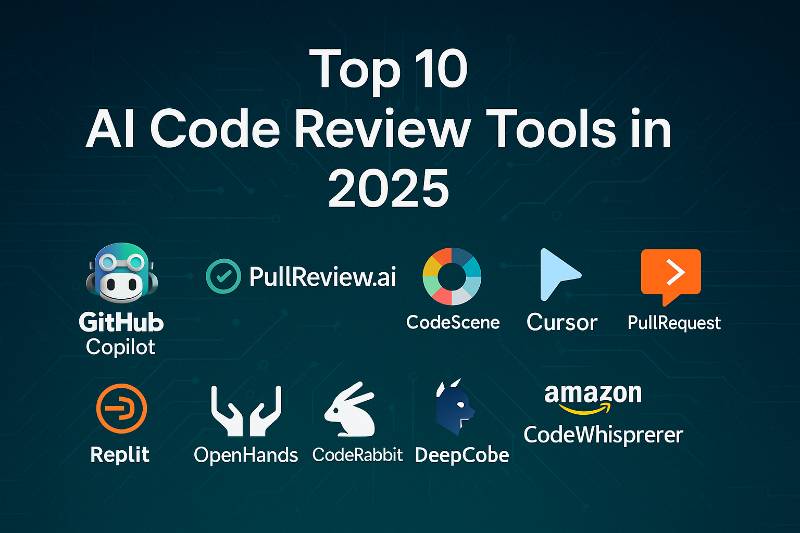
Top 10 AI Code Review Tools for 2026
1. GitHub Copilot
Description: GitHub Copilot, powered by OpenAI, is an AI-driven code review and assistant tool integrated into popular IDEs, ideal for developers seeking real-time code suggestions and reviews.
Key Features:
- Real-time code suggestions and autocompletion.
- Context-aware bug detection and code improvement recommendations.
- Supports over 30 programming languages.
- Seamless integration with GitHub, VS Code, and JetBrains IDEs.
- Automated pull request analysis and commenting.
- Code quality scoring and security vulnerability detection.
Pros: - Boosts productivity with instant suggestions.
- Strong integration with GitHub workflows.
- Continuously learns from user codebases.
Cons: - May suggest overly generic fixes.
- Requires subscription for full features.
- Limited offline capabilities.
2. SonarQube
Description: SonarQube is a code quality and security verification platform that integrates into CI/CD pipelines and pull requests. It analyzes 40+ languages to detect maintainability issues, reliability risks, and security vulnerabilities before release. Customizable quality gates block merges that fail defined standards, and AI features automatically write fixes that maintain the code’s integrity.
Key Features:
- Automated AI Code Review: Continuous inspection of code to detect bugs, vulnerabilities, and code smells, helping teams maintain high software quality and reduce technical debt.
- Pull Request Decoration: Integrates with Git platforms to provide inline feedback on pull requests, highlighting security issues, maintainability problems, and reliability concerns before AI code is merged.
- Quality Gates: Enforce quality and security standards by automatically blocking merges when new AI code fails defined thresholds for issues, coverage, or duplication.
- Security Vulnerability Detection: Built-in static application security testing (SAST) and vulnerability scanning that identify security weaknesses and help developers apply secure coding practices to AI-generated code.
- Code Coverage Integration: Connects with testing frameworks to display unit test coverage and test results, ensuring new AI code changes meet quality benchmarks.
- Multi-language Support: Supports analysis for 40+ programming languages commonly generated by AI (such as Java, JavaScript, Python, C#, and more) within a unified code quality and security platform.
Pros:
- Ideal for teams that want deep code quality and security analysis integrated into their development workflow as they adopt AI coding tools.
- Provides powerful static application security testing (SAST), vulnerability scanning, and automated code review to detect bugs, vulnerabilities, and code smells while reducing technical debt.
Cons:
- Requires separate CI/CD integration rather than acting as a self-contained DevOps platform.
- Advanced features such as enterprise governance, portfolio management, and security reporting require higher-tier editions.
3. CodeScene
Description: CodeScene uses AI to analyze codebases for technical debt, team collaboration patterns, and performance issues, suited for enterprise teams.
Key Features:
- Identifies code smells and architectural issues.
- Visualizes team contribution and code health trends.
- Predictive analytics for technical debt.
- Integrates with Git-based platforms.
- Performance bottleneck detection.
- Automated refactoring suggestions.
Pros: - Deep insights into codebase health.
- Helps prioritize refactoring efforts.
- Strong enterprise-grade analytics.
Cons: - Steep learning curve for new users.
- Higher cost for smaller teams.
- Limited language support compared to competitors.
4. PullRequest
Description: PullRequest combines AI and human expertise for code reviews, targeting teams needing thorough analysis with a human touch.
Key Features:
- AI-driven issue detection with human reviewer oversight.
- Supports multiple languages and frameworks.
- Detailed feedback on pull requests.
- Integration with GitHub and GitLab.
- Customizable review workflows.
- Security and compliance checks.
Pros: - High-quality feedback from expert reviewers.
- Strong focus on security.
- Flexible for various team sizes.
Cons: - Slower review times due to human involvement.
- Higher cost than fully automated tools.
- Limited free tier options.
5. CodeRabbit
Description: CodeRabbit is an AI-powered tool focused on fast, context-aware code reviews, ideal for startups and mid-sized teams.
Key Features:
- Real-time pull request reviews with actionable comments.
- Context-aware suggestions across files.
- Supports popular languages like Python, JavaScript, and Java.
- Integrates with GitHub and CI/CD pipelines.
- Automated code style enforcement.
- Scalable for growing teams.
Pros: - Fast and accurate review process.
- Reduces noise with prioritized feedback.
- Affordable pricing for startups.
Cons: - Limited advanced analytics.
- Occasional integration hiccups.
- Less suited for complex enterprise needs.
6. Amazon CodeWhisperer
Description: Amazon CodeWhisperer is an AI code review and generation tool tailored for AWS users and enterprise developers.
Key Features:
- Real-time code suggestions and reviews.
- Strong AWS ecosystem integration.
- Supports Python, Java, JavaScript, and more.
- Security vulnerability scanning.
- Code optimization recommendations.
- Enterprise-grade compliance features.
Pros: - Seamless AWS integration.
- Robust security scanning.
- Free tier for individual developers.
Cons: - Best suited for AWS-centric workflows.
- Limited IDE support outside AWS tools.
- Can be complex for beginners.
7. Bito AI
Description: Bito AI offers AI-driven code review and generation, designed for developers seeking simplicity and cross-platform support.
Key Features:
- Automated code review with detailed explanations.
- Supports 20+ programming languages.
- Integrates with VS Code, IntelliJ, and GitHub.
- Code snippet generation from natural language.
- Real-time collaboration features.
- Customizable review rules.
Pros: - User-friendly interface.
- Strong language support.
- Affordable for small teams.
Cons: - Less advanced than enterprise-focused tools.
- Limited scalability for large codebases.
- Occasional performance lags.
8. Cursor
Description: Cursor is an AI-powered IDE with built-in code review capabilities, ideal for developers who prefer an all-in-one coding environment.
Key Features:
- AI-driven code suggestions and reviews within the IDE.
- Supports Python, JavaScript, TypeScript, and more.
- Real-time bug detection and fixes.
- Collaborative editing and review tools.
- Customizable AI models for specific workflows.
- Offline mode for secure environments.
Pros: - All-in-one coding and review solution.
- Fast and intuitive interface.
- Strong offline capabilities.
Cons: - Requires adaptation to its IDE.
- Limited integrations compared to others.
- Subscription-based pricing.
9. OpenDevin
Description: OpenDevin is an open-source AI code review tool focused on community-driven development and customization.
Key Features:
- Open-source codebase for full customization.
- AI-driven bug detection and style checks.
- Supports multiple languages and frameworks.
- Integrates with GitHub and GitLab.
- Community-driven updates and plugins.
- Lightweight and fast performance.
Pros: - Free and highly customizable.
- Active community support.
- Lightweight for small projects.
Cons: - Limited enterprise-grade features.
- Requires technical expertise to customize.
- Inconsistent updates.
10. DeepCode
Description: DeepCode uses AI to provide in-depth code analysis and review, targeting developers focused on security and performance optimization.
Key Features:
- Advanced semantic code analysis.
- Real-time security vulnerability detection.
- Supports 10+ programming languages.
- Integrates with GitHub, GitLab, and Bitbucket.
- Automated fix suggestions.
- Performance optimization insights.
Pros: - Strong focus on security.
- Detailed and actionable feedback.
- Easy integration with existing tools.
Cons: - Limited language support.
- Can be overwhelming for beginners.
- Premium pricing for full features.
Comparison Table
| Tool Name | Best For | Platform(s) Supported | Standout Feature | Pricing | G2/Capterra/Trustpilot Rating |
|---|---|---|---|---|---|
| GitHub Copilot | Developers using GitHub | GitHub, VS Code, JetBrains | Real-time code suggestions | Starts at $10/month | 4.7/5 (G2) |
| Codacy | Agile teams | GitHub, GitLab, Bitbucket | Code quality dashboards | Free / Starts at $18/month | 4.5/5 (G2) |
| CodeScene | Enterprises | Git-based platforms | Technical debt analysis | Custom pricing | 4.6/5 (Capterra) |
| PullRequest | Teams needing human expertise | GitHub, GitLab | Hybrid AI-human reviews | Starts at $99/month | 4.4/5 (G2) |
| CodeRabbit | Startups and mid-sized teams | GitHub, CI/CD pipelines | Fast pull request reviews | Starts at $12/month | 4.8/5 (G2) |
| Amazon CodeWhisperer | AWS-centric developers | AWS, VS Code, IntelliJ | AWS integration | Free / Custom | 4.3/5 (G2) |
| Bito AI | Small teams and freelancers | VS Code, IntelliJ, GitHub | Simple interface | Free / Starts at $15/month | 4.5/5 (Capterra) |
| Cursor | Developers wanting an AI IDE | Standalone IDE | All-in-one coding environment | Starts at $20/month | 4.6/5 (G2) |
| OpenDevin | Open-source enthusiasts | GitHub, GitLab | Customizable open-source platform | Free | 4.2/5 (Trustpilot) |
| DeepCode | Security-focused teams | GitHub, GitLab, Bitbucket | Semantic code analysis | Free / Starts at $25/month | 4.4/5 (G2) |
Which AI Code Review Tool is Right for You?
Choosing the right AI code review tool depends on your team’s size, budget, and specific needs:
- Solo Developers/Freelancers: Bito AI or OpenDevin are great choices due to their affordability (free or low-cost) and ease of use. Bito AI’s simple interface suits small projects, while OpenDevin’s open-source nature appeals to those who want customization.
- Startups/Small Teams: CodeRabbit and Codacy offer fast, scalable solutions with affordable pricing. CodeRabbit excels in quick pull request reviews, while Codacy provides robust code quality tracking for growing teams.
- Mid-Sized Teams: GitHub Copilot and PullRequest are ideal for teams integrated with GitHub. Copilot’s real-time suggestions boost productivity, while PullRequest’s hybrid AI-human approach ensures thorough reviews.
- Enterprises: CodeScene and Amazon CodeWhisperer cater to large organizations. CodeScene’s technical debt analysis is perfect for complex codebases, while CodeWhisperer’s AWS integration suits enterprise-grade workflows.
- Security-Focused Teams: DeepCode and PullRequest prioritize security, with DeepCode offering advanced semantic analysis and PullRequest combining AI with expert human oversight.
- Budget-Conscious Teams: OpenDevin (free) and Amazon CodeWhisperer (free tier) are excellent for teams with limited budgets but still needing robust features.
Consider testing free trials or demos to evaluate integration and usability before committing.
Conclusion
AI code review tools in 2026 are transforming software development by automating tedious tasks, catching bugs early, and ensuring high-quality code. From GitHub Copilot’s real-time suggestions to CodeScene’s enterprise-grade analytics, these tools cater to diverse needs, from solo developers to large organizations. As AI continues to evolve, we expect even deeper context awareness and seamless integrations in the future. Try demos or free tiers to find the tool that best fits your workflow, and stay ahead in the fast-paced world of development.
FAQs
What are AI code review tools?
AI code review tools use machine learning to analyze code for bugs, vulnerabilities, and style issues, providing automated feedback to improve quality and speed up reviews.
How do AI code review tools improve developer productivity?
They automate repetitive tasks, catch errors early, and provide actionable suggestions, reducing manual review time and allowing developers to focus on creative tasks.
Are AI code review tools secure?
Most tools, like DeepCode and Amazon CodeWhisperer, prioritize security with compliance features (e.g., SOC 2, GDPR) and on-premise options for sensitive codebases.
Can AI code review tools replace human reviewers?
No, they complement human reviewers by handling routine checks, but human expertise is still valuable for context-specific decisions and complex reviews.
Which AI code review tool is best for startups?
CodeRabbit and Codacy are great for startups due to their affordability, scalability, and fast, actionable feedback tailored to growing teams.
Meta Description: Discover the top 10 AI code review tools of 2026! Compare features, pros, cons, and pricing to find the best AI code review software for your dev team.

Find Trusted Cardiac Hospitals
Compare heart hospitals by city and services — all in one place.
Explore Hospitals
Great overview of AI code review tools with simple and practical comparisons. Very useful for developers looking to improve code quality and productivity.