
Introduction
Attack Surface Management (ASM) is the continuous process of discovering, monitoring, analyzing, and reducing all internet-facing assets that could be exploited by attackers. These assets include known infrastructure like domains and IPs, as well as unknown or forgotten elements such as shadow IT, abandoned subdomains, exposed APIs, cloud misconfigurations, and third-party dependencies.
In today’s environment, organizations no longer operate within a clearly defined perimeter. Cloud adoption, DevOps speed, remote work, SaaS tools, and rapid digital expansion have dramatically increased attack surfaces, making traditional security tools insufficient on their own. ASM helps security teams regain visibility and control by continuously mapping what is exposed and identifying risks before attackers do.
Why ASM is important
- Attackers usually exploit unknown or unmanaged assets
- Traditional vulnerability scanners only cover known systems
- ASM provides attacker-style visibility from the outside-in
- Enables proactive risk reduction rather than reactive response
Key real-world use cases
- Discovering forgotten subdomains and cloud assets
- Identifying exposed services, ports, and APIs
- Detecting misconfigured cloud storage and DNS
- Monitoring third-party and vendor exposure
- Supporting continuous security posture management
What to look for when choosing an ASM tool
- Asset discovery accuracy and coverage
- Continuous monitoring vs point-in-time scans
- Risk prioritization and context
- Integration with security workflows
- Scalability across large digital estates
- Compliance and reporting capabilities
Best for:
Attack Surface Management tools are best suited for security teams, CISOs, SOC analysts, red teams, DevSecOps engineers, and IT risk managers. They are particularly valuable for mid-market and enterprise organizations, SaaS companies, fintech, healthcare, e-commerce, and any business with a large or rapidly changing digital footprint.
Not ideal for:
ASM tools may not be ideal for very small businesses with minimal online presence, static brochure websites, or teams looking only for internal vulnerability scanning. Organizations without dedicated security ownership may find advanced ASM platforms underutilized.
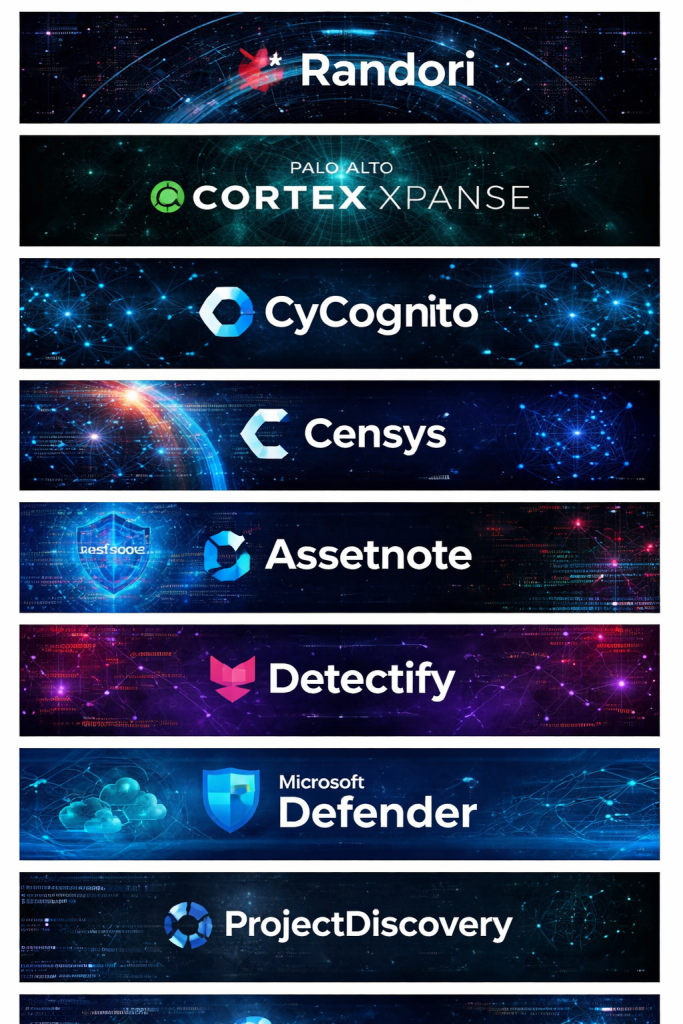
Top 10 Attack Surface Management (ASM) Tools
1 — Randori
Short description:
Randori focuses on attacker-centric attack surface discovery and prioritization, helping enterprises understand which exposures truly matter from an adversary’s perspective.
Key features
- External attack surface discovery
- Adversary emulation modeling
- Asset risk scoring based on exploitability
- Continuous monitoring of exposed services
- Integration with vulnerability management tools
- Executive-level risk reporting
Pros
- Strong attacker-focused risk prioritization
- Excellent visibility into exploitable paths
- Enterprise-grade reporting
Cons
- Higher learning curve for new teams
- Primarily focused on large enterprises
Security & compliance:
SSO, role-based access, encryption, audit logs, SOC 2 aligned
Support & community:
Enterprise onboarding, strong documentation, dedicated support
2 — Palo Alto Cortex Xpanse
Short description:
Cortex Xpanse delivers enterprise-scale ASM with deep discovery, attribution, and integration into the Palo Alto security ecosystem.
Key features
- Global-scale internet asset discovery
- Attribution of unknown assets to owners
- Continuous exposure monitoring
- Risk-based prioritization
- Native integration with SOC workflows
- Automated remediation workflows
Pros
- Very high discovery accuracy
- Strong SOC and SIEM integrations
- Mature enterprise platform
Cons
- Premium pricing
- Best value when used within Palo Alto ecosystem
Security & compliance:
SSO, encryption, audit logs, SOC 2, ISO aligned
Support & community:
Enterprise support, training resources, strong vendor backing
3 — CyCognito
Short description:
CyCognito focuses on uncovering unknown assets and prioritizing risks that attackers are most likely to exploit.
Key features
- Autonomous asset discovery
- Exposure-based risk scoring
- Continuous monitoring
- External attack surface mapping
- Vulnerability validation
- Risk trend analysis
Pros
- Strong focus on unknown asset discovery
- Clear risk prioritization
- Minimal configuration required
Cons
- Limited internal scanning capabilities
- Primarily external-facing focus
Security & compliance:
SSO, encryption, audit logs, GDPR aligned
Support & community:
Good documentation, responsive customer support
4 — Censys Attack Surface Management
Short description:
Censys ASM leverages global internet scanning to provide deep visibility into exposed infrastructure and services.
Key features
- Internet-wide scanning engine
- Real-time asset discovery
- Certificate and domain intelligence
- API-driven workflows
- Historical exposure tracking
- Risk alerts for changes
Pros
- Extremely accurate asset intelligence
- Strong API and automation capabilities
- Ideal for research-driven teams
Cons
- Less guided remediation workflows
- Requires technical expertise
Security & compliance:
Encryption, access controls, compliance varies
Support & community:
Strong documentation, active technical community
5 — Assetnote
Short description:
Assetnote provides continuous attack surface monitoring with a focus on automation and integration into modern security workflows.
Key features
- External asset discovery
- Cloud and SaaS exposure tracking
- Vulnerability detection
- Change monitoring
- API-first design
- Integration with ticketing systems
Pros
- Developer-friendly platform
- Good automation support
- Clean and intuitive interface
Cons
- Smaller ecosystem compared to large vendors
- Less emphasis on compliance reporting
Security & compliance:
SSO, encryption, SOC 2 aligned
Support & community:
Responsive support, growing user community
6 — Detectify Surface Monitoring
Short description:
Detectify combines attack surface monitoring with crowdsourced vulnerability research for continuous external security assessment.
Key features
- Continuous surface monitoring
- Subdomain and asset discovery
- Researcher-driven vulnerability checks
- Automated scanning
- Alerting and remediation guidance
Pros
- Research-backed detection techniques
- Easy to deploy
- Strong scanning accuracy
Cons
- Less advanced asset attribution
- Limited enterprise customization
Security & compliance:
GDPR aligned, encryption, access controls
Support & community:
Strong documentation, security researcher insights
7 — Intrigue.io
Short description:
Intrigue.io specializes in asset discovery and intelligence for organizations seeking deep visibility into complex digital environments.
Key features
- Comprehensive asset discovery
- Relationship mapping between assets
- Cloud and on-prem coverage
- Risk tagging and classification
- Integration with security tools
Pros
- Deep asset relationship visibility
- Flexible and customizable
- Good for complex environments
Cons
- Interface may feel technical
- Less guided workflows for beginners
Security & compliance:
SSO, encryption, audit logging
Support & community:
Strong documentation, enterprise support available
8 — Microsoft Defender External Attack Surface Management
Short description:
Microsoft’s ASM offering integrates tightly with the Defender ecosystem to provide continuous external exposure visibility.
Key features
- Continuous external asset discovery
- Integration with Defender security stack
- Risk prioritization
- Exposure change tracking
- Security posture insights
Pros
- Seamless integration with Microsoft environments
- Good value for existing customers
- Unified security visibility
Cons
- Limited outside Microsoft ecosystem
- Less customization than standalone ASM tools
Security & compliance:
SSO, encryption, SOC 2, ISO, GDPR aligned
Support & community:
Enterprise support, extensive documentation
9 — ProjectDiscovery Cloud Platform
Short description:
ProjectDiscovery brings open-source reconnaissance tools into a managed ASM platform for security engineers and researchers.
Key features
- Asset discovery using open-source tooling
- Continuous monitoring
- Template-based vulnerability detection
- API and automation support
- Community-driven intelligence
Pros
- Highly flexible and extensible
- Strong technical community
- Cost-effective for skilled teams
Cons
- Requires security expertise
- Less executive-level reporting
Security & compliance:
Varies / N/A
Support & community:
Very strong open-source community, documentation-driven support
10 — RiskIQ (Digital Footprint)
Short description:
RiskIQ focuses on digital footprint intelligence, helping organizations understand and defend against external threats.
Key features
- Digital asset discovery
- Brand and domain monitoring
- Threat intelligence integration
- Historical exposure analysis
- Risk visualization dashboards
Pros
- Strong threat intelligence context
- Useful for brand protection
- Good historical visibility
Cons
- Less technical depth for remediation
- Higher cost for advanced features
Security & compliance:
SSO, encryption, SOC 2 aligned
Support & community:
Enterprise-grade support, structured onboarding
Comparison Table
| Tool Name | Best For | Platform(s) Supported | Standout Feature | Rating |
|---|---|---|---|---|
| Randori | Enterprise security teams | Cloud-based | Attacker-centric prioritization | N/A |
| Cortex Xpanse | Large enterprises | Cloud-based | Asset attribution at scale | N/A |
| CyCognito | Unknown asset discovery | Cloud-based | Autonomous discovery | N/A |
| Censys ASM | Research-driven teams | Cloud-based | Internet-wide intelligence | N/A |
| Assetnote | DevSecOps teams | Cloud-based | API-first automation | N/A |
| Detectify | Continuous monitoring | Cloud-based | Researcher-driven detection | N/A |
| Intrigue.io | Complex environments | Cloud-based | Asset relationship mapping | N/A |
| Microsoft Defender EASM | Microsoft-centric orgs | Cloud-based | Native ecosystem integration | N/A |
| ProjectDiscovery | Technical security teams | Cloud-based | Open-source powered ASM | N/A |
| RiskIQ | Digital footprint analysis | Cloud-based | Threat intelligence context | N/A |
Evaluation & Scoring of Attack Surface Management (ASM)
| Criteria | Weight | Average Score |
|---|---|---|
| Core features | 25% | High |
| Ease of use | 15% | Medium |
| Integrations & ecosystem | 15% | High |
| Security & compliance | 10% | High |
| Performance & reliability | 10% | High |
| Support & community | 10% | Medium |
| Price / value | 15% | Medium |
Which Attack Surface Management (ASM) Tool Is Right for You?
Solo users & small teams:
Lightweight or open-source–driven platforms with automation and lower cost are ideal.
SMBs:
Look for ease of use, quick deployment, and clear risk prioritization without heavy overhead.
Mid-market:
Balanced platforms with strong integrations, continuous monitoring, and scalable pricing work best.
Enterprises:
Prioritize depth, attribution, compliance, reporting, and SOC integration.
Budget-conscious:
Open-source–driven or modular ASM tools offer strong value if expertise is available.
Premium solutions:
Full-featured platforms provide strategic visibility, executive reporting, and automation.
Frequently Asked Questions (FAQs)
1. What is Attack Surface Management?
ASM is the continuous discovery and monitoring of all external assets that could be attacked.
2. How is ASM different from vulnerability scanning?
ASM discovers unknown assets first, while vulnerability scanning focuses on known systems.
3. Is ASM only for large enterprises?
No, but larger and fast-growing organizations benefit the most.
4. Does ASM replace penetration testing?
No, ASM complements penetration testing by identifying what should be tested.
5. How often does ASM scan assets?
Most ASM tools provide continuous or near-real-time monitoring.
6. Can ASM detect cloud misconfigurations?
Yes, many ASM platforms identify exposed cloud services and misconfigurations.
7. Is ASM useful for compliance?
Yes, it supports compliance by improving asset visibility and risk reporting.
8. How long does implementation take?
Typically from a few hours to a few days, depending on scope.
9. Are ASM tools noisy with alerts?
Modern ASM tools prioritize risks to reduce alert fatigue.
10. What is the biggest mistake when adopting ASM?
Failing to assign ownership and remediation responsibility.
Conclusion
Attack Surface Management has become a critical pillar of modern cybersecurity, offering visibility into what attackers see first. With expanding digital ecosystems, ASM tools help organizations proactively discover, prioritize, and reduce risk before exploitation occurs.
The most important factors when choosing an ASM solution are asset discovery accuracy, risk prioritization, scalability, and integration into existing security workflows. There is no single best ASM tool for everyone. The right choice depends on your organization’s size, maturity, budget, and security goals.
By aligning the tool with real operational needs rather than feature checklists alone, organizations can turn ASM from a visibility exercise into a powerful driver of risk reduction and security resilience.

Find Trusted Cardiac Hospitals
Compare heart hospitals by city and services — all in one place.
Explore Hospitals