
Introduction
Audit Management Software is a specialized digital solution designed to help organizations plan, execute, document, track, and report audits in a structured and efficient way. These audits may include internal audits, external audits, compliance audits, risk-based audits, operational audits, IT audits, and regulatory inspections. Instead of relying on spreadsheets, emails, and scattered documents, audit management tools centralize the entire audit lifecycle into a single, controlled system.
In today’s regulatory-heavy and risk-aware business environment, audits are no longer optional or annual checkboxes. Organizations are expected to maintain continuous compliance, real-time risk visibility, proper documentation, and strong governance. Audit management software enables teams to reduce manual effort, minimize errors, ensure consistency, and provide management with clear, defensible audit trails.
Real-world use cases include:
- Internal audit teams managing multi-location audits
- Compliance teams tracking regulatory requirements
- Risk teams aligning audits with enterprise risk frameworks
- IT and security teams supporting ISO, SOC, or data protection audits
- Highly regulated industries such as finance, healthcare, energy, and manufacturing
When evaluating audit management software, users should look at:
- Audit lifecycle coverage (planning to reporting)
- Risk and compliance alignment
- Workflow automation
- Reporting and analytics
- Security, access control, and compliance readiness
- Scalability and integration with existing systems
Best for:
Audit Management Software is ideal for internal auditors, compliance officers, risk managers, quality teams, IT governance teams, finance leaders, and regulated enterprises. It benefits mid-sized to large organizations, as well as fast-growing companies preparing for regulatory audits. Industries such as banking, healthcare, insurance, manufacturing, energy, SaaS, and government gain the most value.
Not ideal for:
Very small businesses with minimal regulatory requirements, one-off audits, or teams that only conduct simple annual audits may find these tools excessive. In such cases, lightweight documentation tools or basic task management solutions may be sufficient.
Top 10 Audit Management Software Tools
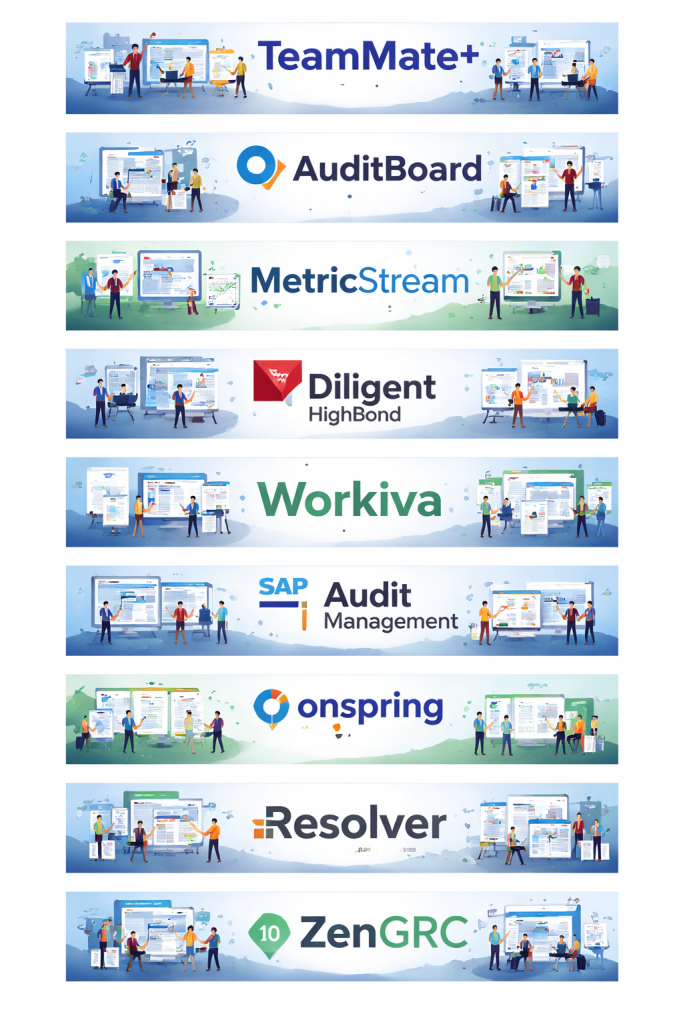
1 — TeamMate+
Short description:
TeamMate+ is a robust, enterprise-grade audit management platform designed for large organizations with complex audit and risk environments. It supports end-to-end audit processes with strong governance controls.
Key features:
- Full audit lifecycle management
- Risk-based audit planning
- Centralized working papers
- Automated workflows and approvals
- Advanced reporting and dashboards
- Issue tracking and remediation
- Integration with risk and compliance modules
Pros:
- Extremely comprehensive and mature platform
- Strong alignment with professional audit standards
- Scales well for large audit departments
Cons:
- Steeper learning curve
- Higher cost compared to SMB-focused tools
- Customization often requires vendor involvement
Security & compliance:
Enterprise-grade encryption, role-based access, audit logs, SOC-aligned controls, GDPR support.
Support & community:
Strong enterprise onboarding, professional training, dedicated support teams, limited open community.
2 — AuditBoard
Short description:
AuditBoard is a modern, cloud-based audit and risk management platform focused on usability and collaboration for internal audit, SOX, and compliance teams.
Key features:
- Audit and SOX management
- Risk assessment and mapping
- Centralized evidence repository
- Real-time collaboration
- Configurable workflows
- Visual dashboards and reporting
Pros:
- Very intuitive user interface
- Fast implementation compared to enterprise tools
- Strong customer satisfaction
Cons:
- Pricing may be high for small teams
- Advanced customization has limits
- Reporting depth varies by module
Security & compliance:
SSO, encryption at rest and in transit, SOC 2, GDPR-ready, detailed access controls.
Support & community:
High-quality documentation, responsive customer success teams, strong onboarding support.
3 — MetricStream
Short description:
MetricStream is a comprehensive Governance, Risk, and Compliance (GRC) platform with powerful audit management capabilities for highly regulated enterprises.
Key features:
- Integrated audit, risk, and compliance modules
- Enterprise risk assessment
- Automated issue management
- Policy and control mapping
- Regulatory change management
- Advanced analytics
Pros:
- Very powerful and flexible
- Ideal for complex regulatory environments
- Strong cross-functional integration
Cons:
- Complex implementation
- Higher total cost of ownership
- Requires experienced administrators
Security & compliance:
Supports ISO standards, SOC, GDPR, HIPAA (context-dependent), strong audit logging.
Support & community:
Enterprise-level support, professional services, extensive documentation.
4 — Diligent HighBond
Short description:
Diligent HighBond combines audit, risk, and compliance into a single analytics-driven platform with a focus on visibility and executive reporting.
Key features:
- Audit management workflows
- Risk and control self-assessments
- Continuous auditing
- Issue tracking and remediation
- Data analytics integration
- Executive-level dashboards
Pros:
- Strong analytics and visualization
- Excellent board-level reporting
- Supports continuous audit models
Cons:
- Interface can feel complex initially
- Premium pricing
- Requires training for full value
Security & compliance:
Enterprise-grade security, encryption, audit trails, GDPR-ready.
Support & community:
Structured onboarding, dedicated customer success, limited community forums.
5 — Workiva
Short description:
Workiva is known for connected reporting and compliance, offering audit management capabilities tightly integrated with financial and regulatory reporting.
Key features:
- Audit documentation management
- Collaborative workflows
- SOX and compliance support
- Real-time data linking
- Version control and traceability
- Reporting automation
Pros:
- Excellent collaboration features
- Strong traceability and data integrity
- Ideal for finance-heavy audits
Cons:
- Less specialized for operational audits
- Pricing can escalate with scale
- Custom workflows may be limited
Security & compliance:
SOC-aligned controls, encryption, role-based access, compliance-ready architecture.
Support & community:
Strong training resources, responsive enterprise support, active user base.
6 — SAP Audit Management
Short description:
SAP Audit Management is part of the SAP ecosystem, designed for organizations already using SAP for enterprise operations and governance.
Key features:
- Integrated audit planning and execution
- Risk-based audit selection
- SAP data integration
- Issue and action tracking
- Reporting and dashboards
- Workflow automation
Pros:
- Seamless integration with SAP systems
- Strong data consistency
- Ideal for SAP-centric enterprises
Cons:
- Limited appeal outside SAP environments
- User interface less modern
- Customization requires SAP expertise
Security & compliance:
Enterprise-grade SAP security, role-based access, compliance-aligned controls.
Support & community:
SAP enterprise support, extensive documentation, large professional ecosystem.
7 — Onspring
Short description:
Onspring is a flexible GRC platform offering customizable audit management for organizations seeking adaptability without extreme complexity.
Key features:
- Configurable audit workflows
- Risk and compliance tracking
- Issue management
- Custom dashboards
- Automation rules
- API integrations
Pros:
- Highly customizable without coding
- Faster deployment than large GRC suites
- Good balance of power and usability
Cons:
- Reporting customization takes effort
- Less depth for very large enterprises
- Smaller ecosystem
Security & compliance:
Encryption, access controls, audit logs, compliance-ready framework.
Support & community:
Strong customer support, onboarding assistance, moderate user community.
8 — Ideagen Pentana Audit
Short description:
Ideagen Pentana Audit is built specifically for internal audit teams, with strong methodology support and structured audit workflows.
Key features:
- Audit planning and scheduling
- Working papers management
- Risk-based audit approach
- Issue tracking
- Reporting and audit trails
- Methodology templates
Pros:
- Designed by audit professionals
- Strong methodological guidance
- Clear audit documentation structure
Cons:
- Interface less modern
- Limited integrations
- Best suited for traditional audit teams
Security & compliance:
Role-based security, encryption, audit trails, compliance-ready.
Support & community:
Good vendor support, structured training, smaller community presence.
9 — Resolver
Short description:
Resolver focuses on risk intelligence and compliance, offering audit management as part of a broader risk-centric platform.
Key features:
- Audit and risk management
- Incident and issue tracking
- Risk assessments
- Workflow automation
- Reporting and dashboards
- Integration with security data
Pros:
- Strong risk-oriented approach
- Good incident-to-audit linkage
- Useful for security-focused organizations
Cons:
- Audit features less deep than pure audit tools
- UI can feel dense
- Customization varies by module
Security & compliance:
Encryption, access control, audit logs, compliance-aligned architecture.
Support & community:
Vendor-led support, onboarding resources, moderate documentation.
10 — ZenGRC
Short description:
ZenGRC is a cloud-based compliance and audit management tool focused on simplicity and fast adoption for growing organizations.
Key features:
- Audit and compliance tracking
- Control mapping
- Evidence management
- Automated reminders
- Reporting dashboards
- Policy management
Pros:
- Easy to use
- Faster implementation
- Good for compliance-driven audits
Cons:
- Limited advanced audit analytics
- Less customization for large enterprises
- Reporting depth may be basic
Security & compliance:
Encryption, role-based access, audit logs, compliance-ready environment.
Support & community:
Good onboarding support, documentation, smaller but active user base.
Comparison Table
| Tool Name | Best For | Platform(s) Supported | Standout Feature | Rating |
|---|---|---|---|---|
| TeamMate+ | Large enterprises | Web-based | End-to-end audit depth | N/A |
| AuditBoard | Internal audit & SOX teams | Web-based | User-friendly design | N/A |
| MetricStream | Highly regulated enterprises | Web-based | Integrated GRC | N/A |
| Diligent HighBond | Risk-driven audits | Web-based | Advanced analytics | N/A |
| Workiva | Financial & compliance audits | Web-based | Real-time collaboration | N/A |
| SAP Audit Management | SAP-centric enterprises | Web-based | SAP integration | N/A |
| Onspring | Custom audit workflows | Web-based | No-code configurability | N/A |
| Ideagen Pentana | Internal audit teams | Web-based | Audit methodology support | N/A |
| Resolver | Risk & incident-focused teams | Web-based | Risk intelligence | N/A |
| ZenGRC | Growing compliance teams | Web-based | Fast implementation | N/A |
Evaluation & Scoring of Audit Management Software
| Criteria | Weight | Evaluation Focus |
|---|---|---|
| Core features | 25% | Audit lifecycle, risk alignment, reporting |
| Ease of use | 15% | UI, learning curve, usability |
| Integrations & ecosystem | 15% | ERP, GRC, data sources |
| Security & compliance | 10% | Encryption, access control, standards |
| Performance & reliability | 10% | Stability, scalability |
| Support & community | 10% | Onboarding, responsiveness |
| Price / value | 15% | Cost vs features |
Which Audit Management Software Tool Is Right for You?
Choosing the right tool depends on context, scale, and priorities.
- Solo users or small teams: Lightweight tools like ZenGRC offer simplicity without heavy overhead.
- SMBs and mid-market: AuditBoard, Onspring, or Ideagen Pentana provide balance between usability and power.
- Large enterprises: TeamMate+, MetricStream, Diligent HighBond, or SAP Audit Management handle complexity and scale.
Budget-conscious vs premium:
Premium platforms deliver deep controls and analytics, while cost-effective tools focus on core audit needs.
Feature depth vs ease of use:
Advanced tools offer configurability but require training. Simpler tools trade flexibility for speed.
Integration and scalability:
Organizations with ERP or GRC ecosystems should prioritize native integrations and long-term scalability.
Security and compliance:
Highly regulated industries should favor platforms with proven security controls and compliance readiness.
Frequently Asked Questions (FAQs)
1. What is audit management software used for?
It helps organizations plan, execute, document, and track audits efficiently and consistently.
2. Is audit management software only for large enterprises?
No, many tools are designed for SMBs and growing companies as well.
3. Can it replace spreadsheets entirely?
Yes, most platforms eliminate manual spreadsheets and email-based workflows.
4. How long does implementation take?
It ranges from a few weeks for simpler tools to several months for enterprise platforms.
5. Does it support regulatory compliance?
Most tools support compliance frameworks depending on configuration and industry needs.
6. Is audit management software secure?
Leading tools offer encryption, access controls, and audit logging.
7. Can external auditors use the system?
Many platforms support controlled external auditor access.
8. What are common mistakes when choosing a tool?
Overbuying complexity or underestimating integration and change management.
9. Is training required?
Yes, especially for enterprise-grade tools.
10. Are there alternatives to audit management software?
For minimal needs, task managers or document tools may work, but they lack audit rigor.
Conclusion
Audit Management Software has become a strategic necessity rather than a convenience. It improves audit quality, enhances transparency, reduces risk, and supports regulatory confidence. The most important factors when choosing a tool are fit, scalability, usability, security, and long-term value.
There is no single “best” audit management software for everyone. The right choice depends on organization size, regulatory environment, audit maturity, budget, and integration needs. By aligning tool capabilities with real-world requirements, organizations can transform audits from a reactive obligation into a proactive governance advantage.

Find Trusted Cardiac Hospitals
Compare heart hospitals by city and services — all in one place.
Explore Hospitals
