
Introduction
Bioinformatics Workflow Managers are specialized software platforms designed to orchestrate, automate, and manage complex biological data analysis pipelines. In modern life sciences, researchers rarely run a single script in isolation. Instead, they execute multi-step workflows involving sequencing data processing, quality control, alignment, variant calling, annotation, and downstream analysis. Workflow managers bring structure, reproducibility, and scalability to these processes.
Their importance has grown rapidly with the explosion of next-generation sequencing (NGS), proteomics, metagenomics, and multi-omics research. Without workflow managers, teams struggle with inconsistent results, poor documentation, manual errors, and difficulty scaling analyses from a laptop to high-performance computing (HPC) or cloud environments.
Real-world use cases include genome and transcriptome analysis, clinical genomics pipelines, drug discovery research, population-scale studies, and regulated biomedical research. When choosing a Bioinformatics Workflow Manager, users should evaluate reproducibility, scalability, ease of use, language flexibility, execution environments (local, HPC, cloud), container support, security, and community maturity.
Best for:
Bioinformatics Workflow Managers are ideal for bioinformaticians, computational biologists, data scientists, research labs, biotech startups, pharmaceutical companies, and academic institutions handling complex or large-scale biological data pipelines.
Not ideal for:
They may be unnecessary for simple, one-off analyses, very small datasets, or teams without technical expertise where fully managed analysis services or point-and-click tools may be more appropriate.
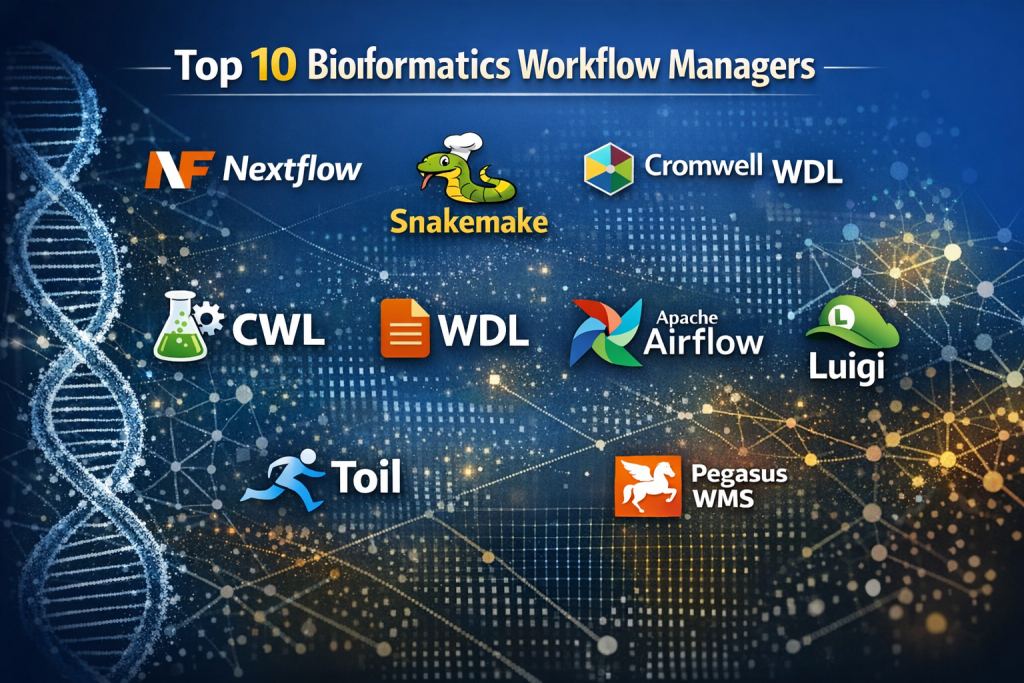
Top 10 Bioinformatics Workflow Managers Tools
1 — Nextflow
Short description:
Nextflow is a powerful workflow manager designed for scalable, reproducible bioinformatics pipelines. It is widely adopted in both academic and enterprise environments.
Key features:
- Domain-specific language optimized for bioinformatics
- Native support for containers (Docker, Singularity)
- Cloud and HPC execution support
- Strong pipeline modularity
- Versioned workflows and reproducibility
- Large ecosystem of prebuilt pipelines
Pros:
- Excellent scalability from laptop to cloud
- Strong industry adoption and tooling ecosystem
Cons:
- Learning curve for new users
- DSL can feel unfamiliar initially
Security & compliance:
Supports container isolation, access controls, and cloud security configurations; compliance depends on deployment environment.
Support & community:
Very strong community, extensive documentation, enterprise support available.
2 — Snakemake
Short description:
Snakemake is a Python-based workflow manager emphasizing simplicity and reproducibility for data-driven bioinformatics pipelines.
Key features:
- Python-based workflow definitions
- Automatic dependency resolution
- Native HPC and cloud execution
- Conda and container integration
- Rule-based workflow structure
- Excellent debugging capabilities
Pros:
- Easy for Python users
- Highly readable workflows
Cons:
- Less opinionated structure for very large teams
- Performance tuning may require expertise
Security & compliance:
Varies by execution environment; supports containerized execution.
Support & community:
Strong academic community, comprehensive documentation.
3 — Cromwell (WDL)
Short description:
Cromwell is a workflow execution engine for WDL workflows, commonly used in clinical and large-scale genomics.
Key features:
- Workflow Description Language (WDL)
- Cloud-native execution
- Strong focus on reproducibility
- Proven clinical genomics usage
- Parallel execution support
- Backend flexibility
Pros:
- Well-suited for regulated genomics
- Clear workflow syntax
Cons:
- Less flexible outside WDL
- Smaller ecosystem than Nextflow
Security & compliance:
Supports auditability and controlled execution; compliance depends on deployment.
Support & community:
Good documentation, moderate community size.
4 — Galaxy
Short description:
Galaxy is a web-based workflow platform offering accessible bioinformatics analysis without extensive coding.
Key features:
- Graphical user interface
- Large library of bioinformatics tools
- Workflow sharing and reproducibility
- Training and tutorial ecosystem
- Cloud and local deployment options
Pros:
- Beginner-friendly
- Ideal for collaborative research
Cons:
- Limited flexibility for custom pipelines
- Performance constraints at scale
Security & compliance:
Supports user management and access controls; compliance varies by deployment.
Support & community:
Very large global community and training resources.
5 — CWL (Common Workflow Language)
Short description:
CWL is an open standard for describing analysis workflows and tools in a portable, vendor-neutral way.
Key features:
- Open, community-driven standard
- Portable across execution engines
- Strong container support
- Explicit input/output definitions
- Emphasis on reproducibility
Pros:
- Vendor-neutral and portable
- Transparent workflow definitions
Cons:
- Verbose syntax
- Requires external execution engines
Security & compliance:
Depends on execution platform; supports container security.
Support & community:
Active standards community, solid documentation.
6 — Toil
Short description:
Toil is a scalable workflow engine designed for large, distributed, and cloud-based bioinformatics pipelines.
Key features:
- Supports CWL and WDL
- Distributed execution
- Cloud-native design
- Fault tolerance
- High scalability
Pros:
- Excellent for massive datasets
- Cloud-optimized architecture
Cons:
- Complex setup
- Smaller user base
Security & compliance:
Varies by deployment; supports secure cloud environments.
Support & community:
Smaller but technically strong community.
7 — Arvados
Short description:
Arvados is a data management and workflow platform focused on reproducibility and data provenance.
Key features:
- Integrated data management
- Strong provenance tracking
- Scalable compute support
- Secure data access controls
- Workflow execution support
Pros:
- Excellent data governance
- Designed for regulated research
Cons:
- Steeper learning curve
- Heavier infrastructure requirements
Security & compliance:
Strong access control and audit capabilities; compliance depends on setup.
Support & community:
Enterprise-focused support, smaller open community.
8 — Luigi
Short description:
Luigi is a Python-based workflow engine originally developed for complex batch pipelines.
Key features:
- Task-based pipeline design
- Dependency management
- Python-native implementation
- Visualization dashboard
- Flexible execution environments
Pros:
- Flexible and extensible
- Suitable for custom pipelines
Cons:
- Not bioinformatics-specific
- Requires more manual configuration
Security & compliance:
N/A – depends on infrastructure.
Support & community:
Active Python community, moderate documentation.
9 — Airflow (Bioinformatics Use)
Short description:
Apache Airflow is a general-purpose workflow orchestration platform adapted by some teams for bioinformatics pipelines.
Key features:
- DAG-based workflows
- Extensive scheduling capabilities
- Scalable execution
- Rich monitoring tools
- Plugin ecosystem
Pros:
- Excellent scheduling and monitoring
- Enterprise-grade reliability
Cons:
- Not designed specifically for bioinformatics
- More overhead for scientific workflows
Security & compliance:
Supports enterprise-grade authentication and auditing.
Support & community:
Very large global community and enterprise support.
10 — Pachyderm
Short description:
Pachyderm combines containerized workflows with data versioning for reproducible bioinformatics pipelines.
Key features:
- Data versioning built-in
- Container-native pipelines
- Kubernetes-based execution
- Incremental processing
- Strong reproducibility model
Pros:
- Excellent data lineage tracking
- Cloud-native design
Cons:
- Kubernetes dependency
- Operational complexity
Security & compliance:
Supports enterprise security models; compliance varies.
Support & community:
Commercial support available, growing community.
Comparison Table
| Tool Name | Best For | Platform(s) Supported | Standout Feature | Rating |
|---|---|---|---|---|
| Nextflow | Large-scale genomics | Local, HPC, Cloud | Pipeline portability | N/A |
| Snakemake | Python-based workflows | Local, HPC, Cloud | Simplicity & readability | N/A |
| Cromwell | Clinical genomics | Cloud, HPC | WDL standard | N/A |
| Galaxy | Non-programmers | Web, Cloud | GUI-driven workflows | N/A |
| CWL | Standardized workflows | Multi-engine | Vendor neutrality | N/A |
| Toil | Massive datasets | Cloud, HPC | Distributed execution | N/A |
| Arvados | Regulated research | Cloud, On-prem | Data provenance | N/A |
| Luigi | Custom pipelines | Local, Cloud | Python task orchestration | N/A |
| Airflow | Enterprise scheduling | Cloud, On-prem | Monitoring & scheduling | N/A |
| Pachyderm | Cloud-native pipelines | Kubernetes | Data versioning | N/A |
Evaluation & Scoring of Bioinformatics Workflow Managers
| Tool | Core Features (25%) | Ease of Use (15%) | Integrations (15%) | Security (10%) | Performance (10%) | Support (10%) | Price/Value (15%) | Total Score |
|---|---|---|---|---|---|---|---|---|
| Nextflow | 24 | 13 | 14 | 8 | 9 | 9 | 13 | 90 |
| Snakemake | 22 | 14 | 13 | 7 | 8 | 8 | 14 | 86 |
| Cromwell | 21 | 12 | 12 | 8 | 8 | 7 | 12 | 80 |
| Galaxy | 20 | 15 | 11 | 7 | 7 | 9 | 13 | 82 |
| CWL | 21 | 10 | 14 | 7 | 8 | 8 | 12 | 80 |
Which Bioinformatics Workflow Managers Tool Is Right for You?
- Solo users: Snakemake or Galaxy for simplicity
- SMBs: Nextflow or Snakemake for scalability
- Mid-market: Nextflow, Cromwell, or Pachyderm
- Enterprise: Nextflow, Arvados, or Airflow
Budget-conscious: Open-source tools like Snakemake, CWL
Premium solutions: Pachyderm, enterprise Nextflow
Ease of use: Galaxy
Deep customization: Nextflow, Snakemake
Security & compliance: Cromwell, Arvados
Frequently Asked Questions (FAQs)
- What is a bioinformatics workflow manager?
A tool that automates and manages multi-step biological data analysis pipelines. - Do I need programming skills?
Some tools require coding, while others offer graphical interfaces. - Are these tools cloud-ready?
Most modern workflow managers support cloud execution. - Which is best for genomics pipelines?
Nextflow and Cromwell are widely used in genomics. - Can workflows be reused?
Yes, most tools emphasize reproducibility and sharing. - Are these tools secure?
Security depends on deployment and infrastructure. - Can they handle large datasets?
Yes, many are designed for high-performance and distributed computing. - Do they support containers?
Most modern tools support Docker or similar technologies. - Are there GUI-based options?
Galaxy is the most popular GUI-based platform. - What is the biggest mistake users make?
Choosing a tool without considering scalability and team expertise.
Conclusion
Bioinformatics Workflow Managers are essential for reproducible, scalable, and efficient biological data analysis. While tools like Nextflow and Snakemake dominate large-scale research, others excel in accessibility, standardization, or enterprise control.
There is no single “best” solution for everyone. The right choice depends on team size, technical expertise, data scale, compliance needs, and infrastructure. By focusing on these factors, organizations can select a workflow manager that delivers long-term value and scientific confidence.

Find Trusted Cardiac Hospitals
Compare heart hospitals by city and services — all in one place.
Explore Hospitals