
Introduction
Body Camera Evidence Management refers to specialized software platforms that securely store, organize, review, and share video, audio, and metadata captured by body-worn cameras. These systems are now a core pillar of modern law enforcement, public safety, and security operations. They ensure that digital evidence remains authentic, tamper-proof, searchable, and legally defensible throughout its lifecycle.
The importance of body camera evidence management has grown rapidly due to increased public accountability, legal scrutiny, and the sheer volume of video generated daily. Without a proper system, agencies risk lost evidence, broken chain of custody, compliance failures, and inefficient investigations.
Real-world use cases include criminal investigations, internal affairs reviews, court evidence preparation, training and performance review, public records requests, and transparency initiatives. Beyond policing, these tools are increasingly used by private security, corrections, transportation authorities, and emergency services.
When evaluating body camera evidence management tools, buyers should focus on security, scalability, usability, redaction capabilities, retention policies, integrations, and long-term cost of ownership. A strong platform should balance operational efficiency with strict compliance and data protection.
Best for:
Law enforcement agencies, public safety departments, corrections facilities, transportation security teams, private security firms, and enterprises requiring secure video evidence handling.
Not ideal for:
Small teams with minimal video needs, organizations without compliance requirements, or users seeking general video storage rather than evidentiary-grade management.
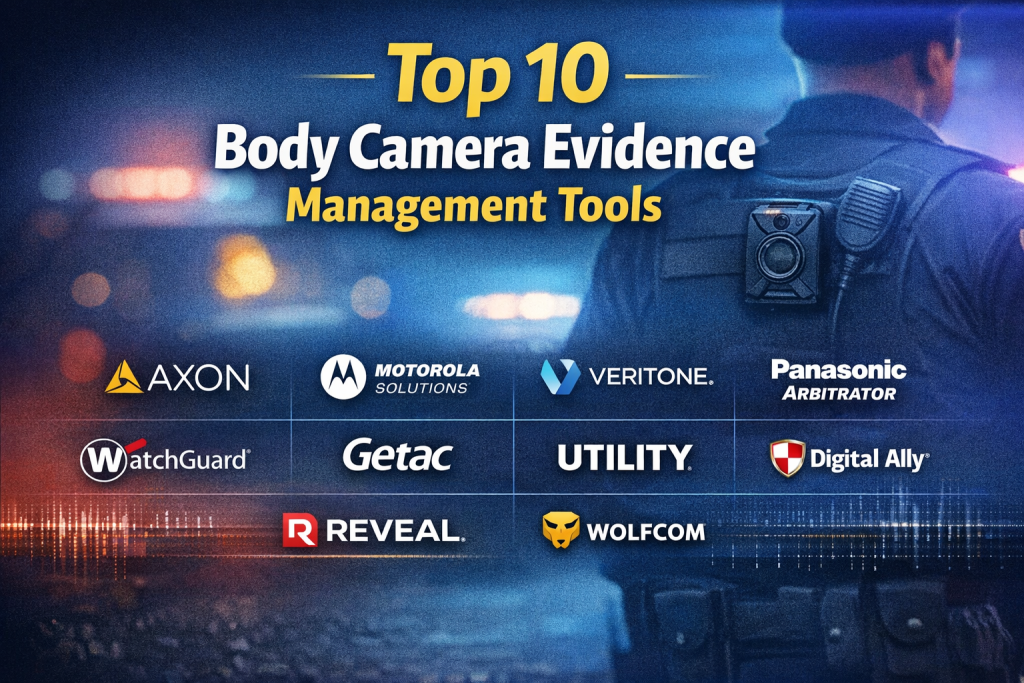
Top 10 Body Camera Evidence Management Tools
1 — Axon Evidence
Short description:
A market-leading digital evidence management platform designed for law enforcement agencies of all sizes, tightly integrated with body cameras and TASER devices.
Key features:
- Secure cloud-based evidence storage
- Automated evidence upload from devices
- Advanced video redaction tools
- Chain-of-custody tracking and audit logs
- Role-based access controls
- Case management and sharing workflows
- Integration with CAD and RMS systems
Pros:
- Industry-leading ecosystem and reliability
- Strong compliance and legal defensibility
- Scales easily for large agencies
Cons:
- Premium pricing
- Less flexibility for non-law-enforcement use cases
Security & compliance:
Encryption at rest and in transit, CJIS alignment, audit logs, role-based permissions.
Support & community:
Extensive documentation, onboarding programs, enterprise-grade support.
2 — Motorola Solutions Evidence Library
Short description:
An enterprise digital evidence platform integrated with Motorola body cameras, radios, and public safety infrastructure.
Key features:
- Centralized video and media management
- Automated metadata tagging
- Secure evidence sharing with prosecutors
- Retention policy automation
- Advanced search and filtering
- Scalable cloud deployment
Pros:
- Excellent integration with public safety tools
- Strong enterprise performance
- Reliable long-term vendor
Cons:
- Complex configuration for small teams
- Higher enterprise cost
Security & compliance:
CJIS-aligned security, encryption, audit trails.
Support & community:
Dedicated enterprise support, structured onboarding.
3 — Veritone Redact
Short description:
An AI-powered evidence redaction and management solution focused on privacy-first video handling.
Key features:
- Automated face, object, and audio redaction
- AI-driven video search
- Cloud and hybrid deployment options
- Multi-format media support
- Collaboration and review workflows
Pros:
- Best-in-class automated redaction
- Reduces manual labor significantly
- Flexible deployment
Cons:
- Not a full body camera ecosystem
- Requires integration with capture devices
Security & compliance:
Encryption, access controls, GDPR-aware design.
Support & community:
Good documentation, responsive enterprise support.
4 — Panasonic Arbitrator
Short description:
A comprehensive in-car and body-worn video evidence management platform used by police and transit agencies.
Key features:
- Unified management for body and vehicle cameras
- Secure evidence archiving
- Incident categorization
- Court-ready export tools
- Offline access capabilities
Pros:
- Strong hardware-software integration
- Reliable performance in field conditions
Cons:
- UI feels dated
- Less innovation compared to newer platforms
Security & compliance:
Encryption, audit logs, CJIS-focused controls.
Support & community:
Established vendor support, structured training.
5 — WatchGuard Evidence Library
Short description:
A cloud-based evidence management solution paired with WatchGuard body cameras and in-car video systems.
Key features:
- Automated uploads and tagging
- Secure sharing with prosecutors
- Case-centric evidence organization
- Retention and deletion policies
- Scalable cloud infrastructure
Pros:
- User-friendly interface
- Strong mid-market value
- Reliable hardware integration
Cons:
- Limited advanced analytics
- Ecosystem less broad than top competitors
Security & compliance:
Encryption, access controls, CJIS-aligned practices.
Support & community:
Good onboarding resources and responsive support.
6 — Getac Evidence Management
Short description:
A secure evidence management platform designed to work with rugged body cameras and field devices.
Key features:
- Secure media ingestion
- Chain-of-custody tracking
- Cloud and on-prem deployment
- Role-based permissions
- Evidence annotation tools
Pros:
- Flexible deployment options
- Designed for harsh environments
Cons:
- Smaller ecosystem
- Less advanced redaction tools
Security & compliance:
Encryption, audit logs, configurable retention.
Support & community:
Enterprise-focused support, moderate documentation.
7 — Utility Evidence Management
Short description:
A modern digital evidence platform emphasizing usability and transparency for law enforcement agencies.
Key features:
- Intuitive evidence review
- Automated device uploads
- Redaction and sharing tools
- Case management features
- Cloud-native architecture
Pros:
- Clean, modern interface
- Faster onboarding for officers
Cons:
- Fewer integrations than large vendors
- Smaller vendor footprint
Security & compliance:
Encryption, audit logs, role-based access.
Support & community:
Strong customer service, growing user base.
8 — Reveal Media DEMS
Short description:
A digital evidence management system built specifically for body-worn camera footage.
Key features:
- Automated uploads
- Evidence categorization
- Secure sharing portals
- Retention policy automation
- Mobile access
Pros:
- Purpose-built for body cameras
- Simple workflows
Cons:
- Limited advanced analytics
- Smaller ecosystem
Security & compliance:
Encryption, access control, audit logging.
Support & community:
Regional support strength, solid documentation.
9 — Digital Ally VuVault
Short description:
A cloud-based evidence management platform supporting body cameras and in-car systems.
Key features:
- Secure cloud storage
- Evidence tagging and search
- Case-based organization
- Sharing and export tools
- Device learning mode
Pros:
- Competitive pricing
- Straightforward setup
Cons:
- UI less polished
- Limited AI capabilities
Security & compliance:
Encryption, CJIS-aware architecture.
Support & community:
Standard support, moderate training resources.
10 — Wolfcom Evidence Management
Short description:
A flexible evidence management system focused on law enforcement and private security teams.
Key features:
- Cloud-based evidence storage
- Evidence categorization
- Role-based access
- Secure sharing
- Scalable retention policies
Pros:
- Affordable for small agencies
- Simple operational model
Cons:
- Fewer enterprise features
- Limited integrations
Security & compliance:
Encryption, access controls, basic audit logs.
Support & community:
Small but responsive support team.
Comparison Table
| Tool Name | Best For | Platform(s) Supported | Standout Feature | Rating |
|---|---|---|---|---|
| Axon Evidence | Large law enforcement agencies | Cloud | End-to-end ecosystem | N/A |
| Motorola Evidence Library | Enterprise public safety | Cloud | Deep CAD/RMS integration | N/A |
| Veritone Redact | Privacy-focused agencies | Cloud / Hybrid | AI redaction | N/A |
| Panasonic Arbitrator | Police & transit | Hybrid | Unified vehicle + body video | N/A |
| WatchGuard Evidence | Mid-market agencies | Cloud | Ease of use | N/A |
| Getac Evidence | Rugged field teams | Cloud / On-prem | Deployment flexibility | N/A |
| Utility Evidence | Modern police departments | Cloud | Usability | N/A |
| Reveal Media DEMS | Body-camera-centric teams | Cloud | Purpose-built workflows | N/A |
| Digital Ally VuVault | Budget-conscious agencies | Cloud | Cost effectiveness | N/A |
| Wolfcom Evidence | Small agencies | Cloud | Affordability | N/A |
Evaluation & Scoring of Body Camera Evidence Management
| Criteria | Weight | Notes |
|---|---|---|
| Core features | 25% | Evidence lifecycle, redaction, sharing |
| Ease of use | 15% | Officer and admin usability |
| Integrations & ecosystem | 15% | CAD, RMS, prosecutors |
| Security & compliance | 10% | Encryption, auditability |
| Performance & reliability | 10% | Upload speed, uptime |
| Support & community | 10% | Training, responsiveness |
| Price / value | 15% | Long-term cost efficiency |
Which Body Camera Evidence Management Tool Is Right for You?
- Solo users & small teams: Look for affordable, cloud-based platforms with minimal setup.
- SMBs & mid-market agencies: Prioritize usability, redaction tools, and integration balance.
- Enterprise & large departments: Focus on scalability, compliance, ecosystem depth, and vendor stability.
- Budget-conscious buyers: Choose platforms with predictable pricing and essential features.
- Security-first organizations: Emphasize audit logs, encryption, and retention controls.
- Integration-heavy environments: Ensure compatibility with CAD, RMS, and court systems.
Frequently Asked Questions (FAQs)
1. Is body camera evidence management legally required?
In many jurisdictions, yes—especially for law enforcement handling evidentiary video.
2. How long should body camera footage be retained?
Retention varies by policy and case type, ranging from days to several years.
3. Can evidence be shared securely with prosecutors?
Most platforms provide secure, time-limited sharing portals.
4. Is AI redaction reliable?
Modern AI redaction is highly effective but still requires human review.
5. Are cloud platforms secure enough for evidence?
Yes, when designed with encryption, access controls, and audit trails.
6. What happens if footage is deleted accidentally?
Leading tools include deletion safeguards and audit tracking.
7. Can private security firms use these tools?
Yes, many platforms support non-law-enforcement users.
8. Do these systems support mobile access?
Most offer learn-mode or mobile-friendly review tools.
9. How complex is implementation?
Cloud systems can be live in weeks; enterprise deployments take longer.
10. What is the most common buyer mistake?
Choosing price over compliance and long-term scalability.
Conclusion
Body Camera Evidence Management systems are no longer optional—they are essential for accountability, efficiency, and legal integrity. The right platform protects evidence, streamlines investigations, and builds public trust.
There is no single “best” tool for everyone. The ideal choice depends on agency size, compliance needs, budget, and integration requirements. By focusing on core features, security, and usability, organizations can confidently select a solution that supports both today’s operations and tomorrow’s demands.

Find Trusted Cardiac Hospitals
Compare heart hospitals by city and services — all in one place.
Explore Hospitals
Great breakdown of features and pros/cons! The comparison makes it much easier to see which system fits specific needs like storage, tagging, and secure access.