
Introduction
Building Energy Management Systems (BEMS) are intelligent software platforms designed to monitor, analyze, control, and optimize energy consumption across buildings and facilities. By collecting real-time data from HVAC systems, lighting, meters, renewable sources, and other energy assets, BEMS help organizations reduce energy waste, lower operating costs, and meet sustainability goals without compromising occupant comfort.
In today’s environment of rising energy prices, strict carbon regulations, and growing ESG expectations, BEMS are no longer optional—they are a strategic necessity. From commercial offices and hospitals to manufacturing plants and smart campuses, organizations rely on BEMS to gain visibility into energy usage, detect inefficiencies, automate control strategies, and generate actionable insights.
Common real-world use cases include:
- Optimizing HVAC and lighting schedules
- Reducing peak demand charges
- Monitoring renewable energy generation
- Ensuring regulatory compliance and reporting
- Improving occupant comfort while cutting costs
When choosing a BEMS, users should evaluate data accuracy, analytics depth, automation capabilities, scalability, integrations, security, ease of use, and total cost of ownership. The right system aligns technical capabilities with business and sustainability objectives.
Best for:
Facility managers, energy managers, sustainability teams, real estate operators, manufacturing plants, hospitals, universities, and large enterprises managing complex energy portfolios.
Not ideal for:
Very small buildings with minimal energy complexity, residential homes with basic smart meters, or organizations seeking only simple billing dashboards rather than advanced analytics and control.
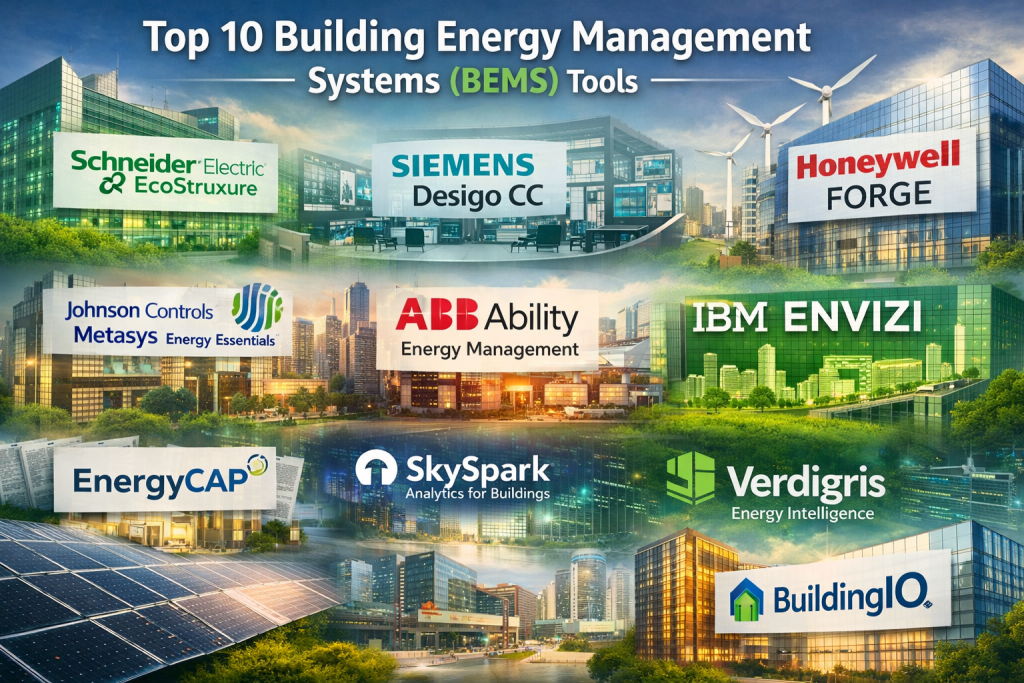
Top 10 Building Energy Management Systems (BEMS) Tools
1 — Schneider Electric EcoStruxure Building
Short description:
An enterprise-grade BEMS designed for large commercial and industrial facilities focusing on energy efficiency, automation, and sustainability.
Key features:
- Real-time energy monitoring and analytics
- Advanced HVAC and lighting control
- AI-driven optimization and fault detection
- Integration with building automation systems
- Sustainability and carbon reporting
- Scalable multi-site management
Pros:
- Extremely powerful analytics and automation
- Strong focus on sustainability and ESG
Cons:
- Higher cost than mid-market solutions
- Requires skilled implementation partners
Security & compliance:
Enterprise-grade encryption, role-based access, audit logs, GDPR, ISO standards (varies by deployment).
Support & community:
Strong global support network, extensive documentation, enterprise onboarding services.
2 — Siemens Desigo CC
Short description:
A comprehensive building management and energy optimization platform for complex infrastructures.
Key features:
- Centralized energy and building control
- Multi-system integration (HVAC, power, security)
- Advanced visualization dashboards
- Predictive analytics and alarms
- Multi-building scalability
Pros:
- Excellent integration across building systems
- Reliable and robust for mission-critical sites
Cons:
- Steep learning curve
- Premium pricing
Security & compliance:
Strong enterprise security, encryption, access controls, GDPR-ready.
Support & community:
Professional support, certified integrators, detailed training resources.
3 — Honeywell Forge Energy Optimization
Short description:
A data-driven energy management platform leveraging AI to optimize building energy performance.
Key features:
- AI-powered energy optimization
- Real-time monitoring and analytics
- Asset performance management
- Cloud-based dashboards
- Predictive maintenance insights
Pros:
- Strong AI and predictive capabilities
- Cloud-first architecture
Cons:
- Best value realized in large deployments
- Customization may require expertise
Security & compliance:
Cloud security controls, encryption, compliance frameworks vary by region.
Support & community:
Enterprise support, onboarding programs, growing user ecosystem.
4 — Johnson Controls Metasys Energy Essentials
Short description:
A flexible BEMS focusing on energy efficiency, comfort, and operational optimization.
Key features:
- Energy usage tracking and benchmarking
- HVAC and lighting optimization
- Demand response capabilities
- Customizable dashboards
- Integration with automation systems
Pros:
- Reliable and proven technology
- Good balance between control and analytics
Cons:
- UI can feel dated
- Advanced analytics may require add-ons
Security & compliance:
Role-based security, encrypted communications, compliance varies by configuration.
Support & community:
Strong global partner network and documentation.
5 — ABB Ability Energy Management
Short description:
An industrial-focused energy management platform ideal for factories and large infrastructure.
Key features:
- Energy and power quality monitoring
- Real-time dashboards and alerts
- Integration with industrial automation
- Demand management and optimization
- Multi-site analytics
Pros:
- Excellent for industrial environments
- High reliability and performance
Cons:
- Less intuitive for non-technical users
- Primarily focused on industrial use cases
Security & compliance:
Industrial-grade security, encryption, compliance standards supported.
Support & community:
Strong enterprise and industrial support services.
6 — IBM Envizi Energy Management
Short description:
A cloud-based energy and sustainability management platform focused on data-driven insights.
Key features:
- Energy data aggregation and normalization
- Sustainability and ESG reporting
- Analytics and benchmarking
- Multi-site portfolio management
- Integration with enterprise systems
Pros:
- Strong reporting and compliance features
- Scales well across portfolios
Cons:
- Limited direct control capabilities
- Relies heavily on data quality
Security & compliance:
Enterprise cloud security, GDPR, SOC-style controls.
Support & community:
Professional support, extensive documentation, enterprise onboarding.
7 — EnergyCAP Energy Management
Short description:
A comprehensive utility bill and energy data management solution.
Key features:
- Utility bill processing and validation
- Energy usage analytics
- Budgeting and forecasting
- Compliance and reporting tools
- Portfolio-wide visibility
Pros:
- Excellent for cost tracking and billing accuracy
- Easy to use for finance and energy teams
Cons:
- Limited real-time control features
- Less automation compared to full BEMS
Security & compliance:
Standard encryption, role-based access, compliance varies.
Support & community:
Good documentation, responsive customer support.
8 — SkySpark
Short description:
An analytics-focused platform specializing in fault detection and diagnostics.
Key features:
- Automated fault detection
- Rule-based and analytics-driven insights
- Energy efficiency diagnostics
- Customizable analytics models
- Integration with BMS platforms
Pros:
- Excellent at identifying inefficiencies
- Flexible analytics framework
Cons:
- Requires technical expertise
- Not a full control system
Security & compliance:
Varies by deployment and integration environment.
Support & community:
Active technical community, strong documentation.
9 — Verdigris Energy Intelligence
Short description:
An AI-driven energy intelligence platform using high-resolution data analytics.
Key features:
- AI-powered energy disaggregation
- Real-time equipment-level insights
- Anomaly detection
- Cloud dashboards
- Sustainability reporting
Pros:
- Deep visibility into energy usage
- Strong AI-driven insights
Cons:
- Hardware dependency
- Best suited for data-focused users
Security & compliance:
Cloud security practices, encryption, GDPR-ready.
Support & community:
Dedicated onboarding, responsive support team.
10 — BuildingIQ
Short description:
A cloud-based energy optimization platform focusing on HVAC efficiency.
Key features:
- HVAC optimization using machine learning
- Energy forecasting
- Automated control strategies
- Comfort optimization
- Cloud analytics
Pros:
- Proven energy savings
- Easy integration with HVAC systems
Cons:
- Narrower scope compared to full BEMS
- Less control over non-HVAC systems
Security & compliance:
Cloud encryption, access controls, compliance varies.
Support & community:
Professional support, focused user base.
Comparison Table
| Tool Name | Best For | Platform(s) Supported | Standout Feature | Rating |
|---|---|---|---|---|
| Schneider Electric EcoStruxure | Large enterprises | Cloud / On-prem | End-to-end automation | N/A |
| Siemens Desigo CC | Complex infrastructures | On-prem / Hybrid | Unified building control | N/A |
| Honeywell Forge | Large portfolios | Cloud | AI optimization | N/A |
| Johnson Controls Metasys | Commercial buildings | On-prem / Hybrid | HVAC integration | N/A |
| ABB Ability | Industrial facilities | Cloud / On-prem | Industrial reliability | N/A |
| IBM Envizi | Sustainability reporting | Cloud | ESG analytics | N/A |
| EnergyCAP | Utility cost management | Cloud | Bill validation | N/A |
| SkySpark | Analytics teams | Cloud / Hybrid | Fault detection | N/A |
| Verdigris | Data-driven orgs | Cloud | High-resolution analytics | N/A |
| BuildingIQ | HVAC optimization | Cloud | Predictive control | N/A |
Evaluation & Scoring of Building Energy Management Systems (BEMS)
| Tool | Core Features (25%) | Ease of Use (15%) | Integrations (15%) | Security (10%) | Performance (10%) | Support (10%) | Price/Value (15%) | Total Score |
|---|---|---|---|---|---|---|---|---|
| EcoStruxure | 23 | 12 | 14 | 9 | 9 | 9 | 11 | 87 |
| Desigo CC | 22 | 11 | 14 | 9 | 9 | 9 | 10 | 84 |
| Honeywell Forge | 21 | 13 | 13 | 9 | 9 | 8 | 11 | 84 |
| Metasys | 20 | 13 | 12 | 8 | 8 | 8 | 12 | 81 |
| ABB Ability | 21 | 11 | 12 | 9 | 9 | 8 | 10 | 80 |
Which Building Energy Management Systems (BEMS) Tool Is Right for You?
- Solo users or small buildings: Lightweight platforms focused on analytics and reporting
- SMBs: Cloud-based BEMS with intuitive dashboards and moderate automation
- Mid-market: Systems offering integration, forecasting, and cost control
- Enterprises: Full-scale platforms with automation, AI, compliance, and scalability
Budget-conscious users should prioritize ease of use and reporting, while premium buyers benefit from AI optimization and automation depth. Always align integration needs, scalability, and security requirements with long-term goals.
Frequently Asked Questions (FAQs)
- What is a BEMS?
A system that monitors, analyzes, and optimizes building energy usage. - How much energy can BEMS save?
Typically 10–30% depending on building complexity and usage patterns. - Is BEMS only for large buildings?
No, but larger facilities see the greatest ROI. - Do BEMS require new hardware?
Sometimes, depending on data collection needs. - How long does implementation take?
From weeks to several months for large sites. - Are cloud-based BEMS secure?
Yes, when proper encryption and access controls are used. - Can BEMS support sustainability reporting?
Most modern systems include ESG and carbon reporting. - Do BEMS replace BMS?
No, they often integrate with existing BMS. - What skills are needed to manage BEMS?
Energy management and basic data analysis skills. - What is the biggest mistake buyers make?
Choosing overly complex systems without internal expertise.
Conclusion
Building Energy Management Systems play a crucial role in reducing costs, improving efficiency, and meeting sustainability goals. While enterprise platforms deliver powerful automation and analytics, simpler solutions may be more suitable for smaller organizations. The best BEMS is not a universal winner—it is the one that aligns with your building size, operational complexity, budget, and long-term energy strategy. Thoughtful evaluation ensures maximum value and measurable impact.

Find Trusted Cardiac Hospitals
Compare heart hospitals by city and services — all in one place.
Explore Hospitals