
Introduction
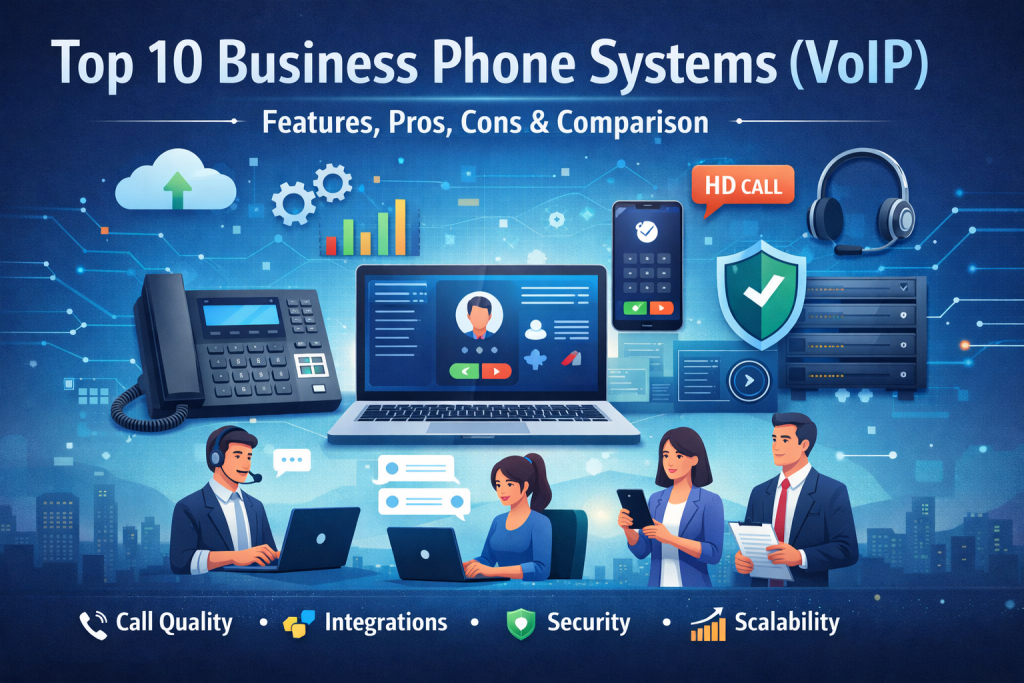
Business Phone Systems (VoIP)—short for Voice over Internet Protocol—are modern communication systems that allow businesses to make and receive phone calls over the internet instead of traditional telephone lines. Unlike legacy PBX systems, VoIP solutions are cloud-based, flexible, and designed to support today’s distributed, fast-moving work environments.
VoIP has become essential because businesses now operate across remote teams, global offices, and digital-first customer touchpoints. From handling sales calls and customer support to internal collaboration and virtual contact centers, VoIP systems power real-time voice communication with advanced features like call routing, analytics, voicemail-to-email, and integrations with business software.
Common real-world use cases include customer support centers managing high call volumes, sales teams tracking call performance, remote teams collaborating across regions, and growing businesses replacing expensive on-premise phone systems.
When choosing a Business Phone System (VoIP), buyers should evaluate call quality, reliability, scalability, integrations, ease of use, security, compliance, customer support, and overall value for money. The right system should grow with the business while remaining simple for everyday users.
Best for:
Business Phone Systems (VoIP) are ideal for startups, SMBs, mid-market companies, and enterprises that rely on frequent voice communication—especially sales teams, support teams, healthcare providers, professional services, retail, and global organizations.
Not ideal for:
Very small businesses with minimal calling needs, organizations in areas with unreliable internet connectivity, or teams that rely almost entirely on asynchronous communication may find VoIP less critical.
Top 10 Business Phone Systems (VoIP) Tools
#1 — RingCentral
Short description:
A comprehensive, enterprise-grade VoIP and unified communications platform designed for growing and large businesses with complex communication needs.
Key features:
- Cloud-based business calling and messaging
- Advanced call routing and auto-attendant
- Video meetings and team messaging
- CRM and productivity integrations
- Call analytics and reporting
- Mobile and desktop apps
- Multi-location management
Pros:
- Very reliable call quality and uptime
- Rich feature set for enterprises
Cons:
- Pricing can be high for small teams
- Interface may feel complex for beginners
Security & compliance:
Encryption in transit and at rest, SSO, audit logs, GDPR, SOC 2, HIPAA (plan-dependent)
Support & community:
Strong documentation, 24/7 support, enterprise onboarding, large user community
#2 — Zoom Phone
Short description:
A cloud phone system built on Zoom’s familiar interface, ideal for teams already using Zoom for meetings.
Key features:
- Cloud PBX with global calling
- Seamless integration with Zoom Meetings
- Call queues and auto-attendants
- Voicemail transcription
- Mobile and desktop apps
- Call recording and analytics
Pros:
- Extremely easy to adopt for Zoom users
- Consistent audio and video experience
Cons:
- Fewer advanced PBX features than some competitors
- Best value only when bundled with Zoom
Security & compliance:
Encryption, SSO, GDPR, SOC 2, ISO standards
Support & community:
Good documentation, ticket-based support, strong global user base
#3 — Microsoft Teams Phone
Short description:
A VoIP calling solution deeply integrated into Microsoft Teams, designed for organizations using Microsoft 365.
Key features:
- Native calling within Microsoft Teams
- PSTN connectivity and call plans
- Auto-attendant and call queues
- Device compatibility (desk phones, headsets)
- Voicemail and call forwarding
- Enterprise-grade administration
Pros:
- Excellent for Microsoft-centric workplaces
- Centralized collaboration and calling
Cons:
- Setup can be complex
- Less intuitive for non-Microsoft users
Security & compliance:
Enterprise-grade security, encryption, GDPR, ISO, SOC, advanced identity controls
Support & community:
Extensive documentation, global partner ecosystem, enterprise support
#4 — Nextiva
Short description:
A user-friendly VoIP platform focused on reliability, customer experience, and ease of management.
Key features:
- Unlimited calling in supported regions
- Auto-attendant and call routing
- Voicemail-to-email
- CRM and helpdesk integrations
- Call analytics and dashboards
- Mobile and desktop apps
Pros:
- Excellent customer support reputation
- Simple setup and clean interface
Cons:
- Advanced analytics limited on lower plans
- International calling costs add up
Security & compliance:
Encryption, GDPR alignment, SOC compliance
Support & community:
Highly rated customer support, onboarding assistance, strong SMB focus
#5 — 8×8
Short description:
An all-in-one VoIP and contact center solution designed for global businesses and hybrid teams.
Key features:
- Global cloud calling
- Advanced contact center features
- Call recording and analytics
- Video meetings and messaging
- CRM integrations
- Multi-country phone numbers
Pros:
- Strong international calling capabilities
- Scales well for enterprises
Cons:
- Interface can feel dated
- Learning curve for advanced features
Security & compliance:
Encryption, SSO, GDPR, HIPAA, SOC, ISO certifications
Support & community:
Enterprise-grade support, detailed documentation, global customer base
#6 — Vonage Business Communications
Short description:
A flexible VoIP system offering modular features for SMBs and growing companies.
Key features:
- Cloud-based PBX
- Call queues and auto-attendants
- CRM and API integrations
- Mobile and desktop apps
- Call recording
- Customizable plans
Pros:
- Flexible feature add-ons
- Good integration ecosystem
Cons:
- Pricing becomes complex with add-ons
- Support experience varies
Security & compliance:
Encryption, GDPR, SOC compliance
Support & community:
Decent documentation, support tickets, developer community for APIs
#7 — Ooma Office
Short description:
An affordable VoIP phone system tailored for small businesses looking for simplicity and value.
Key features:
- Virtual receptionist
- Call forwarding and ring groups
- Voicemail-to-email
- Desktop and mobile apps
- Basic call analytics
Pros:
- Budget-friendly pricing
- Very easy to set up
Cons:
- Limited advanced features
- Not ideal for large teams
Security & compliance:
Standard encryption, limited compliance certifications
Support & community:
Good onboarding resources, phone and email support, SMB-focused
#8 — Dialpad
Short description:
An AI-powered VoIP solution built for modern teams with a focus on real-time insights.
Key features:
- Cloud calling with AI transcription
- Real-time call coaching
- CRM integrations
- Mobile-first design
- Call analytics and insights
- Video meetings and messaging
Pros:
- Powerful AI features
- Clean and modern interface
Cons:
- AI features locked to higher plans
- Limited customization for enterprises
Security & compliance:
Encryption, GDPR, SOC 2, SSO support
Support & community:
Good documentation, responsive support, growing user community
#9 — Grasshopper
Short description:
A virtual phone system designed for solo entrepreneurs and very small businesses.
Key features:
- Virtual phone numbers
- Call forwarding
- Voicemail transcription
- Mobile and desktop apps
- Basic reporting
Pros:
- Extremely easy to use
- No hardware required
Cons:
- Not a full PBX system
- Limited scalability
Security & compliance:
Basic security, compliance varies
Support & community:
Simple documentation, email and phone support
#10 — Aircall
Short description:
A cloud-based phone system built specifically for sales and customer support teams.
Key features:
- Call queuing and routing
- CRM and helpdesk integrations
- Call recording and analytics
- Power dialer for sales teams
- Shared inbox and tags
Pros:
- Excellent for sales and support workflows
- Strong integration ecosystem
Cons:
- Higher pricing for small teams
- Limited general PBX features
Security & compliance:
Encryption, GDPR, SOC 2
Support & community:
Strong onboarding, helpful support, active SaaS user base
Comparison Table
| Tool Name | Best For | Platform(s) Supported | Standout Feature | Rating |
|---|---|---|---|---|
| RingCentral | Enterprises, global teams | Web, Desktop, Mobile | All-in-one UCaaS | N/A |
| Zoom Phone | Zoom-first teams | Web, Desktop, Mobile | Native Zoom integration | N/A |
| Microsoft Teams Phone | Microsoft 365 users | Web, Desktop, Mobile | Deep Teams integration | N/A |
| Nextiva | SMBs | Web, Desktop, Mobile | Customer experience focus | N/A |
| 8×8 | Global enterprises | Web, Desktop, Mobile | International calling | N/A |
| Vonage | Customizable SMBs | Web, Desktop, Mobile | Flexible add-ons | N/A |
| Ooma Office | Small businesses | Web, Desktop, Mobile | Affordable pricing | N/A |
| Dialpad | Modern, AI-driven teams | Web, Desktop, Mobile | AI-powered calls | N/A |
| Grasshopper | Solo users | Mobile, Desktop | Virtual numbers | N/A |
| Aircall | Sales & support teams | Web, Desktop, Mobile | CRM-first calling | N/A |
Evaluation & Scoring of Business Phone Systems (VoIP)
| Criteria | Weight | Key Considerations |
|---|---|---|
| Core features | 25% | Calling, routing, voicemail, analytics |
| Ease of use | 15% | UI clarity, onboarding |
| Integrations & ecosystem | 15% | CRM, helpdesk, APIs |
| Security & compliance | 10% | Encryption, certifications |
| Performance & reliability | 10% | Call quality, uptime |
| Support & community | 10% | Documentation, response time |
| Price / value | 15% | Features vs cost |
Which Business Phone Systems (VoIP) Tool Is Right for You?
- Solo users: Simple tools like Grasshopper or Ooma Office
- SMBs: Nextiva, Vonage, Dialpad for balance of features and cost
- Mid-market: RingCentral, 8×8, Aircall
- Enterprise: RingCentral, Microsoft Teams Phone, 8×8
Budget-conscious teams should focus on core calling features, while premium buyers may prioritize analytics, AI, and integrations. Businesses with strict compliance needs should favor enterprise-grade platforms with certifications.
Frequently Asked Questions (FAQs)
1. What is a VoIP business phone system?
A cloud-based phone system that uses the internet instead of traditional phone lines.
2. Is VoIP reliable for business use?
Yes, with a stable internet connection, VoIP is highly reliable.
3. Can VoIP replace traditional PBX systems?
In most cases, yes—especially for remote and growing teams.
4. Are VoIP calls secure?
Most modern systems use encryption and enterprise-grade security.
5. Do I need special hardware?
No, VoIP works on computers, mobiles, and optional desk phones.
6. Is VoIP cheaper than traditional phones?
Typically yes, especially for long-distance and global calls.
7. Can VoIP scale with my business?
Yes, most tools allow easy user and feature expansion.
8. Does VoIP support remote work?
Absolutely, it’s one of its biggest advantages.
9. What internet speed is required?
Stable broadband with low latency is recommended.
10. What is the biggest mistake buyers make?
Choosing based only on price instead of long-term needs.
Conclusion
Business Phone Systems (VoIP) have become a foundational tool for modern organizations, enabling flexible, scalable, and cost-effective communication. The best solution depends on company size, budget, feature needs, and security requirements.
Rather than searching for a single “best” platform, businesses should focus on finding the right fit—one that aligns with how their teams work today and how they plan to grow tomorrow.

Find Trusted Cardiac Hospitals
Compare heart hospitals by city and services — all in one place.
Explore Hospitals