
Introduction
Consent Management Platforms (CMPs) are specialized tools designed to help organizations collect, manage, store, and demonstrate user consent for data collection and processing activities. In today’s privacy-first digital environment, where regulations like GDPR, CCPA, CPRA, LGPD, and other global data protection laws are actively enforced, managing consent manually is no longer practical or safe.
CMPs play a critical role in ensuring that businesses obtain clear, informed, and auditable consent from users before tracking cookies, processing personal data, or sharing information with third parties. Beyond compliance, CMPs also help build user trust, improve transparency, and reduce legal and financial risks.
Real-world use cases include cookie consent banners on websites, consent tracking for marketing campaigns, preference centers for customers, consent records for audits, and region-specific compliance enforcement. When choosing a CMP, users should evaluate factors such as regulatory coverage, customization, ease of integration, reporting depth, scalability, security posture, and long-term maintainability.
Best for:
Consent Management Platforms are ideal for digital businesses, SaaS companies, eCommerce platforms, healthcare providers, publishers, enterprises handling personal data, legal and compliance teams, marketing teams, and IT/security leaders operating in regulated environments.
Not ideal for:
CMPs may be unnecessary for offline-only businesses, personal blogs with no data collection, internal tools without user tracking, or organizations operating strictly outside regulated data jurisdictions with minimal or no personal data processing.
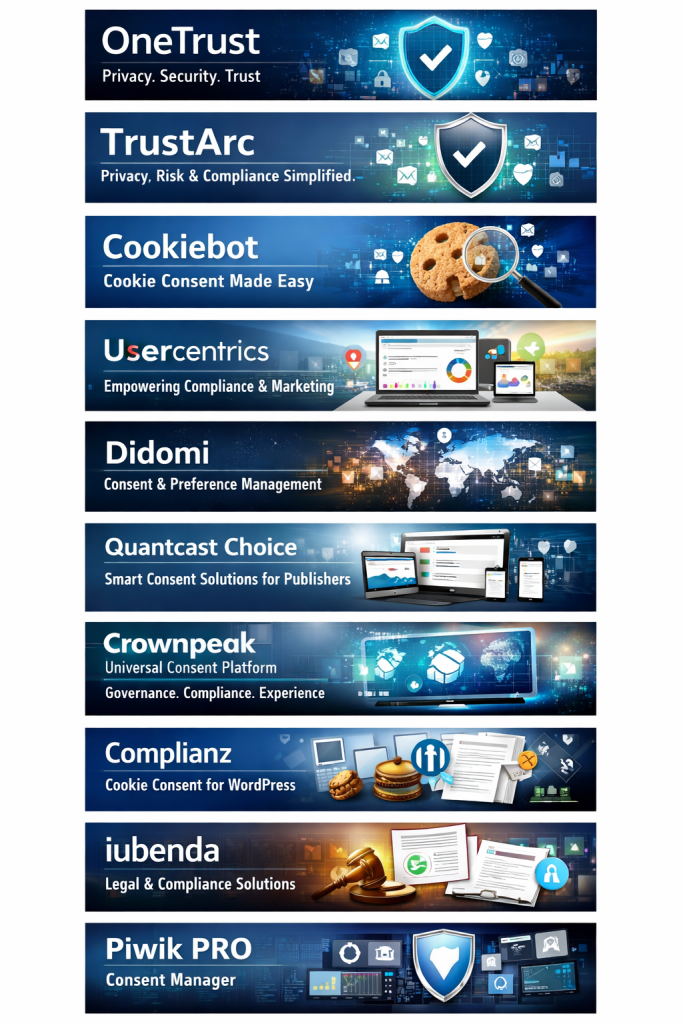
Top 10 Consent Management Platforms (CMP) Tools
1 — OneTrust
Short description:
OneTrust is an enterprise-grade privacy, risk, and consent management platform designed for large organizations with complex regulatory and data governance needs.
Key features:
- Advanced cookie consent and preference management
- Automated regulatory updates and templates
- Data subject rights (DSR) workflows
- Multi-language and geo-specific consent banners
- Vendor risk and third-party management
- Detailed audit trails and reporting
- Customizable consent UX
Pros:
- Extremely comprehensive compliance coverage
- Strong enterprise scalability
- Trusted by global enterprises
Cons:
- Steep learning curve
- Higher cost compared to most CMPs
Security & compliance:
GDPR, CCPA/CPRA, ISO-aligned controls, SOC 2, SSO, encryption, audit logs
Support & community:
Enterprise-grade onboarding, extensive documentation, dedicated support teams
2 — TrustArc
Short description:
TrustArc focuses on privacy compliance automation, offering consent management alongside assessments and governance tools.
Key features:
- Cookie consent management
- Privacy risk assessments
- Consent lifecycle tracking
- Regulatory intelligence updates
- Policy and notice management
- Reporting dashboards
Pros:
- Strong regulatory expertise
- Good balance between automation and control
Cons:
- UI can feel dated
- Customization may require support involvement
Security & compliance:
GDPR, CCPA, ISO-aligned practices, encryption, audit logs
Support & community:
Professional support, onboarding assistance, strong documentation
3 — Cookiebot
Short description:
Cookiebot is a user-friendly CMP focused on automated cookie scanning and consent compliance for websites.
Key features:
- Automated cookie detection and categorization
- Customizable consent banners
- Geo-targeted consent enforcement
- Consent logs for audits
- Multi-language support
- Easy CMS integrations
Pros:
- Very easy to deploy
- Affordable for SMBs
- Strong automation
Cons:
- Limited beyond cookie consent
- Less suitable for complex enterprise needs
Security & compliance:
GDPR, CCPA, encryption, consent logs
Support & community:
Good documentation, responsive support, active user base
4 — Usercentrics
Short description:
Usercentrics provides a flexible CMP designed for marketing, digital teams, and privacy professionals.
Key features:
- Customizable consent banners
- App and website consent management
- Consent analytics and reporting
- Vendor and service control
- Regional compliance enforcement
- Integration-friendly APIs
Pros:
- Strong UX customization
- Good analytics visibility
- Scales from SMB to enterprise
Cons:
- Pricing increases with traffic
- Advanced setup may require expertise
Security & compliance:
GDPR, CCPA, ISO-aligned, encryption, audit logs
Support & community:
Good onboarding, knowledge base, enterprise support
5 — Didomi
Short description:
Didomi is a consent and preference management platform focused on publishers, advertisers, and global brands.
Key features:
- Consent and preference management
- IAB TCF compliance
- Cross-device consent syncing
- Analytics and reporting
- SDKs for mobile apps
- Custom branding options
Pros:
- Excellent for advertising ecosystems
- Strong global compliance coverage
Cons:
- Less intuitive for non-publishers
- Pricing not ideal for small sites
Security & compliance:
GDPR, CCPA, IAB TCF, encryption, audit logs
Support & community:
Strong documentation, responsive support, enterprise-grade SLAs
6 — Quantcast Choice
Short description:
Quantcast Choice is a CMP built with publishers in mind, offering free and premium consent solutions.
Key features:
- IAB TCF compliance
- Consent banners for web and mobile
- Publisher-focused vendor controls
- Analytics dashboards
- Custom UI options
Pros:
- Free tier available
- Easy for publishers to deploy
Cons:
- Limited features outside publishing
- Fewer enterprise governance tools
Security & compliance:
GDPR, IAB TCF, encryption
Support & community:
Basic support for free users, better support on paid plans
7 — Crownpeak Universal Consent Platform
Short description:
Crownpeak’s CMP integrates consent management into broader digital governance and experience platforms.
Key features:
- Consent and preference management
- Integration with content governance
- Global compliance templates
- Centralized reporting
- Brand-level customization
Pros:
- Strong for digital governance teams
- Unified experience management
Cons:
- Less standalone-focused
- Better suited to existing Crownpeak users
Security & compliance:
GDPR, ISO-aligned, encryption, audit logs
Support & community:
Enterprise support, onboarding assistance
8 — Complianz
Short description:
Complianz is a popular CMP for WordPress and small-to-mid-sized websites.
Key features:
- Cookie consent banners
- Automatic cookie scanning
- Geo-targeted compliance
- Legal document generation
- CMS-focused integrations
Pros:
- Affordable
- Easy setup for non-technical users
Cons:
- Limited enterprise scalability
- Primarily web-focused
Security & compliance:
GDPR, CCPA, encryption
Support & community:
Active community, solid documentation, ticket-based support
9 — iubenda
Short description:
iubenda provides consent management combined with legal policy generation for websites and apps.
Key features:
- Consent and cookie management
- Auto-generated legal documents
- Multi-language support
- Consent logs
- App and website coverage
Pros:
- All-in-one legal + consent solution
- Cost-effective for SMBs
Cons:
- Less customizable UI
- Limited enterprise workflows
Security & compliance:
GDPR, CCPA, encryption, consent logs
Support & community:
Good documentation, email support, large SMB user base
10 — Piwik PRO Consent Manager
Short description:
Piwik PRO combines analytics and consent management with a strong focus on data ownership.
Key features:
- Integrated consent manager
- Analytics without third-party data sharing
- Consent storage and reporting
- On-premise and private cloud options
- Privacy-by-design architecture
Pros:
- Strong data control
- Ideal for regulated industries
Cons:
- Best value when used with Piwik analytics
- Smaller ecosystem
Security & compliance:
GDPR, ISO-aligned, encryption, audit logs
Support & community:
Professional support, strong documentation
Comparison Table
| Tool Name | Best For | Platform(s) Supported | Standout Feature | Rating |
|---|---|---|---|---|
| OneTrust | Large enterprises | Web, App, Enterprise | Full privacy governance suite | N/A |
| TrustArc | Compliance teams | Web, Enterprise | Privacy risk automation | N/A |
| Cookiebot | SMB websites | Web | Automated cookie scanning | N/A |
| Usercentrics | Marketing & SaaS | Web, App | Customizable UX & analytics | N/A |
| Didomi | Publishers & advertisers | Web, App | IAB TCF expertise | N/A |
| Quantcast Choice | Publishers | Web, App | Free CMP option | N/A |
| Crownpeak | Digital governance teams | Web, Enterprise | Integrated governance | N/A |
| Complianz | WordPress sites | Web | CMS-friendly setup | N/A |
| iubenda | SMBs & startups | Web, App | Legal + consent combo | N/A |
| Piwik PRO | Regulated industries | Web, On-prem | Privacy-first analytics | N/A |
Evaluation & Scoring of Consent Management Platforms (CMP)
| Criteria | Weight | OneTrust | TrustArc | Cookiebot | Usercentrics | Didomi |
|---|---|---|---|---|---|---|
| Core features | 25% | 9.5 | 9 | 7.5 | 8.5 | 8 |
| Ease of use | 15% | 7 | 7.5 | 9 | 8.5 | 7.5 |
| Integrations & ecosystem | 15% | 9.5 | 8.5 | 7 | 8 | 8 |
| Security & compliance | 10% | 9.5 | 9 | 8 | 8.5 | 8.5 |
| Performance & reliability | 10% | 9 | 8.5 | 8 | 8.5 | 8 |
| Support & community | 10% | 9 | 8.5 | 7.5 | 8 | 8 |
| Price / value | 15% | 6.5 | 7 | 9 | 8 | 7.5 |
Which Consent Management Platforms (CMP) Tool Is Right for You?
- Solo users & small websites: Lightweight tools like Cookiebot, Complianz, or iubenda offer fast setup and affordability.
- SMBs & growing SaaS: Usercentrics or Didomi provide flexibility without enterprise overhead.
- Mid-market companies: TrustArc balances compliance automation with usability.
- Large enterprises: OneTrust or Crownpeak deliver full governance, auditability, and scalability.
- Budget-conscious teams: Look for transparent pricing and minimal traffic-based fees.
- Highly regulated industries: Prioritize security controls, audit logs, and private deployment options.
Frequently Asked Questions (FAQs)
1. What does a CMP actually do?
A CMP collects, stores, and manages user consent for cookies and data processing while providing audit-ready records.
2. Are CMPs legally required?
In many regions, yes—especially when using tracking cookies or processing personal data.
3. Can a CMP slow down my website?
Well-implemented CMPs are lightweight, but poor configuration can impact load times.
4. Do CMPs work for mobile apps?
Many modern CMPs support both web and mobile SDKs.
5. Is cookie consent the same as consent management?
Cookie consent is one part; full CMPs manage broader data processing consent.
6. How long should consent records be stored?
This depends on regulations, but CMPs usually allow configurable retention.
7. Can users change their consent later?
Yes, preference centers allow users to update choices anytime.
8. Do CMPs integrate with analytics tools?
Most CMPs integrate with analytics, marketing, and tag managers.
9. Are free CMPs safe to use?
They can be, but often lack advanced features or support.
10. What’s the biggest mistake when using a CMP?
Assuming installation alone ensures compliance without proper configuration.
Conclusion
Consent Management Platforms are no longer optional for organizations handling personal data. They serve as the foundation for regulatory compliance, user trust, and transparent data practices. While some tools focus on simplicity and affordability, others deliver deep governance and enterprise-grade control.
There is no single “best” CMP for everyone. The right choice depends on company size, regulatory exposure, technical maturity, budget, and long-term privacy strategy. By aligning your needs with the strengths of each platform, you can implement a consent solution that protects both your users and your business.

Find Trusted Cardiac Hospitals
Compare heart hospitals by city and services — all in one place.
Explore Hospitals
