
Introduction
Contract Lifecycle Management (CLM) refers to the systematic process of managing contracts from initial request and drafting through negotiation, approval, execution, renewal, and eventual expiration or termination. In modern organizations, contracts are no longer static documents stored in folders—they are living assets that directly impact revenue, risk, compliance, and relationships. CLM tools bring structure, visibility, and automation to this entire lifecycle.
The importance of CLM has grown rapidly as businesses deal with increasing contract volumes, complex regulations, remote teams, and faster deal cycles. Without a proper CLM system, organizations face risks such as missed renewals, unfavorable clauses, compliance violations, revenue leakage, and slow approval cycles.
Real-world use cases include:
- Sales teams accelerating deal closures with pre-approved templates
- Legal teams reducing risk through clause standardization and audit trails
- Procurement teams managing vendor contracts and renewals
- Finance teams tracking obligations, milestones, and revenue terms
When choosing a CLM tool, users should evaluate factors such as ease of use, automation depth, integration with CRM and ERP systems, security and compliance controls, scalability, and overall return on investment.
Best for:
Contract Lifecycle Management (CLM) tools are ideal for legal teams, sales operations, procurement professionals, compliance officers, finance teams, and leadership in SMBs, mid-market companies, and large enterprises across industries such as SaaS, healthcare, finance, manufacturing, IT services, and government contracting.
Not ideal for:
CLM tools may be unnecessary for freelancers, very small teams with minimal contracts, or organizations managing only a handful of low-risk agreements where basic document storage or simple e-signature tools are sufficient.
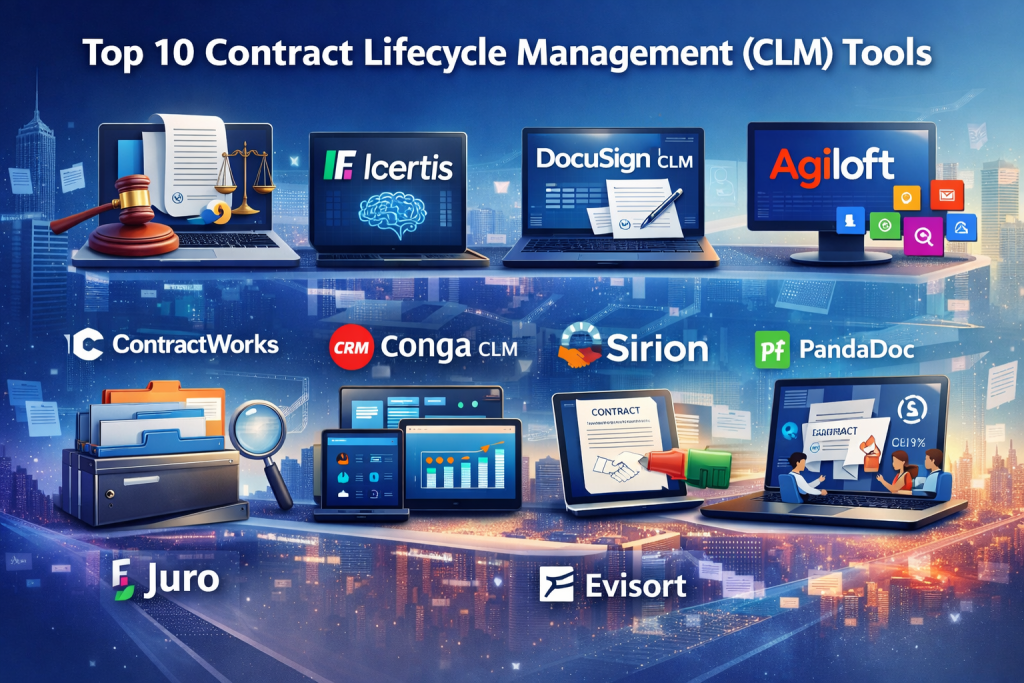
Top 10 Contract Lifecycle Management (CLM) Tools
1 — Ironclad
Short description:
Ironclad is a modern, enterprise-grade CLM platform focused on legal teams that need fast contract turnaround, strong collaboration, and robust workflow automation.
Key features:
- Contract request intake with dynamic questionnaires
- Advanced workflow automation and approvals
- Clause library with fallback logic
- Real-time collaboration and redlining
- Searchable contract repository with metadata extraction
- Analytics and reporting dashboards
Pros:
- Excellent user experience for legal and business users
- Strong collaboration between legal and sales teams
- Highly configurable workflows
Cons:
- Premium pricing may be challenging for SMBs
- Advanced setup requires time and planning
Security & compliance:
SSO, role-based access, encryption at rest and in transit, audit logs, SOC 2, GDPR compliant.
Support & community:
High-quality documentation, guided onboarding, responsive enterprise support, strong legal operations community.
2 — Icertis
Short description:
Icertis is a powerful enterprise CLM solution designed for complex, global organizations managing high contract volumes and regulatory requirements.
Key features:
- AI-driven contract intelligence
- Obligation and compliance tracking
- Clause and policy management
- Advanced analytics and reporting
- Integration with ERP, CRM, and procurement systems
- Multilingual and global contract support
Pros:
- Extremely strong compliance and governance capabilities
- Scales well for large enterprises
- Deep analytics and AI insights
Cons:
- Steep learning curve
- Implementation can be lengthy
Security & compliance:
SOC 1, SOC 2, ISO 27001, GDPR, encryption, audit trails, enterprise-grade access controls.
Support & community:
Dedicated enterprise support, implementation partners, extensive documentation.
3 — DocuSign CLM
Short description:
DocuSign CLM extends beyond e-signature to provide end-to-end contract lifecycle management for organizations already using DocuSign.
Key features:
- Contract generation from templates
- Workflow automation and approvals
- Integrated e-signature
- Clause library and version control
- Searchable contract repository
- CRM and ERP integrations
Pros:
- Seamless integration with DocuSign e-signature
- Familiar interface for existing users
- Strong ecosystem
Cons:
- Advanced CLM features may require higher tiers
- Customization can be limited compared to pure CLM vendors
Security & compliance:
SOC 2, ISO 27001, GDPR, encryption, audit logs, SSO.
Support & community:
Comprehensive documentation, enterprise support, large global user base.
4 — Agiloft
Short description:
Agiloft is a highly configurable CLM platform suitable for organizations that need custom workflows without heavy coding.
Key features:
- No-code workflow customization
- Contract authoring and approvals
- Clause library and redlining
- Obligation and milestone tracking
- Reporting and dashboards
- Integration APIs
Pros:
- Extremely flexible and customizable
- Suitable for diverse contract types
- Strong value for feature depth
Cons:
- Interface feels less modern
- Requires thoughtful configuration
Security & compliance:
Encryption, role-based access, audit logs, GDPR, SOC 2 (varies by deployment).
Support & community:
Detailed documentation, training resources, responsive support team.
5 — ContractWorks
Short description:
ContractWorks is a simple, repository-focused CLM designed for fast deployment and easy contract visibility.
Key features:
- Centralized contract repository
- OCR-based search and tagging
- User permissions and alerts
- Simple reporting
- Fast setup
Pros:
- Very easy to use
- Quick implementation
- Cost-effective for SMBs
Cons:
- Limited workflow automation
- Not ideal for complex negotiations
Security & compliance:
Encryption, SOC 2, audit logs, role-based access.
Support & community:
Friendly support, straightforward documentation, onboarding assistance.
6 — Conga CLM
Short description:
Conga CLM is popular among sales-driven organizations that need strong CRM-based contract automation.
Key features:
- Contract generation from CRM data
- Approval workflows
- Clause management
- E-signature integrations
- Reporting and analytics
Pros:
- Strong CRM alignment
- Good automation for sales contracts
- Scalable for growing businesses
Cons:
- Interface can feel complex
- Best experience requires ecosystem adoption
Security & compliance:
SOC 2, GDPR, encryption, SSO, audit logs.
Support & community:
Extensive documentation, customer success programs, partner ecosystem.
7 — Sirion
Short description:
Sirion focuses on post-signature contract management, particularly for complex supplier and service agreements.
Key features:
- Obligation and performance tracking
- AI-driven contract analytics
- Supplier governance tools
- Risk and compliance monitoring
- Reporting dashboards
Pros:
- Excellent post-execution insights
- Strong for procurement and vendor contracts
- Advanced analytics
Cons:
- Less focus on pre-signature drafting
- Best suited for large organizations
Security & compliance:
ISO 27001, SOC 2, GDPR, encryption, audit logs.
Support & community:
Enterprise-grade support, onboarding programs, industry expertise.
8 — PandaDoc (CLM)
Short description:
PandaDoc CLM is a user-friendly solution combining document automation, e-signatures, and basic contract management.
Key features:
- Contract templates and document automation
- E-signature and approvals
- Real-time collaboration
- Analytics on document activity
- Integrations with CRM tools
Pros:
- Very intuitive interface
- Fast setup
- Good value for SMBs
Cons:
- Limited advanced CLM features
- Not ideal for complex legal workflows
Security & compliance:
Encryption, GDPR, SOC 2, audit trails.
Support & community:
Strong onboarding, live chat support, growing user community.
9 — Juro
Short description:
Juro is a browser-based CLM built for modern legal and commercial teams that want simplicity and speed.
Key features:
- In-browser contract drafting
- Collaborative negotiation
- Workflow approvals
- Contract repository
- Analytics and reporting
Pros:
- Clean, modern UI
- Easy collaboration
- Reduces dependency on word processors
Cons:
- Limited customization for complex needs
- Best for mid-market teams
Security & compliance:
SOC 2, GDPR, encryption, access controls.
Support & community:
Helpful documentation, onboarding support, responsive customer success.
10 — Evisort
Short description:
Evisort is an AI-first CLM platform focused on contract analysis, data extraction, and insights.
Key features:
- AI-powered contract ingestion
- Automatic data extraction
- Search and analytics
- Obligation tracking
- Integration with enterprise systems
Pros:
- Excellent for legacy contract analysis
- Strong AI capabilities
- Minimal manual data entry
Cons:
- Less emphasis on contract drafting
- Premium pricing for advanced AI
Security & compliance:
SOC 2, GDPR, encryption, audit logs.
Support & community:
Dedicated support, onboarding specialists, enterprise training.
Comparison Table
| Tool Name | Best For | Platform(s) Supported | Standout Feature | Rating |
|---|---|---|---|---|
| Ironclad | Legal-led enterprises | Web | Workflow automation | N/A |
| Icertis | Global enterprises | Web | AI compliance intelligence | N/A |
| DocuSign CLM | Existing DocuSign users | Web | E-signature integration | N/A |
| Agiloft | Custom workflows | Web | No-code customization | N/A |
| ContractWorks | SMB visibility | Web | Fast search & setup | N/A |
| Conga CLM | Sales-driven orgs | Web | CRM-based automation | N/A |
| Sirion | Supplier contracts | Web | Post-signature analytics | N/A |
| PandaDoc CLM | SMB sales teams | Web | Ease of use | N/A |
| Juro | Modern legal teams | Web | In-browser contracts | N/A |
| Evisort | Contract analytics | Web | AI data extraction | N/A |
Evaluation & Scoring of Contract Lifecycle Management (CLM)
| Criteria | Weight | Description |
|---|---|---|
| Core features | 25% | Drafting, workflows, repository, analytics |
| Ease of use | 15% | User experience and learning curve |
| Integrations & ecosystem | 15% | CRM, ERP, API availability |
| Security & compliance | 10% | Certifications, access control |
| Performance & reliability | 10% | Stability and scalability |
| Support & community | 10% | Documentation and customer support |
| Price / value | 15% | Cost vs feature depth |
Which Contract Lifecycle Management (CLM) Tool Is Right for You?
- Solo users & SMBs: Look for simplicity, quick setup, and affordability. Lightweight CLMs with strong templates may be sufficient.
- Mid-market companies: Balance ease of use with automation depth and integrations. Configurable workflows become important.
- Enterprises: Prioritize scalability, compliance, advanced analytics, and integration with core systems.
Budget-conscious buyers should focus on essential features and ROI, while premium buyers may value AI, compliance, and customization. Always assess integration needs, future growth, and regulatory requirements before deciding.
Frequently Asked Questions (FAQs)
- What is CLM software used for?
CLM software manages contracts throughout their lifecycle, improving efficiency, compliance, and visibility. - Is CLM only for legal teams?
No. Sales, procurement, finance, and operations teams also benefit significantly. - How long does CLM implementation take?
It ranges from days for simple tools to several months for enterprise platforms. - Do CLM tools replace e-signature software?
Some include e-signature, while others integrate with existing tools. - Are CLM tools secure?
Most enterprise CLMs follow strict security and compliance standards. - Can CLM tools handle legacy contracts?
Yes, many offer AI-based ingestion and data extraction. - Are CLM tools expensive?
Pricing varies widely based on features, users, and scale. - Do CLM tools support customization?
Some offer no-code customization, others require configuration or partners. - What industries use CLM the most?
SaaS, healthcare, finance, manufacturing, and government sectors. - What is the biggest mistake when choosing CLM?
Overbuying complexity or underestimating integration and change management.
Conclusion
Contract Lifecycle Management tools have become essential for organizations that want to reduce risk, improve efficiency, and gain visibility into their contractual relationships. The best CLM solution is not defined by popularity alone but by how well it aligns with your workflows, scale, industry, and compliance needs.
Whether you prioritize ease of use, deep automation, AI insights, or enterprise-grade governance, the right CLM tool can transform contracts from administrative burdens into strategic assets. Carefully evaluate your requirements, involve key stakeholders, and choose a solution that supports both today’s needs and tomorrow’s growth.

Find Trusted Cardiac Hospitals
Compare heart hospitals by city and services — all in one place.
Explore Hospitals