
Introduction
Configure, Price, Quote (CPQ) software for manufacturing is designed to help companies accurately configure complex products, calculate pricing, and generate professional quotes—all while reducing errors and speeding up sales cycles. In manufacturing, where products often involve thousands of configurable options, custom pricing rules, engineering constraints, and compliance requirements, CPQ is no longer a luxury; it is a necessity.
CPQ for Manufacturing plays a critical role in bridging sales, engineering, and production. It ensures that what is sold can actually be built, priced profitably, and delivered on time. Without CPQ, manufacturers often struggle with long quote turnaround times, inconsistent pricing, manual spreadsheets, and costly rework caused by invalid configurations.
Common real-world use cases include:
- Complex product configuration (BOM-driven, rules-based)
- Engineer-to-Order (ETO) and Make-to-Order (MTO) workflows
- Dealer and distributor quoting
- Dynamic pricing with margins, discounts, and regional rules
- Automated proposal and quote generation
What to look for when choosing a CPQ for Manufacturing:
- Configuration depth and rule engine strength
- ERP and CRM integrations
- Pricing flexibility and margin control
- Ease of use for sales teams
- Scalability for future growth
- Security, compliance, and auditability
Best for:
CPQ for Manufacturing tools are ideal for manufacturers with configurable or custom products, including industrial equipment, machinery, electronics, automotive components, building materials, and engineered products. Sales teams, solution engineers, channel partners, and operations leaders benefit the most.
Not ideal for:
Very small manufacturers with simple, fixed-price catalogs, or companies selling standardized SKUs with minimal configuration needs, may find CPQ overkill. In such cases, basic quoting or ERP pricing modules may be sufficient.
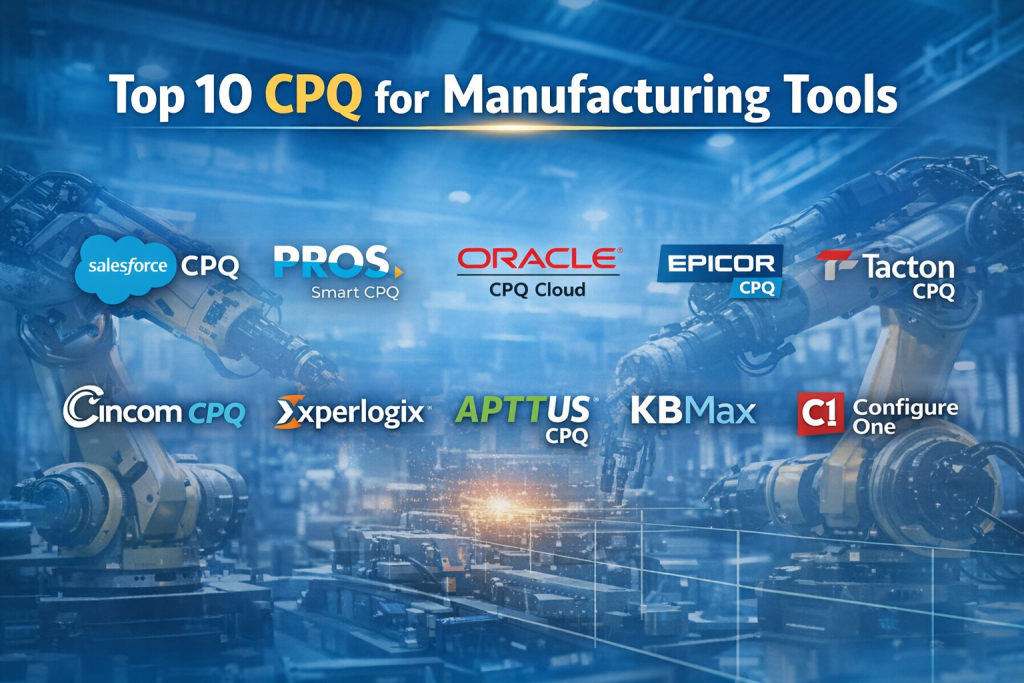
Top 10 CPQ for Manufacturing Tools
1 — Salesforce CPQ
Short description:
Salesforce CPQ is a powerful, enterprise-grade CPQ solution built for complex sales processes and deep CRM integration, widely used by large manufacturing organizations.
Key Features
- Advanced rules-based product configuration
- Automated pricing, discounting, and approvals
- Quote and proposal generation
- Native Salesforce CRM integration
- Guided selling workflows
- Multi-currency and multi-language support
Pros
- Extremely robust and scalable
- Strong ecosystem and customization options
Cons
- High implementation and licensing cost
- Requires Salesforce expertise
Security & Compliance
SSO, encryption, audit logs, SOC 2, GDPR support
Support & Community
Extensive documentation, large user community, enterprise-level support
2 — PROS Smart CPQ
Short description:
PROS Smart CPQ focuses on AI-driven pricing and optimization, making it ideal for manufacturers with complex pricing strategies.
Key Features
- AI-powered price optimization
- Dynamic discount management
- Configuration and quoting workflows
- ERP and CRM integrations
- Margin and profitability analysis
Pros
- Excellent pricing intelligence
- Strong analytics capabilities
Cons
- Less flexible UI for non-technical users
- Configuration complexity for small teams
Security & Compliance
Enterprise security, GDPR, audit logging
Support & Community
Strong enterprise onboarding and dedicated support
3 — Oracle CPQ
Short description:
Oracle CPQ is designed for large manufacturing enterprises needing structured quoting and deep ERP alignment.
Key Features
- Rules-based product configuration
- Guided selling
- Automated approvals
- Quote and contract generation
- Oracle ERP integration
Pros
- Strong enterprise reliability
- Deep ERP compatibility
Cons
- Steep learning curve
- Customization requires technical skills
Security & Compliance
SSO, encryption, SOC, GDPR, ISO-aligned controls
Support & Community
Enterprise documentation and Oracle support network
4 — Epicor CPQ
Short description:
Epicor CPQ is purpose-built for manufacturers with visual and CAD-driven configuration needs.
Key Features
- Visual product configurators
- CAD and BOM integration
- Automated pricing logic
- Quote and proposal generation
- ERP synchronization
Pros
- Excellent for engineered products
- Strong manufacturing focus
Cons
- UI can feel dated
- Limited flexibility outside manufacturing
Security & Compliance
Role-based access, encryption, audit trails
Support & Community
Good documentation and manufacturing-centric support
5 — Tacton CPQ
Short description:
Tacton CPQ excels in Engineer-to-Order (ETO) and highly complex manufacturing environments.
Key Features
- Advanced constraint-based configuration
- Engineering rule automation
- ERP and CAD integrations
- Guided selling for complex products
- Multi-level BOM support
Pros
- Extremely powerful rule engine
- Ideal for custom manufacturing
Cons
- Longer implementation time
- Higher total cost of ownership
Security & Compliance
Enterprise security standards, GDPR compliant
Support & Community
Strong onboarding and technical support
6 — Cincom CPQ
Short description:
Cincom CPQ supports manufacturers selling complex, customizable industrial products through direct and channel sales.
Key Features
- Configuration and pricing automation
- Dealer and distributor support
- Proposal and document automation
- ERP and CRM integrations
- Guided selling workflows
Pros
- Mature CPQ capabilities
- Strong channel sales support
Cons
- Interface not very modern
- Setup requires planning
Security & Compliance
Encryption, access controls, audit logs
Support & Community
Dedicated enterprise support and training
7 — Experlogix CPQ
Short description:
Experlogix CPQ integrates tightly with Microsoft Dynamics, making it ideal for Microsoft-centric manufacturers.
Key Features
- Dynamics ERP and CRM integration
- Rules-based configuration
- Pricing automation
- Visual configurators
- Quote generation
Pros
- Seamless Microsoft ecosystem fit
- User-friendly UI
Cons
- Limited outside Microsoft stack
- Fewer advanced analytics features
Security & Compliance
Microsoft security standards, GDPR support
Support & Community
Good documentation and partner support
8 — Apttus CPQ
Short description:
Apttus CPQ (now part of a broader contract lifecycle suite) supports large-scale manufacturing and enterprise sales operations.
Key Features
- Advanced configuration rules
- Contract and pricing automation
- CRM integration
- Approval workflows
- Multi-region support
Pros
- Strong enterprise functionality
- End-to-end sales lifecycle support
Cons
- Complex setup
- Premium pricing
Security & Compliance
Enterprise-grade security, SOC 2, GDPR
Support & Community
Enterprise support with onboarding programs
9 — KBMax
Short description:
KBMax focuses on 3D visual CPQ, helping manufacturers sell configurable products visually.
Key Features
- 3D and visual configurators
- Rules-based pricing
- CAD and BOM automation
- Quote generation
- CRM and ERP integrations
Pros
- Outstanding visual experience
- Reduces configuration errors
Cons
- Limited for non-visual use cases
- Requires CAD preparation
Security & Compliance
Standard SaaS security controls
Support & Community
Good onboarding and visual CPQ expertise
10 — Configure One
Short description:
Configure One is tailored for complex manufacturing quoting, especially in industrial and custom product sectors.
Key Features
- Advanced configuration rules
- Dynamic pricing logic
- Proposal automation
- ERP integration
- Dealer quoting support
Pros
- Strong manufacturing alignment
- Flexible pricing logic
Cons
- UI learning curve
- Less suitable for simple products
Security & Compliance
Encryption, role-based access, audit logs
Support & Community
Dedicated support and implementation guidance
Comparison Table
| Tool Name | Best For | Platforms Supported | Standout Feature | Rating |
|---|---|---|---|---|
| Salesforce CPQ | Large enterprises | Cloud | CRM-native CPQ | N/A |
| PROS Smart CPQ | Pricing-driven manufacturing | Cloud | AI pricing | N/A |
| Oracle CPQ | ERP-centric enterprises | Cloud | ERP depth | N/A |
| Epicor CPQ | Visual manufacturing | Cloud / On-prem | CAD integration | N/A |
| Tacton CPQ | ETO manufacturers | Cloud | Constraint engine | N/A |
| Cincom CPQ | Industrial sales | Cloud | Channel support | N/A |
| Experlogix CPQ | Microsoft users | Cloud | Dynamics integration | N/A |
| Apttus CPQ | Global enterprises | Cloud | Contract lifecycle | N/A |
| KBMax | Visual sales | Cloud | 3D configurator | N/A |
| Configure One | Custom manufacturing | Cloud | Pricing flexibility | N/A |
Evaluation & Scoring of CPQ for Manufacturing
| Criteria | Weight | Score Considerations |
|---|---|---|
| Core features | 25% | Configuration depth, pricing logic |
| Ease of use | 15% | Sales adoption, UI clarity |
| Integrations & ecosystem | 15% | ERP, CRM, CAD |
| Security & compliance | 10% | Enterprise readiness |
| Performance & reliability | 10% | Scalability |
| Support & community | 10% | Documentation, support |
| Price / value | 15% | ROI vs cost |
Which CPQ for Manufacturing Tool Is Right for You?
- Solo users / SMBs: Look for simpler CPQ with faster deployment
- Mid-market: Balance configuration power with usability
- Enterprise: Prioritize scalability, integrations, and security
- Budget-conscious: Avoid over-customized enterprise platforms
- Feature-heavy needs: Choose rule-engine-focused CPQ
- High compliance needs: Ensure audit logs and access controls
Frequently Asked Questions (FAQs)
1. What is CPQ in manufacturing?
It automates product configuration, pricing, and quote generation for complex manufacturing products.
2. Is CPQ only for large manufacturers?
No, mid-sized manufacturers also benefit, especially with configurable products.
3. How long does CPQ implementation take?
Anywhere from a few weeks to several months, depending on complexity.
4. Does CPQ replace ERP?
No, CPQ complements ERP by handling pre-sales configuration and pricing.
5. Can CPQ handle custom pricing rules?
Yes, advanced CPQ tools excel at this.
6. Is CPQ difficult for sales teams to use?
Modern CPQ tools focus on guided selling to simplify usage.
7. What integrations are critical?
ERP, CRM, CAD, and finance systems.
8. How secure are CPQ platforms?
Enterprise CPQ tools offer strong security and compliance controls.
9. Can dealers use CPQ?
Yes, many CPQ tools support channel and distributor quoting.
10. What is the biggest CPQ mistake?
Over-engineering CPQ without aligning business processes.
Conclusion
CPQ for Manufacturing has become a strategic enabler for companies selling complex and configurable products. The right CPQ solution reduces errors, accelerates sales cycles, improves margins, and aligns sales with engineering and production realities.
There is no single “best” CPQ for Manufacturing. The ideal choice depends on product complexity, company size, integration needs, budget, and growth plans. By focusing on real requirements rather than feature overload, manufacturers can select a CPQ platform that delivers long-term value and measurable business impact.

Find Trusted Cardiac Hospitals
Compare heart hospitals by city and services — all in one place.
Explore Hospitals
This guide feels useful because it connects the Certified DevOps Architect path with the kind of decisions people face in real projects—designing CI/CD that scales, choosing the right cloud setup, setting up observability, and building security into the delivery process. I also like that it highlights architecture thinking, not only tools, because in production you must balance speed, cost, reliability, and team workflow. The real value is in the step-by-step project angle: planning the pipeline, infrastructure as code, deployment strategy, monitoring, and rollback planning, all working together as one system. A good next step for learners is to build a small reference project and document every choice, because that practice is what makes you confident in interviews and on the job.