
Introduction
Deep Learning Frameworks are specialized software libraries and platforms designed to build, train, test, and deploy deep neural networks efficiently. They provide developers, data scientists, and researchers with ready-made building blocks—such as tensors, automatic differentiation, GPU acceleration, and prebuilt neural network layers—so they can focus on solving real problems instead of low-level mathematical implementation.
In today’s data-driven world, deep learning powers image recognition, natural language processing, recommendation engines, autonomous vehicles, fraud detection, medical diagnostics, and voice assistants. Without robust frameworks, developing and scaling these systems would be slow, error-prone, and expensive.
When choosing a deep learning framework, users should evaluate:
- Ease of use and learning curve
- Performance and hardware acceleration
- Community support and ecosystem
- Production readiness and scalability
- Security and compliance requirements
- Integration with existing tools and workflows
Best for:
Deep learning frameworks are ideal for AI researchers, data scientists, machine learning engineers, startups building AI products, mid-size companies scaling intelligent systems, and enterprises deploying AI at scale. Industries such as healthcare, finance, e-commerce, automotive, manufacturing, and media benefit the most.
Not ideal for:
They may not be necessary for simple rule-based systems, basic analytics tasks, or teams without access to sufficient data or compute resources. In such cases, traditional machine learning libraries or low-code AI tools may be more appropriate.
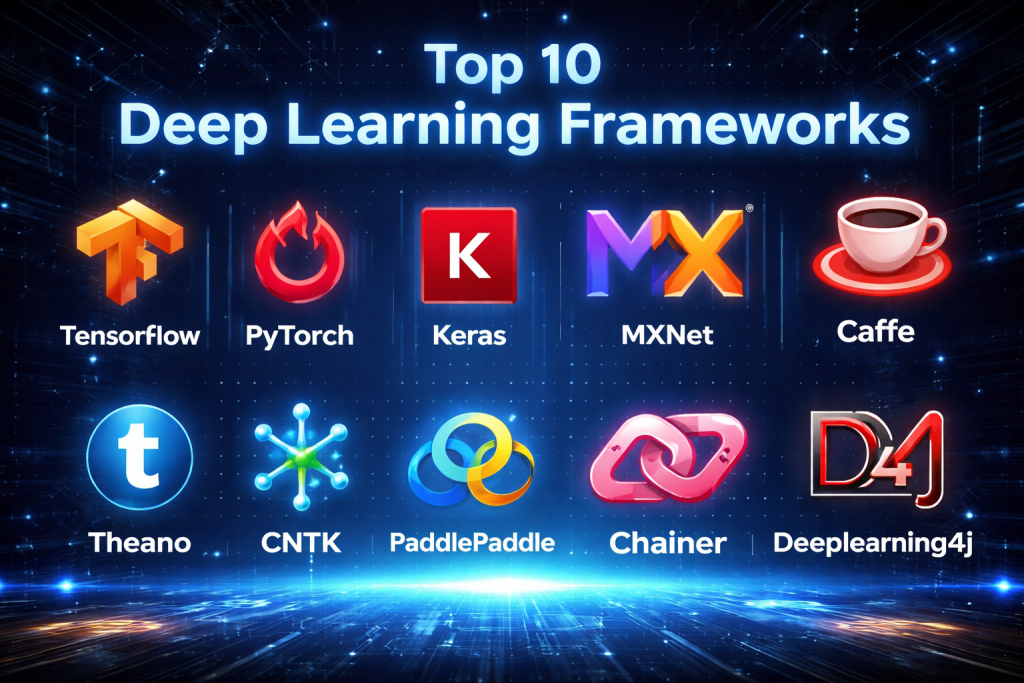
Top 10 Deep Learning Frameworks Tools
1 — TensorFlow
Short description:
TensorFlow is a widely adopted open-source deep learning framework designed for large-scale machine learning and production-grade AI systems.
Key features:
- Flexible computation graphs (eager and graph execution)
- Strong support for GPUs and TPUs
- Extensive ecosystem for training and deployment
- Model optimization and serving tools
- Cross-platform compatibility
- Visualization and debugging utilities
Pros:
- Highly scalable for enterprise workloads
- Strong industry adoption and tooling
Cons:
- Steeper learning curve for beginners
- Verbose syntax in complex models
Security & compliance:
Supports encryption, role-based access, and enterprise security controls; compliance varies by deployment.
Support & community:
Extensive documentation, tutorials, large global community, and enterprise-grade support options.
2 — PyTorch
Short description:
PyTorch is a dynamic deep learning framework known for its flexibility, simplicity, and strong research adoption.
Key features:
- Dynamic computation graphs
- Python-first design
- GPU acceleration
- Rich neural network modules
- Seamless debugging experience
- Growing production deployment tools
Pros:
- Easy to learn and experiment with
- Preferred by researchers and academics
Cons:
- Historically weaker production tooling
- Requires careful optimization for large deployments
Security & compliance:
Varies by deployment; core framework is open-source.
Support & community:
Excellent documentation, active research community, and expanding enterprise ecosystem.
3 — Keras
Short description:
Keras is a high-level neural network API designed for fast experimentation and ease of use.
Key features:
- Simple and intuitive API
- Modular and extensible design
- Supports multiple backends
- Rapid prototyping
- Built-in training loops
- Strong visualization support
Pros:
- Beginner-friendly
- Faster model development
Cons:
- Less control for advanced customization
- Depends on underlying backend performance
Security & compliance:
Varies / N/A depending on backend and deployment.
Support & community:
Strong documentation and active user base.
4 — MXNet
Short description:
MXNet is a scalable deep learning framework optimized for efficiency and distributed training.
Key features:
- Supports multiple programming languages
- Efficient memory usage
- Distributed and parallel training
- Hybrid programming model
- Cloud-ready architecture
Pros:
- High performance at scale
- Flexible language support
Cons:
- Smaller community
- Less beginner-friendly documentation
Security & compliance:
Enterprise-grade options depend on platform deployment.
Support & community:
Moderate community; enterprise support varies.
5 — Caffe
Short description:
Caffe is a deep learning framework focused on speed and modularity, especially in computer vision.
Key features:
- Fast model execution
- Predefined architecture approach
- Optimized for image processing
- Command-line interface
- Lightweight deployment
Pros:
- High performance for vision tasks
- Efficient inference
Cons:
- Limited flexibility
- Smaller ecosystem
Security & compliance:
Varies / N/A.
Support & community:
Declining community support compared to newer frameworks.
6 — Theano
Short description:
Theano is one of the earliest deep learning frameworks, focused on mathematical expression optimization.
Key features:
- Symbolic computation
- GPU acceleration
- Automatic differentiation
- Mathematical rigor
- Research-oriented design
Pros:
- Strong theoretical foundation
- Efficient numerical computation
Cons:
- No longer actively developed
- Not production-ready
Security & compliance:
N/A.
Support & community:
Minimal; mostly legacy usage.
7 — CNTK (Microsoft Cognitive Toolkit)
Short description:
CNTK is a deep learning framework designed for performance and scalability.
Key features:
- Distributed training support
- Efficient neural network execution
- Multi-language support
- Optimized for speech and vision
- Scalable architecture
Pros:
- High performance
- Enterprise-oriented design
Cons:
- Steep learning curve
- Reduced community momentum
Security & compliance:
Enterprise-grade security depends on deployment environment.
Support & community:
Limited compared to top frameworks.
8 — PaddlePaddle
Short description:
PaddlePaddle is an industrial-grade deep learning framework optimized for large-scale production.
Key features:
- Strong NLP and CV support
- Distributed training
- Production-ready deployment
- Multi-hardware compatibility
- High performance optimization
Pros:
- Optimized for real-world applications
- Strong industrial focus
Cons:
- Smaller global community
- Documentation less accessible for beginners
Security & compliance:
Enterprise deployment supports compliance requirements.
Support & community:
Growing community and enterprise backing.
9 — Chainer
Short description:
Chainer introduced dynamic computation graphs, influencing modern frameworks.
Key features:
- Define-by-run approach
- Python-friendly
- GPU acceleration
- Research-focused design
- Flexible model building
Pros:
- Intuitive for experimentation
- Clear model structure
Cons:
- Development discontinued
- Limited production support
Security & compliance:
N/A.
Support & community:
Legacy community only.
10 — DeepLearning4J
Short description:
DeepLearning4J is a JVM-based deep learning framework designed for enterprise Java environments.
Key features:
- Java and Scala support
- Distributed training
- Integration with big data tools
- GPU acceleration
- Production-grade deployment
Pros:
- Ideal for Java-centric enterprises
- Strong scalability
Cons:
- Smaller ecosystem
- Less flexible than Python frameworks
Security & compliance:
Enterprise security and compliance supported via JVM ecosystem.
Support & community:
Commercial support available; moderate community.
Comparison Table
| Tool Name | Best For | Platform(s) Supported | Standout Feature | Rating |
|---|---|---|---|---|
| TensorFlow | Enterprise AI systems | Windows, Linux, macOS | Production-ready scalability | N/A |
| PyTorch | Research & rapid prototyping | Windows, Linux, macOS | Dynamic computation graphs | N/A |
| Keras | Beginners & fast prototyping | Cross-platform | Simplicity and speed | N/A |
| MXNet | Distributed training | Multi-platform | Efficiency at scale | N/A |
| Caffe | Computer vision | Linux, macOS | Fast inference | N/A |
| Theano | Academic research | Cross-platform | Symbolic computation | N/A |
| CNTK | Enterprise workloads | Windows, Linux | Performance optimization | N/A |
| PaddlePaddle | Industrial AI | Cross-platform | Production focus | N/A |
| Chainer | Experimental research | Cross-platform | Define-by-run design | N/A |
| DeepLearning4J | Java enterprises | JVM platforms | Java ecosystem integration | N/A |
Evaluation & Scoring of Deep Learning Frameworks
| Criteria | Weight | TensorFlow | PyTorch | Keras | MXNet | DL4J |
|---|---|---|---|---|---|---|
| Core features | 25% | High | High | Medium | High | Medium |
| Ease of use | 15% | Medium | High | High | Medium | Low |
| Integrations & ecosystem | 15% | High | High | Medium | Medium | Medium |
| Security & compliance | 10% | High | Medium | Medium | Medium | High |
| Performance & reliability | 10% | High | High | Medium | High | High |
| Support & community | 10% | High | High | Medium | Medium | Medium |
| Price / value | 15% | High | High | High | Medium | Medium |
Which Deep Learning Frameworks Tool Is Right for You?
- Solo users & learners: Keras or PyTorch for simplicity and fast iteration
- SMBs & startups: PyTorch or TensorFlow for flexibility and growth
- Mid-market companies: TensorFlow or MXNet for scalability
- Enterprises: TensorFlow or DeepLearning4J for compliance and large-scale deployment
Budget-conscious teams benefit from open-source frameworks, while premium enterprise solutions offer managed services and support. Balance feature depth with ease of use, and prioritize integration, scalability, and security based on your industry.
Frequently Asked Questions (FAQs)
1. What is a deep learning framework?
A software library that simplifies building, training, and deploying neural networks.
2. Which framework is best for beginners?
Keras and PyTorch are generally easiest to start with.
3. Are deep learning frameworks free?
Most are open-source; infrastructure and enterprise support may cost extra.
4. Can I deploy models to production with these tools?
Yes, especially with TensorFlow, PyTorch, and enterprise-focused frameworks.
5. Do I need GPUs to use them?
GPUs are recommended for performance but not mandatory.
6. Which framework is best for research?
PyTorch is widely favored in academic research.
7. Are these tools secure?
Security depends on deployment and configuration.
8. Can they scale for big data?
Yes, many support distributed and parallel training.
9. What are common mistakes?
Choosing overly complex tools or ignoring scalability needs.
10. Are there alternatives to deep learning frameworks?
Yes, traditional ML libraries or low-code AI platforms for simpler tasks.
Conclusion
Deep learning frameworks are the backbone of modern artificial intelligence, enabling everything from intelligent automation to advanced scientific research. While tools like TensorFlow and PyTorch dominate today’s landscape, each framework offers unique strengths tailored to different users and scenarios.
The best deep learning framework is not universal—it depends on your goals, team expertise, budget, scalability needs, and compliance requirements. By evaluating features, ease of use, ecosystem strength, and long-term maintainability, you can select a framework that delivers real value and future-proofs your AI initiatives.

Find Trusted Cardiac Hospitals
Compare heart hospitals by city and services — all in one place.
Explore Hospitals