
Introduction
Edge Device Management Tools are platforms designed to deploy, monitor, secure, update, and control devices operating at the edge of a network. These devices can include IoT sensors, gateways, industrial controllers, retail kiosks, medical devices, vehicles, and smart infrastructure systems that process data close to where it is generated rather than sending everything to centralized cloud environments.
As organizations adopt edge computing to reduce latency, improve reliability, and enable real-time decision-making, managing thousands—or even millions—of distributed devices becomes a major operational challenge. Edge Device Management Tools solve this by providing centralized visibility, remote configuration, secure updates, monitoring, and lifecycle management across diverse hardware and operating systems.
Why this matters:
Without proper edge management, organizations face risks such as security vulnerabilities, inconsistent configurations, downtime, and skyrocketing operational costs. Effective edge device management ensures security, scalability, performance, and compliance while supporting business-critical workloads at the edge.
Key real-world use cases include:
- Manufacturing plants managing industrial IoT and robotics
- Retail chains running digital signage and POS devices
- Healthcare providers monitoring connected medical equipment
- Smart cities managing traffic, utilities, and surveillance systems
- Energy and utilities managing remote field devices
- Logistics companies tracking fleets and edge gateways
What to look for when choosing an Edge Device Management Tool:
- Device provisioning and lifecycle management
- Remote monitoring, diagnostics, and updates
- Security controls (identity, encryption, access management)
- Scalability for large distributed environments
- Integration with cloud, analytics, and DevOps tools
- Reliability in low-connectivity environments
- Transparent pricing and enterprise support
Best for:
Edge Device Management Tools are ideal for IoT architects, platform engineers, DevOps teams, IT operations, product companies, and enterprises operating distributed device fleets. Industries such as manufacturing, retail, healthcare, transportation, energy, telecom, and smart infrastructure benefit the most.
Not ideal for:
They may be unnecessary for small teams with only a few devices, proof-of-concept projects, or environments where devices are static, centrally located, and rarely updated. In such cases, lightweight device control or basic MDM solutions may be sufficient.
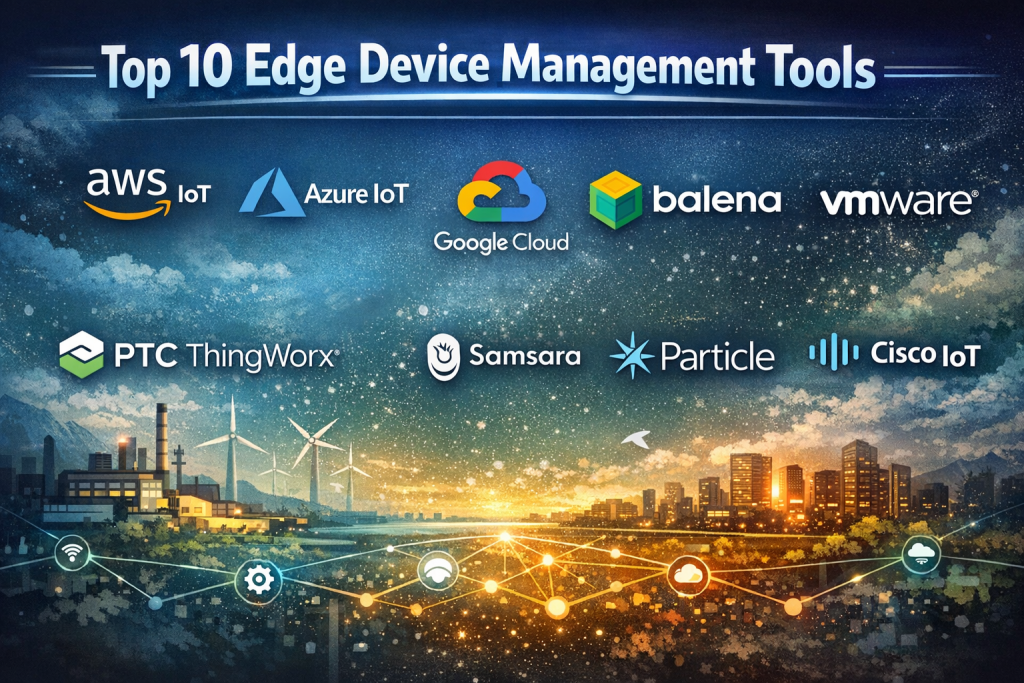
Top 10 Edge Device Management Tools
1 — AWS IoT Device Management
Short description:
A fully managed service for onboarding, organizing, monitoring, and remotely managing IoT and edge devices at massive scale, tightly integrated with the AWS ecosystem.
Key features:
- Secure device provisioning and registry
- Fleet indexing and device grouping
- Remote monitoring and diagnostics
- Over-the-air (OTA) firmware updates
- Policy-based access control
- Integration with edge analytics and AI services
- Scales to millions of devices
Pros:
- Extremely scalable and reliable
- Deep integration with cloud services and analytics
- Strong security and identity management
Cons:
- Complexity for beginners
- Costs can grow with scale and usage
- Strong dependency on a single cloud ecosystem
Security & compliance:
Supports encryption, IAM, audit logs, SOC 2, ISO standards, GDPR compliance (varies by region).
Support & community:
Extensive documentation, enterprise-grade support, large global user community.
2 — Azure IoT Hub
Short description:
A cloud-hosted service providing secure communication, monitoring, and lifecycle management for IoT and edge devices within the Microsoft ecosystem.
Key features:
- Bi-directional device communication
- Device twins for state management
- OTA firmware and configuration updates
- Edge runtime support
- Strong integration with enterprise IT tools
- Built-in monitoring and diagnostics
Pros:
- Enterprise-friendly and well-integrated
- Strong hybrid and edge capabilities
- Familiar tooling for Microsoft-centric teams
Cons:
- Learning curve for non-Microsoft users
- Pricing can be complex
- Less flexible outside Azure stack
Security & compliance:
Supports encryption, RBAC, audit logs, ISO, SOC 2, GDPR.
Support & community:
Strong enterprise support, large documentation library, active partner ecosystem.
3 — Google Cloud IoT Core
Short description:
A managed service focused on securely connecting, managing, and ingesting data from globally distributed edge devices.
Key features:
- Secure device authentication
- Device registry and metadata
- Real-time telemetry ingestion
- Integration with data analytics tools
- Lightweight device management
- Scalable messaging infrastructure
Pros:
- Excellent data analytics integration
- Global scalability
- Clean and modern architecture
Cons:
- Limited advanced device lifecycle features
- Less mature ecosystem
- Requires custom tooling for full management
Security & compliance:
Encryption, IAM-based access, GDPR support; compliance varies by configuration.
Support & community:
Good documentation, moderate community presence, enterprise support available.
4 — Balena
Short description:
A developer-friendly edge device management platform designed for deploying and managing containerized applications on distributed devices.
Key features:
- Container-based application deployment
- OTA updates with rollback support
- Device fleet monitoring
- Remote access and diagnostics
- Supports diverse hardware
- Git-based workflows
Pros:
- Very developer-friendly
- Strong for containerized edge apps
- Simple onboarding and updates
Cons:
- Less suitable for non-container use cases
- Limited enterprise governance features
- Smaller ecosystem than hyperscalers
Security & compliance:
Supports encryption, device authentication; compliance certifications vary.
Support & community:
Good documentation, active open-source community, paid enterprise support.
5 — VMware Edge Compute Stack
Short description:
An enterprise-grade edge platform focused on virtualization, orchestration, and lifecycle management of edge infrastructure.
Key features:
- Centralized edge infrastructure management
- Virtualization and container support
- Policy-based configuration
- High availability and resilience
- Integration with data center tools
- Secure remote operations
Pros:
- Enterprise reliability and governance
- Strong infrastructure abstraction
- Ideal for complex edge environments
Cons:
- High cost
- Requires skilled administrators
- Overkill for small deployments
Security & compliance:
Enterprise-grade security, ISO, SOC, audit logging support.
Support & community:
Strong enterprise support, professional services, mature ecosystem.
6 — PTC ThingWorx
Short description:
An industrial IoT platform emphasizing device connectivity, digital twins, and analytics for manufacturing and industrial environments.
Key features:
- Device connectivity and modeling
- Industrial protocol support
- Edge analytics and visualization
- Digital twin capabilities
- Lifecycle and asset management
- Integration with PLM systems
Pros:
- Strong industrial focus
- Rich analytics and modeling
- Proven in manufacturing use cases
Cons:
- Steep learning curve
- Higher licensing costs
- Less flexible for non-industrial use
Security & compliance:
Supports role-based access, encryption, industrial compliance standards.
Support & community:
Enterprise support, industry-focused partners, solid documentation.
7 — Samsara
Short description:
A connected operations platform focused on fleet, asset, and equipment management with embedded edge device control.
Key features:
- Real-time device and asset tracking
- Remote diagnostics
- Edge data analytics
- OTA updates
- Compliance reporting
- Centralized dashboards
Pros:
- Strong real-world operational focus
- Easy-to-use interface
- Excellent visibility for fleets
Cons:
- Limited customization
- Industry-specific focus
- Premium pricing
Security & compliance:
Encryption, compliance reporting, SOC 2 support.
Support & community:
Strong customer support, onboarding services, moderate community.
8 — Particle
Short description:
An end-to-end IoT platform combining hardware, connectivity, and device management for rapid deployment.
Key features:
- Device provisioning and management
- Secure connectivity
- OTA firmware updates
- Device health monitoring
- Integrated hardware ecosystem
- Developer APIs
Pros:
- Fast time to market
- Simplified IoT stack
- Strong developer experience
Cons:
- Vendor lock-in risk
- Less flexible for large custom deployments
- Costs increase with scale
Security & compliance:
Secure authentication, encrypted communication; compliance varies.
Support & community:
Good documentation, developer-focused community, paid support plans.
9 — Cisco IoT Control Center
Short description:
A centralized platform for managing IoT connectivity, visibility, and lifecycle across large-scale deployments.
Key features:
- Device and connectivity management
- Network-level visibility
- Policy-based controls
- Multi-network support
- Analytics and reporting
- Enterprise integrations
Pros:
- Strong networking expertise
- Reliable and secure
- Ideal for telecom-heavy environments
Cons:
- Less application-level control
- Complex setup
- Enterprise pricing
Security & compliance:
Enterprise security standards, audit logs, regulatory compliance support.
Support & community:
Global enterprise support, extensive documentation.
10 — Kaa IoT
Short description:
An open-source-first IoT and edge management platform offering flexibility and customization for diverse use cases.
Key features:
- Device lifecycle management
- Customizable data pipelines
- OTA updates
- Multi-tenant architecture
- Integration-ready APIs
- Open-source extensibility
Pros:
- Highly customizable
- No forced vendor lock-in
- Cost-effective for large fleets
Cons:
- Requires engineering effort
- Smaller ecosystem
- Support quality depends on plan
Security & compliance:
Supports encryption and access control; compliance depends on deployment.
Support & community:
Active open-source community, commercial support available.
Comparison Table
| Tool Name | Best For | Platform(s) Supported | Standout Feature | Rating |
|---|---|---|---|---|
| AWS IoT Device Management | Massive-scale IoT deployments | Cloud, Edge | Extreme scalability | N/A |
| Azure IoT Hub | Enterprise IoT | Cloud, Edge | Device twins | N/A |
| Google Cloud IoT Core | Data-driven IoT | Cloud | Analytics integration | N/A |
| Balena | Containerized edge apps | Edge devices | OTA app deployment | N/A |
| VMware Edge Compute Stack | Enterprise edge infrastructure | Edge, Data Center | Virtualization | N/A |
| PTC ThingWorx | Industrial IoT | Edge, Cloud | Digital twins | N/A |
| Samsara | Fleet operations | Edge devices | Real-time tracking | N/A |
| Particle | Rapid IoT products | Hardware, Cloud | End-to-end stack | N/A |
| Cisco IoT Control Center | Network-centric IoT | Cloud, Network | Connectivity control | N/A |
| Kaa IoT | Custom IoT solutions | Edge, Cloud | Open-source flexibility | N/A |
Evaluation & Scoring of Edge Device Management Tools
| Criteria | Weight | Explanation |
|---|---|---|
| Core features | 25% | Device lifecycle, updates, monitoring |
| Ease of use | 15% | Onboarding, UI, learning curve |
| Integrations & ecosystem | 15% | Cloud, analytics, DevOps tools |
| Security & compliance | 10% | Identity, encryption, audits |
| Performance & reliability | 10% | Uptime, scale, resilience |
| Support & community | 10% | Documentation, responsiveness |
| Price / value | 15% | Cost efficiency at scale |
Which Edge Device Management Tool Is Right for You?
- Solo users & small teams: Developer-friendly platforms like Balena or Particle provide simplicity and fast deployment.
- SMBs: Managed cloud platforms with predictable pricing and good support work best.
- Mid-market companies: Look for balance—scalability, integrations, and manageable complexity.
- Enterprises: Hyperscaler platforms or VMware-based solutions offer governance, security, and scale.
Budget-conscious teams should consider open-source or usage-based platforms, while premium solutions suit mission-critical operations.
If you value feature depth, enterprise platforms excel. If ease of use matters more, developer-centric tools are better.
Integration and scalability needs grow quickly—choose tools that won’t limit future expansion.
Security and compliance are non-negotiable in regulated industries; prioritize platforms with proven certifications and audit capabilities.
Frequently Asked Questions (FAQs)
- What is edge device management?
It refers to managing, monitoring, securing, and updating devices that operate at the edge of networks. - How is it different from traditional device management?
Edge devices are distributed, often offline, and require autonomous management capabilities. - Are these tools only for IoT?
Mostly yes, but they also manage gateways, industrial systems, and smart infrastructure. - Do I need cloud connectivity?
Most tools benefit from cloud integration, but some support offline-first operations. - Is security built in?
Leading platforms include encryption, identity management, and audit logging. - Can these tools scale to millions of devices?
Yes, hyperscaler platforms are designed for massive scale. - Are open-source tools reliable?
They can be, but require skilled teams for setup and maintenance. - What is OTA update support?
It allows remote firmware or software updates without physical access. - How long does implementation take?
From days for simple setups to months for large enterprise deployments. - What is the biggest mistake buyers make?
Choosing tools that don’t scale or integrate well with existing systems.
Conclusion
Edge Device Management Tools are essential for organizations embracing edge computing and distributed architectures. The right platform ensures security, scalability, operational efficiency, and long-term sustainability of edge deployments.
Rather than searching for a single “best” solution, focus on your specific use case, scale, industry requirements, and team capabilities. A tool that excels for industrial manufacturing may not suit a consumer IoT startup—and vice versa.
By carefully evaluating features, usability, integrations, security, and cost, you can select an Edge Device Management Tool that not only meets today’s needs but also supports future growth and innovation.

Find Trusted Cardiac Hospitals
Compare heart hospitals by city and services — all in one place.
Explore Hospitals
