
Introduction
An Electronic Lab Notebook (ELN) is a digital platform designed to replace traditional paper lab notebooks. It allows researchers, scientists, and engineers to record, manage, search, and share experimental data in a structured, secure, and compliant way. ELNs are now a foundational component of modern laboratories, supporting everything from early-stage academic research to highly regulated pharmaceutical and biotech development.
The importance of ELNs has grown rapidly due to data integrity requirements, reproducibility challenges, collaboration across distributed teams, and regulatory compliance needs. Unlike paper notebooks, ELNs provide version control, timestamps, audit trails, and advanced search—making experiments easier to reproduce and validate.
Real-world use cases include:
- Life sciences research (biology, chemistry, genomics)
- Pharmaceutical R&D and clinical development
- Academic and government research labs
- Materials science, energy, and chemical engineering
- Contract research organizations (CROs)
When choosing an ELN, users should evaluate:
- Usability and learning curve
- Support for scientific workflows
- Collaboration and data sharing
- Integration with instruments and other systems
- Security, compliance, and audit readiness
- Scalability and long-term data management
Best for:
Electronic Lab Notebook (ELN) tools are best suited for scientists, researchers, lab managers, QA teams, and regulated industries that require structured documentation, traceability, and collaboration. They are valuable for startups, universities, SMB labs, and global enterprises alike.
Not ideal for:
ELNs may be excessive for very small labs with minimal documentation needs, short-term student projects, or teams that only require basic note-taking without compliance, collaboration, or long-term data retention requirements.
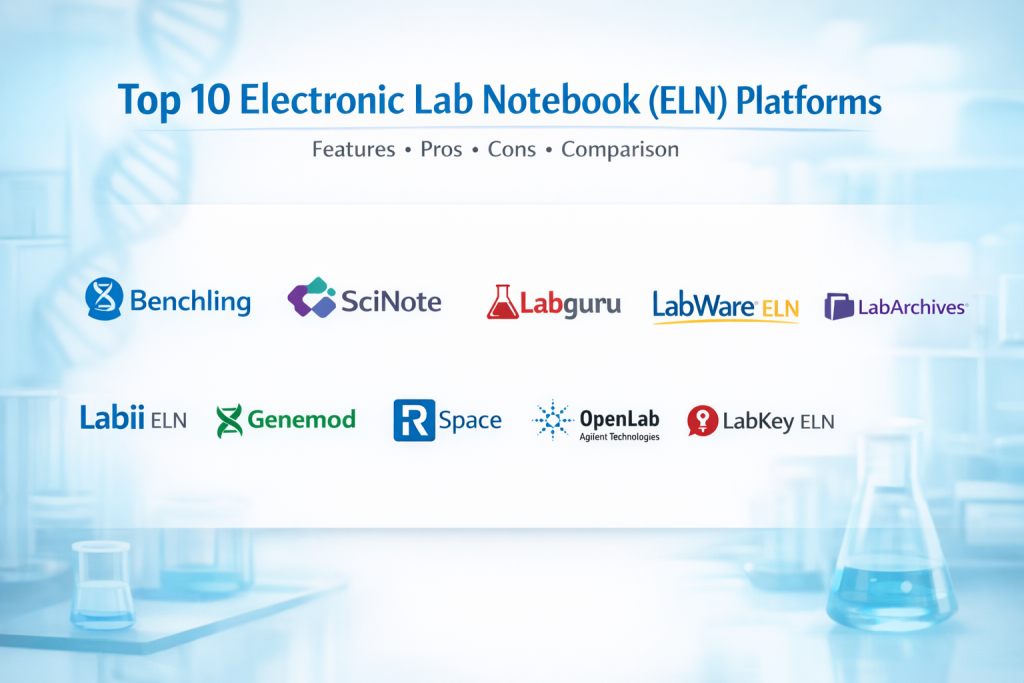
Top 10 Electronic Lab Notebook (ELN) Tools
1 — Benchling
Short description:
A modern, cloud-based ELN built specifically for life sciences teams, combining experimental documentation with molecular biology workflows.
Key features:
- Intuitive, scientist-friendly interface
- DNA, RNA, and protein sequence management
- Real-time collaboration and commenting
- Structured experiment templates
- Powerful search and version control
- Inventory and sample tracking (optional modules)
Pros:
- Very easy for biologists to adopt
- Strong collaboration and usability
Cons:
- Less flexible for non-life-science use cases
- Advanced features can be costly
Security & compliance:
SSO, role-based access, encryption, audit logs, GDPR; compliance depth varies by plan.
Support & community:
Strong documentation, onboarding resources, responsive enterprise support, active user community.
2 — LabArchives
Short description:
A widely used ELN in academia and industry, known for flexibility and long-term data archiving.
Key features:
- Cloud and on-premise deployment options
- Customizable notebook structures
- Data versioning and timestamps
- Collaboration with permissions
- File attachment and rich text editing
- Long-term data preservation
Pros:
- Suitable for many scientific disciplines
- Strong academic adoption
Cons:
- Interface feels dated to some users
- Limited built-in scientific intelligence
Security & compliance:
Encryption, access controls, audit trails, GDPR; HIPAA support available in enterprise plans.
Support & community:
Extensive documentation, training materials, solid institutional support.
3 — Labguru
Short description:
An all-in-one ELN and lab management platform combining documentation, inventory, and workflows.
Key features:
- Experiment documentation and templates
- Inventory and reagent management
- Protocol management
- Workflow automation
- Reporting and dashboards
- API and integrations
Pros:
- Combines ELN and LIMS-like features
- Good for growing labs
Cons:
- Interface can feel complex
- Performance may vary with large datasets
Security & compliance:
SSO, encryption, audit trails, GDPR; compliance scope depends on deployment.
Support & community:
Good onboarding, customer success teams, structured enterprise support.
4 — SciNote
Short description:
A flexible ELN designed for transparency, reproducibility, and compliance across research environments.
Key features:
- Hierarchical project organization
- Team collaboration and sharing
- Task and protocol management
- Customizable workflows
- API access
- Integration with repositories
Pros:
- Strong focus on reproducibility
- Clear project organization
Cons:
- Limited advanced analytics
- UI may feel basic for power users
Security & compliance:
Audit logs, access controls, GDPR; ISO support varies by edition.
Support & community:
Good documentation, responsive support, growing research community.
5 — eLabJournal
Short description:
A mature ELN focused on compliance, traceability, and regulated laboratory environments.
Key features:
- Structured experiment documentation
- Digital signatures and approvals
- Sample and inventory tracking
- Audit trails and versioning
- Integration with instruments
- Reporting tools
Pros:
- Strong compliance orientation
- Well-suited for regulated labs
Cons:
- Less intuitive UI
- Slower onboarding for new users
Security & compliance:
GxP, GDPR, audit trails, encryption, electronic signatures.
Support & community:
Professional enterprise support, detailed documentation, training services.
6 — PerkinElmer Signals Notebook
Short description:
An enterprise-grade ELN designed for large R&D organizations with complex workflows.
Key features:
- Advanced data modeling
- Chemical and biological data support
- Integration with enterprise systems
- Workflow automation
- Analytics and visualization
- Scalable architecture
Pros:
- Powerful and highly configurable
- Ideal for large enterprises
Cons:
- Steep learning curve
- High cost
Security & compliance:
Enterprise SSO, encryption, audit logs, GDPR, regulated-industry support.
Support & community:
Dedicated enterprise support, professional services, strong vendor backing.
7 — Dotmatics ELN
Short description:
A configurable ELN platform optimized for scientific data capture and analysis.
Key features:
- Customizable experiment templates
- Chemical structure support
- Data visualization
- Integration with analytics tools
- Scalable architecture
- API access
Pros:
- Highly flexible for scientific workflows
- Strong analytics integration
Cons:
- Requires configuration effort
- UI less intuitive for beginners
Security & compliance:
Role-based access, audit trails, encryption; compliance varies by deployment.
Support & community:
Enterprise-focused support, documentation, professional services.
8 — RSpace
Short description:
An ELN focused on collaboration, data integrity, and research lifecycle management.
Key features:
- Rich text and data capture
- Collaboration and sharing
- Version control
- Integration with repositories
- Data linking
- Publishing support
Pros:
- Excellent collaboration tools
- Good for academic research
Cons:
- Limited inventory management
- Less suited for regulated industry
Security & compliance:
Access controls, audit trails, GDPR; compliance depth varies.
Support & community:
Strong academic support, training resources, active user base.
9 — LabKey Server
Short description:
An open-source platform combining ELN functionality with data integration and analysis.
Key features:
- Open-source flexibility
- Data integration pipelines
- Custom workflows
- Reporting and dashboards
- API and extensibility
- On-premise deployment
Pros:
- Highly customizable
- Strong data integration
Cons:
- Requires technical expertise
- Less polished UI
Security & compliance:
Depends on deployment; access controls and audit capabilities available.
Support & community:
Active developer community, documentation, optional commercial support.
10— Open Science Framework (OSF)
Short description:
A research management platform emphasizing transparency and open science principles.
Key features:
- Project and data management
- Collaboration and sharing
- Version control
- Integration with repositories
- Pre-registration support
- Long-term archiving
Pros:
- Strong open science focus
- Free core features
Cons:
- Not a traditional ELN replacement
- Limited lab-specific workflows
Security & compliance:
Access controls, GDPR; not designed for regulated environments.
Support & community:
Large academic community, extensive documentation, community support.
Comparison Table
| Tool Name | Best For | Platform(s) Supported | Standout Feature | Rating |
|---|---|---|---|---|
| Benchling | Life sciences teams | Web | Molecular biology workflows | N/A |
| LabArchives | Academia & mixed labs | Web, On-prem | Long-term archiving | N/A |
| Labguru | Growing labs | Web | ELN + inventory | N/A |
| SciNote | Reproducible research | Web | Project organization | N/A |
| eLabJournal | Regulated labs | Web, On-prem | Compliance & traceability | N/A |
| Signals Notebook | Large enterprises | Web | Advanced workflows | N/A |
| Dotmatics ELN | Data-driven R&D | Web | Analytics integration | N/A |
| RSpace | Academic collaboration | Web | Research lifecycle support | N/A |
| LabKey Server | Technical teams | On-prem | Open-source flexibility | N/A |
| OSF | Open research | Web | Transparency & sharing | N/A |
Evaluation & Scoring of Electronic Lab Notebook (ELN)
| Criteria | Weight | Key Considerations |
|---|---|---|
| Core features | 25% | Experiment capture, search, versioning |
| Ease of use | 15% | UI, onboarding, learning curve |
| Integrations & ecosystem | 15% | Instruments, LIMS, analytics |
| Security & compliance | 10% | Audit trails, encryption, standards |
| Performance & reliability | 10% | Stability, scalability |
| Support & community | 10% | Documentation, training |
| Price / value | 15% | Cost vs features |
Which Electronic Lab Notebook (ELN) Tool Is Right for You?
- Solo users: Lightweight tools with simple interfaces and low cost
- SMBs: ELNs combining documentation with inventory and collaboration
- Mid-market: Platforms offering configurability and integrations
- Enterprise: Highly scalable, compliant, and customizable solutions
Balance budget vs capability, ease of use vs depth, and current needs vs future scalability. Regulated industries should always prioritize audit trails, validation, and compliance readiness.
Frequently Asked Questions (FAQs)
- What problem does an ELN solve?
It improves data integrity, searchability, collaboration, and compliance compared to paper notebooks. - Is an ELN legally acceptable?
Yes, many ELNs support audit trails and electronic signatures. - Do ELNs replace LIMS?
No, they complement LIMS by focusing on experimental documentation. - Are ELNs secure?
Most offer encryption, access controls, and audit logs. - Can ELNs be used offline?
Some support limited offline access; most are cloud-based. - Are ELNs expensive?
Pricing varies widely based on features and scale. - How long does implementation take?
From days for small teams to months for enterprises. - Can ELNs integrate with instruments?
Many support integrations via APIs or connectors. - Are ELNs suitable for education?
Yes, many universities use them extensively. - What is the biggest mistake when choosing an ELN?
Ignoring usability and long-term scalability.
Conclusion
Electronic Lab Notebooks have become essential tools for modern research, enabling better data management, collaboration, and compliance. While many platforms offer overlapping features, the right choice depends on discipline, team size, regulatory needs, and budget.
There is no single “best” ELN for everyone. The most successful implementations come from matching real laboratory workflows with the right balance of usability, features, and governance. Choosing wisely today ensures research data remains reliable, reusable, and valuable for years to come.

Find Trusted Cardiac Hospitals
Compare heart hospitals by city and services — all in one place.
Explore Hospitals