
Introduction
Endpoint Telemetry Platforms are specialized tools designed to collect, analyze, and contextualize data generated by endpoints such as laptops, desktops, servers, virtual machines, and mobile devices. This telemetry includes system performance metrics, security events, process behavior, user activity signals, and configuration changes. By continuously monitoring endpoints, these platforms provide deep visibility into what is happening across an organization’s distributed IT environment.
In today’s world of remote work, cloud-first infrastructure, and increasingly sophisticated cyber threats, endpoints have become one of the most critical — and vulnerable — layers of the technology stack. Endpoint telemetry enables organizations to detect anomalies, investigate incidents, improve performance, and meet compliance requirements in near real time. Without accurate telemetry, teams are often blind to early warning signs of breaches, system degradation, or policy violations.
Common real-world use cases include proactive threat detection, incident response, digital forensics, performance troubleshooting, compliance auditing, and behavioral analytics. When evaluating Endpoint Telemetry Platforms, buyers should focus on data depth, real-time visibility, scalability, integration with existing security tools, usability, and compliance readiness.
Best for:
Endpoint Telemetry Platforms are ideal for security teams, SOC analysts, IT operations teams, compliance officers, and DevOps teams working in SMBs, mid-market organizations, and large enterprises across industries such as finance, healthcare, SaaS, manufacturing, and government.
Not ideal for:
They may be excessive for very small teams, single-device users, or organizations with minimal security and monitoring needs, where lightweight system monitoring or basic antivirus solutions may be sufficient.
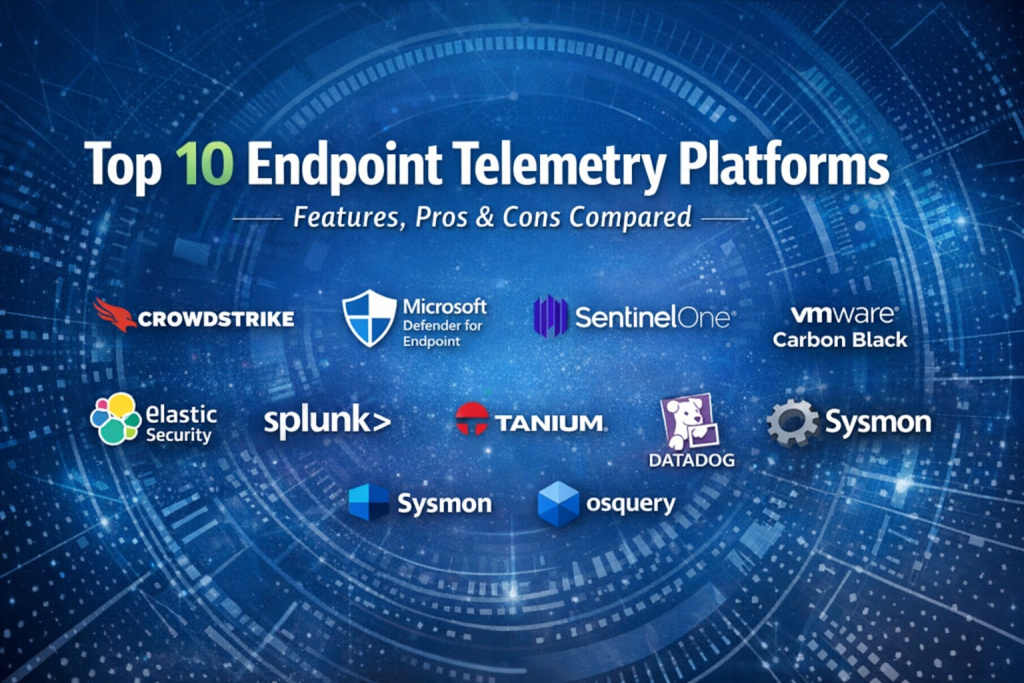
Top 10 Endpoint Telemetry Platforms Tools
1 — CrowdStrike Falcon
Short description:
CrowdStrike Falcon is a cloud-native endpoint telemetry and security platform focused on real-time threat detection and response. It is designed for enterprises and security-first organizations.
Key features:
- Real-time endpoint telemetry collection
- Behavioral analytics and AI-driven threat detection
- Endpoint Detection and Response (EDR)
- Threat hunting and forensic analysis
- Cloud-native architecture with lightweight agents
- Integrated incident response workflows
Pros:
- Extremely fast detection and response
- Minimal performance impact on endpoints
- Strong enterprise-grade security capabilities
Cons:
- Premium pricing
- Advanced features may overwhelm smaller teams
Security & compliance:
Supports SSO, encryption, audit logs, SOC 2, ISO 27001, GDPR, and other global standards.
Support & community:
Enterprise-grade support, detailed documentation, and a strong global security community.
2 — Microsoft Defender for Endpoint
Short description:
Microsoft Defender for Endpoint provides deep telemetry across Windows, macOS, Linux, and mobile endpoints, tightly integrated with the Microsoft ecosystem.
Key features:
- Native endpoint telemetry for OS and application activity
- Advanced threat protection and EDR
- Automated investigation and remediation
- Deep integration with Microsoft 365 and Azure
- Threat analytics dashboards
- Cross-platform endpoint support
Pros:
- Seamless integration for Microsoft-centric environments
- Strong built-in security analytics
- Competitive value for existing Microsoft customers
Cons:
- Less flexible outside the Microsoft ecosystem
- Complex configuration for advanced use cases
Security & compliance:
Supports SSO, encryption, audit logs, GDPR, ISO, SOC 2, and enterprise compliance frameworks.
Support & community:
Extensive documentation, large user community, and enterprise support options.
3 — SentinelOne Singularity
Short description:
SentinelOne Singularity is an AI-powered endpoint telemetry and security platform emphasizing autonomous response and behavioral analysis.
Key features:
- Continuous endpoint telemetry streaming
- AI-based behavioral detection
- Autonomous threat mitigation
- Endpoint rollback and remediation
- Unified EDR and XDR capabilities
- Rich visualization dashboards
Pros:
- Strong automation reduces manual workload
- Clear forensic timelines
- Effective against zero-day threats
Cons:
- Learning curve for advanced features
- Higher cost for full platform capabilities
Security & compliance:
Supports SOC 2, ISO 27001, GDPR, audit logging, and encryption.
Support & community:
Good documentation, responsive enterprise support, and growing community.
4 — VMware Carbon Black
Short description:
VMware Carbon Black focuses on continuous endpoint telemetry for threat detection, incident response, and compliance monitoring.
Key features:
- Continuous endpoint behavior monitoring
- Threat hunting and investigation tools
- Policy-based endpoint control
- Integration with VMware ecosystem
- Cloud and on-prem deployment options
- Compliance-focused reporting
Pros:
- Deep visibility into endpoint behavior
- Strong policy and compliance controls
- Mature threat hunting capabilities
Cons:
- User interface can feel complex
- Performance tuning required in large deployments
Security & compliance:
Supports audit logs, encryption, SOC 2, ISO, and GDPR.
Support & community:
Enterprise-focused support and solid documentation.
5 — Elastic Security
Short description:
Elastic Security combines endpoint telemetry with SIEM capabilities, offering flexible data ingestion and advanced analytics.
Key features:
- High-volume endpoint telemetry ingestion
- Real-time search and analytics
- Open and extensible data model
- Endpoint and SIEM correlation
- Custom dashboards and alerts
- Scalable cloud-native architecture
Pros:
- Highly customizable and flexible
- Strong analytics and search capabilities
- Suitable for complex environments
Cons:
- Requires skilled configuration
- Costs increase with data volume
Security & compliance:
Varies depending on deployment; supports encryption and audit logging.
Support & community:
Large open-source community and optional enterprise support.
6 — Splunk Enterprise Security
Short description:
Splunk Enterprise Security leverages endpoint telemetry to provide advanced security analytics and incident response capabilities.
Key features:
- Centralized endpoint telemetry collection
- Advanced correlation and analytics
- Real-time monitoring dashboards
- Threat intelligence integration
- Incident response workflows
- Highly scalable architecture
Pros:
- Extremely powerful analytics
- Flexible integrations
- Mature enterprise adoption
Cons:
- Expensive at scale
- Steep learning curve
Security & compliance:
Supports SOC 2, ISO, GDPR, encryption, and audit logs.
Support & community:
Strong enterprise support and large user community.
7 — Tanium
Short description:
Tanium provides real-time endpoint telemetry with a focus on IT operations, security, and asset management.
Key features:
- Real-time endpoint visibility
- Unified security and IT operations telemetry
- Patch and configuration monitoring
- Incident response capabilities
- Scalable peer-to-peer architecture
- Asset discovery and inventory
Pros:
- Near real-time data at scale
- Unified view across IT and security
- Strong enterprise scalability
Cons:
- High cost
- Complex initial setup
Security & compliance:
Supports encryption, audit logging, and enterprise compliance standards.
Support & community:
Enterprise-focused onboarding and support services.
8 — Datadog Endpoint Monitoring
Short description:
Datadog Endpoint Monitoring extends observability into endpoints, combining performance and security telemetry.
Key features:
- Endpoint performance metrics
- Process-level telemetry
- Unified observability dashboards
- Integration with cloud and application monitoring
- Real-time alerts
- Scalable SaaS architecture
Pros:
- Excellent visualization and usability
- Strong integration with DevOps workflows
- Fast deployment
Cons:
- Limited deep security features
- Pricing grows with usage
Security & compliance:
Supports SOC 2, GDPR, encryption, and SSO.
Support & community:
High-quality documentation and responsive support.
9 — Sysmon
Short description:
Sysmon is a Windows system service that generates detailed endpoint telemetry for advanced monitoring and forensics.
Key features:
- Low-level process and network telemetry
- File and registry change monitoring
- Highly detailed event logs
- Custom configuration rules
- Integration with SIEM tools
- Lightweight footprint
Pros:
- Free and highly detailed telemetry
- Excellent for forensic analysis
- Flexible configuration
Cons:
- Windows-only
- Requires external tools for analysis
Security & compliance:
Varies / N/A (depends on downstream tools).
Support & community:
Strong community-driven documentation.
10 — Osquery
Short description:
Osquery is an open-source endpoint telemetry framework that exposes operating system data as SQL tables.
Key features:
- Cross-platform endpoint telemetry
- SQL-based querying
- Flexible scheduling and logging
- Integration with SIEM and security tools
- Lightweight and extensible
- Open-source ecosystem
Pros:
- Extremely flexible
- Transparent data collection
- Strong open-source community
Cons:
- Requires engineering effort
- No native visualization layer
Security & compliance:
Varies / N/A depending on implementation.
Support & community:
Large open-source community and extensive documentation.
Comparison Table
| Tool Name | Best For | Platform(s) Supported | Standout Feature | Rating |
|---|---|---|---|---|
| CrowdStrike Falcon | Enterprise security teams | Windows, macOS, Linux | AI-driven real-time detection | N/A |
| Microsoft Defender for Endpoint | Microsoft-centric organizations | Windows, macOS, Linux, Mobile | Native OS integration | N/A |
| SentinelOne Singularity | Automated endpoint security | Windows, macOS, Linux | Autonomous response | N/A |
| VMware Carbon Black | Compliance-focused enterprises | Windows, macOS, Linux | Continuous behavior monitoring | N/A |
| Elastic Security | Custom analytics teams | Cross-platform | Flexible data ingestion | N/A |
| Splunk Enterprise Security | Large SOC teams | Cross-platform | Advanced correlation | N/A |
| Tanium | Large enterprises | Cross-platform | Real-time scale | N/A |
| Datadog Endpoint Monitoring | DevOps & SRE teams | Cross-platform | Unified observability | N/A |
| Sysmon | Windows security analysts | Windows | Low-level telemetry | N/A |
| Osquery | Engineering-driven teams | Windows, macOS, Linux | SQL-based telemetry | N/A |
Evaluation & Scoring of Endpoint Telemetry Platforms
| Criteria | Weight | Score Focus |
|---|---|---|
| Core features | 25% | Depth and accuracy of telemetry |
| Ease of use | 15% | Setup, UI, and workflows |
| Integrations & ecosystem | 15% | Compatibility with existing tools |
| Security & compliance | 10% | Standards and controls |
| Performance & reliability | 10% | Stability at scale |
| Support & community | 10% | Documentation and assistance |
| Price / value | 15% | ROI and scalability |
Which Endpoint Telemetry Platforms Tool Is Right for You?
- Solo users / small teams: Osquery or Sysmon provide lightweight telemetry without heavy cost.
- SMBs: Microsoft Defender for Endpoint or Datadog offer strong value and usability.
- Mid-market: SentinelOne and Elastic Security balance depth and flexibility.
- Enterprise: CrowdStrike, Splunk, and Tanium excel at scale and security depth.
Budget-conscious teams should prioritize open-source or bundled solutions, while premium buyers benefit from automation, threat intelligence, and enterprise support. Always align telemetry depth with compliance and scalability requirements.
Frequently Asked Questions (FAQs)
1. What is endpoint telemetry?
Endpoint telemetry is the continuous collection of data from endpoint devices about processes, activity, and system behavior.
2. How is endpoint telemetry different from antivirus?
Antivirus focuses on known threats, while telemetry provides deep behavioral visibility for detection and analysis.
3. Do endpoint telemetry platforms impact performance?
Most modern tools use lightweight agents with minimal performance impact.
4. Are these tools required for compliance?
Many compliance frameworks strongly recommend or require endpoint monitoring and audit trails.
5. Can telemetry help with incident response?
Yes, it provides timelines, root cause analysis, and forensic evidence.
6. Are open-source options reliable?
They are powerful but require skilled teams to operate effectively.
7. How long is telemetry data stored?
Retention varies by tool and configuration.
8. Do these platforms support remote work?
Yes, they are especially valuable in distributed environments.
9. Can telemetry integrate with SIEM tools?
Most platforms support SIEM and SOAR integrations.
10. What is the most common mistake buyers make?
Choosing overly complex tools without the resources to manage them.
Conclusion
Endpoint Telemetry Platforms have become foundational to modern security, compliance, and IT operations. They provide the visibility required to detect threats early, troubleshoot issues faster, and maintain trust in distributed environments. When choosing a solution, focus on data depth, usability, scalability, and integration, rather than brand alone. There is no single “best” platform — the right choice depends entirely on your organization’s size, risk profile, and operational maturity.

Find Trusted Cardiac Hospitals
Compare heart hospitals by city and services — all in one place.
Explore Hospitals