
Introduction
Environmental Monitoring Platforms are digital systems designed to collect, analyze, visualize, and manage environmental data from sensors, satellites, field devices, and manual inputs. These platforms help organizations track air quality, water quality, noise levels, weather conditions, emissions, soil health, radiation, and other environmental parameters in real time or near-real time.
Their importance has grown rapidly due to climate change, stricter regulations, ESG reporting requirements, smart city initiatives, and industrial compliance needs. Governments rely on them for public health and policy decisions, industries use them to stay compliant and reduce environmental risk, and research institutions depend on them for long-term environmental studies.
Real-world use cases include:
- Air quality monitoring in smart cities
- Industrial emissions and compliance tracking
- Water quality management for utilities and municipalities
- Environmental impact assessment for infrastructure projects
- Climate and weather trend analysis
- Early warning systems for floods, pollution, or hazardous leaks
When choosing an Environmental Monitoring Platform, users should evaluate:
- Data accuracy and sensor integration
- Real-time alerts and analytics
- Scalability and reliability
- Compliance and reporting capabilities
- Ease of use and visualization quality
- Security and data governance
Best for:
Environmental Monitoring Platforms are ideal for government agencies, municipalities, industrial operators, environmental consultants, researchers, utilities, energy companies, mining firms, and smart city planners who need accurate, auditable, and actionable environmental insights.
Not ideal for:
They may be excessive for individual users, very small teams, or organizations with only occasional environmental data needs, where simpler data loggers or manual reporting tools may be sufficient.
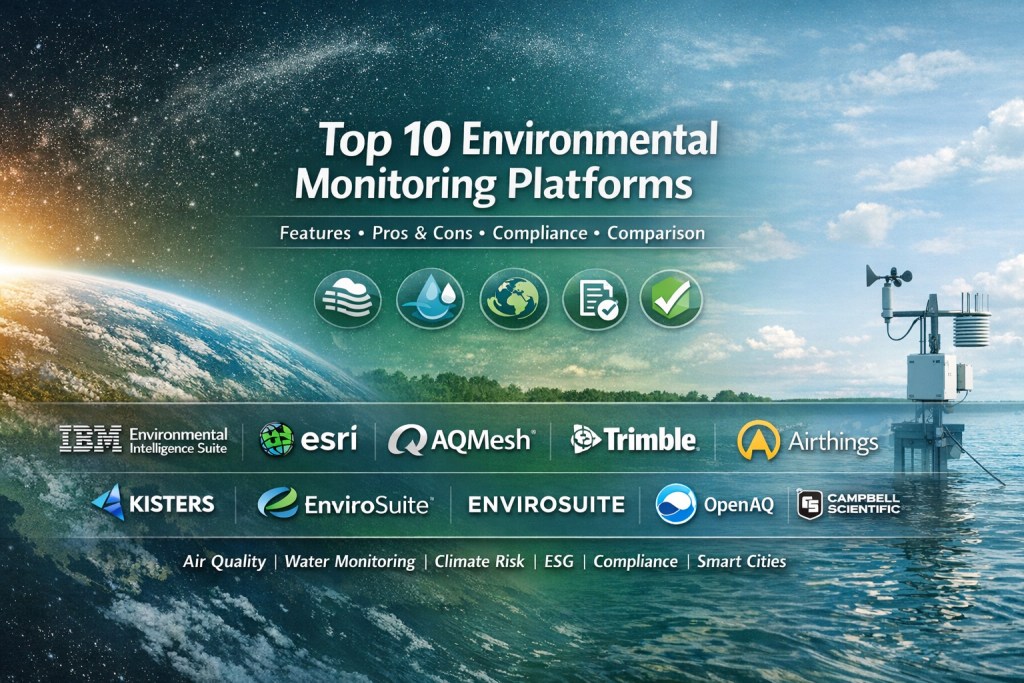
Top 10 Environmental Monitoring Platforms Tools
1 — IBM Environmental Intelligence Suite
Short description:
A comprehensive, enterprise-grade platform combining environmental monitoring, climate risk analytics, and AI-driven insights for governments and large organizations.
Key features:
- AI-powered environmental and climate analytics
- Air, water, weather, and climate data integration
- Predictive modeling and risk forecasting
- Advanced geospatial visualization
- Automated compliance and reporting tools
- Integration with IoT sensors and external datasets
Pros:
- Extremely powerful analytics and forecasting
- Strong enterprise scalability and reliability
Cons:
- High cost for smaller organizations
- Requires technical expertise to fully leverage
Security & compliance:
Enterprise-grade security, encryption, role-based access, GDPR support, ISO-aligned practices.
Support & community:
Professional enterprise support, extensive documentation, onboarding assistance.
2 — Esri ArcGIS Environmental Monitoring
Short description:
A GIS-centric environmental monitoring solution ideal for spatial analysis, mapping, and geospatial decision-making.
Key features:
- Advanced GIS and spatial analytics
- Real-time sensor and field data integration
- Environmental modeling and visualization
- Custom dashboards and maps
- Strong support for land, water, and air datasets
Pros:
- Best-in-class geospatial capabilities
- Highly flexible and customizable
Cons:
- Steep learning curve
- Licensing complexity for large deployments
Security & compliance:
Enterprise security controls, SSO support, role-based permissions.
Support & community:
Large global community, training programs, professional services.
3 — AQMesh
Short description:
A specialized air quality monitoring platform using compact sensor pods for urban and industrial environments.
Key features:
- High-density air quality sensor networks
- Real-time air pollution data
- Cloud-based dashboards and alerts
- Regulatory and public reporting tools
- Weather and dispersion modeling
Pros:
- Excellent for urban air quality projects
- Fast deployment and low visual impact
Cons:
- Focused mainly on air quality
- Limited multi-environment monitoring
Security & compliance:
Encrypted data transmission, GDPR-aligned practices.
Support & community:
Strong onboarding, responsive technical support.
4 — Trimble Environmental Monitoring
Short description:
A monitoring platform focused on environmental compliance, construction, and infrastructure projects.
Key features:
- Noise, vibration, dust, and air monitoring
- Construction and infrastructure compliance tracking
- Automated alerts and thresholds
- Cloud-based reporting
- Mobile-friendly dashboards
Pros:
- Excellent for construction and infrastructure use
- Strong compliance workflows
Cons:
- Less suited for climate research
- Limited advanced AI analytics
Security & compliance:
Secure cloud infrastructure, audit trails, role-based access.
Support & community:
Professional support, strong documentation.
5 — Airthings
Short description:
An easy-to-use indoor and workplace environmental monitoring platform focused on health and safety.
Key features:
- Indoor air quality and radon monitoring
- Real-time alerts and historical trends
- Wireless sensor ecosystem
- Simple dashboards for non-technical users
- Health-focused insights
Pros:
- Very user-friendly
- Quick setup with minimal training
Cons:
- Limited outdoor monitoring
- Fewer enterprise integrations
Security & compliance:
Standard cloud security, GDPR compliance.
Support & community:
Good documentation, responsive customer support.
6 — Kisters Environmental Data Management
Short description:
A robust data management platform for water, hydrology, and environmental research organizations.
Key features:
- Large-scale environmental data storage
- Time-series data management
- Advanced analytics and modeling
- Integration with field instruments
- Regulatory reporting support
Pros:
- Excellent for long-term datasets
- Highly reliable and accurate
Cons:
- Less intuitive UI
- Longer implementation time
Security & compliance:
Strong data governance, encryption, access controls.
Support & community:
Professional support, industry-focused expertise.
7 — EnviroSuite
Short description:
A predictive environmental intelligence platform focused on emissions, odor, and noise management.
Key features:
- Predictive dispersion modeling
- Odor and noise impact analysis
- Real-time monitoring and alerts
- Stakeholder communication tools
- Scenario modeling
Pros:
- Strong predictive capabilities
- Useful for community impact management
Cons:
- Specialized focus
- Higher learning curve
Security & compliance:
Enterprise security, GDPR compliance.
Support & community:
Dedicated customer success teams.
8 — Envirosuite
Short description:
An industrial-grade monitoring platform focused on mining, waste management, and heavy industry.
Key features:
- Emissions and dust monitoring
- Predictive environmental risk modeling
- Automated alerts and reporting
- Integration with industrial sensors
- Compliance dashboards
Pros:
- Tailored for heavy industry
- Strong compliance support
Cons:
- Not ideal for small organizations
- Premium pricing
Security & compliance:
ISO-aligned security, role-based access.
Support & community:
Industry-specific support teams.
9 — OpenAQ
Short description:
An open data platform focused on global air quality data aggregation and transparency.
Key features:
- Aggregated global air quality datasets
- Open APIs and data access
- Visualization and analysis tools
- Community-driven data sharing
- Research-friendly design
Pros:
- Free and open data access
- Excellent for research and public awareness
Cons:
- Limited enterprise features
- Data quality varies by source
Security & compliance:
Varies / N/A (open data model).
Support & community:
Strong open-source community and documentation.
10 — Campbell Scientific LoggerNet
Short description:
A trusted platform for managing data loggers and field-based environmental monitoring systems.
Key features:
- Reliable data logger management
- Field sensor integration
- Time-series data collection
- Offline and remote operation
- Scientific-grade accuracy
Pros:
- Extremely reliable hardware integration
- Ideal for remote environments
Cons:
- Outdated UI
- Limited modern analytics
Security & compliance:
Basic security controls; compliance varies by deployment.
Support & community:
Strong technical documentation and scientific user base.
Comparison Table
| Tool Name | Best For | Platform(s) Supported | Standout Feature | Rating |
|---|---|---|---|---|
| IBM Environmental Intelligence Suite | Large enterprises, governments | Web, Cloud | AI climate risk analytics | N/A |
| Esri ArcGIS Environmental Monitoring | GIS-driven organizations | Web, Desktop | Advanced geospatial analysis | N/A |
| AQMesh | Urban air quality projects | Web, Cloud | Dense air sensor networks | N/A |
| Trimble Environmental Monitoring | Construction & infrastructure | Web, Mobile | Compliance monitoring | N/A |
| Airthings | Indoor & workplace health | Web, Mobile | Ease of use | N/A |
| Kisters | Water & hydrology agencies | Web, On-prem | Time-series data handling | N/A |
| EnviroSuite | Odor & noise management | Web, Cloud | Predictive modeling | N/A |
| Envirosuite | Heavy industry | Web, Cloud | Industrial compliance | N/A |
| OpenAQ | Researchers & NGOs | Web | Open air quality data | N/A |
| Campbell Scientific LoggerNet | Field research | Desktop | Scientific accuracy | N/A |
Evaluation & Scoring of Environmental Monitoring Platforms
| Criteria | Weight | Description |
|---|---|---|
| Core features | 25% | Breadth and depth of monitoring capabilities |
| Ease of use | 15% | UI, onboarding, learning curve |
| Integrations & ecosystem | 15% | Sensors, APIs, third-party tools |
| Security & compliance | 10% | Data protection and governance |
| Performance & reliability | 10% | Accuracy and uptime |
| Support & community | 10% | Documentation and assistance |
| Price / value | 15% | Cost vs benefits |
Which Environmental Monitoring Platforms Tool Is Right for You?
- Solo users & small teams: Look for simple, affordable platforms with minimal setup, such as indoor or focused monitoring tools.
- SMBs: Choose scalable platforms that balance usability with compliance reporting.
- Mid-market organizations: Prioritize integrations, analytics, and automation.
- Enterprises & governments: Opt for AI-driven, highly secure platforms with predictive modeling.
Budget-conscious users should focus on open data or modular tools, while premium users benefit from advanced analytics and forecasting. Always balance feature depth vs usability, and ensure the platform aligns with security and regulatory needs.
Frequently Asked Questions (FAQs)
- What is an Environmental Monitoring Platform?
A system that collects and analyzes environmental data to support compliance, safety, and sustainability decisions. - Are these platforms real-time?
Most support real-time or near-real-time monitoring, depending on sensor connectivity. - Do they require IoT sensors?
Many integrate with sensors, but some also use satellite or public datasets. - Are they suitable for smart cities?
Yes, especially GIS-based and air quality platforms. - How secure is environmental data?
Enterprise tools offer encryption, access controls, and compliance features. - Can they support regulatory reporting?
Yes, many include automated compliance reports. - Are open platforms reliable?
They are excellent for research but may lack enterprise guarantees. - How long does implementation take?
From days for simple tools to months for large enterprise deployments. - Do they support mobile access?
Most modern platforms provide mobile dashboards. - Is there a single best platform?
No—each excels in different scenarios and industries.
Conclusion
Environmental Monitoring Platforms play a crucial role in protecting public health, ensuring regulatory compliance, and supporting sustainability goals. The best solution depends on data needs, scale, industry, budget, and technical expertise. By carefully evaluating features, security, scalability, and usability, organizations can select a platform that delivers accurate insights and long-term value rather than chasing a one-size-fits-all solution.

Find Trusted Cardiac Hospitals
Compare heart hospitals by city and services — all in one place.
Explore Hospitals