
Introduction
Feature Store Platforms are specialized systems designed to centralize, manage, and serve machine learning features consistently across training, validation, and production environments. In simple terms, they act as the single source of truth for features, ensuring that data scientists and ML engineers use the same feature definitions everywhere—eliminating mismatch issues that commonly break models in production.
As organizations move from experimentation to large-scale AI adoption, feature complexity increases. Multiple teams build features from diverse data sources, reuse them across models, and need them delivered in real time and batch modes. Feature stores solve this by providing versioning, lineage, governance, and low-latency serving for features.
Why Feature Store Platforms Are Important
- Prevent training–serving skew
- Enable feature reuse across teams
- Improve ML model reliability and speed to production
- Support real-time and batch ML use cases
- Strengthen governance, security, and compliance
Real-World Use Cases
- Fraud detection using real-time transaction features
- Recommendation systems in e-commerce and media platforms
- Customer churn prediction in telecom and SaaS
- Dynamic pricing and demand forecasting
- Personalized marketing and ad targeting
What to Look for When Choosing a Feature Store Platform
- Offline and online feature support
- Versioning and feature lineage
- Data freshness and latency
- Integrations with ML frameworks and data platforms
- Security, access control, and compliance
- Ease of use for data science and engineering teams
Best for:
Data scientists, ML engineers, and MLOps teams in startups to large enterprises building production-grade machine learning systems—especially in finance, retail, healthcare, SaaS, and AI-driven platforms.
Not ideal for:
Teams running only small-scale experiments, rule-based systems, or basic analytics workflows where feature reuse and real-time serving are not required.
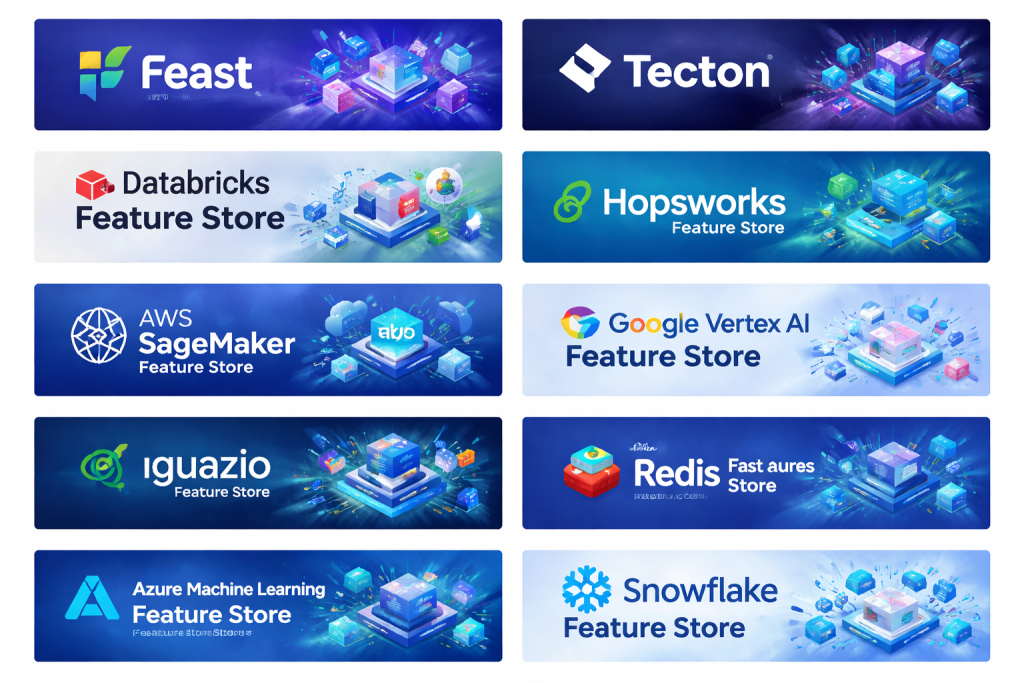
Top 10 Feature Store Platforms Tools
1 — Feast
Short description:
Feast is an open-source feature store designed for ML teams that want flexibility and control. It works well for organizations building custom MLOps stacks.
Key Features
- Open-source and cloud-agnostic
- Online and offline feature stores
- Tight integration with popular data warehouses
- Feature versioning and metadata management
- Real-time feature serving
- Pluggable storage backends
Pros
- Strong community adoption
- Highly customizable architecture
- No vendor lock-in
Cons
- Requires engineering effort to operate
- Limited built-in UI compared to managed platforms
Security & Compliance
Varies by deployment; depends on underlying infrastructure.
Support & Community
Active open-source community, good documentation, enterprise support via partners.
2 — Tecton
Short description:
Tecton is an enterprise-grade, fully managed feature store built for large-scale production ML workloads.
Key Features
- Real-time and batch feature pipelines
- Built-in data validation and monitoring
- Feature lineage and versioning
- Low-latency online serving
- Strong cloud-native architecture
- Enterprise governance controls
Pros
- Excellent performance and reliability
- Reduces operational burden
- Strong enterprise readiness
Cons
- Premium pricing
- Less flexible than open-source options
Security & Compliance
SOC 2, encryption, access control, audit logging.
Support & Community
Enterprise-grade support, onboarding assistance, strong documentation.
3 — Databricks Feature Store
Short description:
Databricks Feature Store is designed for teams already using the Databricks Lakehouse ecosystem.
Key Features
- Native integration with Databricks ML
- Centralized feature registry
- Automatic feature reuse
- Built-in access controls
- Batch and near-real-time features
- Model-feature linkage
Pros
- Seamless Databricks integration
- Strong governance
- Scales well for large datasets
Cons
- Limited outside Databricks ecosystem
- Real-time serving options are evolving
Security & Compliance
Enterprise-grade security, role-based access, compliance-ready.
Support & Community
Strong enterprise support and extensive documentation.
4 — Hopsworks Feature Store
Short description:
Hopsworks provides an open-core feature store with enterprise capabilities for real-time ML systems.
Key Features
- Online and offline feature storage
- Built-in feature validation
- Feature lineage and provenance
- Real-time streaming support
- Integration with major ML frameworks
- Managed and self-hosted options
Pros
- Mature feature store capabilities
- Strong focus on real-time ML
- Flexible deployment options
Cons
- Setup can be complex
- UI learning curve for new users
Security & Compliance
SSO, encryption, audit logs, GDPR-ready.
Support & Community
Commercial support available; active user community.
5 — AWS SageMaker Feature Store
Short description:
AWS SageMaker Feature Store is a fully managed service tightly integrated with the AWS ML ecosystem.
Key Features
- Managed online and offline stores
- Native AWS integrations
- Automated data ingestion
- Feature metadata tracking
- Low-latency inference support
- Scalability on demand
Pros
- Easy for AWS-native teams
- Highly scalable and reliable
- Minimal infrastructure management
Cons
- AWS lock-in
- Limited customization outside AWS
Security & Compliance
IAM-based access, encryption, SOC, GDPR, HIPAA-ready.
Support & Community
Strong AWS documentation and enterprise support plans.
6 — Google Vertex AI Feature Store
Short description:
Vertex AI Feature Store is built for teams operating within Google Cloud’s ML platform.
Key Features
- High-throughput online serving
- Seamless Vertex AI integration
- Managed infrastructure
- Feature monitoring
- Batch and real-time ingestion
- Scalability for large datasets
Pros
- Excellent performance
- Strong ML lifecycle integration
- Minimal operational overhead
Cons
- Google Cloud dependency
- Limited portability
Security & Compliance
Enterprise-grade security, encryption, compliance certifications.
Support & Community
Strong enterprise support and cloud documentation.
7 — Azure Machine Learning Feature Store
Short description:
Azure ML Feature Store integrates feature management into Microsoft’s ML ecosystem.
Key Features
- Feature reuse across pipelines
- Native Azure integration
- Managed storage and serving
- Role-based access control
- Feature versioning
- ML lifecycle integration
Pros
- Ideal for Azure-centric organizations
- Good enterprise governance
- Smooth integration with Azure services
Cons
- Less mature than some competitors
- Best suited only for Azure users
Security & Compliance
Enterprise security, ISO, GDPR-ready.
Support & Community
Strong Microsoft enterprise support.
8 — Iguazio Feature Store
Short description:
Iguazio focuses on real-time data science and operational ML use cases.
Key Features
- Real-time feature ingestion
- Low-latency serving
- Streaming data support
- Built-in monitoring
- Kubernetes-native
- End-to-end ML platform integration
Pros
- Strong real-time performance
- Designed for operational ML
- Enterprise scalability
Cons
- Higher learning curve
- Premium pricing
Security & Compliance
Enterprise security controls, encryption, audit logs.
Support & Community
Enterprise-focused support model.
9 — Redis Feature Store
Short description:
Redis-based feature stores prioritize ultra-low latency for online inference workloads.
Key Features
- In-memory feature serving
- Extremely low latency
- High throughput
- Simple key-value access
- Scales horizontally
- Real-time feature access
Pros
- Exceptional speed
- Ideal for online predictions
- Simple architecture
Cons
- Limited offline feature management
- Requires additional tooling for full lifecycle
Security & Compliance
Varies by deployment; enterprise Redis offers compliance options.
Support & Community
Strong community and enterprise support options.
10 — Snowflake Feature Store
Short description:
Snowflake Feature Store extends feature management within the Snowflake data cloud.
Key Features
- Native Snowflake integration
- Centralized feature registry
- SQL-based feature creation
- Secure data sharing
- Scalable batch processing
- Governance controls
Pros
- Ideal for Snowflake users
- Strong data governance
- Simplified feature management
Cons
- Limited real-time serving
- Best for batch ML use cases
Security & Compliance
Enterprise-grade security, encryption, compliance-ready.
Support & Community
Strong enterprise documentation and support.
Comparison Table
| Tool Name | Best For | Platform(s) Supported | Standout Feature | Rating |
|---|---|---|---|---|
| Feast | Custom MLOps stacks | Multi-cloud, on-prem | Open-source flexibility | N/A |
| Tecton | Enterprise ML | Cloud | Production-ready performance | N/A |
| Databricks Feature Store | Lakehouse users | Databricks | Deep ecosystem integration | N/A |
| Hopsworks | Real-time ML | Cloud, on-prem | Feature lineage | N/A |
| AWS SageMaker Feature Store | AWS users | AWS | Fully managed service | N/A |
| Vertex AI Feature Store | Google Cloud users | GCP | High throughput serving | N/A |
| Azure ML Feature Store | Azure users | Azure | Enterprise governance | N/A |
| Iguazio | Operational ML | Cloud, Kubernetes | Streaming features | N/A |
| Redis Feature Store | Low-latency inference | Multi-platform | Ultra-fast access | N/A |
| Snowflake Feature Store | Batch ML | Snowflake | SQL-first approach | N/A |
Evaluation & Scoring of Feature Store Platforms
| Criteria | Weight | Notes |
|---|---|---|
| Core features | 25% | Feature lifecycle, versioning, serving |
| Ease of use | 15% | Learning curve, UI, workflows |
| Integrations & ecosystem | 15% | ML tools, data platforms |
| Security & compliance | 10% | Enterprise readiness |
| Performance & reliability | 10% | Latency, scalability |
| Support & community | 10% | Documentation, help |
| Price / value | 15% | Cost vs capability |
Which Feature Store Platforms Tool Is Right for You?
Solo Users and Startups
Open-source tools like Feast or Snowflake-based solutions are often sufficient and cost-effective.
SMB and Mid-Market Teams
Managed platforms such as Hopsworks or cloud-native options reduce operational overhead.
Enterprise Organizations
Premium solutions like Tecton, AWS SageMaker, or Vertex AI provide scalability, governance, and support.
Budget vs Premium
- Budget-conscious: Open-source and cloud-native integrations
- Premium: Fully managed, enterprise-grade feature stores
Feature Depth vs Ease of Use
- Deep control: Open-source platforms
- Simplicity: Managed cloud services
Security and Compliance
Regulated industries should prioritize platforms with built-in compliance and auditability.
Frequently Asked Questions (FAQs)
- What problem does a feature store solve?
It ensures consistent feature usage across training and production. - Is a feature store mandatory for ML projects?
Not for small projects, but essential for production-scale ML. - Can feature stores handle real-time data?
Yes, many support low-latency online serving. - Are feature stores expensive?
Costs vary from free open-source to premium enterprise platforms. - Do feature stores replace data warehouses?
No, they complement them. - How hard is implementation?
Managed services are easier; open-source requires engineering effort. - Can non-technical users use feature stores?
Mostly designed for data and ML teams. - What are common mistakes?
Poor feature naming, lack of governance, ignoring monitoring. - Are feature stores secure?
Enterprise platforms offer strong security; open-source depends on setup. - What are alternatives?
Custom pipelines or embedded feature management, though less scalable.
Conclusion
Feature Store Platforms play a critical role in modern machine learning systems by enabling reliable, scalable, and reusable features. The right platform can dramatically reduce model failures, improve collaboration, and accelerate time to production.
There is no single “best” feature store for everyone. Open-source tools offer flexibility, cloud-native services provide convenience, and enterprise platforms deliver robustness and governance. The best choice depends on team size, technical maturity, budget, and compliance needs.
By focusing on real-world requirements rather than hype, organizations can select a feature store that truly supports long-term ML success.

Find Trusted Cardiac Hospitals
Compare heart hospitals by city and services — all in one place.
Explore Hospitals
This article offers a clear and practical overview of the top feature store platforms, helping readers understand how these tools support machine learning workflows by centralizing, managing, and serving features for models. By comparing key features, strengths, and limitations of each platform, it gives a balanced view that’s useful for data scientists, ML engineers, and decision‑makers evaluating options for their projects. The focus on real use cases and practical criteria makes it easier to choose the right feature store based on specific needs — whether it’s scalability, integration, or performance.