
Introduction
FinOps Chargeback Tools are specialized platforms designed to allocate, track, and recover cloud and IT costs across teams, projects, departments, or business units. In modern cloud-driven organizations, infrastructure spending is no longer centralized—it’s distributed across engineering teams, products, and services. Without proper chargeback or showback mechanisms, costs quickly become opaque, uncontrolled, and politically sensitive.
These tools bring financial accountability into cloud operations by mapping real usage to real owners. They help organizations understand who is consuming what, why costs are rising, and how to optimize spending without slowing innovation. For finance teams, they provide transparency and forecasting. For engineering leaders, they offer actionable insights tied to architecture decisions. For executives, they connect cloud spend directly to business value.
Why FinOps Chargeback Tools Matter
- Cloud costs scale faster than traditional IT budgets
- Teams need cost ownership without slowing delivery
- Finance needs accurate allocation for budgeting and reporting
- Leadership needs visibility and governance without micromanagement
Key Real-World Use Cases
- Allocating AWS, Azure, and GCP costs by team or product
- Internal billing for shared platforms and services
- Showback reporting for engineering accountability
- Chargeback for business units, subsidiaries, or clients
- Cost optimization tied to architectural decisions
What to Look for When Choosing a FinOps Chargeback Tool
- Accurate cost allocation (tags, labels, Kubernetes, shared costs)
- Multi-cloud and hybrid support
- Clear dashboards and reporting
- Automation and forecasting
- Security, compliance, and auditability
- Ease of adoption across finance and engineering teams
Best for:
FinOps practitioners, cloud architects, finance teams, DevOps leaders, and enterprises managing multi-team or multi-cloud environments where cost accountability is critical.
Not ideal for:
Very small teams with minimal cloud spend, early-stage startups without cost complexity, or organizations that do not require internal cost allocation or financial transparency.
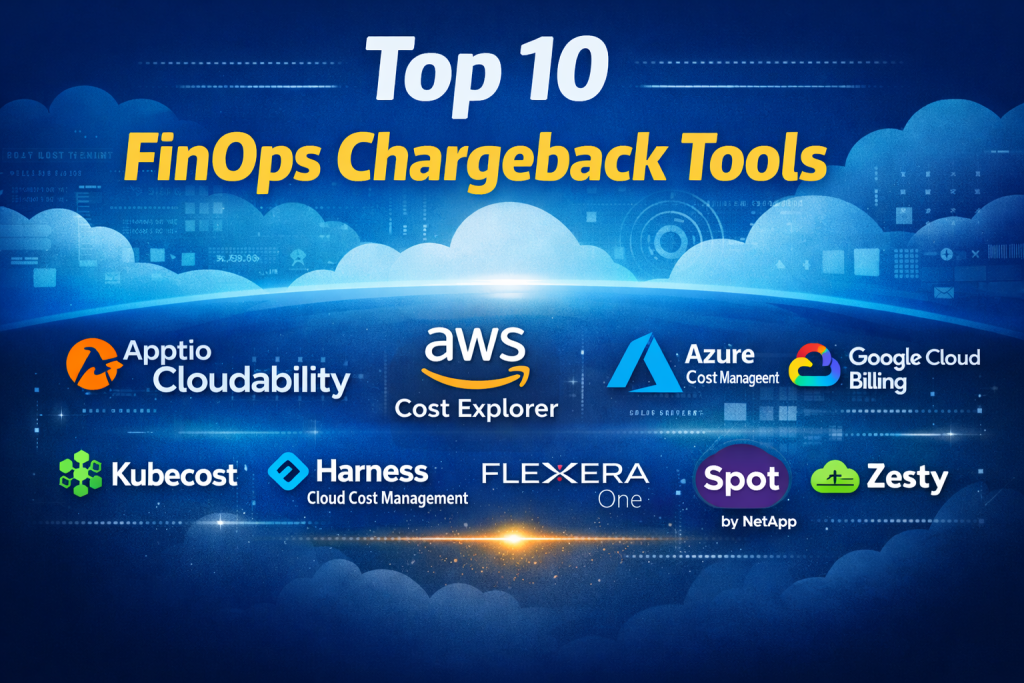
Top 10 FinOps Chargeback Tools
1 — Apptio Cloudability
Short description:
A market-leading FinOps platform focused on enterprise-grade cloud cost allocation, optimization, and chargeback across large organizations.
Key features
- Advanced cost allocation and chargeback rules
- Multi-cloud support (AWS, Azure, GCP)
- Kubernetes cost visibility
- Forecasting and budget tracking
- Unit economics and business metrics mapping
- Executive-ready dashboards
Pros
- Very mature FinOps capabilities
- Strong alignment with finance teams
- Scales well for large enterprises
Cons
- Premium pricing
- Steeper learning curve for small teams
Security & compliance:
SOC 2, SSO, encryption, audit logs, enterprise-grade governance.
Support & community:
Strong documentation, enterprise onboarding, dedicated customer success, active FinOps community.
2 — CloudHealth
Short description:
A comprehensive cloud financial management platform offering chargeback, governance, and optimization under the VMware ecosystem.
Key features
- Cost allocation and showback/chargeback
- Policy-based governance
- Multi-cloud visibility
- Reserved instance optimization
- Budget alerts and reporting
- Compliance monitoring
Pros
- Deep governance capabilities
- Strong VMware integration
- Trusted enterprise platform
Cons
- UI can feel complex
- Best value for VMware-centric environments
Security & compliance:
SOC 2, ISO standards, role-based access control.
Support & community:
Enterprise-grade support, detailed documentation, professional services available.
3 — AWS Cost Explorer
Short description:
Native AWS cost analysis tool designed for basic chargeback and cost visibility within AWS environments.
Key features
- Cost allocation tags
- Usage-based reporting
- Forecasting and trends
- Budget alerts
- Native AWS integration
Pros
- Included with AWS
- No third-party setup
- Accurate AWS-native data
Cons
- AWS-only
- Limited advanced chargeback features
Security & compliance:
AWS-native security, IAM-based access, encryption.
Support & community:
Backed by AWS documentation and global community.
4 — Azure Cost Management
Short description:
Microsoft’s built-in cost management solution for Azure-centric organizations needing cost allocation and chargeback visibility.
Key features
- Azure-native cost allocation
- Budgeting and alerts
- Forecasting and reports
- Management group support
- Tag-based chargeback
Pros
- Seamless Azure integration
- Included for Azure users
- Strong enterprise controls
Cons
- Limited multi-cloud support
- Less flexible than specialized tools
Security & compliance:
Azure security standards, RBAC, encryption.
Support & community:
Strong Microsoft documentation and enterprise support.
5 — Google Cloud Billing
Short description:
Native billing and cost analysis tools for Google Cloud users focusing on transparency and internal cost allocation.
Key features
- Labels-based cost allocation
- Budget alerts
- BigQuery billing export
- Forecasting tools
- Resource-level reporting
Pros
- Tight GCP integration
- Developer-friendly data access
- Transparent pricing data
Cons
- GCP-only
- Requires customization for advanced chargeback
Security & compliance:
Google Cloud security standards, IAM controls.
Support & community:
Good documentation, strong developer ecosystem.
6 — Kubecost
Short description:
A Kubernetes-native cost monitoring and chargeback platform designed for containerized workloads.
Key features
- Pod, namespace, and cluster cost allocation
- Kubernetes-native dashboards
- Shared cost allocation
- Forecasting and alerts
- Integration with major clouds
Pros
- Best-in-class Kubernetes visibility
- Open-source roots
- Strong DevOps adoption
Cons
- Kubernetes-focused only
- Less finance-oriented reporting
Security & compliance:
SSO, RBAC, encryption; compliance varies by deployment.
Support & community:
Active open-source community, enterprise support available.
7 — Harness CCM
Short description:
A modern cloud cost management platform emphasizing automation, governance, and engineering-driven FinOps.
Key features
- Automated cost allocation
- Kubernetes and cloud visibility
- Budget enforcement
- Forecasting and anomaly detection
- CI/CD cost insights
Pros
- Strong DevOps integration
- Automation-first approach
- Modern UI
Cons
- Best suited for Harness users
- Enterprise pricing model
Security & compliance:
SOC 2, SSO, RBAC, encryption.
Support & community:
Strong enterprise support, growing community.
8 — Flexera One
Short description:
An IT financial management platform extending chargeback beyond cloud into software and infrastructure assets.
Key features
- Cloud and IT asset cost allocation
- Chargeback and showback
- Vendor and license optimization
- Financial reporting
- Multi-cloud support
Pros
- Broad IT visibility
- Strong financial reporting
- Enterprise-grade controls
Cons
- Heavier platform footprint
- Less developer-centric
Security & compliance:
SOC 2, ISO standards, enterprise security.
Support & community:
Strong enterprise services, detailed documentation.
9 — Spot by NetApp
Short description:
A cloud optimization and cost management platform focusing on automation and savings across dynamic workloads.
Key features
- Automated cost optimization
- Chargeback reporting
- Kubernetes and container support
- Predictive analytics
- Multi-cloud compatibility
Pros
- Strong automation
- Good for dynamic workloads
- Cost-saving focus
Cons
- Less finance-centric reporting
- Learning curve for automation
Security & compliance:
SSO, encryption, compliance varies by deployment.
Support & community:
Enterprise support, growing user base.
10 — Zesty
Short description:
An intelligent cloud optimization platform focusing on predictive scaling and cost efficiency.
Key features
- Predictive resource scaling
- Cost allocation insights
- Automated optimization
- Cloud-native integrations
- Forecasting analytics
Pros
- Strong automation
- Innovative optimization approach
- Easy deployment
Cons
- Less traditional chargeback focus
- Smaller ecosystem
Security & compliance:
Encryption, RBAC; compliance varies.
Support & community:
Responsive support, smaller but focused community.
Comparison Table
| Tool Name | Best For | Platform(s) Supported | Standout Feature | Rating |
|---|---|---|---|---|
| Apptio Cloudability | Large enterprises | AWS, Azure, GCP | Advanced chargeback & unit economics | N/A |
| CloudHealth | Governance-heavy orgs | Multi-cloud | Policy-based cost control | N/A |
| AWS Cost Explorer | AWS-only teams | AWS | Native AWS integration | N/A |
| Azure Cost Management | Azure enterprises | Azure | Deep Microsoft integration | N/A |
| Google Cloud Billing | GCP users | GCP | BigQuery billing exports | N/A |
| Kubecost | Kubernetes teams | Kubernetes, multi-cloud | Pod-level cost allocation | N/A |
| Harness CCM | DevOps-driven orgs | Multi-cloud | CI/CD cost visibility | N/A |
| Flexera One | IT finance teams | Multi-cloud, IT assets | ITAM + FinOps | N/A |
| Spot by NetApp | Dynamic workloads | Multi-cloud | Automated optimization | N/A |
| Zesty | Predictive optimization | Cloud-native | AI-driven scaling | N/A |
Evaluation & Scoring of FinOps Chargeback Tools
| Criteria | Weight |
|---|---|
| Core features | 25% |
| Ease of use | 15% |
| Integrations & ecosystem | 15% |
| Security & compliance | 10% |
| Performance & reliability | 10% |
| Support & community | 10% |
| Price / value | 15% |
Which FinOps Chargeback Tool Is Right for You?
- Solo users / Small teams: Native cloud tools or lightweight platforms
- SMBs: Kubecost, Harness CCM for balance
- Mid-market: CloudHealth, Spot by NetApp
- Enterprise: Apptio Cloudability, Flexera One
Budget-conscious: Native tools and open-source-first platforms
Premium solutions: Enterprise FinOps suites with deep reporting
Ease of use: Native cloud tools
Feature depth: Dedicated FinOps platforms
Security needs: Enterprise-grade tools with SOC 2 and audit logs
Frequently Asked Questions (FAQs)
- What is FinOps chargeback?
It assigns cloud costs directly to teams or business units based on actual usage. - Chargeback vs showback?
Chargeback bills teams internally; showback only reports costs without billing. - Do I need multi-cloud support?
Only if you operate across multiple cloud providers. - Are native cloud tools enough?
For simple needs, yes. Complex environments need specialized platforms. - How long does implementation take?
From days (native tools) to weeks (enterprise platforms). - Is Kubernetes cost visibility necessary?
Yes, if containers are a major workload. - Do these tools slow down engineers?
No, when implemented correctly, they improve accountability without friction. - How accurate is cost allocation?
Highly accurate when tagging and policies are enforced. - Can finance teams use these tools easily?
Yes, most platforms offer finance-friendly dashboards. - What’s the biggest mistake teams make?
Ignoring governance and failing to enforce tagging standards.
Conclusion
FinOps Chargeback Tools play a critical role in bridging the gap between cloud usage and financial accountability. The right platform brings transparency, trust, and optimization—without slowing innovation. While enterprise solutions offer unmatched depth, smaller teams may thrive with simpler or native tools.
There is no universal winner. The best FinOps chargeback tool is the one that aligns with your organization’s size, cloud maturity, financial governance needs, and engineering culture. Choose based on clarity, scalability, and long-term value—not just features.

Find Trusted Cardiac Hospitals
Compare heart hospitals by city and services — all in one place.
Explore Hospitals
This is an outstanding breakdown of the FinOps chargeback landscape. As organizations scale their cloud footprints, the transition from opaque spending to true financial accountability is critical. I especially appreciate how you’ve highlighted specialized tools like Kubecost for container visibility alongside enterprise giants like Apptio Cloudability. This post is a must-read for anyone looking to bridge the gap between engineering and finance. Great work!