
Introduction
Healthcare Electronic Health Record (EHR) systems are the digital backbone of modern clinical operations. They replace paper charts with structured, searchable, and shareable patient records that support clinicians, administrators, and care teams across the entire care journey. From outpatient clinics and specialty practices to large hospital networks, EHR systems play a critical role in improving care quality, patient safety, and operational efficiency.
The importance of EHR systems goes far beyond record-keeping. They enable clinical decision support, care coordination, billing accuracy, population health management, and regulatory compliance. Real-world use cases include managing chronic disease care, reducing medication errors, supporting telehealth, streamlining insurance claims, and generating insights for quality improvement initiatives.
When choosing a Healthcare EHR system, organizations should evaluate factors such as clinical functionality, ease of use, interoperability, security and compliance, scalability, vendor support, and total cost of ownership. The right system should align with clinical workflows rather than forcing clinicians to adapt to rigid software.
Best for:
Healthcare EHR systems are best suited for physicians, nurses, allied health professionals, clinic administrators, hospitals, diagnostic centers, and healthcare networks that require accurate, secure, and interoperable patient data management.
Not ideal for:
They may be unnecessary for solo practitioners with extremely low patient volumes, non-clinical wellness providers, or organizations that only need basic scheduling and invoicing without clinical documentation.
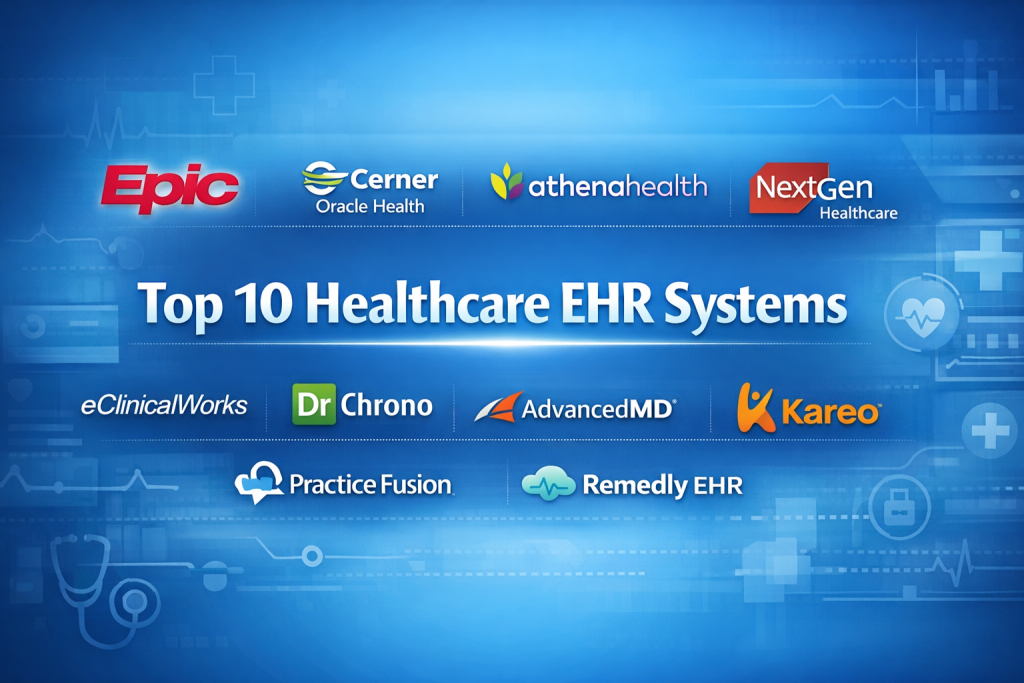
Top 10 Healthcare EHR Systems Tools
1 — Epic Systems
Short description:
A comprehensive enterprise-grade EHR platform widely used by large hospitals and academic medical centers, designed for complex clinical environments.
Key features:
- Unified patient record across departments
- Advanced clinical decision support
- Integrated billing and revenue cycle management
- Population health and analytics tools
- Strong interoperability frameworks
- Telehealth and patient portal modules
Pros:
- Extremely robust and scalable
- Strong ecosystem and industry adoption
Cons:
- High implementation and licensing cost
- Steep learning curve for new users
Security & compliance:
HIPAA, SOC 2, audit logs, role-based access, encryption.
Support & community:
Extensive documentation, enterprise support, large user community.
2 — Oracle Health
Short description:
A powerful EHR solution focused on hospitals and health systems, emphasizing data interoperability and analytics.
Key features:
- End-to-end clinical workflows
- Real-time clinical analytics
- Interoperability and data exchange
- Population health management
- Integrated revenue cycle tools
Pros:
- Strong data and analytics capabilities
- Scales well for large systems
Cons:
- Complex configuration
- Requires significant IT resources
Security & compliance:
HIPAA, ISO-aligned controls, encryption, audit trails.
Support & community:
Enterprise-grade support, structured onboarding.
3 — MEDITECH
Short description:
A long-standing EHR vendor offering flexible solutions for community hospitals and mid-sized healthcare organizations.
Key features:
- Web-based EHR platform
- Clinical and administrative modules
- Revenue cycle management
- Interoperability tools
- Mobile access for clinicians
Pros:
- Reliable performance
- Suitable for mid-sized hospitals
Cons:
- UI feels dated in some modules
- Limited customization compared to newer platforms
Security & compliance:
HIPAA, encryption, access controls.
Support & community:
Strong customer support and training programs.
4 — athenahealth
Short description:
A cloud-native EHR platform popular with ambulatory practices and physician groups.
Key features:
- Cloud-based access
- Automated billing and claims
- Interoperability network
- Patient engagement tools
- Real-time performance dashboards
Pros:
- Easy to use
- Reduced IT overhead
Cons:
- Less suited for large hospitals
- Customization limitations
Security & compliance:
HIPAA, SOC 2, encryption.
Support & community:
Strong onboarding, responsive customer support.
5 — Allscripts
Short description:
A flexible EHR solution serving both ambulatory and hospital settings with modular deployment options.
Key features:
- Modular clinical documentation
- Interoperability frameworks
- Practice management tools
- Analytics and reporting
- Mobile clinician access
Pros:
- Configurable workflows
- Broad market coverage
Cons:
- Integration complexity
- Variable user experience
Security & compliance:
HIPAA, encryption, audit logs.
Support & community:
Mixed reviews on support responsiveness.
6 — NextGen Healthcare
Short description:
An EHR platform tailored for ambulatory practices and specialty clinics.
Key features:
- Specialty-specific templates
- Integrated practice management
- Population health tools
- Patient engagement features
- Reporting and analytics
Pros:
- Strong specialty focus
- Intuitive user interface
Cons:
- Limited enterprise scalability
- Reporting customization can be complex
Security & compliance:
HIPAA, SOC 2, encryption.
Support & community:
Good training resources and customer support.
7 — eClinicalWorks
Short description:
A widely adopted EHR for small to mid-sized practices emphasizing affordability and functionality.
Key features:
- Comprehensive ambulatory EHR
- Telehealth integration
- Patient portals
- Billing and scheduling
- Analytics dashboards
Pros:
- Cost-effective
- Broad feature set
Cons:
- Interface can feel cluttered
- Performance varies with scale
Security & compliance:
HIPAA, encryption, audit trails.
Support & community:
Large user base, mixed support feedback.
8 — Practice Fusion
Short description:
A lightweight, cloud-based EHR designed for small practices.
Key features:
- Cloud-native architecture
- E-prescribing
- Scheduling and charting
- Basic reporting
- Patient engagement tools
Pros:
- Easy setup
- Low upfront cost
Cons:
- Limited advanced features
- Not ideal for complex care settings
Security & compliance:
HIPAA, encryption.
Support & community:
Basic support and documentation.
9 — Greenway Health
Short description:
An EHR platform focusing on ambulatory practices and value-based care.
Key features:
- Clinical documentation
- Population health analytics
- Revenue cycle tools
- Interoperability features
- Reporting and dashboards
Pros:
- Strong analytics focus
- Supports value-based care models
Cons:
- Learning curve
- Integration challenges
Security & compliance:
HIPAA, encryption, audit logs.
Support & community:
Structured training and enterprise support.
10 — DrChrono
Short description:
A modern EHR solution optimized for mobile-first and small practices.
Key features:
- iPad-first design
- Customizable templates
- Telehealth support
- Billing and scheduling
- Patient portal
Pros:
- User-friendly
- Mobile flexibility
Cons:
- Limited hospital functionality
- Reporting depth is basic
Security & compliance:
HIPAA, encryption.
Support & community:
Good onboarding and responsive support.
Comparison Table
| Tool Name | Best For | Platform(s) Supported | Standout Feature | Rating |
|---|---|---|---|---|
| Epic Systems | Large hospitals | Web, Enterprise | Unified enterprise EHR | N/A |
| Oracle Health | Health systems | Web, Enterprise | Advanced analytics | N/A |
| MEDITECH | Community hospitals | Web | Reliability | N/A |
| athenahealth | Ambulatory practices | Cloud | Ease of use | N/A |
| Allscripts | Mixed settings | Web | Modular design | N/A |
| NextGen Healthcare | Specialty clinics | Web | Specialty templates | N/A |
| eClinicalWorks | SMB practices | Web | Cost efficiency | N/A |
| Practice Fusion | Small clinics | Cloud | Simplicity | N/A |
| Greenway Health | Value-based care | Web | Population analytics | N/A |
| DrChrono | Mobile practices | Web, iOS | Mobile-first UX | N/A |
Evaluation & Scoring of Healthcare EHR Systems
| Criteria | Weight | Evaluation Notes |
|---|---|---|
| Core features | 25% | Depth of clinical and administrative capabilities |
| Ease of use | 15% | Clinician adoption and workflow fit |
| Integrations & ecosystem | 15% | Interoperability and third-party support |
| Security & compliance | 10% | Regulatory and data protection readiness |
| Performance & reliability | 10% | System uptime and responsiveness |
| Support & community | 10% | Vendor and peer support |
| Price / value | 15% | Cost relative to delivered value |
Which Healthcare EHR Systems Tool Is Right for You?
- Solo users: Lightweight, cloud-based tools with simple workflows
- SMBs: Cost-effective platforms with integrated billing and scheduling
- Mid-market: Configurable EHRs with specialty support
- Enterprise: Highly scalable systems with advanced analytics
Budget-conscious organizations may prioritize ease of use and cloud delivery, while premium buyers often seek deep customization, analytics, and long-term scalability. Integration needs, compliance requirements, and growth plans should heavily influence the final decision.
Frequently Asked Questions (FAQs)
- What is an EHR system?
A digital platform for managing patient medical records and clinical workflows. - Is EHR mandatory for healthcare providers?
In many regions, regulations strongly encourage or require EHR adoption. - How long does EHR implementation take?
It can range from weeks for small clinics to months for hospitals. - Are cloud EHR systems secure?
Yes, when properly implemented with encryption and compliance controls. - Can EHR systems integrate with labs and pharmacies?
Most modern EHRs support such integrations. - What is interoperability in EHR?
The ability to exchange data with other healthcare systems. - Are EHR systems expensive?
Costs vary widely based on scale and features. - Do EHRs support telehealth?
Many now include built-in telehealth modules. - What are common EHR mistakes?
Ignoring workflow fit and underestimating training needs. - Can EHRs improve patient outcomes?
Yes, through better data access and decision support.
Conclusion
Healthcare EHR systems are essential tools for delivering safe, efficient, and data-driven care. While leading platforms offer powerful capabilities, no single solution fits every organization. The best choice depends on clinical needs, organizational size, budget, and long-term strategy. By carefully evaluating features, usability, security, and support, healthcare providers can select an EHR system that truly enhances care delivery rather than complicating it.

Find Trusted Cardiac Hospitals
Compare heart hospitals by city and services — all in one place.
Explore Hospitals