
Introduction
A Hospital Information System (HIS) is the digital backbone of modern healthcare institutions. It brings together clinical, administrative, financial, and operational data into a unified platform, enabling hospitals to run efficiently while delivering safe, high-quality patient care. From patient registration and electronic medical records to billing, pharmacy, laboratory, and analytics, HIS platforms support nearly every hospital workflow.
The importance of HIS has grown rapidly with rising patient volumes, regulatory pressures, and the need for real-time clinical decision-making. Hospitals use HIS to reduce medical errors, improve coordination between departments, ensure compliance, and gain actionable insights from data. In real-world settings, HIS tools support emergency care, inpatient and outpatient management, revenue cycle optimization, population health initiatives, and interoperability with external providers.
When choosing a Hospital Information System, buyers should evaluate clinical depth, usability, integration capabilities, scalability, security, compliance, vendor support, and total cost of ownership. The right HIS is not just software—it is a long-term operational partner that must align with the hospital’s size, specialty mix, regulatory environment, and digital maturity.
Best for:
Hospital Information Systems are best suited for multi-specialty hospitals, academic medical centers, specialty clinics, government hospitals, and large healthcare networks that require integrated clinical and administrative workflows, strong compliance controls, and enterprise-grade reliability.
Not ideal for:
Small single-physician practices, non-clinical care centers, or organizations needing only basic scheduling and billing may find full-scale HIS platforms too complex, costly, or resource-intensive, and may benefit more from lightweight practice management or EHR-only solutions.
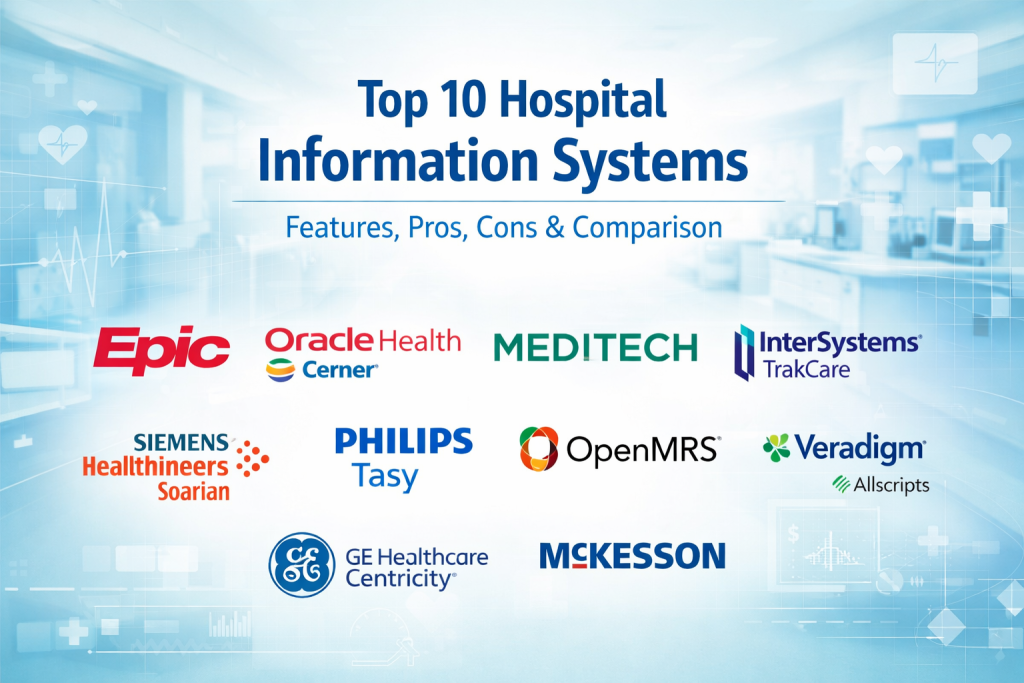
Top 10 Hospital Information Systems Tools
1 — Epic Systems
Short description:
A comprehensive, enterprise-grade HIS platform widely used by large hospitals and academic medical centers for end-to-end clinical and administrative operations.
Key features:
- Integrated EHR, billing, pharmacy, lab, and radiology modules
- Real-time clinical decision support
- Advanced analytics and population health tools
- Patient engagement portals
- Interoperability with external systems
- Customizable workflows
- Scalable enterprise architecture
Pros:
- Extremely comprehensive and mature platform
- Strong interoperability and data consistency
Cons:
- High implementation and licensing cost
- Requires significant training and IT resources
Security & compliance:
HIPAA, GDPR support, encryption, audit logs, SSO, role-based access controls.
Support & community:
Extensive documentation, structured onboarding, enterprise-level support, large professional user community.
2 — Oracle Health (Cerner)
Short description:
A globally adopted HIS solution offering strong clinical workflows, interoperability, and analytics for hospitals of all sizes.
Key features:
- Unified patient record
- Clinical decision support
- Revenue cycle management
- Health information exchange
- AI-assisted analytics
- Cloud-ready deployment
Pros:
- Strong global presence and scalability
- Robust reporting and analytics
Cons:
- Interface complexity for some users
- Customization can be resource-heavy
Security & compliance:
HIPAA, ISO standards, encryption, audit trails.
Support & community:
Enterprise support, formal training programs, global partner ecosystem.
3 — MEDITECH
Short description:
A long-standing HIS vendor focused on usability and cost-effective solutions for small to mid-sized hospitals.
Key features:
- Integrated clinical and financial modules
- Web-based Expanse platform
- Mobile clinician access
- Patient engagement tools
- Interoperability standards support
Pros:
- User-friendly interface
- More affordable than many enterprise peers
Cons:
- Fewer advanced analytics features
- Limited customization compared to top-tier systems
Security & compliance:
HIPAA compliance, encryption, role-based security.
Support & community:
Strong vendor support, structured onboarding, moderate community size.
4 — Veradigm (Allscripts)
Short description:
A flexible HIS platform designed for hospitals seeking modular deployment and strong integration with third-party systems.
Key features:
- Modular HIS architecture
- Interoperability-focused design
- Clinical documentation tools
- Revenue cycle support
- Data analytics capabilities
Pros:
- Flexible deployment options
- Strong interoperability focus
Cons:
- Interface consistency varies by module
- Some legacy components remain
Security & compliance:
HIPAA, encryption, audit logging, access controls.
Support & community:
Vendor-led support, documentation, smaller but active user base.
5 — InterSystems TrakCare
Short description:
An integrated HIS platform built on a high-performance data engine, popular in international and multi-facility environments.
Key features:
- Unified clinical and administrative system
- High-performance database engine
- Interoperability and data sharing
- Scalable multi-facility support
- Customizable workflows
Pros:
- Excellent performance and reliability
- Strong interoperability capabilities
Cons:
- Requires skilled technical staff
- Smaller ecosystem in some regions
Security & compliance:
HIPAA, GDPR, encryption, audit trails.
Support & community:
Enterprise support, technical documentation, global user community.
6 — Siemens Healthineers Soarian
Short description:
A hospital-focused HIS platform emphasizing clinical documentation, diagnostics integration, and workflow optimization.
Key features:
- Clinical documentation management
- Diagnostic and imaging integration
- Revenue cycle tools
- Care coordination features
- Analytics dashboards
Pros:
- Strong diagnostic workflow integration
- Reliable clinical documentation tools
Cons:
- Less flexible customization
- Gradual product transition in some markets
Security & compliance:
HIPAA, encryption, role-based access.
Support & community:
Enterprise support, formal training resources.
7 — GE Healthcare Centricity
Short description:
A HIS platform designed to support clinical workflows with a strong focus on imaging and diagnostics.
Key features:
- Clinical data management
- Imaging and diagnostics integration
- Reporting and analytics
- Workflow automation
- Interoperability tools
Pros:
- Strong imaging integration
- Trusted global brand
Cons:
- Interface feels dated to some users
- Limited modular flexibility
Security & compliance:
HIPAA, encryption, audit logs.
Support & community:
Vendor support, documentation, moderate community.
8— Philips Tasy
Short description:
A comprehensive HIS solution widely used in emerging markets, covering clinical, administrative, and operational workflows.
Key features:
- End-to-end hospital management
- Clinical documentation
- Financial and billing modules
- Analytics and reporting
- Interoperability support
Pros:
- Broad functional coverage
- Suitable for mid-sized hospitals
Cons:
- Regional availability varies
- Customization can be complex
Security & compliance:
HIPAA-aligned controls, encryption, audit trails.
Support & community:
Vendor-led support, regional partner ecosystem.
9 — OpenMRS
Short description:
An open-source HIS platform designed for resource-constrained environments and global health initiatives.
Key features:
- Open-source architecture
- Modular extensions
- Community-driven development
- Customizable workflows
- Global health focus
Pros:
- No licensing costs
- Highly customizable
Cons:
- Requires strong in-house technical expertise
- Limited enterprise-grade support
Security & compliance:
Varies / N/A depending on deployment and configuration.
Support & community:
Large open-source community, documentation, community forums.
10 — McKesson Legacy HIS Solutions
Short description:
Historically significant HIS platforms still used in some hospitals, often integrated with newer systems.
Key features:
- Core hospital operations support
- Billing and administrative tools
- Integration with external modules
- Stable legacy workflows
Pros:
- Proven reliability
- Familiar workflows for long-term users
Cons:
- Limited innovation
- Gradually being phased out
Security & compliance:
HIPAA-aligned controls, varies by implementation.
Support & community:
Limited ongoing support, shrinking user base.
Comparison Table
| Tool Name | Best For | Platform(s) Supported | Standout Feature | Rating |
|---|---|---|---|---|
| Epic Systems | Large enterprise hospitals | Web, on-prem, hybrid | End-to-end enterprise coverage | N/A |
| Oracle Health (Cerner) | Global hospital networks | Cloud, on-prem | Interoperability & analytics | N/A |
| MEDITECH | Mid-sized hospitals | Web, mobile | Ease of use | N/A |
| Veradigm (Allscripts) | Modular deployments | Web, hybrid | Flexible integrations | N/A |
| InterSystems TrakCare | Multi-facility systems | Web, on-prem | High-performance data engine | N/A |
| Siemens Soarian | Clinical documentation | Web | Diagnostics integration | N/A |
| GE Centricity | Imaging-focused hospitals | Web | Imaging workflows | N/A |
| Philips Tasy | Emerging markets | Web | Broad HIS coverage | N/A |
| OpenMRS | NGOs, public health | Web | Open-source flexibility | N/A |
| McKesson Legacy | Existing users | On-prem | Proven stability | N/A |
Evaluation & Scoring of Hospital Information Systems
| Evaluation Criteria | Weight | Description |
|---|---|---|
| Core features | 25% | Clinical, administrative, and financial depth |
| Ease of use | 15% | User experience and learning curve |
| Integrations & ecosystem | 15% | Interoperability and third-party support |
| Security & compliance | 10% | Regulatory readiness and data protection |
| Performance & reliability | 10% | Stability and uptime |
| Support & community | 10% | Vendor and peer support |
| Price / value | 15% | Cost vs delivered value |
Which Hospital Information Systems Tool Is Right for You?
- Solo or small hospitals: Look for simpler, cost-effective platforms with essential workflows and faster onboarding.
- SMBs and mid-market hospitals: Balance usability, modularity, and integration capabilities.
- Large enterprises: Prioritize scalability, compliance, analytics, and long-term vendor stability.
- Budget-conscious buyers: Open-source or mid-tier vendors may offer better value.
- Security-driven organizations: Choose platforms with strong audit trails, encryption, and compliance certifications.
Frequently Asked Questions (FAQs)
- What is a Hospital Information System?
It is an integrated platform managing clinical, administrative, and financial hospital operations. - Is HIS different from EHR?
Yes. EHR is a core component, while HIS covers the entire hospital ecosystem. - How long does HIS implementation take?
Typically 6–24 months depending on size and complexity. - Are HIS platforms cloud-based?
Many now support cloud, on-prem, and hybrid deployments. - Is HIS suitable for small hospitals?
Yes, but smaller hospitals should choose lighter or modular solutions. - How important is interoperability?
Critical for data sharing, referrals, and regulatory compliance. - What are common implementation mistakes?
Underestimating training, change management, and data migration. - Is open-source HIS secure?
Security depends on configuration and governance. - Can HIS improve patient outcomes?
Yes, through better coordination, data access, and decision support. - Is there a single best HIS?
No. The best system depends on organizational needs and context.
Conclusion
Hospital Information Systems are foundational to modern healthcare delivery. They streamline workflows, enhance patient safety, and enable data-driven decision-making across clinical and administrative domains. While leading platforms offer powerful capabilities, no single HIS fits every organization.
The most important factors are alignment with hospital size, clinical complexity, budget, integration needs, and compliance requirements. By carefully evaluating these dimensions, healthcare leaders can select a Hospital Information System that delivers long-term value and supports high-quality patient care.

Find Trusted Cardiac Hospitals
Compare heart hospitals by city and services — all in one place.
Explore Hospitals