
Introduction
Insurance Policy Administration Systems (PAS) are the operational backbone of modern insurance organizations. These platforms manage the full policy lifecycle—from product configuration and quoting to underwriting, policy issuance, endorsements, renewals, and cancellations. As insurers face growing regulatory pressure, rising customer expectations, and rapid digital transformation, legacy policy systems are increasingly becoming bottlenecks rather than enablers.
A modern PAS helps insurers launch products faster, automate complex workflows, improve accuracy, and deliver consistent customer experiences across channels. Real-world use cases include launching usage-based insurance products, managing multi-jurisdiction compliance, automating renewals for large commercial books, and supporting omnichannel customer journeys.
When evaluating Insurance Policy Administration Systems, buyers should focus on core functionality depth, ease of configuration, integration capability, scalability, security and compliance, and total cost of ownership. Equally important is the vendor’s industry expertise and long-term roadmap.
Best for:
Insurance Policy Administration Systems are best suited for life, health, property & casualty (P&C), and specialty insurers ranging from fast-growing digital insurers to large global carriers. Product managers, underwriting teams, IT leaders, operations heads, and compliance officers all benefit directly.
Not ideal for:
Very small agencies, brokers, or MGAs with minimal policy complexity may find full-scale PAS platforms excessive. In such cases, lighter agency management systems or embedded policy modules within CRM platforms may be more cost-effective.
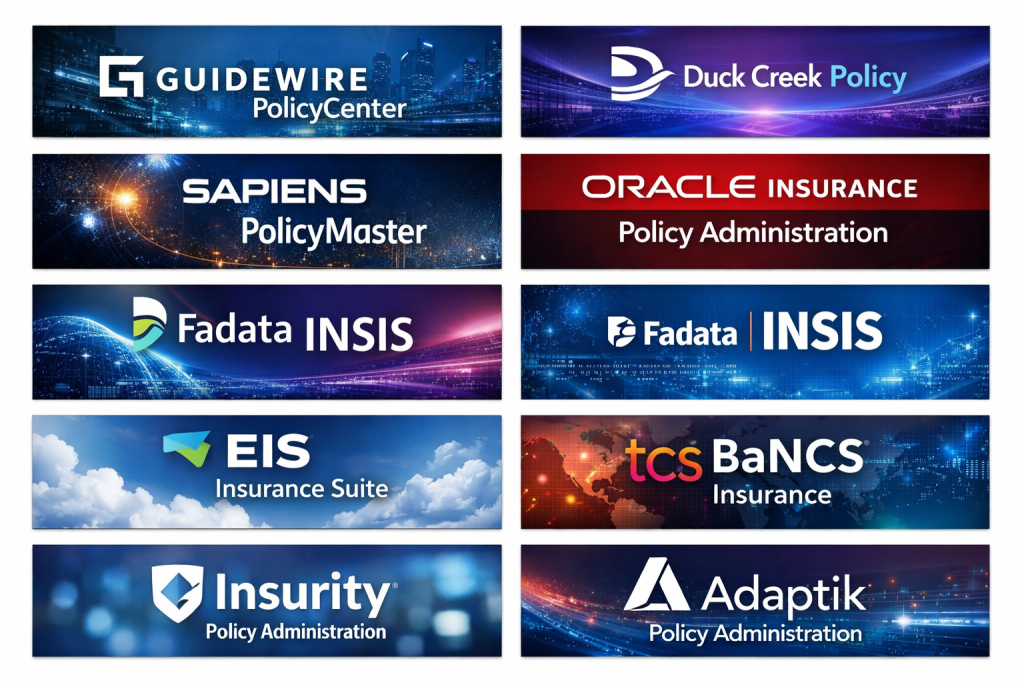
Top 10 Insurance Policy Administration Systems Tools
1 — Guidewire PolicyCenter
Short description:
Guidewire PolicyCenter is a market-leading PAS for P&C insurers, designed for complex, large-scale insurance operations with deep configurability.
Key features:
- End-to-end policy lifecycle management
- Product and rate configuration engine
- Strong underwriting workflow automation
- Multi-jurisdiction support
- Tight integration with claims and billing systems
- Cloud and on-prem deployment options
Pros:
- Extremely powerful for complex P&C use cases
- Strong ecosystem and partner network
Cons:
- High implementation cost
- Requires skilled technical teams
Security & compliance:
Enterprise-grade security, role-based access, audit trails, regulatory compliance support.
Support & community:
Extensive documentation, certified partners, strong enterprise support.
2 — Duck Creek Policy
Short description:
Duck Creek Policy is a flexible, cloud-native PAS focused on speed, configurability, and modern insurance product innovation.
Key features:
- Low-code product configuration
- Cloud-native SaaS architecture
- API-first integration model
- Real-time rating and quoting
- Support for P&C and specialty lines
Pros:
- Faster product launches
- Strong digital integration
Cons:
- Costs scale quickly with usage
- Advanced customization still needs expertise
Security & compliance:
SOC-aligned controls, encryption, access management.
Support & community:
Good documentation, active partner ecosystem, enterprise support available.
3 — Majesco Policy
Short description:
Majesco Policy is a comprehensive PAS supporting life, health, and P&C insurers with strong domain-specific capabilities.
Key features:
- Pre-configured industry templates
- Endorsement and renewal automation
- Product lifecycle management
- Digital and mobile enablement
- Strong analytics integration
Pros:
- Broad line-of-business coverage
- Accelerated implementations
Cons:
- UI can feel dated in some modules
- Customization complexity for niche products
Security & compliance:
Enterprise security controls, compliance frameworks vary by deployment.
Support & community:
Structured onboarding, global support teams, industry expertise.
4 — Sapiens PolicyMaster
Short description:
Sapiens PolicyMaster is a modular PAS designed for insurers seeking flexibility across life, pensions, and general insurance.
Key features:
- Modular architecture
- Product and rate configuration
- Underwriting rules engine
- Multi-currency and multi-language support
- API-driven integrations
Pros:
- Strong configurability
- Suitable for international insurers
Cons:
- Implementation timelines can be long
- Requires experienced SI partners
Security & compliance:
Role-based access, audit logs, regulatory compliance support.
Support & community:
Enterprise-level support, solid documentation.
5 — Oracle Insurance Policy Administration
Short description:
Oracle’s Insurance Policy Administration platform targets large insurers needing scalability and integration with broader enterprise systems.
Key features:
- High-volume policy processing
- Enterprise integration capabilities
- Advanced data management
- Support for complex policy structures
- Cloud and hybrid deployment
Pros:
- Excellent scalability
- Strong enterprise ecosystem
Cons:
- High licensing and implementation cost
- Less agility for rapid product changes
Security & compliance:
Strong enterprise security, compliance certifications vary.
Support & community:
Global enterprise support, extensive documentation.
6 — Fadata INSIS
Short description:
Fadata INSIS is a comprehensive PAS widely used by European insurers across life, health, and P&C lines.
Key features:
- Unified core insurance platform
- Product configuration tools
- Policy servicing automation
- Claims and billing integration
- International regulatory support
Pros:
- Proven stability
- Broad functional coverage
Cons:
- UI modernization lags newer platforms
- Longer upgrade cycles
Security & compliance:
Strong compliance focus, enterprise security controls.
Support & community:
Regional expertise, structured enterprise support.
7 — EIS Suite
Short description:
EIS Suite is a next-generation, cloud-native PAS designed for digital-first insurers and rapid innovation.
Key features:
- Microservices architecture
- Real-time policy changes
- Open API ecosystem
- Digital customer experiences
- Scalable cloud deployment
Pros:
- Highly flexible and modern
- Excellent for greenfield projects
Cons:
- Higher learning curve
- Premium pricing
Security & compliance:
Modern cloud security, encryption, compliance frameworks supported.
Support & community:
Strong vendor engagement, growing community.
8 — TCS BaNCS Insurance
Short description:
TCS BaNCS Insurance offers an integrated PAS as part of a broader core insurance suite for global insurers.
Key features:
- End-to-end policy lifecycle
- Multi-line support
- Strong process automation
- Integration with analytics and CRM
- Global compliance readiness
Pros:
- Proven at large scale
- Strong process standardization
Cons:
- Customization can be complex
- Heavier implementation footprint
Security & compliance:
Enterprise-grade security, auditability, compliance support.
Support & community:
Global delivery teams, enterprise support model.
9 — Insurity PAS
Short description:
Insurity PAS focuses on P&C insurers seeking configurable workflows and faster time-to-market.
Key features:
- Configurable product modeling
- Policy issuance and servicing
- Integration with rating engines
- Cloud deployment options
- Analytics support
Pros:
- Faster implementations
- Strong P&C focus
Cons:
- Limited support for life insurance
- Smaller ecosystem than tier-1 vendors
Security & compliance:
Standard enterprise security, compliance varies.
Support & community:
Good vendor support, smaller user community.
10 — Adaptik Policy
Short description:
Adaptik Policy is a flexible PAS often used by MGAs and specialty insurers for rapid product configuration.
Key features:
- Configurable policy workflows
- Specialty line support
- API-based integrations
- Endorsement and renewal handling
- Cloud-ready architecture
Pros:
- Agile and configurable
- Suitable for niche insurance models
Cons:
- Less suited for very large carriers
- Smaller global presence
Security & compliance:
Standard security controls; compliance varies by deployment.
Support & community:
Responsive vendor support, limited community scale.
Comparison Table
| Tool Name | Best For | Platform(s) Supported | Standout Feature | Rating |
|---|---|---|---|---|
| Guidewire PolicyCenter | Large P&C insurers | Cloud / On-prem | Deep P&C capabilities | N/A |
| Duck Creek Policy | Digital insurers | Cloud | Low-code configurability | N/A |
| Majesco Policy | Multi-line insurers | Cloud / Hybrid | Industry templates | N/A |
| Sapiens PolicyMaster | Global insurers | Cloud / On-prem | Modular design | N/A |
| Oracle Insurance PAS | Enterprises | Cloud / Hybrid | Enterprise scalability | N/A |
| Fadata INSIS | European insurers | On-prem / Cloud | Unified core suite | N/A |
| EIS Suite | Digital-first insurers | Cloud | Microservices architecture | N/A |
| TCS BaNCS Insurance | Large global carriers | Cloud / On-prem | Process standardization | N/A |
| Insurity PAS | P&C insurers | Cloud | Fast deployment | N/A |
| Adaptik Policy | MGAs & specialty insurers | Cloud | High configurability | N/A |
Evaluation & Scoring of Insurance Policy Administration Systems
| Criteria | Weight | Description |
|---|---|---|
| Core features | 25% | Policy lifecycle depth, product modeling |
| Ease of use | 15% | UI, configuration simplicity |
| Integrations & ecosystem | 15% | APIs, third-party compatibility |
| Security & compliance | 10% | Controls, regulatory readiness |
| Performance & reliability | 10% | Scalability, uptime |
| Support & community | 10% | Vendor support quality |
| Price / value | 15% | Cost vs delivered value |
Which Insurance Policy Administration Systems Tool Is Right for You?
- Solo users & SMBs: Lightweight, configurable systems like Adaptik may be sufficient.
- Mid-market insurers: Duck Creek, Insurity, or Majesco balance power and agility.
- Enterprise carriers: Guidewire, Oracle, TCS BaNCS, and Sapiens excel at scale.
- Budget-conscious teams: Focus on SaaS-based, modular platforms.
- Premium needs: Choose platforms with deep compliance and customization.
- Integration-heavy environments: API-first platforms like EIS stand out.
- Regulated markets: Prioritize vendors with proven audit and compliance frameworks.
Frequently Asked Questions (FAQs)
1. What is an Insurance Policy Administration System?
It is software that manages the entire policy lifecycle from creation to renewal.
2. Is PAS different from claims systems?
Yes. PAS handles policies, while claims systems manage claims processing.
3. Cloud or on-prem—what’s better?
Cloud offers agility; on-prem suits strict regulatory environments.
4. How long does implementation take?
Anywhere from a few months to over a year depending on complexity.
5. Are PAS platforms customizable?
Most offer configuration, but depth varies by vendor.
6. Do small insurers need a full PAS?
Not always—lighter solutions may suffice.
7. How important are integrations?
Critical, especially with billing, CRM, and claims systems.
8. What are common implementation mistakes?
Underestimating data migration and change management.
9. Are these systems secure?
Leading platforms offer enterprise-grade security.
10. Can PAS support new insurance products?
Yes, modern PAS platforms are built for rapid product innovation.
Conclusion
Insurance Policy Administration Systems are no longer just operational tools—they are strategic platforms that shape how insurers innovate, comply, and serve customers. The right PAS can accelerate product launches, reduce operational risk, and support long-term growth.
There is no single “best” solution for everyone. The ideal platform depends on insurer size, line of business, regulatory environment, budget, and digital ambition. By carefully evaluating features, scalability, integrations, and support, insurers can choose a PAS that aligns with both today’s needs and tomorrow’s strategy.

Find Trusted Cardiac Hospitals
Compare heart hospitals by city and services — all in one place.
Explore Hospitals
This is a very well‑organized and insightful comparison of insurance policy administration systems! Highlighting the features, strengths, and limitations of each platform makes it much easier for insurance professionals and IT decision‑makers to evaluate solutions that align with their operational goals. With policy administration being such a core part of customer service, compliance, and workflow efficiency, this guide offers practical clarity for anyone assessing options in the market. Thanks for putting together such a helpful and informative resource!